
Elegy vs Eulogy: Meaning, Difference & Usage
Elegy vs eulogy is a useful distinction to understand because both words relate to death, remembrance, and grief, yet they describe different forms of expression. An elegy is usually a poem or reflective work that mourns a loss, while a eulogy is a speech or written tribute honoring a specific person who has died.
The difference between elegy and eulogy becomes especially important when planning a funeral service, writing a memorial tribute, or discussing literature. The terms can overlap in emotional purpose, but their typical format, audience, and setting are not the same.
The Short Answer: Elegy vs Eulogy
An elegy is a poem, song, or reflective composition expressing sorrow over death or another profound loss. A eulogy is a speech or written tribute that praises and remembers a deceased person, usually delivered at a funeral or memorial service.
| Term | Basic meaning | Typical form | Common setting |
|---|---|---|---|
| Elegy | A work expressing grief or mourning | Poem, song, or literary reflection | Literature, personal writing, music, or remembrance |
| Eulogy | A tribute praising a person who has died | Speech or written memorial statement | Funeral service or memorial service |
The simplest rule is this: if you are writing a mourning poem, you are probably writing an elegy. If you are preparing a funeral speech about someone’s life, memories, and character, you are probably preparing a eulogy.
Neither word is limited to a single emotional tone. An elegy may include admiration and consolation, while a eulogy may acknowledge sadness, regret, humor, or unresolved feelings. The main difference concerns the form and purpose of the work, not whether the writing feels sad.
Elegy Definition and Meaning
The traditional elegy definition is a poem or song that mourns the death of a person or reflects on a serious loss. In broader modern usage, an elegy can also lament the passing of an era, a place, a tradition, a relationship, or an ideal.
The word elegy is connected with the Greek term elegeia, which referred to a type of poetic composition associated with lament. English writers have used the form in many ways, from intensely personal poems about a dead friend to meditations on human mortality.
An elegy does not have to mention a funeral. It may be written months or years after a death, and it may be published for a broad audience rather than read aloud at a ceremony. Its focus is often the speaker’s experience of grief and loss, including memory, absence, anger, acceptance, or spiritual reflection.
What an Elegy Usually Does
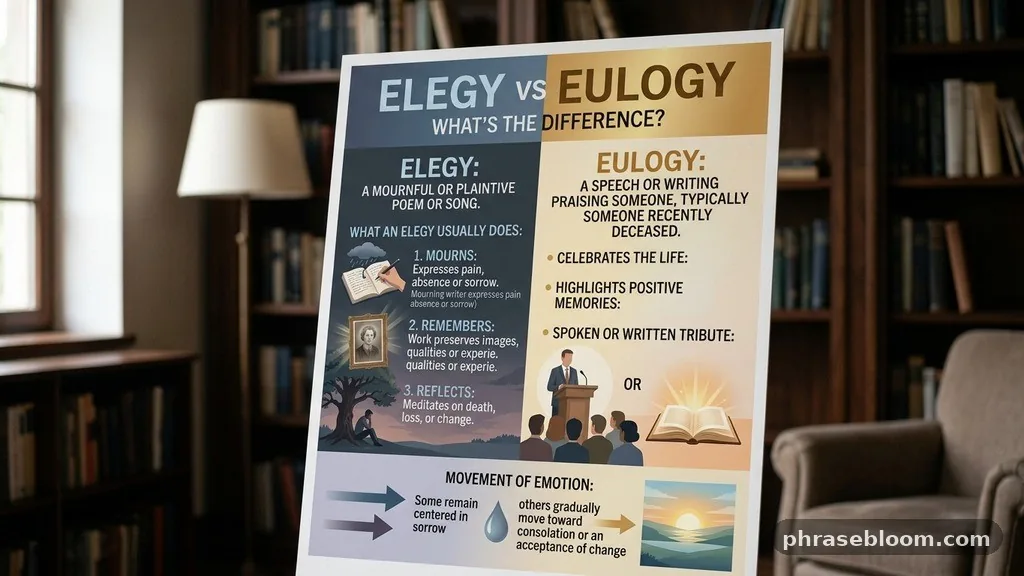
An elegy generally performs three related actions: it mourns, remembers, and reflects. Some elegies remain centered on sorrow, while others gradually move toward consolation or an acceptance of change.
- Mourning: The writer expresses pain, absence, or sorrow.
- Remembering: The work preserves images, qualities, or experiences associated with the person or subject.
- Reflecting: The writer considers mortality, time, nature, faith, or the meaning of loss.
- Transforming: The grief may become a broader statement about love, memory, or human life.
An elegy can therefore be intimate without being biographical. The writer may reveal very little factual information about the deceased and still create a powerful account of mourning.
Eulogy Definition and Meaning
The eulogy definition is a speech or piece of writing that honors a person who has died. The word comes from Greek roots associated with speaking well of someone, which explains why praise and remembrance are central to its meaning.
A eulogy is usually connected to a particular person and a particular occasion. It may be delivered by a family member, friend, colleague, religious leader, or professional celebrant during a funeral service or memorial service.
The speaker often combines personal memories with important facts about the person’s life. A strong eulogy might mention a person’s family, work, service, humor, principles, friendships, or influence, but it should sound like a human tribute rather than a résumé.
What a Eulogy Usually Does
A eulogy serves both the deceased person’s memory and the people who are grieving. It gives mourners a shared account of who the person was and why that life mattered to the community gathered in the room.
Unlike an obituary, which commonly provides concise factual information such as dates, relatives, employment, and service details, a eulogy is more personal and interpretive. An obituary tells readers what happened; a eulogy helps listeners understand the character and significance of the person who died.
A eulogy does not need to present someone as perfect. A gentle, truthful story about a familiar habit or human weakness can make a tribute warmer and more credible, provided it respects the person and the circumstances of the service.
The Difference Between Elegy and Eulogy
The difference between elegy and eulogy is easiest to see by comparing their usual form, subject, audience, and purpose. An elegy is commonly a literary or artistic expression of grief, while a eulogy is commonly a spoken or written tribute addressed to people who knew, loved, or respected the deceased.
| Feature | Elegy | Eulogy |
|---|---|---|
| Primary purpose | To mourn, lament, and reflect | To honor, remember, and praise |
| Typical form | Poem, song, or literary work | Speech, letter, or memorial statement |
| Usual subject | A person, place, period, ideal, or other loss | A particular deceased person |
| Typical audience | Readers or listeners of the artistic work | Mourners attending a funeral or memorial |
| Typical tone | Reflective, mournful, philosophical, or meditative | Personal, honoring, affectionate, and commemorative |
These categories are not absolute. A eulogy may contain an elegiac passage, especially when the speaker reflects on absence or mortality. An elegy may praise the dead person just as a eulogy does.
The crucial distinction is usually the work’s dominant function. If the central act is lamenting a loss through poetic or reflective language, “elegy” is the better term. If the central act is publicly honoring an individual at a ceremony, “eulogy” is more precise.
Elegy Examples in Literature and Everyday Writing
Elegy examples can be found in poetry, music, essays, speeches, and personal memorial writing. Some are formal literary works, while others are short reflections written for a family website, community publication, or private journal.
A poem about a parent’s death that explores childhood memories, silence in the house, and the changes brought by grief is an elegiac poem. It may never mention the funeral or address an audience directly.
A song written after the death of a public figure may also function as an elegy if it mourns that person and reflects on their influence. The work can honor the individual while still being classified as an elegy because its structure and emotional purpose are artistic mourning.
Original Elegy Examples

- “After my grandfather died, I wrote an elegy about the garden he planted and the quiet that settled over it.”
- “The poet’s latest book includes an elegy for a vanished coastal town.”
- “Her song became an elegy for the friends she lost during the war.”
- “The final stanza turns the mourning poem toward gratitude rather than simple despair.”
These examples show that an elegy may focus on a person or something larger than a person. The subject can be a landscape, culture, relationship, or historical moment if the writing expresses a meaningful sense of loss.
Someone asking how to write an elegy should begin with a specific emotional or sensory truth rather than a general statement about sadness. A remembered voice, object, location, gesture, or repeated phrase can give the poem a concrete center.
Eulogy Examples for Funerals and Memorial Services
Eulogy examples tend to be more direct and personal than elegies. They usually identify the person, establish the speaker’s relationship with them, share a few meaningful memories, and explain what the person gave to others.
A eulogy does not need to cover every stage of a person’s biography. In a short funeral speech, two or three carefully chosen memories can communicate more than a long list of accomplishments.
Original Eulogy Examples
- “My aunt never entered a room without asking who needed help, and that habit shaped the way our whole family cared for one another.”
- “He was a patient teacher, a loyal friend, and the person many of us called when a difficult problem needed a calm answer.”
- “Her greatest gift was making ordinary gatherings feel important because she gave every guest her full attention.”
- “We will remember his laughter, but we will also remember the dependable kindness behind it.”
These lines could appear in a eulogy because they honor a particular person and connect personal qualities with shared memories. They are not merely announcements of death or lists of dates.
Someone learning how to write a eulogy should consider the audience as well as the deceased. A story that feels meaningful to one relative may need brief context for coworkers, neighbors, or friends who did not know the person in the same way.
A Practical Eulogy Structure
A simple structure can help when emotions make writing difficult. Begin by naming the person and your relationship, move into two or three specific memories, and close with a statement about the person’s lasting influence or the love shared with those present.
Read the draft aloud before the service. Spoken language often needs shorter sentences than written prose, and reading aloud can reveal places where the tone is too formal, the story is unclear, or the ending arrives abruptly.
How to Write an Elegy
Writing an elegy begins with deciding what kind of loss the work will hold. The subject might be a deceased person, but it could also be a childhood, a home, a language, a relationship, or a landscape that no longer exists in the same form.
Specific images make grief understandable. Instead of saying only that the speaker feels empty, the elegy might describe a coat still hanging by the door, a favorite cup left untouched, or a road that now feels unfamiliar.
Useful Steps for an Elegy
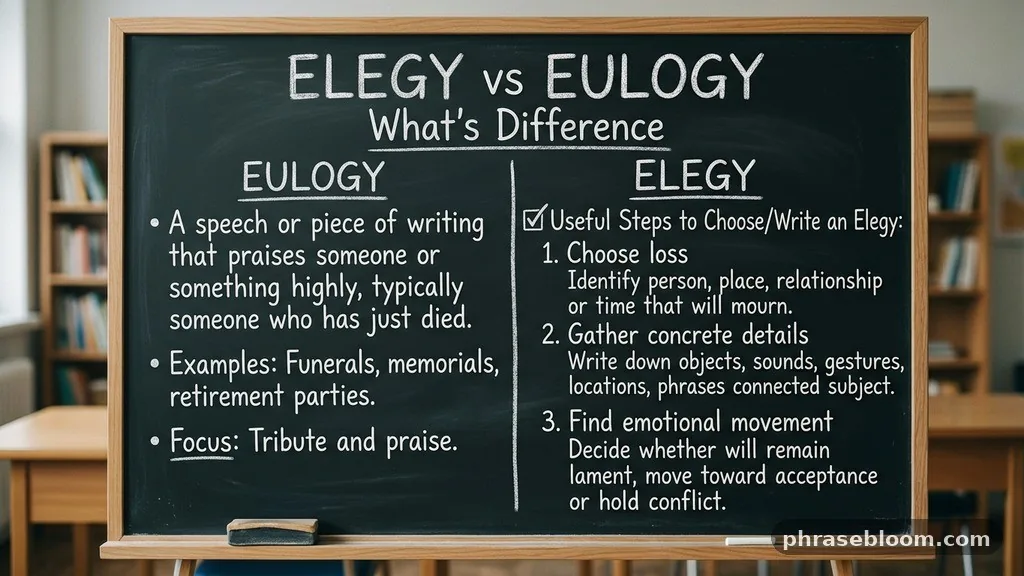
- Choose the loss. Identify the person, place, relationship, or time that the poem will mourn.
- Gather concrete details. Write down objects, sounds, gestures, locations, and phrases connected to the subject.
- Find the emotional movement. Decide whether the poem will remain in lament, move toward acceptance, or hold conflicting feelings together.
- Use a fitting form. Free verse, regular meter, repeated lines, prose poetry, and song lyrics can all carry elegiac meaning.
- Revise for precision. Remove broad statements that do not reveal anything specific about the loss.
An elegy does not have to offer a cheerful lesson. Grief is often uneven, and a poem may be more honest when it allows anger, confusion, love, and relief to appear together.
Readers who want historical context can consult the Encyclopaedia Britannica overview of elegy for a concise reference to the form’s literary development.
How to Write a Eulogy
Writing a eulogy requires a different balance. The speaker needs to express genuine feeling while giving listeners enough structure to follow the tribute during an emotionally difficult occasion.
Start by making a private list of memories before trying to create polished sentences. Include the person’s ordinary habits, relationships, work, humor, values, and the moments that show how they affected other people.
A Reliable Eulogy Outline
- Opening: State the person’s name and explain your relationship.
- Character: Identify one or two qualities that defined the person.
- Stories: Share brief incidents that demonstrate those qualities.
- Community: Explain how family, friends, colleagues, or neighbors experienced the person.
- Closing: Offer a final expression of love, gratitude, farewell, or continuing influence.
Keep the focus on the deceased rather than on the speaker’s writing ability. A plain sentence such as “She always noticed when someone was being left out” can be more moving than an elaborate description that could apply to anyone.
Timing also matters. A funeral director, celebrant, or family member may provide a requested limit, and the service schedule may require a short tribute. Preparing a concise version is wise even if there is no formal limit.
Humor can belong in a eulogy when it reflects the person’s character and suits the audience. Avoid stories that embarrass the family, expose private information, or require a long explanation before listeners understand why the memory matters.
Elegy, Eulogy, Obituary, and Tribute Speech
Several related terms are often confused because they all appear in conversations about death and remembrance. Their meanings overlap, but they are not interchangeable.
| Term | What it usually is | Main purpose |
|---|---|---|
| Elegy | A poem or reflective work | To mourn and contemplate loss |
| Eulogy | A speech or written tribute | To honor and remember the deceased |
| Obituary | A public death announcement and biography | To inform readers about a death and a person’s life |
| Tribute speech | A speech honoring someone | To praise or recognize a person, living or deceased |
| Memorial tribute | A broad term for an act or work of remembrance | To preserve memory and express respect |
An obituary may include a short eulogy-like passage, but its primary purpose is usually public information. A tribute speech may honor a living teacher, retiring colleague, or public figure, so it does not necessarily relate to death at all.
The setting also matters. A funeral service is often associated with a eulogy, while a memorial service may include a eulogy, an elegiac reading, music, photographs, or several kinds of tribute.
Can an Elegy Be a Eulogy?
In some situations, a work can be both elegiac and eulogistic. A poem read at a memorial service may mourn a person while praising their character, giving it qualities associated with both an elegy and a eulogy.
Still, the words are not exact synonyms. Calling a funeral speech an elegy may emphasize its mournful or poetic tone, but “eulogy” remains the clearer term if the speech is primarily a public tribute to the deceased.
Similarly, calling a poem a eulogy may be understandable if it praises a dead person, but “elegy” is usually more accurate if the work is literary, lyrical, and centered on grief or reflection.
Think of the terms as overlapping circles rather than identical labels. The overlap comes from shared subjects and emotions, while the difference comes from form, context, and dominant purpose.
Common Mistakes in Using Elegy and Eulogy
One common mistake is using “eulogy” for any writing about death. A newspaper obituary, a poem about a lost city, and a speech at a funeral are all related to death, but they perform different functions.
Another mistake is assuming that an elegy must follow one fixed poetic structure. Although some historical traditions use recognizable forms, modern elegies can be written in free verse, prose, song, or experimental formats.
Frequent Usage Problems
- Calling an obituary a eulogy: Use “obituary” for a public death notice and biographical account, unless the text specifically functions as a personal tribute.
- Calling every funeral reading an elegy: Use “eulogy” for a speech honoring the deceased, and reserve “elegy” for a poem or reflective work of mourning.
- Assuming praise makes a work a eulogy: An elegy can praise someone while remaining an elegy because of its poetic form and meditative purpose.
- Expecting an elegy to sound formal: An elegy may use everyday language, private images, or conversational phrasing.
- Writing a biography instead of a eulogy: A eulogy needs selected memories and interpretation, not an exhaustive list of dates and achievements.
Another practical problem is choosing a label before deciding what the writing needs to do. If the assignment calls for an elegy, focus on the language of mourning and reflection; if it calls for a eulogy, focus on a person and the community’s act of remembrance.
Choosing the Right Word in Different Situations
Use eulogy when the context is a funeral speech, memorial address, or personal tribute to someone who has died. Examples include “She delivered a moving eulogy for her father” and “The family asked three friends to share short eulogies.”
Use elegy when the context is poetry, literature, music, or a reflective work that mourns a loss. Examples include “The poem is an elegy for a lost childhood” and “The composer wrote an elegy after the conductor’s death.”
If you are uncertain, describe the work instead of forcing a technical label. “A memorial poem” or “a speech honoring her life” may communicate your meaning more clearly than a word used only because it sounds literary.
| Situation | Most natural term | Example |
|---|---|---|
| A poem about a deceased friend | Elegy | “He published an elegy for his friend.” |
| A speech at a funeral | Eulogy | “Her brother delivered the eulogy.” |
| A newspaper death notice | Obituary | “The obituary listed the service details.” |
| A poem mourning a vanished culture | Elegy | “The collection includes an elegy for the old neighborhood.” |
| A speech honoring a retiring teacher | Tribute speech | “Students prepared a tribute speech for their teacher.” |
Frequently Asked Questions
What is the difference between an elegy and a eulogy?
An elegy is usually a poem or reflective work expressing grief over a loss. A eulogy is usually a speech or written tribute honoring a deceased person, often at a funeral or memorial service.
Can an elegy be used as a funeral reading?
Yes. An elegy can be read at a funeral or memorial service, especially when the family wants a literary expression of grief. It may complement a eulogy rather than replace it.
Is a eulogy always spoken?
No. A eulogy can be written for publication, a memorial program, a family archive, or an online remembrance. In ordinary usage, however, the word most often refers to a speech delivered aloud.
Is an obituary the same as a eulogy?
No. An obituary primarily announces a death and provides factual information about the person’s life and service arrangements. A eulogy is a personal tribute that emphasizes memory, character, and emotional significance.
What should I choose for a poem about someone who died?
“Elegy” is usually the best term if the work is a poem or lyrical reflection centered on mourning. If the poem is specifically written to praise the person at a funeral, it may also have a eulogistic quality.
Conclusion
The clearest way to remember the Elegy vs Eulogy distinction is to connect each word with its usual form. An elegy is a poem or reflective work of mourning, while a eulogy is a speech or written tribute honoring a particular person who has died.
Use the word that matches the work’s main purpose, and do not worry if the categories overlap. A thoughtful funeral may include both an elegy and a eulogy, each offering a different way to express grief, gratitude, and remembrance.
You may also like: Die vs Dice: Meaning, Plural, and Usage Explained