
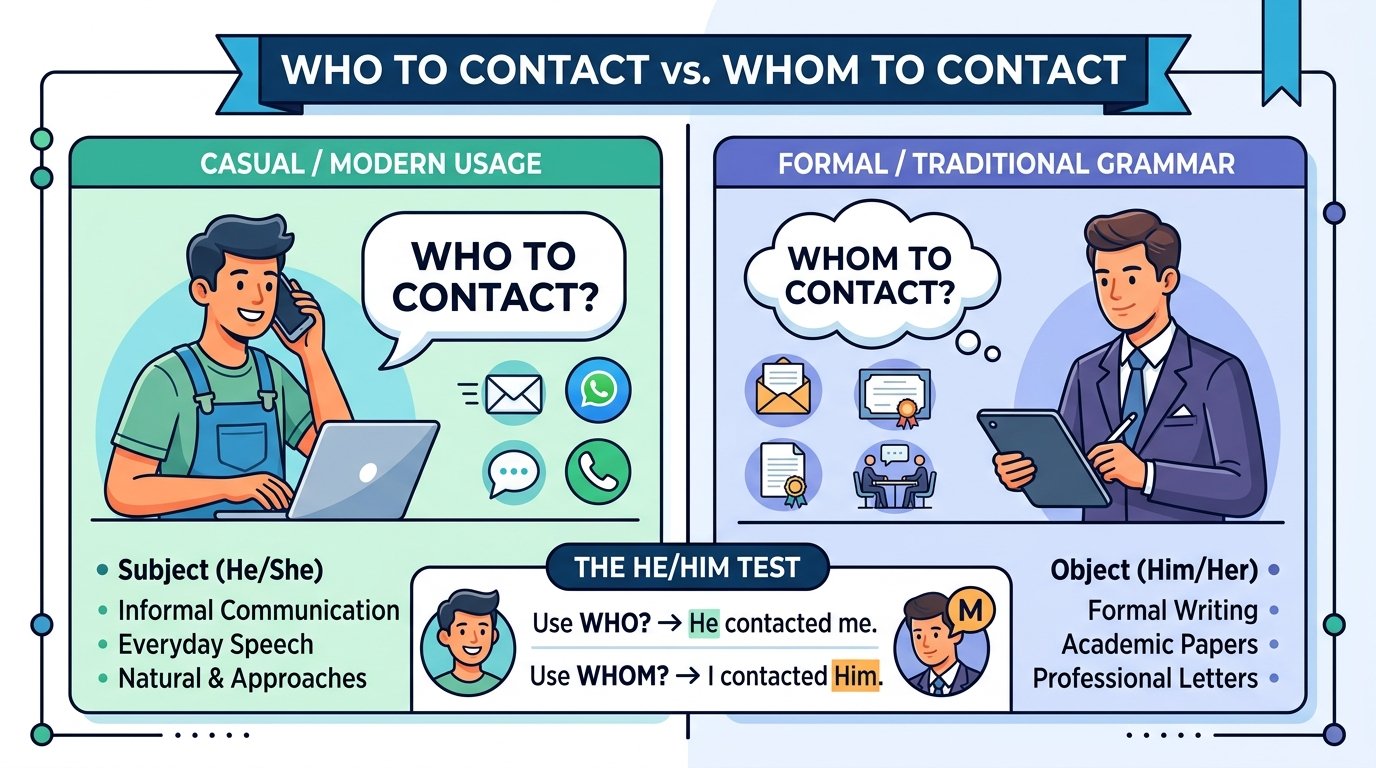
Choosing between Who to Contact or Whom to Contact can feel confusing, especially when you want your English to sound polished. The two phrases communicate the same basic idea, but traditional grammar treats “who” and “whom” differently.
The main difference comes down to their grammatical roles. Who is a subject pronoun, while whom is an object pronoun. Since the person being contacted receives the action, traditional grammar generally favors “whom” in this construction.
However, modern English is more flexible. “Who to contact” is extremely common in everyday speech, workplace communication, and informal writing.
This guide explains the difference clearly, shows when each form works best, and gives you a simple test for making the right choice.
Who to Contact or Whom to Contact: Why Does the Confusion Exist?
The confusion exists because English has gradually moved away from using “whom” in everyday communication.
In older and more formal English, writers carefully distinguished between subject and object pronouns. For example, “who” performed an action, while “whom” received an action.
Consider this sentence:
“Whom should I contact?”
The person asking the question is performing the action of contacting. The person being contacted receives that action. Therefore, traditional grammar identifies “whom” as the object.
Yet native speakers increasingly use “who” in places where traditional grammar would expect “whom.” As a result, “Who should I contact?” sounds completely natural to most English speakers.
Why It Matters in Professional Settings
The distinction can still matter in formal writing. Business letters, academic papers, job applications, and highly polished professional correspondence may favor traditional grammar.
Using whom to contact can create a more formal impression. Meanwhile, who to contact usually sounds more conversational and approachable.
That does not mean “who to contact” is always wrong in professional communication. Modern professional English commonly accepts it, particularly in internal emails and workplace conversations.
Your audience, purpose, and level of formality should guide the choice.
Who to Contact or Whom to Contact: Which One Is Correct?
If you follow traditional grammar, “whom to contact” is the formally correct choice.
The reason is straightforward. “Contact” is a transitive verb, meaning it can take an object. The person you contact is the object of that verb.
For example:
“Please tell me whom to contact.”
Here, “whom” represents the person who will receive the action of contacting.
However, “who to contact” is widely accepted in modern English. It is especially common in conversation, casual emails, customer service communication, and informal workplace messages.
A useful way to understand the difference is to compare the two forms:
| Phrase | Traditional Grammar | Modern Usage | Best Context |
|---|---|---|---|
| Whom to contact | Correct | Accepted | Formal writing |
| Who to contact | Traditionally less formal | Widely accepted | Everyday communication |
Therefore, the answer is not simply “one is right and one is wrong.” Whom to contact is the safer option when grammatical formality matters, while who to contact is natural in ordinary communication.
If you want to use “Who to Contact vs Whom to Contact” correctly, consider the setting before choosing your wording.
What Does “Who to Contact” Mean? Origins, Definition, and Usage
The phrase refers to identifying the person you should communicate with about a particular issue.
For example:
“Do you know who to contact about the application?”
The phrase can refer to contacting someone by phone, email, message, or another form of communication.
Definition of Who to Contact
Who to contact means the person you should reach out to or communicate with.
In this phrase, “who” identifies the person. Although traditional grammar may prefer “whom” because the person is technically an object, modern English frequently uses “who” in this structure.
The phrase is especially common because it is simple, direct, and natural.
Origins of the Word “Whom”
“Whom” comes from the older English system of grammatical case. Historically, English made a stronger distinction between subject and object forms.
The relationship is similar to:
- he → him
- she → her
- they → them
- who → whom
As English became less dependent on grammatical case endings, “whom” became less common in ordinary speech.
It has not disappeared, though. Formal writing, legal language, academic writing, and certain fixed expressions continue to use it.
Why “Who to Contact” Is Sometimes Considered Incorrect
The concern comes from traditional grammar rules rather than from modern everyday usage.
According to the traditional distinction, “who” is a subject pronoun, while “whom” is an object pronoun.
Compare:
“Who contacted you?”
Here, “who” performs the action.
“Whom did you contact?”
Here, “whom” receives the action.
That distinction explains why formal grammar traditionally recommends “whom to contact.”
Still, saying “who to contact” does not create confusion for most modern readers. It is now a well-established part of English usage.
Common Reasons for the “Who to Contact” and “Whom to Contact” Confusion
Several factors make this distinction difficult.
First, spoken English rarely maintains a strict difference between “who” and “whom.” Many speakers use “who” almost everywhere.
Second, sentence structure can hide the grammatical role of the pronoun. In “I don’t know whom to contact,” the object relationship is not immediately obvious.
Third, formal grammar and modern usage do not always agree. A form can be traditionally preferred while another form is common and accepted in everyday English.
Finally, many people were taught the simple rule that “who” means subject and “whom” means object, but applying that rule inside longer sentences can be difficult.
Side-by-Side Comparison: Who to Contact vs Whom to Contact
The difference between (Who to Contact) and (Whom to Contact) becomes clearer when you examine the context.
| Situation | Recommended Form | Explanation |
|---|---|---|
| Academic paper | Whom to contact | Maintains formal grammatical style |
| Formal business letter | Whom to contact | Sounds polished and precise |
| Cover letter | Whom to contact | Suitable for professional writing |
| Internal workplace chat | Who to contact | Natural and conversational |
| Customer service | Who to contact | Friendly and easy to understand |
| Text message | Who to contact | Matches informal language |
| Everyday conversation | Who to contact | Common in spoken English |
This comparison shows that register matters.
If you’re writing a dissertation, formal proposal, or highly polished business letter, “whom” is a sensible choice. If you’re sending a quick message to a coworker, “who” is usually more natural.
The Simple He/Him Test for Who and Whom
The easiest way to choose between the two is the he/him test.
Replace the pronoun with either “he” or “him.”
If “he” works, use who.
If “him” works, use whom.
For example:
“Who should contact the manager?”
Turn it into a statement:
“He should contact the manager.”
Because “he” works, “who” is correct.
Now consider:
“Whom should I contact?”
Change it into a statement:
“I should contact him.”
Because “him” works, “whom” is correct.
This method works because “who/he” are subject forms, while “whom/him” are object forms.
Everyday Examples of Who to Contact or Whom to Contact
Context makes the distinction easier to understand.
Business Correspondence
Formal:
“Please advise whom to contact regarding the contract.”
Informal:
“Can you tell me who to contact about the contract?”
Both sentences are understandable. The first simply has a more formal tone.
Customer Service
A customer might write:
“I’m not sure who to contact about my order.”
This sounds natural because customer service communication usually prioritizes clarity and friendliness.
Job Applications
A formal application could say:
“I would appreciate knowing whom to contact regarding additional documents.”
The traditional object form works well in this professional setting.
Workplace Communication
An employee might ask:
“Do you know who to contact about the new schedule?”
This is perfectly natural for an internal message.
Professional Networking
A formal networking message could say:
“Could you please let me know whom to contact regarding consulting opportunities?”
Here, “whom” gives the sentence a more polished tone.
How to Spell “Who to Contact or Whom to Contact” Correctly
If you’re wondering how to spell “Who to Contact or Whom to Contact”, both phrases are spelled correctly.
The issue is not spelling. It is grammar and usage.
“Who” contains three letters, while “whom” contains four. The added “m” can help you remember the object form.
A useful memory trick is:
him → whom
Both contain the letter “m.”
So if you can say “him,” choose “whom.”
For example:
“I need to contact him.”
Therefore:
“I need to know whom to contact.”
If “he” works instead:
“He will contact me.”
Therefore:
“Do you know who will contact me?”
Practice Sentences
Try these examples:
“Do you know who to contact for technical support?”
“Please tell me whom to contact about the contract.”
“I don’t know who to contact about my order.”
“Could you advise me whom to contact regarding the application?”
“The website explains who to contact for general questions.”
These examples show how both forms operate naturally depending on context and grammatical preference.
Formal Writing vs Modern English Usage
Traditional grammar strongly favors “whom” when the pronoun functions as an object.
Modern English, however, has simplified many distinctions between subject and object pronouns.
This is why “who” appears frequently in places where “whom” was once expected.
You may still see “whom” in legal documents, academic writing, formal correspondence, and expressions such as “to whom it may concern.”
Meanwhile, “who” dominates ordinary conversation.
Therefore, modern usage does not mean that traditional grammar has become meaningless. Instead, English now allows more variation based on register and context.
Is “Whom” Outdated?
“Whom” is not outdated, but it is less common than it once was.
Many speakers consider it formal, stiff, or old-fashioned in casual conversation. As a result, “who” often sounds more natural.
Still, “whom” remains useful when you want grammatical precision or a formal tone.
The best approach is not to avoid “whom” completely. Instead, understand its function and use it when the context calls for it.
Frequently Asked Questions About Who to Contact or Whom to Contact
What’s the correct way to spell “Who to Contact or Whom to Contact”?
Both phrases are spelled correctly. The difference is grammatical: “who” is traditionally subjective, while “whom” is traditionally objective.
Is “whom to contact” grammatically correct?
Yes. “Whom to contact” follows traditional English grammar because “whom” functions as the object receiving the action of contacting.
Can I use “who to contact” in professional emails?
Yes. Modern professional English commonly accepts “who to contact,” particularly in internal emails where natural, clear communication matters more than formal grammar.
Is “whom” outdated in modern English?
No. “Whom” remains grammatically valid and appears frequently in formal writing, academic contexts, legal language, and certain established expressions.
How do I remember when to use “whom”?
Use the he/him test. If “him” fits the sentence, choose “whom.” If “he” fits, choose “who.”
Conclusion: Why Choosing the Right Phrase Matters
Understanding Who to Contact or Whom to Contact becomes easier when you focus on grammatical function and context. Traditional grammar recommends “whom to contact” because the person receives the action. However, “who to contact” is widely accepted in modern English, especially in conversation and informal communication. For formal letters, academic writing, and polished professional documents, “whom” remains the safer choice. In everyday speech and casual workplace messages, “who” sounds more natural. When uncertain, use the simple he/him test. Most importantly, choose the form that matches your audience, purpose, and level of formality.
Related reading: For Who or For Whom, Who Else vs Whom Else, Some of Whom vs Some of Who.
2 thoughts on “Who to Contact or Whom to Contact: Understanding the Difference”