

Company-wide and companywide are both used in English, and they usually express the same idea: something involving the entire company. In professional writing, company-wide is generally the safest and clearest choice before a noun, as in “company-wide policy,” unless your organization or preferred style guide uses the closed form companywide.
The two-word form, “company wide,” is usually not the preferred spelling when the words function together as one modifier. The right choice depends on grammatical position, editorial style, audience, and consistency, so understanding how each form works will help you write clearer emails, policies, reports, websites, and workplace announcements.
Company-Wide or Companywide: The Short Answer
Both company-wide and companywide are accepted forms in contemporary English usage. They normally have the same basic meaning: affecting, involving, or applying to the entire company.
Before a noun, the hyphenated form is often the most immediately readable option. For example, “company-wide training” clearly shows that “company-wide” operates as a single compound modifier describing “training.”
The closed form, “companywide,” is also used in professional and business writing. Some dictionaries, publications, and organizations prefer it because English compounds often develop from hyphenated forms into closed compounds over time.
There is no universal rule that makes one spelling correct in every situation. If your employer, publisher, university, or client has a house style, follow it. If no specific guidance applies, use company-wide before a noun, especially when clarity is more important than following a particular editorial preference.
- Company-wide: a clear hyphenated compound, especially useful before a noun.
- Companywide: a closed compound used by many professional writers and organizations.
- Company wide: generally less polished when the two words function together as one expression.
- Best practical rule: choose one accepted form and use it consistently throughout the document.
What Company-Wide Means
Company-wide describes something that extends across the whole company rather than being limited to one department, location, team, or group of employees. A company-wide policy applies to the organization as a whole, while a department policy applies only to a particular part of it.
For example, in the sentence “The company introduced a company-wide security policy,” the compound adjective modifies “security policy.” The policy is not only for the information technology department. It applies across the company.
The expression can refer to actions, decisions, communications, programs, changes, standards, or events. Common examples include company-wide announcements, company-wide meetings, company-wide training, and company-wide initiatives.
The hyphen helps readers see that “company” and “wide” belong together. Without it, “company wide” may briefly look like two independent words, even though the intended meaning is a single concept covering the organization.
Company-wide as a compound modifier

A compound modifier is a group of words that works together to describe a noun. In “company-wide benefits program,” the words “company-wide” function as one adjective phrase before “benefits program.” The hyphen signals that relationship.
Compound modifiers are especially useful in business English because workplace documents often contain long strings of descriptive words. Compare “company-wide compliance review” with “compliance review across the company.” Both are understandable, but the first is more compact.
The hyphen is not an indication that the expression has a special meaning different from companywide. It mainly makes the structure easier to read and identifies the words as a unit.
Company-wide meaning in context
The exact scope of a company-wide action depends on the organization. In a multinational corporation, it may include offices in several countries. In a small business, it may mean that every employee, including managers and part-time staff, is included.
Consider the sentence “The company-wide survey closes Friday.” The phrase does not necessarily tell readers what questions appear in the survey or how responses will be used. It tells them that the survey is intended for the company as a whole.
What Companywide Means
Companywide is the closed-compound form of the same expression. It is written as one word, without a space or hyphen, and it generally means “throughout the company” or “affecting the entire company.”
In “The companywide changes will begin in July,” companywide functions as an adjective modifying “changes.” The sentence has the same basic meaning as “The company-wide changes will begin in July.”
The difference between companywide and company-wide is usually a matter of spelling convention and style rather than meaning. A publication that prefers closed compounds may use companywide in every position, while another organization may prefer company-wide before nouns.
English contains many compounds that appear in more than one form. Some remain hyphenated, some become closed compounds, and some are written as separate words depending on their history and current usage. That pattern is why it is unwise to describe companywide as universally wrong or company-wide as universally mandatory.
Is companywide one word?
Yes. Companywide is written as one word when that form is selected. It is not written as “company wide” and does not require a hyphen in the closed-compound style.
For example, these sentences use the one-word form correctly:
- The companywide initiative will reduce duplicate reporting.
- Companywide changes to the benefits plan begin in January.
- The chief executive addressed the issue in a companywide announcement.
Even when companywide is grammatically and stylistically acceptable, it may not be the preferred choice for every audience. If readers could mistake it for a typo, or if your organization consistently uses company-wide, the hyphenated version may be a better practical choice.
Company-Wide vs. Companywide in Real Sentences
Both forms can appear in ordinary workplace communication. The examples below show how the expression works in policies, announcements, training, reports, and technology projects.
Policies and procedures
“The company-wide remote-work policy applies to all full-time employees.” Here, company-wide is a compound modifier placed directly before “remote-work policy.” The hyphen makes the intended grouping easy to identify.
“The companywide policy requires managers to document equipment requests.” This version is also clear and grammatical. It may be especially appropriate if the organization’s policy documents use closed compounds throughout.
Employee announcements
“A company-wide announcement about the office closure will be sent this afternoon.” The expression identifies the announcement as one intended for the entire organization.
“The human resources team issued a companywide announcement about the new enrollment deadline.” The one-word form works in the same grammatical position and does not change the announcement’s scope.
Training and workplace communication
“Employees must complete company-wide training on data handling by June 30.” The phrase describes training required across the company, not a course limited to one department.
“The new managers attended companywide training before taking responsibility for their teams.” The closed form is compact and natural in an internal report.
Business reports
“The report recommends a company-wide change to the customer complaint process.” In this sentence, the change affects the whole company.
“Companywide changes to the approval process reduced the number of duplicated reviews.” This example uses the closed form at the beginning of a sentence, where the meaning remains clear from the noun that follows.
Technology rollouts
“The software team completed a company-wide rollout of the new identity-management system.” The hyphenated modifier describes the rollout as organization-wide.
“The new platform was introduced companywide after the pilot ended.” Here, companywide appears after the verb and functions adverbially, meaning that the introduction occurred across the company.
Meetings and initiatives
“The chief operating officer will speak at the company-wide meeting on Thursday.” The meeting includes the company as a whole or is intended for employees across the organization.
“The sustainability committee launched a companywide initiative to reduce unnecessary printing.” The form selected is a style choice, not a change in the initiative’s scope.
When Should Company-Wide Be Hyphenated?
The most useful guideline is simple: use a hyphen when “company-wide” functions as a compound modifier before a noun, unless your style guide or house style prefers companywide. Examples include company-wide policy, company-wide announcement, company-wide initiative, company-wide training, and company-wide change.
The hyphen shows that the two words operate together. In “company-wide training program,” readers can immediately understand that the training program is company-wide. The structure is especially helpful when several modifiers appear in sequence.
| Form | Spelling | Meaning | Typical grammatical function | Practical recommendation |
|---|---|---|---|---|
| Company-wide | Hyphenated | Across or affecting the entire company | Compound adjective before a noun; sometimes predicate or adverbial | Safest general choice before a noun when no house style applies |
| Companywide | One word | Across or affecting the entire company | Adjective or adverbial use | Use if preferred by your organization, publication, or style guide |
| Company wide | Two words | Usually intended to mean across the company | Separate words, though often used as a compound incorrectly | Usually revise to company-wide, companywide, or “across the company” |
However, compound-modifier rules should not be treated as an automatic command to hyphenate every occurrence. Established usage can influence the spelling, and many closed compounds are now familiar enough to appear without a hyphen.
Placement also matters. Before a noun, a hyphen can prevent ambiguity. After a linking verb, the expression may be a predicate adjective, and some styles retain the hyphen while others use the closed form.
Company-wide policy and companywide policy
Both “company-wide policy” and “companywide policy” can be found in professional writing. If you are creating a new document without a governing style, “company-wide policy” is a clear default because the hyphen visibly connects the modifier.
If your employee handbook uses “companywide” in headings, policy titles, and body text, changing only one occurrence to company-wide may create unnecessary inconsistency. In that setting, “companywide policy” is the better choice for house-style reasons.
The key is not to alternate randomly. A document that uses “company-wide policy” on one page and “companywide policy” on the next may look unedited, even though both forms communicate the same meaning.
What About Company Wide Without a Hyphen?
“Company wide” as two separate words is generally not the preferred spelling when the words function together as one compound expression. For example, “The company wide policy applies to all offices” looks less polished than “The company-wide policy applies to all offices” or “The companywide policy applies to all offices.”
The problem is grammatical grouping. In the intended meaning, “company” does not independently modify “wide,” and “wide” does not independently modify “policy.” The two words work together to describe the policy.
That does not mean the sequence can never occur as two separate words. A writer might use the words separately in a sentence with a different structure, although such constructions are less common and may require careful context.
For ordinary business writing, the clearer alternatives are:
- Use “company-wide policy” when a hyphenated compound is preferred.
- Use “companywide policy” when the organization uses the closed form.
- Rewrite the phrase as “policy across the company.”
- Use “policy that applies throughout the company.”
Rewriting is often the best solution when readers may question the spelling. “The policy applies across the company” is direct, natural, and avoids a debate over whether the modifier should be open, hyphenated, or closed.
Can Company-Wide Appear After a Noun or Verb?
Yes. Company-wide can appear after a noun or verb, although its grammatical function may change. In “The policy is company-wide,” it functions as a predicate adjective after the linking verb “is.” It describes the policy rather than appearing immediately before the noun.
Many professional styles retain the hyphen in this position because company-wide remains a compound adjective. The sentence is clear and standard in ordinary workplace communication.
Companywide can also be used after a linking verb: “The policy is companywide.” This is the same grammatical structure with the closed-compound spelling.
Adverbial use after a verb
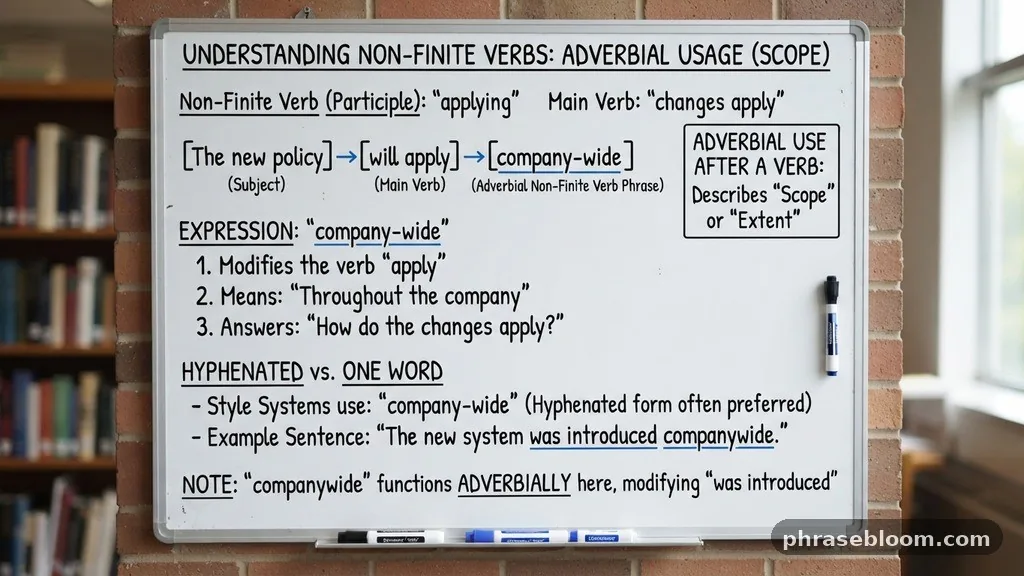
In “The changes apply company-wide,” the expression describes the scope of the verb “apply.” It means that the changes apply throughout the company. Some writers and style systems use the hyphenated form for this adverbial use.
In “The new system was introduced companywide,” companywide functions adverbially. It tells readers where or across what scope the introduction took place.
Some readers may prefer the clearer phrase “throughout the company,” particularly in formal or international writing. Compare these versions:
- The changes apply company-wide.
- The changes apply companywide.
- The changes apply throughout the company.
All three can communicate the same basic idea. The third is often the least dependent on a house style because it uses an ordinary prepositional phrase rather than a compound form.
American English and British English Usage
There is no reliable rule that makes company-wide exclusively British or companywide exclusively American. Both forms appear in English-language business communication on both sides of the Atlantic, and the difference is better explained by editorial preference, dictionary treatment, and organizational style than by nationality alone.
English compounds often develop gradually. A phrase may begin as two words, become hyphenated as a compound modifier, and later appear as a closed compound. That development does not happen at exactly the same speed in every publication or region.
American English and British English can differ in punctuation and compound-word preferences, but writers should not assume that every spelling contrast follows a simple regional division. A British company may use companywide in its internal documents, while an American publisher may prefer company-wide.
Formal writing does not automatically require the hyphenated form. Professional writing requires clarity, grammatical control, and consistency, but a document that consistently uses companywide can be entirely professional.
If you are writing for an international audience, consider the reader’s familiarity with the closed compound. When there is any risk of confusion, “across the company” or “throughout the company” is a useful alternative that works naturally in American English, British English, and global business communication.
For general reference on spelling and usage conventions, consult an established language reference such as the Oxford Learner’s Dictionaries. When a workplace style guide gives a specific instruction, that internal guidance should normally control the document.
Useful Alternatives to Company-Wide and Companywide
Sometimes the best answer is not to choose between two spellings. A rewrite can make the scope of an action clearer and may suit a formal report, legal document, or public announcement better than a compact compound.
Across the company
“The survey was distributed across the company” is straightforward and conversational. It emphasizes distribution among departments, locations, or employee groups.
This phrase works well in emails and reports because it is unlikely to be challenged as a spelling choice. It can also be more precise when the action reaches most, but not literally every, part of the organization.
Throughout the company
“The standard applies throughout the company” has a formal tone and clearly indicates broad scope. It is useful in policies, compliance documents, and executive communications.
Throughout may suggest coverage across the organization, though the writer should still state exceptions if particular teams or offices are excluded.
Across the organization and organization-wide
Organization-wide is useful when the entity is not technically a company, such as a nonprofit, government body, university, or association. “The organization-wide framework applies to all regional offices” is natural in those settings.
“Across the organization” is the open-phrase alternative. It may sound less compressed and more accessible to readers who are still learning business English.
Enterprise-wide
Enterprise-wide often appears in technology, finance, risk management, and large-scale operations. “The enterprise-wide data standard applies to every business unit” can sound more precise than company-wide when the entity contains multiple divisions or subsidiaries.
Choose enterprise-wide only when it accurately describes the scope. It can imply a large or complex organization, so it is not always an interchangeable substitute for company-wide.
Common Mistakes in Company-Wide Usage
Most mistakes involve inconsistency or treating a style preference as a difference in meaning. Careful editing can correct them without making the writing sound artificial.
Switching forms without a reason
A report may begin with “company-wide initiative,” use “companywide changes” in the next section, and end with “company wide training.” This mixture makes the document appear uncontrolled.
Choose one form during editing and apply it throughout, unless a quoted title or official name requires a different spelling.
Using company wide as a compound modifier
“The company wide meeting starts at noon” should normally become “The company-wide meeting starts at noon” or “The companywide meeting starts at noon.” The revised versions show that the expression functions as one modifier.
Inventing companywidely
Companywidely is not a useful standard form for professional writing. Writers who need an adverbial meaning should use company-wide, companywide, across the company, or throughout the company, depending on the chosen style.
For example, write “The new procedure was adopted throughout the company,” not “The new procedure was adopted companywidely.”
Treating companywide as a noun
Companywide is normally an adjective or adverbial expression, not a noun. “The companywide begins next week” is not standard workplace English.
Use a noun such as “company-wide program,” “companywide initiative,” or “organization-wide rollout.”
Using a compact form where precision matters
In a legal or policy document, “company-wide” may not identify every covered entity clearly enough. If subsidiaries, contractors, or regional offices are treated differently, write the scope explicitly.
For example, “This policy applies to all employees of the parent company and its domestic subsidiaries” is more precise than relying only on “company-wide.”
How to Choose the Right Form
A practical decision process can settle most company-wide usage questions in seconds. Start with grammar, then check style, audience, and consistency.
- Identify the meaning. Confirm that you mean something affecting or involving the entire company.
- Check the position. If the expression comes directly before a noun, consider “company-wide” as the clearest default.
- Check the house style. Look at the employee handbook, website, policy library, or editorial manual for an established preference.
- Consider the audience. If readers may find companywide unfamiliar, choose the hyphenated form or rewrite the phrase.
- Review the sentence function. Decide whether the expression is an adjective before a noun, a predicate adjective, or an adverbial modifier.
- Apply the choice consistently. Search the document for all versions, including “company wide.”
- Rewrite if necessary. Use “across the company” or “throughout the company” when that produces a clearer sentence.
For example, suppose you are drafting an internal policy. If the organization has no stated preference, write “company-wide policy.” If the company’s existing documents consistently use “companywide,” match that style instead.
The decision should be deliberate, but it does not need to become complicated. The best form is the accepted form that fits the sentence and matches the surrounding document.
Professional Writing Guidance by Context
Business emails usually benefit from the most readable form. “We will hold a company-wide briefing on Friday” is immediately clear, while “We will hold a briefing across the company on Friday” may sound more natural if the message is conversational.
Employee handbooks and policy documents require consistency above all. Select company-wide or companywide in the document’s style rules, then use that form in headings, definitions, procedures, and cross-references.
Legal and compliance documents may need more than a spelling decision. If “company-wide” has legal consequences, define which entities, employees, locations, and contractors are included rather than assuming the adjective provides a complete scope.
Business reports can use either accepted form. The hyphenated version is often easy to scan in headings such as “Company-Wide Risk Review,” while the closed form may fit a publication that uses closed compounds throughout.
Websites and marketing materials should prioritize plain language. “Available throughout the company” may be clearer than either compound when the audience includes customers, job applicants, or readers who do not work in corporate environments.
Internal software interfaces have limited space, but brevity should not create confusion. “Companywide access” can work in a permissions menu if that is the organization’s established form; “Access across the company” may be clearer in explanatory text.
Academic or formal writing should follow the style guide required by the institution, department, journal, or publisher. Do not assume that academic writing automatically demands a hyphenated form. Citation style and editorial manuals may address compound modifiers differently.
Examples You Can Copy and Adapt
The following sentences show both accepted spellings in realistic contexts. Replace the surrounding details with information appropriate to your organization.
- The company-wide policy takes effect on July 1.
- The companywide policy applies to employees in every regional office.
- Please share this company-wide announcement with your teams.
- The companywide announcement explains the revised travel procedure.
- All supervisors must complete company-wide training by Friday.
- Companywide training will be offered in English and Spanish.
- The new security standard is company-wide.
- The new security standard is companywide.
- The changes apply company-wide beginning next quarter.
- The new access controls will be introduced companywide.
- The audit identified a company-wide need for clearer approval records.
- The audit found that the process should be standardized throughout the company.
- Our company-wide initiative focuses on reducing duplicate customer records.
- The companywide initiative includes offices, warehouses, and service centers.
- We will discuss the rollout at the next company-wide meeting.
- The software update was deployed across the company after a successful pilot.
These examples do not show a difference in meaning between the two spellings. They show how a writer may select a form based on house style, grammatical placement, readability, or a preference for plain-language alternatives.
FAQ: Company-Wide and Companywide
Is company-wide or companywide correct?
Both company-wide and companywide are used as correct forms in English. They generally mean the same thing, so the choice usually depends on style, grammatical position, and organizational consistency.
Is company-wide more formal than companywide?
Not necessarily. The hyphenated form may look more traditional or immediately readable, but companywide can also appear in formal business writing. Follow the applicable style guide rather than assuming the hyphen automatically makes a document more formal.
Should company-wide be hyphenated before a noun?
It is generally a clear choice before a noun, as in “company-wide policy” or “company-wide training.” However, some organizations and publications prefer the closed form “companywide,” so check house style first.
Is company wide without a hyphen wrong?
When the words function together as one compound modifier, “company wide” is generally not the preferred spelling. Use company-wide, companywide, or rewrite the phrase as “across the company.”
Can I write “the policy is company-wide”?
Yes. In that sentence, company-wide functions as a predicate adjective after “is.” “The policy is companywide” is also possible if your chosen style uses the closed compound.
Can company-wide be used after a verb?
Yes. In “The changes apply company-wide,” the expression has an adverbial function and describes the scope of “apply.” “The changes apply throughout the company” is a clear alternative.
Is companywide one word?
Yes. Companywide is the closed-compound spelling. It is written without a space and without a hyphen.
Which form should I use in professional writing?
Use your organization’s established form if one exists. If no style rule applies, company-wide is a safe and clear choice before a noun, while companywide is acceptable when used consistently and understood by your audience.
Is there an American versus British difference?
There is no simple rule assigning company-wide to British English and companywide to American English. Both forms occur in both varieties, so editorial preference and house style are more reliable guides than geography.
What is a good alternative to company-wide?
Use “across the company” or “throughout the company.” If the entity is broader or different from a company, “organization-wide” or “enterprise-wide” may be more accurate.
Should I use one spelling consistently throughout a document?
Yes. Consistency makes professional writing look controlled and helps readers focus on the message rather than the spelling. Search for company-wide, companywide, and company wide during the final edit.
Final Recommendation
Company-wide and companywide normally carry the same meaning, and both can be appropriate in professional writing. Use company-wide as a clear default before a noun when no house style applies, but choose companywide if that is the established form in your organization or publication.
Avoid using company wide as an unhyphenated compound, and consider “across the company” when a rewrite would sound more natural. The strongest company-wide usage is consistent, audience-aware, and precise about scope, especially in policies and formal documents. If your workplace has a preferred style, follow it throughout the document.
Related reading: IONK Meaning in Text, ILY Meaning in Text, NMMS Meaning in Text.