
My Father and I or My Father and Me: Which Is Right?
<meta name=”description” content=”Learn when to use “my father and I” or “my father and me,” with clear rules, examples, and a simple pronoun test.”>
Choosing between “my father and I” or “my father and me” depends on the pronoun’s job in the sentence. Use “my father and I” when the phrase is the subject of a sentence, and use “my father and me” when it is the object of a verb or preposition. The difference is grammatical, not a matter of politeness or formality alone.
The easiest way to decide is to remove the other person temporarily. If “I” sounds correct by itself, use “my father and I.” If “me” is correct, use “my father and me.” That quick pronoun test works in emails, essays, workplace writing, and everyday conversation.
Use “my father and I” when the compound subject performs the action. Use “my father and me” when the compound object receives the action, follows a preposition, or appears in another objective-case position.
| Phrase | Grammatical role | Example |
|---|---|---|
| My father and I | Compound subject | My father and I visited the museum. |
| My father and me | Compound object | The guide welcomed my father and me. |
| My father and me | Object of a preposition | The letter was addressed to my father and me. |
| My father and I | Subject complement in a formal rewrite | My father and I were the speakers. |
In “My father and I attended the ceremony,” the phrase is the subject of the sentence because it performs the action of attending. In “The organizer thanked my father and me,” the phrase is the object of the verb “thanked” because the thanks were directed toward those two people.
Word order does not change the rule. The phrase can appear at the beginning, in the middle, or near the end of a sentence, but its grammatical function remains the deciding factor.
What “My Father and I” Means
“My father and I” is a compound subject made up of a noun phrase and a subject pronoun. The phrase functions in the nominative case, which means it occupies the position normally used for the subject of a sentence.
For example, in “My father and I planned the trip,” the two people are doing the planning. In “After the meeting, my father and I called the bank,” the phrase still acts as the subject even though an introductory phrase appears first.
Here are several correct uses of “my father and I”:
- My father and I watched the parade from the front steps.
- My father and I submitted the application together.
- My father and I disagree about the best route.
- My father and I were invited to speak at the ceremony.
- My father and I have kept the photograph for many years.
The important question is not whether “my father” comes before “I.” The question is whether the entire phrase is the subject of the sentence. If it performs the main verb, “I” is usually the correct pronoun.
This is why “My father and I went to the library” is correct, while “My father and me went to the library” is not standard formal English. The phrase is doing the going, so the subject pronoun “I” is required.
What “My Father and Me” Means
“My father and me” contains the object pronoun “me.” It is used when the phrase receives the action of a verb or follows a preposition such as “to,” “for,” “with,” “between,” or “from.” In grammatical terms, this is the objective case.
Consider the sentence “The photographer asked my father and me to stand together.” The photographer performed the asking, while “my father and me” received that action. The phrase is therefore a compound object.
Correct examples include:
- The teacher congratulated my father and me after the presentation.
- She sent the documents to my father and me.
- The decision surprised my father and me.
- Several relatives traveled with my father and me.
- The invitation was intended for my father and me.
The same choice applies after a preposition. “Between my father and me” is correct because “between” takes an object, not a subject pronoun. “The discussion stayed between my father and I” is a common grammar mistake in formal writing.
Many people choose “I” because it sounds more formal or respectful. That instinct often creates errors. “Me” is not an inferior form; it is the correct object pronoun in the right sentence structure.
The Pronoun Test: Remove the Other Person
The most reliable practical method is to remove “my father” and read the sentence with only the pronoun. This exposes the grammatical role without the distraction of a compound phrase.
Test for “I”
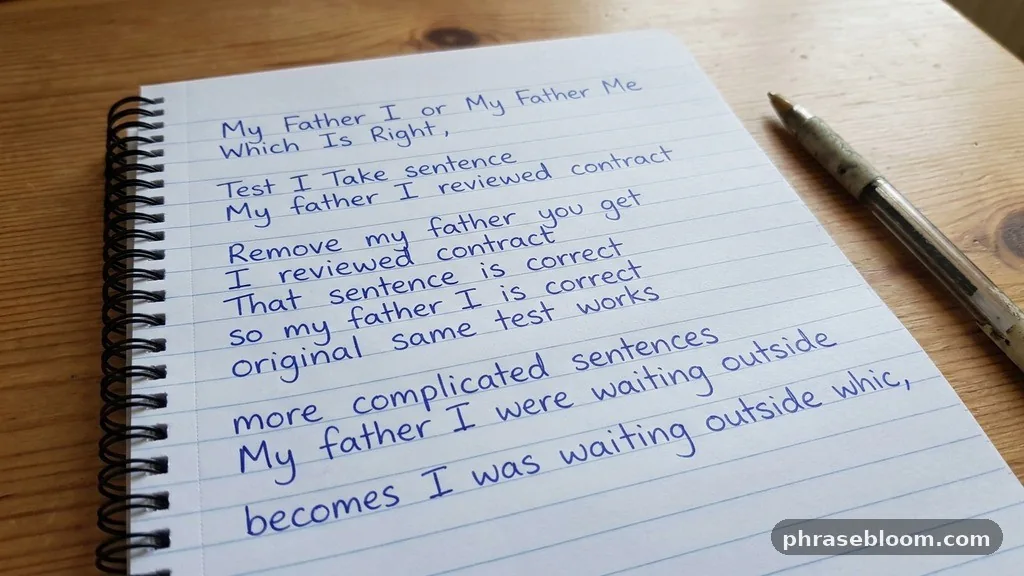
Take the sentence “My father and I reviewed the contract.” Remove “my father,” and you get “I reviewed the contract.” That sentence is correct, so “my father and I” is correct in the original.
The same test works in more complicated sentences. “My father and I were waiting outside” becomes “I was waiting outside,” which confirms the subject pronoun.
Test for “me”
Now consider “The manager called my father and me.” Remove “my father,” and the sentence becomes “The manager called me.” Because “me” is correct by itself, the full phrase must be “my father and me.”
For a prepositional phrase, “The gift was from my father and me” becomes “The gift was from me.” That is the correct form, so “from my father and me” is also correct.
The test is especially useful because speakers often judge the full phrase by sound. The extra noun can hide the mistake. Removing it reveals whether the pronoun is acting as the subject, the object of a verb, or the object of a preposition.
Subject Pronouns, Object Pronouns, and Pronoun Case
English pronouns change form according to their grammatical position. “I” is a subject pronoun, while “me” is an object pronoun. The technical distinction is called pronoun case.
| Pronoun type | Form | Typical position | Example |
|---|---|---|---|
| Subject pronoun | I | Subject of a sentence | I called the office. |
| Object pronoun | Me | Object of a verb | The office called me. |
| Object pronoun | Me | Object of a preposition | The letter came to me. |
English has fewer visible case endings than languages such as Latin or German, but the difference survives in personal pronouns. We say “she” as a subject and “her” as an object, just as we say “I” as a subject and “me” as an object.
This pattern explains why “My father and I” and “my father and me” are not interchangeable in standard formal writing. The noun “father” does not change form, but the pronoun does.
Some sentences contain both forms in different positions. “My father and I gave the letter to the director, who thanked my father and me.” The first phrase is the subject, and the second is the object of “thanked.”
For a fuller reference on pronoun case and sentence roles, the Purdue Online Writing Lab’s pronoun resources provide an established academic explanation.
Common Sentence Patterns and Examples
Most questions about “my father and I or my father and me” arise in a few recurring sentence patterns. Learning those patterns is more useful than memorizing isolated examples.
When the phrase comes before the verb
If “my father and I” appears before the main verb and performs the action, it is normally the compound subject. “My father and I signed the lease” and “My father and I discussed the proposal” both follow this pattern.
Even when the verb comes later, the same rule applies. “After several hours of discussion, my father and I reached an agreement” still uses “I” because the pair reached the agreement.
When the phrase follows an action verb
Use “my father and me” after verbs such as “invited,” “helped,” “called,” “saw,” “met,” “thanked,” and “emailed” when the phrase receives the action. “The coordinator emailed my father and me” is correct because the coordinator sent the email to the two recipients.
A frequent error is to write “The coordinator emailed my father and I.” The presence of an action verb does not automatically require “I.” You must ask who performed the action and who received it.
When the phrase follows a preposition
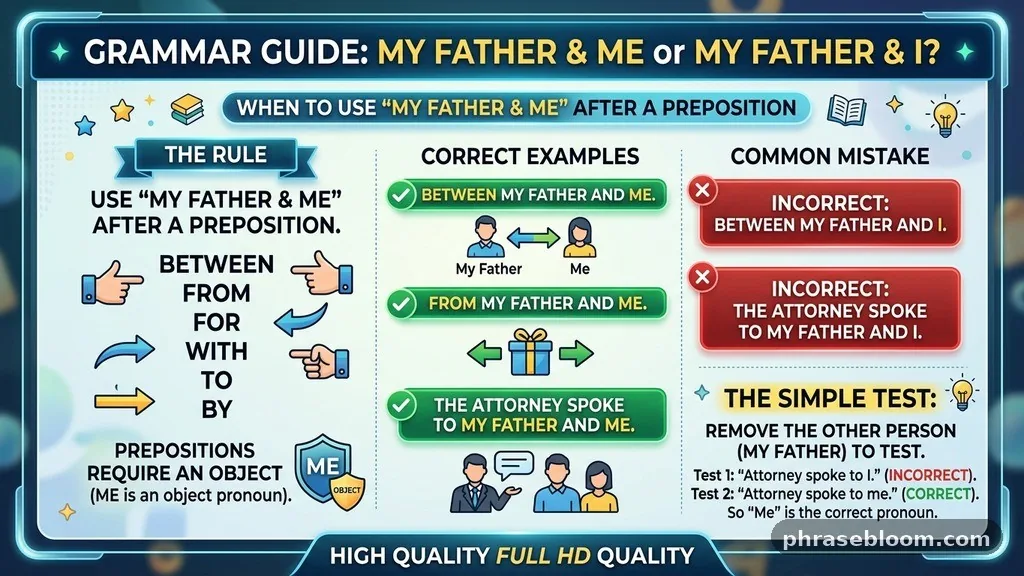
Use “my father and me” after a preposition. Examples include “with my father and me,” “for my father and me,” “between my father and me,” and “from my father and me.”
“The attorney spoke with my father and me” is correct. The preposition “with” requires an object, so “I” would not fit the sentence when tested alone: “The attorney spoke with I” is incorrect.
Subject Complements and Sentences with “Be”
Sentences with forms of “be” create more uncertainty because the phrase after the verb may describe or identify the subject. This position is often called a subject complement, and everyday usage does not always follow the simple subject-versus-object test neatly.
Consider “The speakers were my father and me.” Many speakers use “me” naturally after “were,” and the sentence is widely accepted in ordinary English. A more formal or less debatable rewrite is “My father and I were the speakers.”
Both versions communicate the same identification, but the rewrite places “my father and I” clearly in the subject position. It also avoids the awkwardness that some readers feel about either “my father and I” or “my father and me” after a linking verb.
Here are useful approaches:
- Natural identification: The guests were my father and me.
- Clear formal rewrite: My father and I were the guests.
- Less natural formal style: The guests were my father and I.
Traditional grammar instruction has sometimes preferred the nominative form after “be,” especially in highly formal contexts. Modern English usage is more varied, and many editors prefer rewriting the sentence rather than forcing a pronoun choice that sounds stiff.
If the sentence is part of a formal report, application, or academic paper, “My father and I were the speakers” is usually the cleanest option. It is grammatical, direct, and free from the subject-complement debate.
American English, British English, and Style Preferences
The choice between “my father and I” and “my father and me” is not mainly a difference between American English and British English. Both varieties use “I” for subjects and “me” for objects, and the basic grammar rule remains the same.
Regional differences can appear in tone, rhythm, and editorial preference. A British publication, American company, or international institution may adopt a slightly different house style for formal constructions, but that does not turn the core pronoun distinction into a national rule.
Informal English also permits more variation in speech. Native speakers may say “It was him” or “It was me” even though traditional formal grammar has sometimes recommended “he” or “I” after a linking verb. That everyday pattern does not change the rule for ordinary subjects and objects.
Professional writers should avoid assuming that one form is exclusively American or exclusively British. Instead, check the organization’s style guide, examine nearby examples in the same publication, and choose the form that fits the sentence’s grammatical function.
Consistency matters more than trying to imitate a national variety. A document that uses “my father and I” correctly as a subject and “my father and me” correctly as an object will sound more controlled than one that uses “I” everywhere to appear formal.
Formal, Professional, and Academic Writing
In business emails, use the same grammatical rule you would use in conversation, but take extra care with compound phrases. “My father and I will attend the appointment” is appropriate when the two people will attend. “Please send the confirmation to my father and me” is appropriate when they are the recipients.
Employee handbooks and policy documents often benefit from direct sentence structure. Instead of writing “The responsibility belongs to my father and I,” write “The responsibility belongs to my father and me.” The preposition “to” makes the objective form necessary.
Academic writing rewards precision rather than exaggerated formality. “My father and I interviewed three local residents” is correct if the writers conducted the interviews. “The participants spoke with my father and me” is correct if the writers received the conversations.
Legal and administrative documents deserve special care because small grammatical ambiguities can slow interpretation. If a phrase after “be” feels uncertain, rewrite the sentence so the pronoun has an unmistakable role.
- Business email: My father and I will join the call at noon.
- Policy document: The rule applies to my father and me.
- Research report: My father and I collected the responses.
- Formal letter: Please contact my father or me with questions.
- Website copy: My father and I founded the workshop in 2018.
The best professional writing is not the writing that uses “I” most often. It is the writing that assigns each pronoun the correct grammatical function and presents the information without forcing the reader to untangle the sentence.
Common Mistakes and How to Correct Them
The most common mistake is using “I” simply because it sounds formal. Writers may produce sentences such as “The receptionist spoke with my father and I,” even though the pronoun follows the preposition “with.” The correction is “The receptionist spoke with my father and me.”
Another mistake is using “me” as the subject because it sounds conversational. “My father and me visited the office” should be “My father and I visited the office.” Removing “my father” makes the problem obvious: “Me visited the office” is not standard formal English.
Writers also switch forms inconsistently within one document. A report may say “My father and I submitted the form” in one paragraph, then write “The clerk contacted my father and I” later. Consistency here does not mean choosing one pronoun for every sentence; it means applying the correct form each time.
| Incorrect sentence | Correct sentence | Reason |
|---|---|---|
| My father and me attended. | My father and I attended. | The phrase is the subject. |
| She called my father and I. | She called my father and me. | The phrase is the object of “called.” |
| This is between my father and I. | This is between my father and me. | The phrase follows a preposition. |
| The award went to my father and I. | The award went to my father and me. | The phrase follows “to.” |
A final mistake is changing the sentence unnecessarily. If “The director thanked my father and me” is already clear, do not rewrite it as “The director thanked my father and myself.” “Myself” is a reflexive pronoun and does not replace “me” merely to sound more formal.
Examples You Can Copy and Adapt
Real examples make the distinction easier to remember because they show how the pronouns behave in workplace and personal contexts. Each sentence below uses the form that matches its grammatical position.
“My father and I” as the subject
- My father and I reviewed the insurance documents before signing them.
- My father and I are meeting the contractor on Friday.
- After the announcement, my father and I discussed the possible changes.
- My father and I prepared the presentation for the community board.
- Although we had different opinions, my father and I reached a decision.
In every example, the phrase performs the main action. The verb is connected to “my father and I,” so the subject pronoun “I” is required.
“My father and me” as the object
- The bank sent my father and me a revised statement.
- The tour guide showed my father and me the oldest part of the building.
- The company invited my father and me to the annual reception.
- The counselor spoke privately with my father and me.
- The final decision surprised my father and me.
Here, another person or thing performs the action. The phrase receives the action or follows a preposition, so “me” is the correct object pronoun.
Rewriting an awkward sentence
If you are unsure about a sentence such as “The finalists were my father and me,” you can keep it as natural English or rewrite it as “My father and I were the finalists.” The second version is often preferable in formal writing because the compound subject is unmistakable.
A Practical Decision Method
When you encounter “my father and I or my father and me,” follow a short sequence instead of relying on instinct. First, identify the verb or preposition connected to the phrase. Then ask whether the phrase performs an action, receives an action, or follows a preposition.
- Find the main verb or preposition.
- Ask who performs the action.
- Remove “my father” from the sentence.
- Choose “I” if the remaining sentence needs “I.”
- Choose “me” if the remaining sentence needs “me.”
- Rewrite the sentence if a linking verb creates an awkward subject-complement construction.
For example, “My father and I met the architect” becomes “I met the architect.” The phrase is a subject. “The architect met my father and me” becomes “The architect met me.” The phrase is an object.
In a longer sentence, do not let introductory phrases distract you. “Before the office opened, my father and I waited outside” still requires “I,” because the compound subject performed the waiting.
Likewise, “Before the office opened, the guard spoke with my father and me” requires “me,” because the phrase follows “with.” Grammar becomes much easier when you focus on the relationship between the pronoun and the sentence structure.
When to Rewrite Instead of Choosing
Sometimes the best solution is not to choose between the two forms. A rewrite can make the sentence shorter, more natural, and easier to understand, especially in formal English.
For example, “The people responsible were my father and me” may sound acceptable in conversation but awkward in a formal report. “My father and I were responsible” is more direct if that meaning is intended.
Other useful rewrites include:
- Original: The guests included my father and I. Rewrite: My father and I were among the guests.
- Original: The disagreement involved my father and I. Rewrite: My father and I were involved in the disagreement.
- Original: The winners were my father and me. Rewrite: My father and I won the award.
- Original: The responsibility fell on my father and I. Rewrite: The responsibility fell on my father and me.
Rewriting is not an admission that the original sentence is impossible. It is a practical editing choice. Clear sentence structure is especially valuable in reports, applications, public notices, and documents read by people from different language backgrounds.
Do not rewrite every sentence unnecessarily, though. “The manager thanked my father and me” is already concise and natural. A good editor changes a sentence when the revision improves clarity, not merely because the pronoun question feels difficult.
FAQ: My Father and I or My Father and Me
Is “my father and I” or “my father and me” correct?
Both are correct in different grammatical positions. Use “my father and I” as the subject, as in “My father and I traveled together,” and use “my father and me” as an object, as in “The guide welcomed my father and me.”
Is “my father and I” more formal?
“I” is not automatically more formal. It is the correct subject pronoun, while “me” is the correct object pronoun. Using “I” in an object position, such as “She called my father and I,” is incorrect in standard formal writing.
Should I write “my father and me” after a preposition?
Yes. Use “my father and me” after prepositions such as “to,” “for,” “with,” “from,” and “between.” Examples include “for my father and me” and “between my father and me.”
Can I write “my father and me” as the subject?
In standard formal English, use “my father and I” when the phrase is the subject. The pronoun test confirms this: “My father and I went” becomes “I went,” while “My father and me went” becomes “Me went,” which is not standard.
What should I do if the phrase follows “is” or “was”?
You may encounter both forms after a linking verb in everyday English. If the sentence feels awkward or you are writing formally, rewrite it so the phrase is clearly the subject, as in “My father and I were the speakers.”
Final Rule for Choosing the Right Form
The choice between “my father and I or my father and me” becomes straightforward once you identify the phrase’s role. Use “I” for a subject, “me” for an object or the object of a preposition, and the removal test whenever the full phrase sounds confusing.
In formal or professional writing, favor clarity over forced formality. If a sentence involving “be” feels debatable, rewrite it, then apply the same rule consistently throughout the document. With that habit, you can make the correct choice quickly and confidently in emails, essays, reports, and conversation.
Related: How to Use “My Question Is” Correctly · Is Summer Capitalized? Grammar Rules Explained? · Who to Contact or Whom to Contact