
Under One’s Breath: Meaning and Examples
The phrase under one’s breath describes speaking so quietly that other people may barely hear, or may not hear at all. It often suggests a private remark, a quiet complaint, muttering, or words deliberately kept from the people nearby.
This idiom matters because its meaning depends on more than volume. It can show irritation, embarrassment, secrecy, disbelief, or a person’s habit of talking to themselves. The examples below explain the phrase definition, its grammatical patterns, related expressions, and the difference between speaking softly and saying something under your breath.
What “Under One’s Breath” Means
Under one’s breath means speaking very quietly, usually so that other people cannot clearly hear what is being said. The speaker may be directing the words toward another person, speaking to themselves, or making a comment that they do not want to announce openly.
The expression is an idiom, so its meaning is not completely literal. A person is not placing words physically beneath their breath. Instead, the image suggests that the voice is held low and close, almost hidden from the surrounding conversation.
In everyday use, the idiom often carries an emotional suggestion. Someone may speak under their breath because they are annoyed, nervous, embarrassed, sarcastic, or trying not to attract attention.
- Quiet speech: “She answered under her breath.”
- A concealed reaction: “He muttered under his breath when the meeting ran late.”
- A private complaint: “I heard her grumble under her breath.”
- Self-directed speech: “He counted under his breath while checking the figures.”
The phrase does not always imply anger. A child might repeat instructions under their breath while memorizing them, and an actor might rehearse a line quietly before speaking aloud.
The exact interpretation comes from context, tone, and the words themselves. “Thank goodness,” whispered under one’s breath, sounds relieved. “That was brilliant,” said under one’s breath may be sincere, sarcastic, or intentionally private.
The Idiom’s Core Sense: Quiet but Meaningful Speech
The central idea behind the idiom is speech that is audible to the speaker but not fully available to everyone else. The words exist, but they are delivered with reduced volume, unclear articulation, or both.
That is why the expression can overlap with several forms of quiet speech. Whispering usually involves producing a soft voice without normal vocal vibration.
Mumbling involves unclear pronunciation. Mutters may be quiet and irritated, while a private remark can be quiet simply because the speaker wants discretion.
“Under one’s breath” describes the situation and manner of speaking rather than one exact vocal technique. A speaker could whisper under their breath, mumble under their breath, or say a short sentence under their breath in a low voice.
Volume is only part of the meaning
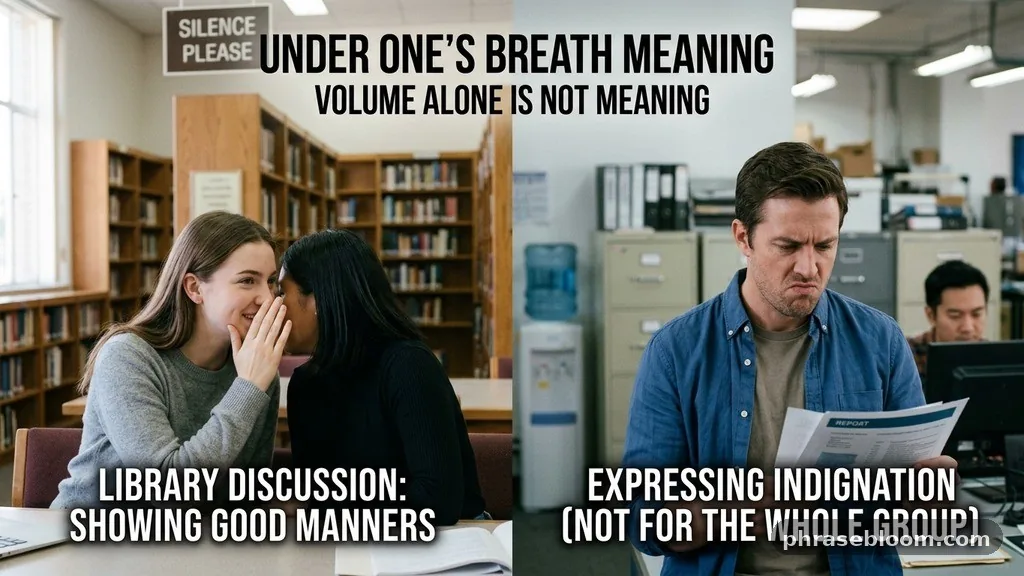
A sentence spoken under your breath is often barely audible, but low volume alone does not create the full idiomatic meaning. Someone speaking quietly during a library discussion may simply be showing good manners.
The phrase becomes more expressive when the quiet speech is not meant for the whole group. If a worker says, “I can’t believe this,” under their breath after receiving another task, the comment sounds like a concealed reaction or quiet complaint.
The expression can suggest intention
Sometimes the speaker deliberately lowers their voice. A manager might say a confidential name under their breath so that visitors cannot hear. In another situation, the speaker may not intend to be secretive but may be so frustrated or absorbed that the words come out quietly.
This distinction helps explain why the phrase can sound either neutral or negative. The same physical behavior may represent discretion, self-control, nervousness, or expressing annoyance.
Common Grammar Patterns
“Under one’s breath” usually appears as an adverbial phrase. In plain terms, it tells readers how someone speaks or performs an action involving speech.
The possessive word changes according to the subject. Use “under my breath” for yourself, “under your breath” for the person you are addressing, “under his breath” or “under her breath” for one person, and “under their breath” for a plural or gender-neutral subject.
| Subject | Correct form | Example |
|---|---|---|
| I | under my breath | I apologized under my breath. |
| You | under your breath | Why are you complaining under your breath? |
| He | under his breath | He muttered under his breath. |
| She | under her breath | She read the instructions under her breath. |
| They | under their breath | They criticized the decision under their breath. |
The phrase commonly follows a speech verb such as “say,” “mutter,” “whisper,” “complain,” “remark,” or “grumble.” It can also appear before the verb for emphasis: “Under his breath, Daniel repeated the address.”
Typical sentence structures
One frequent pattern is subject + speech verb + under one’s breath. For example, “Maya thanked the receptionist under her breath” tells us that Maya spoke quietly while offering thanks.
Another pattern places the phrase before the verb: “Under my breath, I counted the remaining boxes.” This arrangement gives the quiet manner of speaking more attention and can create a reflective or slightly dramatic tone.
The idiom can also follow a direct quotation. “This is going to take forever,” he muttered under his breath. The quotation makes the private remark clear, while the idiom explains how it was delivered.
Under One’s Breath in Real Sentences
Natural example sentences show how flexible the expression is. It can appear in workplace conversations, family scenes, fiction, classroom settings, and ordinary descriptions of thought becoming speech.
Workplace examples
“The analyst muttered under her breath when the spreadsheet lost its formatting.” This example suggests frustration, but it does not say that the analyst made a loud complaint.
“I thanked him under my breath and returned to the report.” Here, the phrase presents a quiet response that may have been sincere, restrained, or slightly reluctant.
“During the presentation, Luis repeated the key figures under his breath.” This is not necessarily a complaint. He may be memorizing the numbers or checking his own understanding.
“She said, ‘That should be easy,’ under her breath before opening the complicated file.” The quiet remark may reveal confidence, sarcasm, or an attempt to encourage herself.
Family and social examples
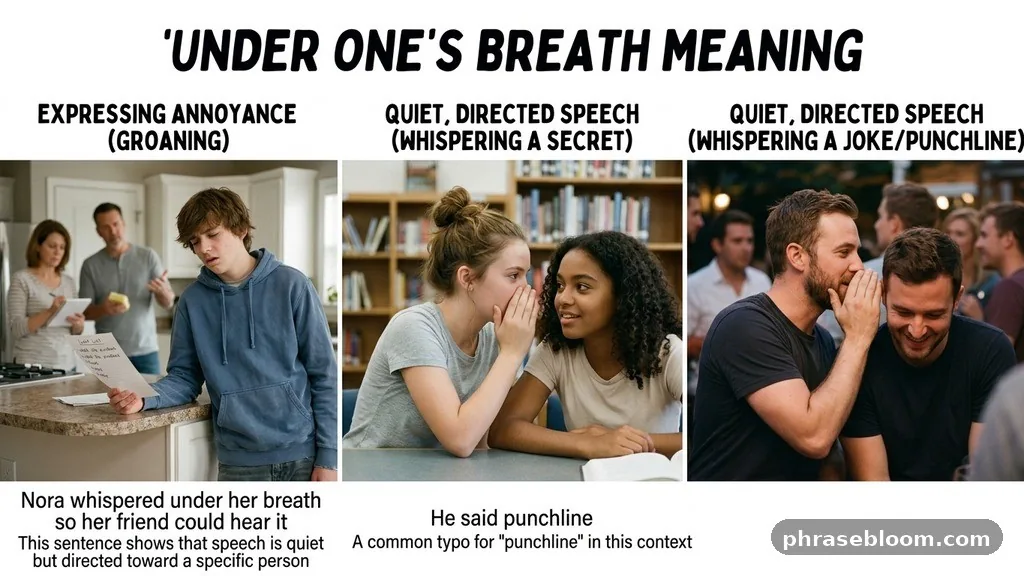
“The teenager groaned under his breath when his parents added another chore.” The verb “groaned” and the situation make the annoyance clear.
“Nora whispered the answer under her breath so her friend could hear it.” This sentence shows that the speech is quiet but directed toward a specific person.
“He said the punchline under his breath, and nobody at the table understood it.” In this case, quiet delivery prevents the remark from having its intended effect.
Fiction and narrative examples
“Under her breath, the detective repeated the street name.” The positioning at the start gives the action a thoughtful, private quality.
“‘Not again,’ the mechanic muttered under his breath.” The words function as a quiet complaint, and the verb “muttered” reinforces the idiom.
“The student counted under her breath as the seconds passed.” This sentence presents talking to oneself as a way to measure time or stay focused.
Is It Whispering, Mumbling, or Mutting?
The phrase overlaps with “whispering,” “mumbling,” and “muttering,” but the terms are not identical. Choosing the right verb gives readers more information about the speaker’s voice and attitude.
Whispering focuses on a very soft voice. A whisper may be clear enough for one nearby listener, especially in a quiet room. “She whispered under her breath” combines the quiet vocal method with the private or restrained quality of the idiom.
Mumbling focuses on unclear pronunciation. A person may mumble because they are tired, shy, distracted, or speaking with their mouth partly closed. “He mumbled under his breath” suggests that the words were both quiet and difficult to understand.
Muttering often suggests a low, continuous, or irritated style of speech. “She muttered under her breath” commonly signals grumbling or dissatisfaction, although the context can soften that interpretation.
| Expression | Main emphasis | Example |
|---|---|---|
| Whispering | Very low volume | He whispered the address. |
| Mumbling | Unclear pronunciation | She mumbled an apology. |
| Muttering | Low, often irritated speech | He muttered about the delay. |
| Speaking under one’s breath | Quiet, private, or restrained delivery | She complained under her breath. |
These words can be combined, but repetition may become clumsy. “He muttered under his breath” is idiomatic. “He whispered quietly under his breath” may sound repetitive because “whispered” and “quietly” already communicate much of the same idea.
Why People Speak Under Their Breath
People speak under their breath for many reasons, and the idiom does not automatically mean that they are being rude. The surrounding action and dialogue determine the emotional meaning.
- Annoyance: A person may complain quietly rather than start an argument.
- Embarrassment: Someone may avoid drawing attention to an uncertain answer.
- Privacy: A speaker may want only one nearby person to hear.
- Self-encouragement: Quiet words can help someone stay calm or focused.
- Disbelief: A person may react privately to surprising information.
- Habit: Some people verbalize thoughts through low-level mumbling.
In a workplace, speaking under one’s breath may indicate restrained disagreement. An employee who says, “That makes perfect sense,” under their breath after a confusing announcement may be using sarcasm rather than offering genuine support.
In a personal setting, the same expression may signal vulnerability. Someone waiting for medical news might repeat a calming phrase under their breath because the words help them manage anxiety.
Quiet complaints and hidden reactions
A quiet complaint is often the most recognizable use. “He grumbled under his breath about the parking fee” shows dissatisfaction without describing an open confrontation.
Yet the idiom can also describe concealed speech that is not intended to criticize anyone. A person may say a phone number under their breath while searching for a pen. The speech is private because the speaker is concentrating, not because the speaker is angry.
Good writing avoids assuming an emotion that the scene does not support. If the only fact is low volume, “said quietly” may be more precise than “muttered under his breath.”
Synonyms, Related Phrases, and Antonyms
Several expressions can replace “under one’s breath,” but each has a slightly different emphasis. The best synonym depends on whether you want to highlight volume, privacy, unclear speech, or attitude.
Useful alternatives include quietly, softly, in a low voice, in a whisper, to oneself, in a murmur, and in a subdued voice. “She spoke softly” is neutral, while “she muttered to herself” suggests less polished or less clearly articulated speech.
“Privately” may work when the important point is the audience rather than the volume. “He mentioned the concern privately to his supervisor” does not necessarily mean he whispered. It means he did not raise the concern publicly.
Possible antonyms include aloud, out loud, loudly, publicly, and in a clear voice. These expressions emphasize open, audible communication.
| Phrase | What it emphasizes | Example |
|---|---|---|
| Quietly | Low volume | She quietly read the note. |
| In a low voice | Controlled, reduced volume | He answered in a low voice. |
| To oneself | Speech directed inward or privately | She repeated the steps to herself. |
| Aloud | Audible speech | He read the instructions aloud. |
| Publicly | Open communication before others | She criticized the plan publicly. |
“Barely audible” is a useful descriptive alternative when you want to avoid the emotional suggestion of the idiom. “His reply was barely audible” tells readers about volume without claiming that he was hiding a reaction or making a complaint.
Origin and Development of the Expression
The expression draws on an old association between breath and voice. Speech is produced by moving air, so describing words as being “under” the breath creates an image of language kept close, low, and partially concealed.
Over time, the phrase developed into a familiar idiom for low-volume speech. Its modern use can describe both deliberate secrecy and an involuntary private reaction. The expression is now common in conversation, fiction, journalism, and general prose.
The possessive form is important because the speaker’s breath belongs to the person speaking. English therefore uses “under my breath,” “under your breath,” “under his breath,” and similar variations rather than one fixed phrase with “one’s” in every sentence.
“Under one’s breath” is the dictionary-style form used when discussing the idiom generally. In ordinary writing, a writer usually selects the pronoun that matches the subject.
For a reliable reference on how idioms and phrases are recorded in English, readers can consult the Cambridge Dictionary. A dictionary entry can confirm common definitions, pronunciation information, and example usage, but context still determines the most natural choice in a particular sentence.
Common Mistakes and Better Choices
One common mistake is treating “under one’s breath” as a description of every quiet voice. A person who speaks softly in a hospital may not be speaking under their breath if they are clearly addressing the listener and have no private or restrained intention.
Another mistake is assuming that the idiom always signals hostility. “She practiced the unfamiliar name under her breath” is quiet speech without a complaint. The verb and situation should guide the reader’s interpretation.
Writers sometimes use “under his breath” when “to himself” would be more accurate. “He planned the schedule under his breath” sounds unusual because planning is not necessarily speech. “He planned the schedule silently” or “he worked through the schedule to himself” may be clearer.
Another issue is unnecessary repetition. “She whispered softly under her breath” contains three signals of low volume. In many contexts, “she whispered” or “she spoke under her breath” is enough.
- Less precise: “He talked under his breath loudly.”
- Better: “He complained under his breath.”
- Less natural: “She said it under her breath to everyone.”
- Better: “She announced it to everyone” or “She said it quietly to her colleague.”
- Less clear: “He was under his breath during the meeting.”
- Better: “He muttered under his breath during the meeting.”
The final example shows that the idiom normally needs a speech-related verb. “Under one’s breath” describes how words are delivered, so the sentence should make clear that someone spoke, muttered, whispered, or said something.
How to Use the Phrase in Formal and Creative Writing
In formal writing, the expression is acceptable when describing behavior, dialogue, or a person’s manner of speaking. It is less suitable when a precise technical description is needed, because idioms can leave the exact volume or acoustic quality open to interpretation.
A business report might say, “Several attendees expressed concerns privately after the presentation.” If the report specifically observed quiet speech, “Several attendees made quiet comments under their breath” is possible, but it may sound more judgmental.
In fiction, the idiom is especially useful because it reveals a character’s reaction without requiring a full public statement. A character who mutters under their breath can communicate resistance while still remaining outwardly controlled.
In academic writing, use the expression only when discussing language, dialogue, behavior, or a quoted example. A formal analysis might explain that a character’s words “are delivered under her breath,” indicating concealed dissatisfaction. The phrase itself is not too informal, but the surrounding argument should remain precise.
Workplace communication
For emails and internal messages, direct wording is usually clearer than an idiom. Write “I said this quietly because the discussion was confidential” if the exact reason matters. Use “under my breath” in a personal account, narrative, or informal message where its emotional nuance is useful.
A manager describing an incident should avoid turning an observation into an unsupported judgment. “The employee muttered under his breath” reports a perceived manner of speaking. “The employee was disrespectful” adds an interpretation that may require more evidence.
Creative dialogue
Dialogue tags and action beats can carry the idiom naturally. “That’s just what we needed,” Priya muttered under her breath. The sentence gives readers the spoken words, the delivery, and the likely attitude without explaining the emotion separately.
Use variety, though. Repeating “under his breath” in every scene can make the prose feel mechanical. Depending on the context, “he murmured,” “she whispered,” “they grumbled,” or “he said quietly” may provide a better rhythm.
Practical Examples You Can Adapt
The following example sentences show different meanings and grammatical settings. They can be adapted for workplace communication, fiction, classroom writing, or everyday conversation.
- “I repeated the unfamiliar street name under my breath before making the call.”
- “She muttered under her breath when the printer stopped working again.”
- “The coach gave the final instruction under his breath so the opposing team would not hear.”
- “He apologized under his breath, but his expression remained tense.”
- “Mina whispered under her breath during the ceremony.”
- “The customer complained under her breath while waiting for assistance.”
- “He counted the boxes under his breath to avoid losing track.”
- “‘That was a brilliant idea,’ she said under her breath, clearly being sarcastic.”
- “The child practiced the difficult sentence under his breath.”
- “I heard someone grumbling under their breath near the back of the room.”
- “She read the directions under her breath while assembling the shelf.”
- “The actor spoke the opening line under her breath before the curtain rose.”
Notice that the idiom does not require a negative meaning. In the examples involving counting, practicing, and rehearsing, the quiet speech supports concentration. In the examples involving complaints or sarcasm, the same phrase signals a private reaction.
Placement can also change emphasis. “He muttered under his breath during the call” treats the phrase as part of the action. “Under his breath, he muttered during the call” foregrounds the concealed or low-volume quality.
FAQ About Under One’s Breath
What does “under one’s breath” mean?
It means speaking very quietly, often so that other people cannot clearly hear. The phrase may suggest a private remark, muttering, a quiet complaint, nervousness, or talking to oneself.
Is “under your breath” the same expression?
Yes. “Under your breath” is the form used when addressing or referring to “you.” The general dictionary-style version is “under one’s breath,” while ordinary sentences use the pronoun that matches the speaker.
Does the phrase always mean that someone is angry?
No. Anger and grumbling are common associations, but someone can speak under their breath while practicing a sentence, counting, concentrating, or trying to keep private information from others.
What is the difference between whispering and speaking under one’s breath?
Whispering primarily describes a very soft vocal method. Speaking under one’s breath describes quiet, restrained, or partly concealed speech and may also suggest a private reaction. The two expressions can appear together.
What are good alternatives to “under one’s breath”?
Depending on the context, use “quietly,” “softly,” “in a low voice,” “in a whisper,” “to oneself,” “under one’s breath,” or “barely audibly.” Choose the alternative that communicates whether volume, privacy, unclear speech, or emotion matters most.
Final Takeaway
The idiom under one’s breath describes speech that is quiet, private, restrained, or difficult for others to hear. It often accompanies muttering or a quiet complaint, but it can also describe concentration, rehearsal, nervousness, or talking to oneself.
Use the expression when its nuance helps the reader understand both the sound and the speaker’s situation. If you only need to describe low volume, “quietly,” “softly,” or “in a low voice” may be more precise. Once you understand that distinction, you can use under one’s breath naturally in conversation, formal writing, and vivid dialogue.
Related: Its Self or Itself · Talking Out of the Side of Your Mouth · Quotation Marks When Quoting Yourself