
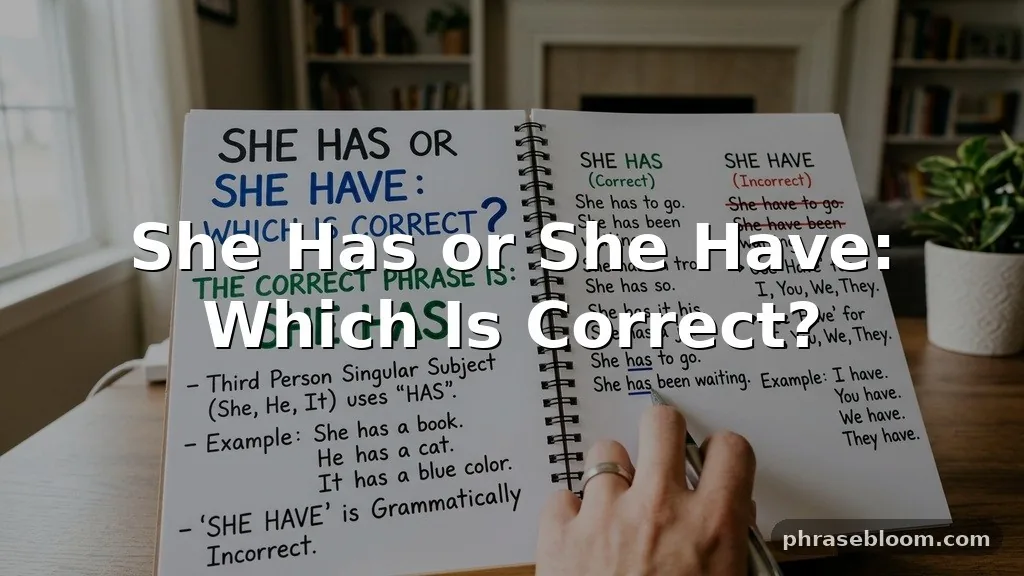
The correct form is “she has,” not “she have,” when the sentence uses the present simple tense. The pronoun she is a singular, third-person subject, so it takes has, the irregular third-person form of have.
That rule applies to possession, experiences, conditions, and many common expressions: “She has a car,” “She has already arrived,” and “She has enough time.” You will also learn why questions use “Does she have?” and why negative sentences use “She does not have,” even though affirmative sentences use “she has.”
She Has or She Have: The Direct Answer
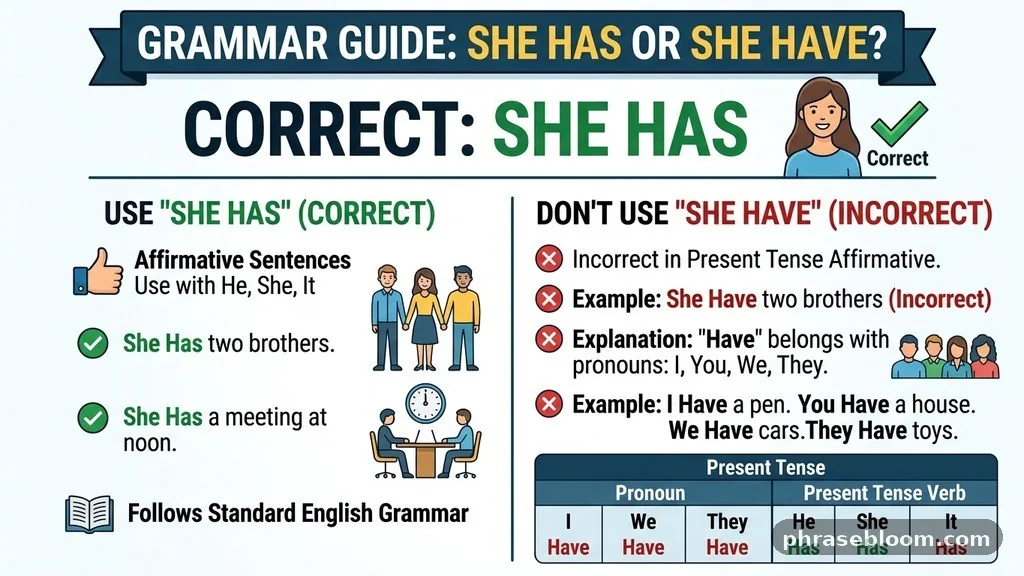
Use “she has” in an affirmative sentence when she is the subject. For example, “She has two brothers” and “She has a meeting at noon” follow standard English grammar.
“She have” is not correct as a normal present-tense affirmative sentence. The form have belongs with the pronouns I, you, we, and they, while has belongs with he, she, and it.
| Subject | Correct form | Example |
|---|---|---|
| I | have | I have a question. |
| You | have | You have enough time. |
| He | has | He has a new job. |
| She | has | She has a new job. |
| It | has | It has a useful feature. |
| We | have | We have a plan. |
| They | have | They have several options. |
The key principle is subject-verb agreement. A singular third-person subject changes the form of the verb in the present simple tense, and she is one of those subjects.
Why “She Has” Is Grammatically Correct
Has is the third-person singular form of the verb have. Although have is the base form, English changes it to has after a singular subject such as he, she, or it.
This is an example of an irregular verb form. Most present-tense verbs add -s for the third-person singular, as in “she works” or “she drives.” The verb have does not become “haves”; it changes completely to has.
Consider these examples:
- She has a blue notebook.
- She has three appointments today.
- She has a strong interest in history.
- She has enough information to decide.
- She has a cold.
In each sentence, she is a singular subject and has is the main verb. The verb may describe ownership, a relationship, a physical condition, an experience, or a situation rather than literal possession.
The same rule applies when a noun replaces the pronoun. “Maria has a question” is correct because Maria is one person. “The department has a new manager” is also correct because department is grammatically singular.
How “Have” and “Has” Work in English Grammar
The words have and has can function as main verbs or auxiliary verbs. As main verbs, they often express possession, connection, obligation, experiences, or conditions.
As auxiliary verbs, they help form perfect tenses. In “She has finished the report,” has is a helping verb, while finished is the main verb. The combination shows that the action has been completed with relevance to the present.
| Use | Example | Role of has or have |
|---|---|---|
| Possession | She has a bicycle. | Main verb |
| Relationship | She has two cousins. | Main verb |
| Experience | She has worked here for years. | Auxiliary verb |
| Completed action | She has completed the form. | Auxiliary verb |
| Obligation | She has to leave early. | Main verb in a fixed expression |
The form depends on the subject. “She has completed the form” is correct, while “They have completed the form” uses have because they is plural.
For a deeper reference on how have works as both an ordinary verb and an auxiliary, consult this English grammar reference on have. The important practical point is simple: the subject controls the form.
“She Has” in Affirmative Sentences
An affirmative sentence states that something is true, exists, happens, or applies. With a singular subject beginning with the pronoun she, the ordinary present-tense form is she has.
“She has a valid passport” states possession. “She has considerable experience” describes a quality or background. “She has lunch at one” uses has in a common expression for eating a meal.
Here are several patterns you can copy and adapt:
- She has + noun: She has a new assignment.
- She has + number or quantity: She has five minutes.
- She has + past participle: She has completed the training.
- She has to + base verb: She has to submit the form.
- She has been + adjective or noun phrase: She has been busy all morning.
- She has been + -ing form: She has been studying since dawn.
The word after has can change, but the agreement rule does not. A noun, an adjective phrase, or a verb phrase may follow, yet she still requires has in these structures.
Do not confuse the correct form with the meaning of the sentence. “She has not finished” and “She has a finished report” use has differently, but both are grammatically possible because the subject is singular.
Why Questions Use “Does She Have?”
Many learners notice that affirmative sentences use “she has,” but questions use “Does she have?” The reason is that does becomes the auxiliary verb carrying the third-person singular marker, so the main verb returns to its base form, have.
“Does she have a ticket?” is correct. “Does she has a ticket?” is incorrect because the sentence would mark third-person singular agreement twice, once in does and again in has.
Compare these forms:
| Sentence type | Correct pattern | Example |
|---|---|---|
| Affirmative | She has | She has a reservation. |
| Yes-or-no question | Does she have | Does she have a reservation? |
| Negative | She does not have | She does not have a reservation. |
| Short answer | Yes, she does | Yes, she does. |
The same pattern appears with other verbs. We say “She works here,” but “Does she work here?” We say “She likes tea,” but “Does she like tea?” The auxiliary does changes the structure of question formation.
Wh-questions follow the same rule. “What does she have?” and “How many files does she have?” both use have after does.
Negative Sentences: “She Does Not Have”
In a standard negative sentence, use “she does not have” or the contraction “she doesn’t have.” Do not write “she does not has,” because does already carries the third-person singular form.
Examples include “She does not have enough evidence,” “She doesn’t have a current address,” and “She does not have to attend the meeting.” The main verb remains have after the auxiliary does.
The contrast is easy to see:
- Affirmative: She has a valid license.
- Negative: She does not have a valid license.
- Question: Does she have a valid license?
- Short negative answer: No, she does not.
In formal writing, she does not have is often preferable because it is more explicit. In conversation, she doesn’t have is natural and correct.
There is another structure worth separating from ordinary possession: “she has not.” This form is used with a past participle in the present perfect, as in “She has not responded” or “She has not completed the review.” Here, has is an auxiliary verb, and responded or completed is the main verb.
Common Mistakes With “She Has” and “She Have”
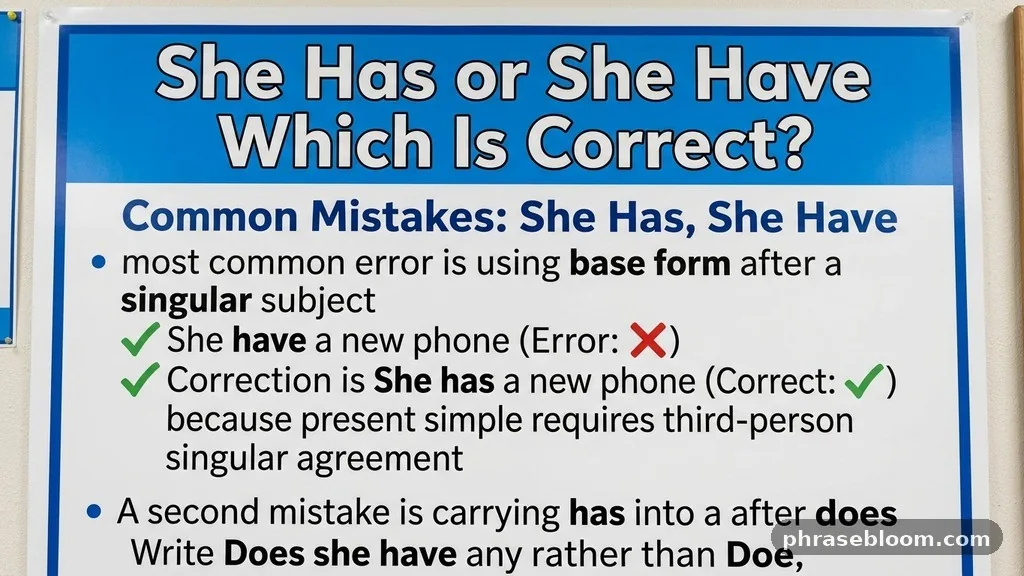
The most common error is using the base form after a singular subject: “She have a new phone.” The correction is “She has a new phone,” because the present simple requires third-person singular agreement.
A second mistake is carrying has into a question after does. Write “Does she have any questions?” rather than “Does she has any questions?” The auxiliary verb takes the grammatical load, so the main verb stays in its base form.
| Incorrect | Correct | Reason |
|---|---|---|
| She have a plan. | She has a plan. | She is third-person singular. |
| Does she has a plan? | Does she have a plan? | Does already marks the question. |
| She do not have a plan. | She does not have a plan. | She requires does in the present simple. |
| She has not went home. | She has not gone home. | The perfect tense requires a past participle. |
Another error occurs when writers mistake a nearby plural noun for the subject. In “She has several important responsibilities,” the subject is she, not responsibilities. The plural noun does not change the verb.
Word order can also cause confusion. In “The documents she has are confidential,” she has remains correct inside the relative clause. The noun documents does not control the verb in that clause because she is the subject of has.
Possessive Statements and Common Expressions
The verb have appears in many expressions that do not mean permanent ownership. “She has breakfast,” “she has a conversation,” and “she has a problem” all use the same grammatical form while describing different situations.
Possessive statements are among the easiest examples. “She has a laptop” means that a laptop is associated with her or in her possession. “She has two sisters” describes a family relationship, not an object she owns.
Common expressions include:
- She has a break at noon.
- She has an appointment with the dentist.
- She has a good reason for leaving.
- She has a clear understanding of the issue.
- She has a responsibility to report the problem.
- She has difficulty concentrating in noisy rooms.
These expressions are useful in professional writing because they allow you to describe responsibilities, qualifications, schedules, and conditions precisely. “She has five years of experience” is more natural than trying to force the verb own into a sentence about experience.
Remember that a noun after has does not make the verb plural. “She has several tasks” is correct, just as “She has one task” is correct. The subject remains the singular pronoun she.
“She Has” in Perfect Tenses
When has acts as an auxiliary verb, it combines with a past participle to form the present perfect. This tense connects a past action with the present, although the exact meaning depends on the verb and context.
“She has finished the report” means the report is complete now. “She has visited Spain twice” describes life experience up to the present. “She has lived here since 2021” describes a situation that began in the past and continues now.
The basic structure is:
- Affirmative: She has + past participle.
- Negative: She has not + past participle.
- Question: Has she + past participle?
- Short answer: Yes, she has. No, she hasn’t.
Examples include “She has written three chapters,” “She has not received the message,” and “Has she submitted the application?” Notice that questions in the present perfect use has directly, not does, because has is functioning as the auxiliary.
This distinction explains why both “Does she have a report?” and “Has she written a report?” are correct. The first question asks about possession or availability. The second asks whether an action has been completed.
How to Choose the Correct Form Quickly
You can solve most she has or she have questions by identifying the sentence type first. Then check whether another auxiliary verb, such as does or has, is already present.
- Find the subject. If it is she, treat it as third-person singular.
- For an affirmative present-simple sentence, use has.
- After does, use the base verb have.
- Before a past participle in the present perfect, use has.
- Read the completed sentence aloud and check whether the structure sounds complete.
For example, start with the idea “she and a current passport.” An affirmative sentence becomes “She has a current passport.” To ask a question, move to “Does she have a current passport?” To make it negative, write “She does not have a current passport.”
This method works because it separates subject-verb agreement from question formation. The word have is not wrong by itself. It is wrong in “she have” when no auxiliary has taken the third-person singular form.
Examples in Workplace, Academic, and Everyday English
Professional writing frequently uses she has to describe a person’s duties, qualifications, or actions. “She has responsibility for the regional accounts” and “She has completed the required training” are both suitable for a report or evaluation.
Academic writing uses the same grammar. “She has examined three possible explanations” is an affirmative present-perfect sentence, while “Does she have sufficient evidence?” is a correctly formed research question.
Everyday English includes shorter, more conversational examples. “She has my keys,” “She has a headache,” and “She has to catch the bus” are ordinary present-tense sentences.
| Context | Example sentence | Grammar point |
|---|---|---|
| Workplace | She has responsibility for the client account. | Possession of a duty or role |
| Education | She has completed the final assignment. | Present perfect |
| Customer service | Does she have the order number? | Question with does |
| Daily conversation | She has a cold today. | Condition or state |
| Planning | She does not have enough time. | Negative with does not |
These examples also show why grammar should be judged by the complete sentence rather than by a single word. Has is not always the main verb, and have is not always incorrect after she. The surrounding auxiliary structure determines the form.
FAQ: She Has or She Have
Is “she has” or “she have” correct?
“She has” is correct in an affirmative present-tense sentence. “She has a new position” follows subject-verb agreement. Use “she have” only when another auxiliary structure requires the base verb, as in “Does she have a new position?”
Is “she have” ever correct?
Yes, but not as a simple affirmative sentence. It is correct after an auxiliary such as does, as in “Does she have the correct address?” It can also appear after modal verbs, as in “She may have the answer” or “She should have more time.”
Why do we say “Does she have” instead of “Does she has”?
Does is the auxiliary verb that marks the third-person singular in the question. The main verb therefore stays in its base form, have. “Does she has” incorrectly marks the same agreement twice.
Is “she has not” correct?
Yes. Use “she has not” with a past participle in the present perfect, as in “She has not replied.” In a possession sentence, use “she does not have,” as in “She does not have the file.”
What is the easiest way to remember the rule?
Remember this pattern: she has, does she have, and she does not have. The first is affirmative, while the other two use the auxiliary does, which leaves the main verb as have.
Conclusion
The answer to “She Has or She Have” depends mainly on sentence structure, but the central rule is straightforward: use she has in an affirmative present-simple sentence. Use does she have for questions and she does not have for negatives.
When has is a helping verb, use it with a past participle in forms such as “she has finished” or “she has not arrived.” Once you identify the subject and any auxiliary verb, the correct choice becomes clear. Try applying the pattern to your own sentences, and check the complete structure rather than judging has or have in isolation.