
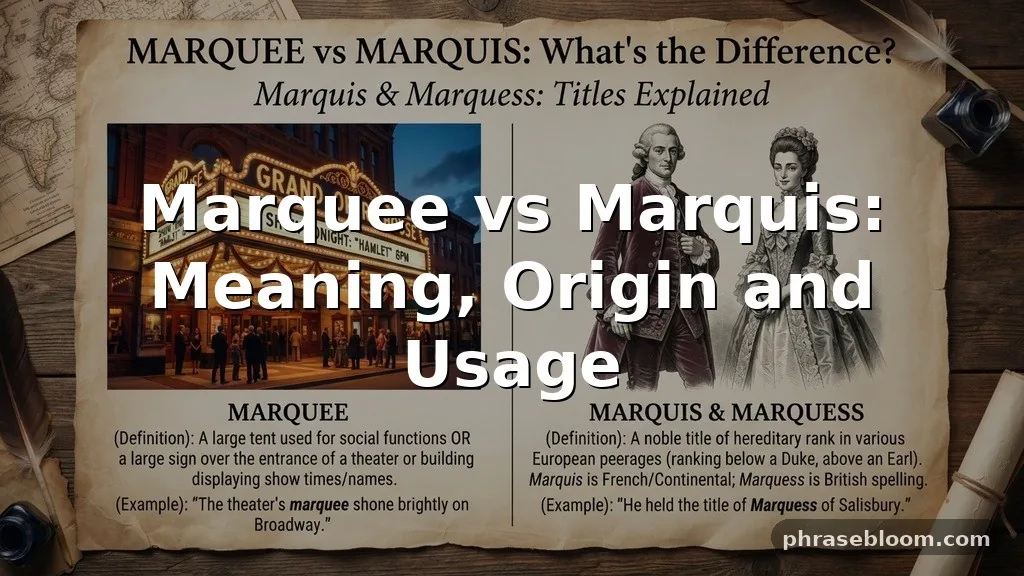
Marquee vs Marquis is a useful distinction because the words look similar but refer to very different things. Marquee can mean a large tent, a theater sign, or a headline attraction, while marquis is a noble title associated with European aristocracy. Their pronunciations also differ in some varieties of English, even though both words have French connections.
The spelling becomes easier once you connect each word with its context. A wedding may take place under a marquee, a theater may display a marquee sign, and a historical figure such as the Marquis de Lafayette held a noble title. The sections below explain the marquee definition, marquis definition, pronunciation, etymology, and modern uses so you can choose the right word confidently.
Marquee vs Marquis: The Quick Answer
Marquee usually refers to a large temporary tent, a theater or cinema sign, or a person or event presented as the main attraction. Marquis refers to a rank of nobility, traditionally placed below a duke and above an earl or count in many European systems.
They are not interchangeable. Writing “the marquis was covered in canvas” changes the meaning from a tent to a nobleman, while writing “the marquee inherited the estate” changes a title into a structure or display.
| Word | Main meaning | Typical pronunciation | Example |
|---|---|---|---|
| Marquee | A tent, sign, or featured attraction | mar-KEY | The guests gathered beneath the marquee. |
| Marquis | A noble title | MAR-kwis in many English contexts | The marquis addressed the assembly. |
The safest memory aid is simple: a marquee is a place, display, or attraction; a marquis is a person with a title. The words share historical connections, but their modern meanings have separated clearly.
What Does Marquee Mean?
The most concrete marquee meaning is a large tent used for an outdoor event. A marquee tent may host a wedding reception, exhibition, concert, trade show, or formal dinner. It is typically larger and more structured than an ordinary camping tent, with enough interior space for tables, lighting, flooring, and event equipment.
In British English, marquee is especially common for this kind of event tent. A sentence such as “The reception will be held in the marquee” tells readers that the celebration will take place inside a temporary covered structure. In American English, people may also use “tent,” “event tent,” or “party tent,” depending on the setting.
Marquee also has a long-established connection with theaters and cinemas. A theater marquee is the sign or illuminated structure that displays the name of a theater, the title of a film, or information about a performance. The classic image is a projecting sign above an entrance, often surrounded by lights.
For example, “The theater marquee announced a midnight screening” uses marquee as a noun for the display. The related phrase marquee sign is also common, especially when discussing architecture, advertising, restoration, or commercial design.
In modern business and media writing, marquee can function as an adjective. A “marquee player” is a highly prominent athlete, while a “marquee client” is an especially prestigious or recognizable customer. A “marquee event” is one of the most important events in a schedule.
- Marquee tent: a large temporary structure for an event.
- Theater marquee: a sign displaying a venue, film, or performance.
- Marquee attraction: the main feature that draws attention.
- Marquee client: a prominent or prestigious customer.
- Marquee player: a star participant, especially in sports.
These uses share an idea of visibility and prominence. A physical marquee is a noticeable structure, a theater marquee attracts public attention, and a marquee attraction is the feature people are expected to notice first.
What Does Marquis Mean?
The marquis definition is based on rank. A marquis, also written marquess in some British usage, is a nobleman whose traditional rank falls between a duke and an earl or count. The corresponding title for a woman is usually marchioness.
The title developed in connection with border territories. In medieval Europe, a ruler or nobleman responsible for defending a frontier could hold a title associated with a march, a border region. The exact privileges and ranking systems differed between countries, so the historical role was not identical everywhere.
In British peerage, marquess is the more usual spelling for a male holder of the rank. Marquis remains familiar in English because it reflects the French form and appears in historical names, translated writing, and references to continental European nobility.
The word can also describe the rank itself rather than a particular person. A history book might discuss “the marquis’s political influence,” while a reference work may explain how a marquisate was inherited. In both cases, the subject is aristocratic rank, not a structure or sign.
A marquis was traditionally part of a hereditary system, although the legal meaning of a title depends on the country and historical period. Modern references may use the title ceremonially, historically, or socially rather than to describe governing authority.
Marquis and Marquess
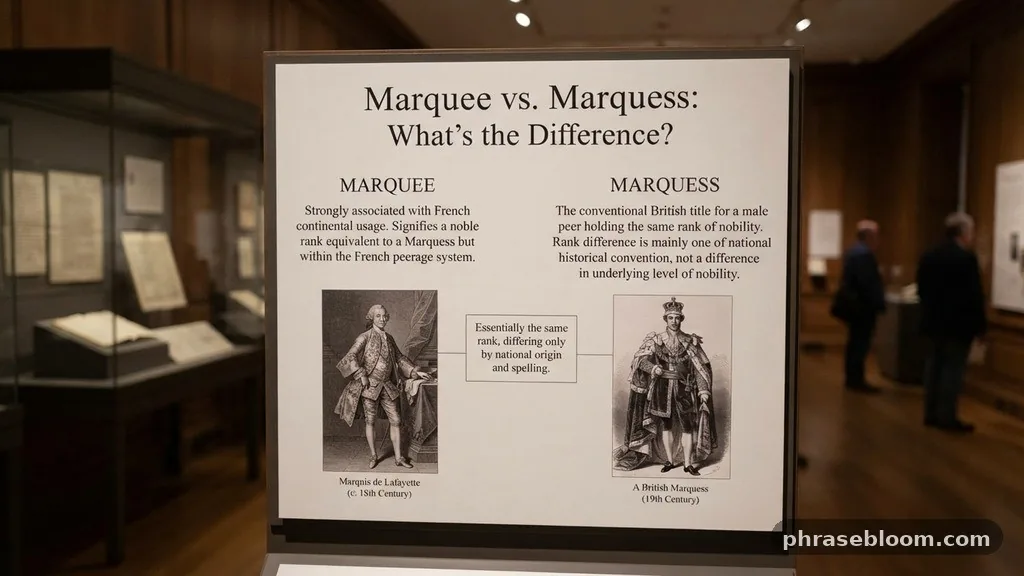
Marquis is strongly associated with French and continental usage, while marquess is the conventional British title for a male peer of that rank. The difference is mainly one of national and historical convention, not a difference in the underlying level of nobility.
For example, “the Marquis de Lafayette” is the established form of Lafayette’s title. In a discussion of the British peerage, however, a writer would normally refer to a marquess rather than a marquis.
Do not confuse either spelling with marquee. The shared first letters reflect related historical development, but a marquis is a titled person and a marquee is not.
Marquee Pronunciation and Marquis Pronunciation
The usual marquee pronunciation in English is “mar-KEY,” with the stress on the second syllable. It rhymes approximately with “key.” This pronunciation is used for the tent, theater sign, and featured attraction.
The common marquis pronunciation in English is “MAR-kwis,” with the stress on the first syllable. The final sound resembles “quiz,” although the exact vowel may vary by speaker and region.
French pronunciation is different. The French title marquis is commonly pronounced closer to “mar-KEE,” while English speakers often use the anglicized “MAR-kwis” in historical or literary contexts. Names and titles may retain a family or regional pronunciation, so the preference of the person involved takes priority.
| Term | English pronunciation | Meaning | Memory cue |
|---|---|---|---|
| Marquee | mar-KEY | Tent, sign, or featured attraction | Rhymes with “key” |
| Marquis | MAR-kwis | Nobleman or noble rank | Sounds similar to “mar-kiss” or “mar-kwis” |
| Marquess | MAR-kwis | British form of the title | Same basic sound as English marquis |
Pronunciation alone is not always enough to identify the word in speech, especially in names or regional accent. Context supplies the missing information. A sentence about lighting, canvas, or a theater probably concerns marquee, while a sentence about a palace, peerage, or inheritance probably concerns marquis.
The Etymology Behind the Two Words
The etymology of marquee and marquis helps explain their resemblance. Both words are connected to French forms associated with a frontier or border region and with the nobleman responsible for such a territory. The historical path from military office to modern event tent is indirect, which is why the meanings can feel unrelated today.
Marquis comes through French and ultimately relates to a “march,” meaning a border territory. The title described a person connected with the defense or administration of a frontier. Similar terms appear across European languages, although spelling and rank systems vary.
Marquee is also linked to French usage. English adopted it for a large tent, and the word later developed additional meanings related to public display and prominence. The precise historical explanation for every stage of the change is more complicated than saying that one word simply came from the other.
The connection between a noble title and a tent is sometimes explained through historical associations with a marquise, the wife or female counterpart of a marquis. That explanation appears in popular word histories, but writers should avoid presenting a neat anecdote as the complete account of the word’s development.
Language often preserves a visible family resemblance after meanings have diverged. The same pattern appears in many English words borrowed from French, where spelling, pronunciation, and meaning changed at different times. Marquee and marquis are best learned as separate modern vocabulary items with related origins.
Marquis de Lafayette
The Marquis de Lafayette is one of the best-known historical figures associated with the title. Lafayette was a French aristocrat and military officer who supported the American cause during the American Revolution and later participated in French political life.
His name is normally written with Marquis because it is part of his established title and historical identity. Replacing it with marquee would produce a spelling error, not a stylistic variation. A sentence such as “The Marquis de Lafayette visited the United States” uses the title correctly.
Marquee in Events, Theater, and Business
The event-related use of marquee is practical and easy to recognize. Event planners may discuss the size, layout, flooring, heating, lighting, and weather protection of a marquee tent. A venue description might state, “The garden can accommodate a marquee for the summer reception.”
In theater and cinema, marquee usually refers to a prominent sign or display. “The film’s title appeared in bright letters across the marquee” describes the physical sign outside the venue. The word can also refer to the whole visual presentation around the entrance, not only to an individual panel or line of text.
Businesses use marquee figuratively to describe prominence. A company may announce a “marquee partnership” when the other organization is especially well known or strategically important. A sports report may call a match a “marquee matchup” because it is expected to draw unusual attention.
This figurative use can sound promotional, so it should match the tone of the document. In a marketing release, “marquee launch event” may be appropriate. In a technical report, “primary launch event” or “main event” may be more precise.
Marquee can also appear in software and web discussions. Older web developers may remember the deprecated HTML marquee element, which automatically moved text across a page.
Modern web standards generally favor CSS animations and accessible interface patterns instead of relying on the old scrolling element. The MDN reference for the HTML marquee element provides technical background and explains its deprecated status.
That digital meaning should not be confused with the business adjective. In “marquee customer,” the word means prominent.
In “marquee element,” it refers to a historical HTML feature. Context controls the interpretation.
Marquis in History, Titles, and Culture
Marquis belongs primarily to historical, political, genealogical, and literary contexts. A historian might write about the authority of a marquis in early modern France, while a novelist might introduce a character as “the marquis of a remote province.” The title immediately signals social rank and a connection with aristocracy.
The title does not automatically identify a specific country. France, Spain, Italy, Portugal, and other European states used related ranks, but the legal status and precedence could differ. A careful writer should identify the national setting rather than assume every marquis held the same powers.
In French nobility, a marquis could be associated with a marquisate, a territory or estate linked to the title. In British peerage, the comparable male title is usually marquess. These distinctions matter in historical writing because titles are part of a document’s evidence, not merely decorative labels.
Modern popular culture often uses marquis in fictional aristocratic settings. Period dramas, historical novels, and role-playing games may feature a marquis as part of a court or noble family. Such uses can be accurate within the fictional world even when the character’s powers are invented.
Marquis should normally be treated as a noun or part of a proper title. It is not an adjective for something expensive, elegant, or prestigious. If a sentence says “the marquis ballroom,” the writer may have intended “marquee ballroom,” “marquis’s ballroom,” or a different phrase entirely.
Common Mistakes with Marquee and Marquis
The most common error is choosing the word by appearance rather than meaning. Because the spellings differ by only a few letters, proofreading software or a quick visual scan may not catch the mistake. Read the sentence for context before deciding which form belongs there.
- Incorrect: The guests waited beneath the marquis. Correct: The guests waited beneath the marquee.
- Incorrect: The marquee inherited the estate. Correct: The marquis inherited the estate.
- Incorrect: The marquee de Lafayette supported the revolution. Correct: The Marquis de Lafayette supported the revolution.
- Incorrect: The theater displayed a marquis sign. Correct: The theater displayed a marquee sign.
- Incorrect: The company hired a marquee of the province. Correct: The company hired a marquis of the province, if a noble title is intended.
Another mistake is treating marquee as if it always refers to a tent. In “marquee actor” or “marquee product,” the word is an adjective meaning highly prominent or attractive to attention. Substituting marquis would turn a figurative business expression into a reference to a nobleman.
Writers sometimes capitalize a common noun unnecessarily. “The guests entered the marquee” needs lowercase marquee, while “the Marquis de Lafayette” uses uppercase Marquis because it forms part of a proper name or title placed before a name.
Pronunciation can create confusion in spoken communication. If a name contains Marquis, ask or verify how the person pronounces it rather than imposing the common English version. For ordinary vocabulary, the surrounding words usually make the intended meaning clear.
Marquee vs Marquis in Real Sentences
Examples are often more useful than a dictionary definition because they show how grammar and context work together. The following sentences use both words in realistic settings.
Examples with marquee
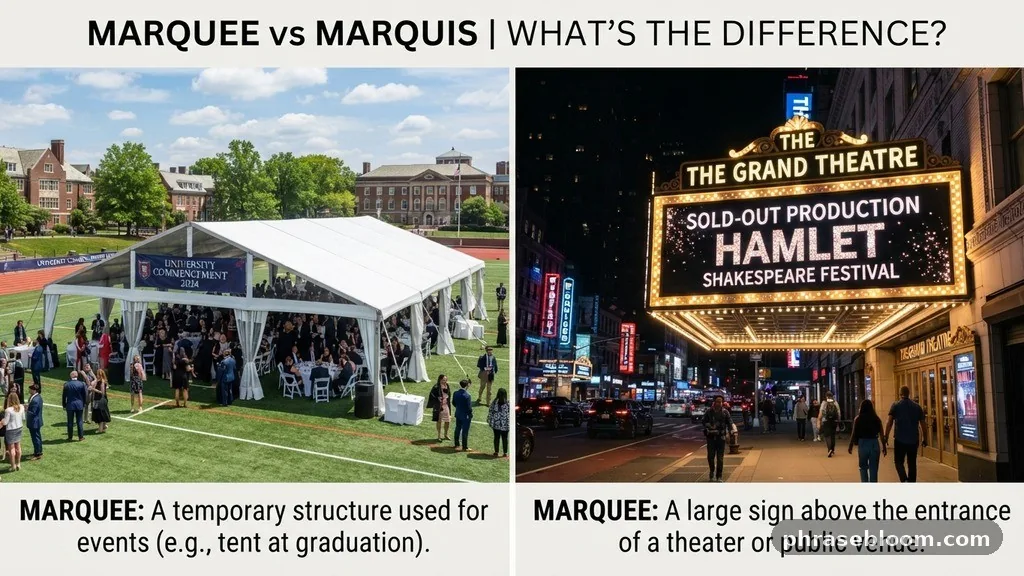
“The university installed a marquee tent beside the athletics field for commencement guests.” Here, marquee identifies a temporary event structure.
“The theater marquee displayed the name of the sold-out production.” In this sentence, the word refers to a public sign outside a performance venue.
“The software company made its new security platform the marquee product of the annual conference.” Marquee acts as an adjective meaning the most prominent or attention-grabbing product.
“A marquee client joined the firm’s advisory program after a six-month review.” The phrase describes a prestigious or highly visible customer.
“The festival’s marquee event begins at eight o’clock on Saturday.” The adjective signals that this is the festival’s principal attraction.
Examples with marquis
“The marquis granted permission for the estate archive to be opened.” Marquis is a noun referring to a titled nobleman.
“Visitors studied a portrait of the Marquis de Lafayette in the museum’s American history gallery.” The word forms part of a historical title.
“The novel follows a young marquis who must decide whether to sell his family estate.” The title identifies the character’s aristocratic rank.
“The archive contains correspondence between the marquis and the royal court.” The surrounding references to letters and court life make the title clear.
“The British historian used marquess rather than marquis when discussing the peerage.” This sentence highlights a national spelling convention without suggesting that the two ranks are entirely unrelated.
How to Choose the Right Word
Start with the basic question: are you describing a structure, sign, attraction, or noble person? If the answer is a structure or display, choose marquee. If the answer is a titled aristocrat, choose marquis or, in a British peerage context, marquess.
Next, examine the words around it. Terms such as canvas, reception, theater, lights, film, product, client, and event point toward marquee. Terms such as estate, title, court, aristocracy, inheritance, nobleman, and peerage point toward marquis.
Use this quick decision process when editing:
- Identify whether the word describes an object, an attraction, or a person.
- Check whether the context is an event, theater, business, history, or nobility.
- Confirm the spelling in a reliable dictionary if the sentence remains unclear.
- Preserve the established spelling of a person’s name or historical title.
- Read the complete sentence aloud to catch a meaning that looks visually plausible.
In formal writing, precision matters more than choosing the word that looks more familiar. A single letter can change the subject from a tent to a nobleman. That is a small spelling difference with a large semantic effect.
American and British Usage
Both American English and British English use marquee, but the emphasis can differ by context. British speakers are particularly familiar with marquee as a word for a large outdoor event tent. American speakers also use it, although “tent” or “event tent” may be more common in some everyday situations.
The theater and publicity meanings occur in both varieties. American sports and entertainment writing frequently uses marquee for a major attraction, star, matchup, or event. British publications use the same figurative sense, especially in reporting about theater, sport, and business.
Marquis is likewise understood in both varieties, but British usage more often distinguishes the traditional British title marquess from the French or continental form marquis. American writing may use marquis more broadly in historical references, particularly when reproducing a person’s established title.
These are tendencies, not absolute rules. A writer should not assume that marquee is exclusively British or that marquis is exclusively American. Country, subject, publication style, and the established form of a proper name all influence the choice.
For historical or academic writing, follow the terminology used by the relevant institution, archive, or period source. For general business writing, use the spelling that your audience will recognize and keep it consistent throughout the document.
Alternatives That Avoid Confusion
Sometimes the best solution is to rewrite the sentence. If you are unsure whether readers will understand marquee, use “event tent,” “theater sign,” “main attraction,” or “featured product,” depending on the intended meaning.
For example, “The reception will take place in the event tent” is more direct than “The reception will take place in the marquee” for an international audience unfamiliar with the event-tent sense. Similarly, “The theater’s illuminated sign displayed the film title” removes any ambiguity for readers who may know marquee only as a business adjective.
Useful alternatives include:
- Event tent: clear for weddings, festivals, and outdoor receptions.
- Theater sign: direct when discussing cinema or performance venues.
- Main attraction: suitable for general audiences.
- Featured product: useful in sales, marketing, and product reports.
- Prominent client: more restrained than marquee client.
- Nobleman: clear when explaining the meaning of marquis to non-specialists.
Rewriting does not mean the original word is incorrect. It means clarity should guide vocabulary. A specialist audience may prefer marquee, while a public information notice may benefit from a more explicit phrase.
FAQ: Marquee vs Marquis
Is marquee the same as marquis?
No. Marquee can mean a large tent, theater sign, or featured attraction. Marquis is a noble title, traditionally associated with a rank below duke and above earl or count in several European systems.
What is the correct marquee pronunciation?
In ordinary English, marquee is usually pronounced “mar-KEY.” The word rhymes approximately with “key,” whether it refers to a tent, sign, or prominent attraction.
What is the usual marquis pronunciation?
English speakers commonly pronounce marquis as “MAR-kwis.” The French pronunciation is closer to “mar-KEE,” and the pronunciation of a particular person’s title or family name should be respected.
Is a marquis a noble title?
Yes. A marquis is traditionally a nobleman of a rank associated with a marquisate. In British English, the comparable title is usually spelled marquess.
Can marquee describe a person?
Yes, but not as a title. In phrases such as “marquee athlete,” “marquee client,” or “marquee actor,” marquee means prominent, prestigious, or likely to attract attention.
Conclusion
The practical answer to Marquee vs Marquis is to match the spelling to the meaning. Choose marquee for a tent, theater sign, or leading attraction, and choose marquis for a noble title, with marquess often preferred for the British peerage.
Remember the context, check the pronunciation when a name is involved, and preserve the established spelling of historical titles. Once you connect marquee with a visible structure or attraction and marquis with aristocratic rank, the distinction becomes straightforward.
Explore more on PhraseBloom.