
SEO Title: If She Was or If She Were: Which Is Correct?
SEO Meta Description: Learn when to use “if she was” or “if she were,” with clear rules, examples, and practical guidance for formal English.
The choice between “if she was” and “if she were” depends on whether you mean a real past event or an imagined, unlikely, or contrary-to-fact situation. The phrase If She Was or If She Were causes confusion because both forms can be grammatical, but they belong to different patterns of English usage.
Use “if she was” for a possible or known past condition, and generally use “if she were” for a hypothetical or unreal condition. The distinction becomes clearer when you identify the meaning of the if-clause, the tense of the situation, and the level of formality required.
The Short Answer: “If She Was” or “If She Were”
Both “if she was” and “if she were” are used in standard English, but they do not normally communicate the same idea. “If she was” usually refers to a real past possibility, while “if she were” traditionally marks an unreal, imagined, or unlikely situation.
| Expression | Typical meaning | Example |
|---|---|---|
| If she was | A possible or real past condition | If she was at the meeting, she heard the announcement. |
| If she were | A hypothetical or contrary-to-fact condition | If she were here, she would help us decide. |
In formal English, “if she were” is the safer choice for an unreal condition, especially in sentences such as “If she were my manager” or “If she were available, we would ask her to join us.” This use is traditionally called the past subjunctive, although its meaning is often about the present or future rather than the past.
“If she was” is appropriate when the speaker is uncertain about what happened. For example, “If she was at the office yesterday, she may have seen the package” discusses a possible past fact, not an imaginary present situation.
What “If She Was” Means
“If she was” commonly introduces a condition connected with a real past event. The speaker may not know whether the event occurred, but the possibility is treated as part of the real world. The sentence does not necessarily suggest that the condition is impossible or contrary to fact.
Consider the sentence, “If she was absent on Monday, the supervisor probably contacted her.” The writer does not know whether she was absent, so “was” presents the absence as an uncertain past possibility.
This pattern is associated with the indicative mood, the ordinary verb form used for facts, questions, reports, and possibilities that remain connected to reality. It often appears in first and third conditional sentences involving a past condition and a likely result.
- If she was at the conference, she may have collected the revised materials.
- If she was delayed by traffic, she probably missed the opening presentation.
- If she was responsible for the report, she should explain the missing figures.
- If she was told about the change, she may have updated the schedule.
In each example, the speaker is considering whether something actually happened. The condition is uncertain, but it is not being presented as an imaginary alternative to reality.
“If she was” can also describe a genuine past condition whose result is known or likely. “If she was the person who approved the order, her signature should appear in the file” refers to a question about a real document and a real approval process.
Examples involving real past conditions
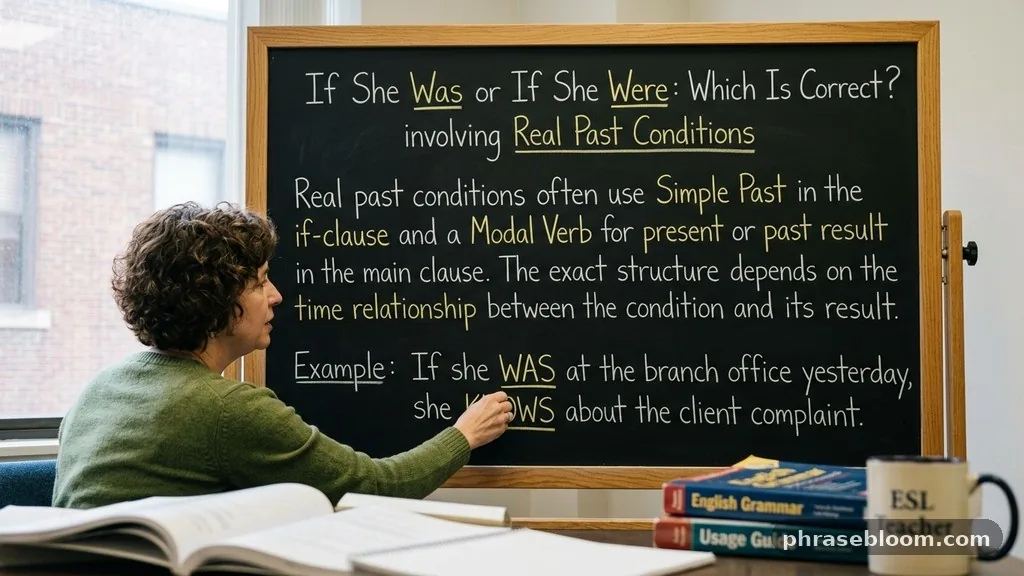
Real past conditions often use the simple past in the if-clause and a modal verb, present result, or past result in the main clause. The exact structure depends on the time relationship between the condition and its result.
“If she was at the branch office yesterday, she knows about the client complaint” connects a possible past location with a present consequence. “If she was at the branch office yesterday, she would have signed the visitor log” connects a possible past location with an expected past result.
The use of “was” does not automatically make a sentence informal or incorrect. It is the natural choice when the writer is investigating a past situation rather than imagining a different present reality.
What “If She Were” Means
“If she were” is traditionally used for a hypothetical, unreal, or contrary-to-fact condition. It is especially common when the speaker imagines a situation that is not true now, seems unlikely, or cannot easily happen.
In “If she were here, she would know what to do,” the speaker implies that she is not here. The sentence imagines an alternative present and describes its likely result.
This form belongs to the subjunctive mood, sometimes called the irrealis mood because it concerns situations outside the speaker’s established reality. In modern English, “were” is most clearly preserved in the phrase “if she were,” even though “she” normally takes “was” in the past tense.
- If she were the director, she would change the approval process.
- If she were available this afternoon, we would ask her to lead the interview.
- If she were more familiar with the software, the task would take less time.
- If she were in charge of the project, she might choose a different supplier.
These examples describe unreal conditionals. The speaker is not reporting that she is the director, available, familiar with the software, or in charge of the project. Instead, the speaker is testing an imagined possibility.
The past subjunctive can look confusing because “were” does not necessarily refer to past time. “If she were here” usually means “if she were here now,” while “if she were available tomorrow” refers to a possible future situation.
Common expressions with “were”
Some expressions make the hypothetical meaning especially clear. “I wish she were here” expresses a desire about a situation that is not true at present. “She talks as if she were the owner” suggests that her behavior gives that impression, even though she may not be the owner.
The same pattern appears in advice and speculation. “If I were you” is a fixed and widely accepted expression for giving advice, and “If she were in your position” uses the same hypothetical logic.
For further reference on conditional structures and the subjunctive, consult the Cambridge Dictionary explanation of conditionals and wishes. The important practical point is simple: use “were” when the condition is imagined rather than presented as a real past possibility.
Why the Difference Exists
The difference between “was” and “were” comes from the distinction between ordinary past-tense grammar and the subjunctive pattern. In ordinary subject-verb agreement, “she was” is correct because “she” is a third-person singular subject.
For example, “She was at work” follows the normal indicative pattern. The verb agrees with the subject in the usual way, and the sentence reports or describes a possible fact.
In “If she were at work, she would answer the phone,” “were” does not follow ordinary subject-verb agreement. It signals that the condition is hypothetical, contrary to fact, or otherwise outside the speaker’s established reality.
| Grammar pattern | Verb form | Meaning | Example |
|---|---|---|---|
| Indicative past | was | Real or possible past situation | If she was there, she heard the discussion. |
| Past subjunctive | were | Unreal or hypothetical situation | If she were there, she would speak up. |
| Wish construction | were | A present situation the speaker wants to change | I wish she were here. |
| As-if construction | were | An imagined comparison | She acted as if she were in charge. |
The distinction is meaningful, but everyday speech does not always preserve it perfectly. Many speakers use “was” in hypothetical clauses, particularly in casual conversation, while formal writing often retains “were” to make the unreal meaning unmistakable.
That variation does not mean the two forms are interchangeable in every sentence. “If she was at the meeting” and “If she were at the meeting” can suggest different circumstances, even though a listener may sometimes infer the intended meaning from context.
“If She Was” or “If She Were” in Real Sentences
The best way to choose between the forms is to examine realistic sentences rather than memorize a single isolated rule. Ask whether the condition concerns an event that may have happened or an imagined state that does not match the facts.
Workplace and business examples
“If she was involved in the vendor review, she can answer the procurement team’s questions” treats her involvement as uncertain but possible. The writer is trying to identify what happened during a real business process.
“If she were involved in the vendor review, she would already know about the pricing change” suggests that she is not involved. The sentence imagines a different organizational arrangement and predicts its result.
“If she was in the office yesterday, she may have approved the request” concerns a possible past presence. “If she were in the office today, she could approve the request” concerns a present condition that is probably not true.
Personal and everyday examples
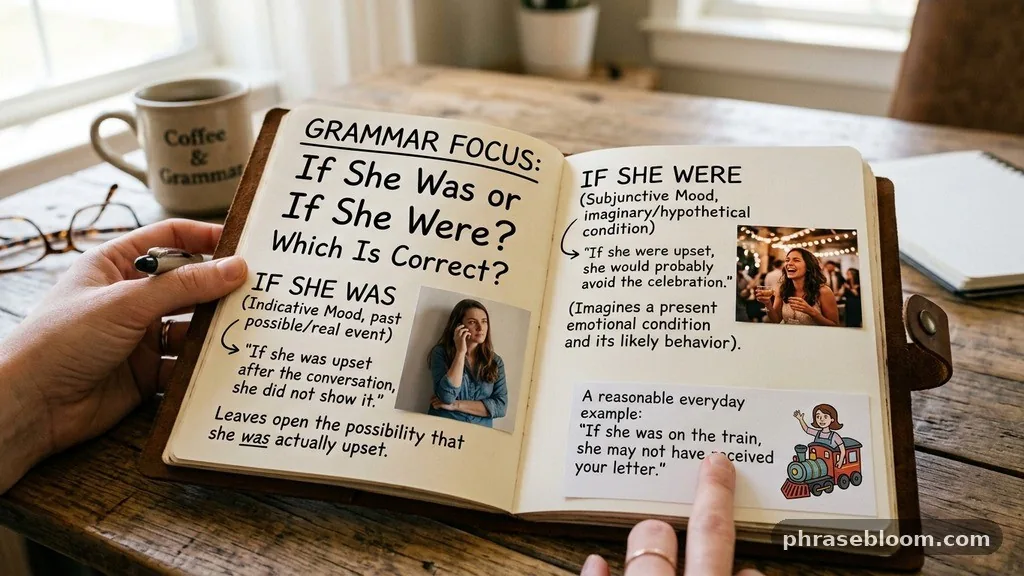
“If she was upset after the conversation, she did not show it” leaves open the possibility that she was upset. “If she were upset, she would probably avoid the celebration” imagines a present emotional condition and its likely behavior.
“If she was on the train, she may not have received your message” is a reasonable explanation for a past failure to respond. “If she were on the train now, she could not join the video call” presents the train ride as a current hypothetical explanation.
Academic and analytical examples
Academic writing often benefits from the distinction because it separates evidence from speculation. “If the participant was exposed to the stimulus, the result may reflect that exposure” describes an uncertain event in a study.
“If the participant were exposed to a different stimulus, the result might change” describes a hypothetical experimental condition. The second sentence does not claim that the different exposure occurred.
In analytical writing, “were” can therefore help readers recognize that a conclusion is conditional rather than factual. It marks a thought experiment, alternative interpretation, or unreal scenario.
When “If She Was” Is the Better Choice
Choose “if she was” when the condition refers to a specific past event that could have occurred. This includes questions about someone’s location, actions, knowledge, or status at a particular time.
- If she was at the reception, someone should have recorded her arrival.
- If she was notified last week, the delay needs another explanation.
- If she was the author of the memo, she can clarify its recommendation.
- If she was working late, she may have seen the system error.
- If she was unavailable during the call, send her the recording.
These sentences do not necessarily imply that the condition is false. They keep the possibility open and ask the reader to consider evidence or consequences.
“Was” is also natural when the sentence discusses a sequence of real past events. “If she was tired after the flight, she still completed the presentation” describes a past condition and a known action.
Another useful test is to paraphrase the sentence as “If it is true that she was…” If that wording makes sense, “was” is probably appropriate. “If it is true that she was at the hearing, she may know what happened” clearly concerns a possible past fact.
Do not replace “was” with “were” simply because the sentence begins with “if.” The conjunction “if” introduces many kinds of conditions, including real, likely, uncertain, imagined, and impossible ones.
When “If She Were” Is the Better Choice
Choose “if she were” when the sentence imagines a situation that is not currently true or is presented as unlikely. This is especially clear when the main clause contains “would,” “could,” or “might.”
- If she were the department head, she would reorganize the team.
- If she were available next week, she could attend the planning session.
- If she were more experienced with contracts, she might spot the problem.
- If she were here now, she would know which file to open.
- If she were willing to reconsider, the negotiation might continue.
These sentences are not reports about established facts. They explore what would happen under an alternative condition.
The form is especially useful when the condition is contrary to fact. “If she were the client, we would send the notice directly to her” normally implies that she is not the client.
It can also express low probability without making impossibility explicit. “If she were to resign, the board would need an interim chair” presents resignation as a hypothetical future event, not as a confirmed plan.
In formal writing, “were” helps maintain a visible difference between an unreal condition and a factual past condition. That precision can be valuable in legal analysis, policy writing, academic argument, and professional recommendations.
Conversational English and Formal English
In conversational English, many speakers say “if she was” in situations where traditional grammar recommends “if she were.” You may hear “If she was here, she would help us” in ordinary speech, especially in relaxed regional or social settings.
That usage is common enough to be understood easily, but it does not erase the traditional distinction. In formal English, “if she were here” remains the more careful choice when the meaning is hypothetical or contrary to fact.
The choice should reflect the audience and purpose. A casual text message can tolerate more variation, while a university essay, formal report, public statement, or legal document benefits from the clearer subjunctive form.
| Context | Preferred approach | Example |
|---|---|---|
| Casual conversation | Both may be heard; meaning and naturalness guide the choice | If she was here, she’d know what to do. |
| Formal report | Use “were” for an unreal condition | If she were present, the outcome might differ. |
| Past investigation | Use “was” for an uncertain real event | If she was present, the minutes should mention her. |
| Academic analysis | Preserve the distinction when it affects interpretation | If she were exposed to the variable, the result could change. |
Standard English is not identical to the way every native speaker talks in every setting. Formal writing often preserves grammatical distinctions that conversational English relaxes, particularly when those distinctions improve clarity.
Writers should also consider consistency. If a document uses “were” for hypothetical conditions in one section, switching casually to “was” in another can make the editing look uneven, even when the meaning remains understandable.
Related Expressions: “I Wish She Were” and “As If She Were”
The pattern extends beyond conditional sentences. “I wish she were here” expresses a desire about a present situation that is not true. The speaker is not saying that she is here; the speaker is imagining a preferred alternative.
“I wish she was here” is also heard in conversational English and is widely understood. In formal writing, however, “I wish she were here” more clearly preserves the subjunctive pattern and is often preferred by editors.
The expression “as if she were” works in a similar way. “She spoke as if she were the final decision-maker” compares her behavior with an imagined status. The sentence does not necessarily claim that she actually held that role.
- I wish she were able to join the meeting.
- He behaves as if she were responsible for every decision.
- The memo reads as if she were already aware of the risk.
- They treated her as though she were the project owner.
These patterns are useful grammar examples because they show that “were” is not limited to sentences beginning with “if.” It can mark an unreal or imagined state after “wish,” “as if,” “as though,” and similar expressions.
The same principle applies to “If I were you.” Although “I was” is normal in ordinary past-tense statements, “If I were you” is the established form for advice based on an imagined change of identity or position.
Common Mistakes and How to Fix Them
One frequent mistake is using “were” for every sentence that begins with “if.” That approach ignores the difference between a real past condition and an unreal one.
Incorrect reasoning: “If always requires were.” Better reasoning: identify whether the sentence investigates a real possibility or imagines an alternative reality.
Another mistake is using “was” for a clearly contrary-to-fact condition in formal writing. “If she was the president, she would change the law” may be understood, but “If she were the president” is the more traditional and precise form when she is not the president.
Writers sometimes create confusion by changing forms within one argument. For example, a report might use “If she were responsible” in one paragraph and “If she was responsible” in the next, even though both sentences describe the same hypothetical scenario.
- Real past possibility: If she was at the interview, she heard the question.
- Unreal present possibility: If she were at the interview, she would answer it.
- Present wish: I wish she were available.
- Imagined comparison: She acts as if she were the supervisor.
Do not treat “was” as ungrammatical in every hypothetical-looking sentence. Context matters, and conversational English often permits forms that formal editors may revise.
Finally, avoid changing the intended time reference. “If she were at the meeting yesterday” may sound unusual if the sentence simply asks whether she attended. “If she was at the meeting yesterday” is usually clearer for that real past question.
A Practical Decision Method
You can choose the correct form by asking three quick questions. First, is the condition a real past possibility?
If yes, use “was.” Second, is the condition imagined, unlikely, or contrary to fact? If yes, use “were.” Third, does the document require formal English or follow a house style that favors one pattern?
- Identify the time and reality of the condition. Ask whether the person may actually have been in that situation.
- Check the meaning of the main clause. “Would,” “could,” and “might” often accompany hypothetical conditions, though they do not decide the issue by themselves.
- Choose “was” for real past possibilities. Use it when you are checking or reporting something that may have happened.
- Choose “were” for unreal or imagined conditions. Use it when the sentence creates an alternative situation.
- Review the audience and style. Formal writing generally benefits from maintaining the traditional distinction.
- Read the sentence aloud. If the meaning remains unclear, rewrite it to state the condition directly.
For example, “If she was available, we contacted her” describes a past process involving people who may have been available. “If she were available, we would contact her” describes a present situation in which she is probably not available.
If the distinction feels awkward, rewrite the sentence. “Because her attendance is uncertain, we checked the sign-in sheet” can replace “If she was at the meeting…” Likewise, “If she became available, we would invite her” can replace a more complicated hypothetical sentence.
Rewriting is not an admission that the grammar is difficult. It is a practical editing decision that can make the intended meaning more direct.
Professional Writing Guidance
Business emails should favor clarity over unnecessary formality. Use “if she was” when discussing a possible past action, such as “If she was included in the original distribution, she may already have the report.” Use “if she were” for a hypothetical recommendation, such as “If she were available, we would ask her to review the proposal.”
Employee handbooks and policy documents should preserve the traditional distinction where it helps prevent ambiguity. A statement such as “If she were unable to complete the training” describes a possible policy scenario, while “If she was unable to complete the training” may refer to a specific past case under review.
Legal and compliance writing requires special care because a small change in meaning can affect how a condition is interpreted. Writers should identify whether they are describing an established fact, an uncertain event, or a hypothetical circumstance before selecting the verb form.
Academic writing generally favors “were” for unreal conditionals and “was” for real past possibilities. This distinction is especially useful in research discussions, where a writer may compare an observed result with a hypothetical alternative.
Websites, marketing copy, and internal software interfaces can use natural language, but the same rule still applies. A sentence such as “If she were a new customer, she would see this message” describes a hypothetical user state, while “If she was a customer last year, her account may still be active” describes a possible past status.
Recommended editing checklist
- Mark every sentence containing “if she was” or “if she were.”
- Ask whether each condition is real, possible, imagined, or contrary to fact.
- Use “was” for uncertain real past events.
- Use “were” for unreal or hypothetical situations in formal writing.
- Check related phrases such as “I wish she were” and “as if she were.”
- Keep the chosen pattern consistent throughout the document.
A style guide may establish a preferred approach, but it should not replace meaning-based analysis. If your organization’s editorial policy prefers “was” in conversational material, follow that policy while still making the sentence’s intended reality clear.
Examples You Can Copy and Adapt
The following examples show the difference in practical settings. Each sentence is built around a different meaning, so the verb choice is not merely a matter of personal preference.
- If she was at the client dinner, she may know why the contract was delayed.
- If she were at the client dinner, she would probably support the proposal.
- If she was responsible for the spreadsheet, ask her to confirm the totals.
- If she were responsible for the spreadsheet, she would have access to the source data.
- If she was informed about the merger, she did not mention it to the team.
- If she were informed about the merger, she could prepare the department for questions.
- If she was absent during the vote, the chair should record that fact.
- If she were absent during the vote, another member would need to speak for the department.
- I wish she were able to attend the conference.
- He spoke as if she were already a member of the board.
The first sentence in each pair considers a real event that may have occurred. The second imagines a different condition and describes what would follow from it.
When editing a sentence, replace the condition with a direct explanation. “If she was at the dinner” can become “Her attendance at the dinner is uncertain.” “If she were at the dinner” can become “She is not at the dinner, but her presence would change the discussion.”
These paraphrases reveal the underlying meaning and make the correct verb easier to choose.
Frequently Asked Questions
Is “if she was” or “if she were” correct?
Both can be correct. Use “if she was” for a real or possible past condition, and use “if she were” for an unreal, hypothetical, or contrary-to-fact condition.
Is “if she were” more formal?
It is generally more formal when it expresses a hypothetical condition. Formal English often preserves the past subjunctive distinction, while conversational English may use “if she was” more broadly.
Should I write “if she were” before a noun or adjective?
Use “if she were” when the sentence imagines an unreal status, identity, or condition. For example, “If she were the manager, she would change the schedule.”
Is “if she was” wrong in a hypothetical sentence?
It is not always treated as wrong in conversational English, and many speakers use it naturally. In formal writing, “if she were” is usually the safer choice when the condition is clearly unreal.
Can I write “I wish she were here”?
Yes. “I wish she were here” is the traditional formal form because it expresses a present situation that is not true. “I wish she was here” also occurs in everyday speech.
Can “were” refer to the present or future?
Yes. In “If she were here now,” “were” refers to the present. In “If she were available tomorrow,” it refers to a hypothetical future condition.
What is the simplest rule to remember?
Use “was” when you are asking whether something really happened, and use “were” when you are imagining a situation that is not currently real. Then check the tone and style of your document.
Conclusion
The choice between “if she was” and “if she were” depends on reality, time, and formality. “If she was” fits a possible or known past event, while “if she were” fits a hypothetical or contrary-to-fact situation. The same distinction appears in “I wish she were” and “as if she were.”
When deciding between If She Was or If She Were, identify what the sentence is really saying before checking the verb. Use the traditional distinction in formal writing, follow your organization’s style where one exists, and rewrite the sentence if the intended meaning remains unclear.
You may also like: Hassle vs Hastle: Understanding the Difference and Correct Usage · Invision or Envision: Understanding the Difference and Correct Usage Today · Soo vs So: Understanding the Difference and Correct English Usage