
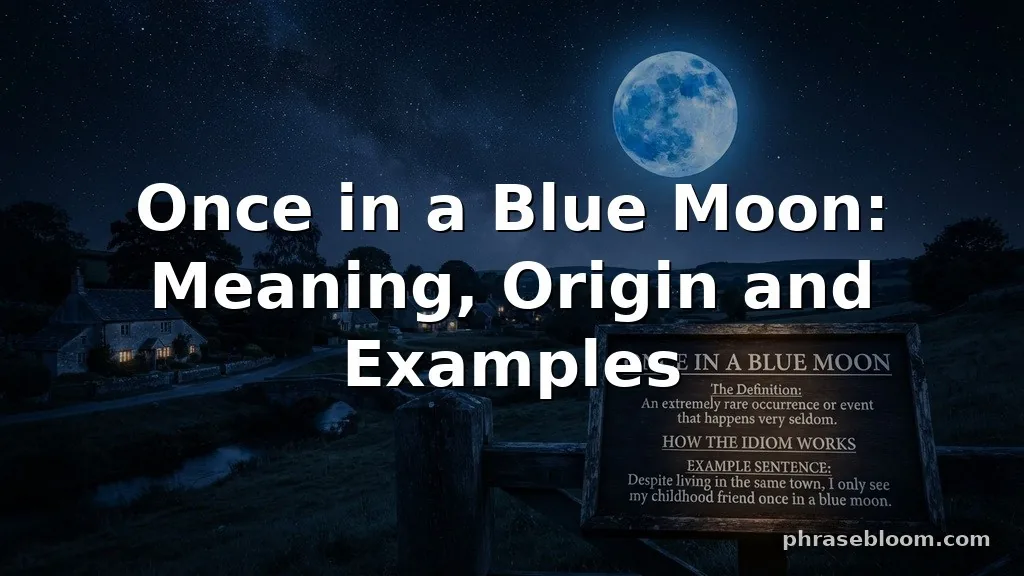
The phrase Once in a Blue Moon describes something that happens very rarely. It is a common English idiom for an event that occurs only occasionally, not on a regular schedule, and its meaning is usually figurative rather than astronomical.
You might hear it in everyday conversations, workplace writing, films, and personal stories. This article explains the idiom definition, the origin of blue moon, the difference between the astronomical and figurative meanings, and the best ways to use the expression in natural example sentences.
What Does Once in a Blue Moon Mean?
Once in a blue moon means very rarely or almost never. If someone says, “I eat dessert once in a blue moon,” they mean that they eat dessert only on unusual or infrequent occasions.
The phrase does not normally mean that an event happens exactly once during a particular moon cycle. Instead, it is a frequency expression. It tells listeners that something happens far less often than “sometimes” or “once in a while.”
For example, a person might say, “My cousins visit us once in a blue moon.” The speaker probably means that the visits are uncommon, but not necessarily that they happen according to a precise astronomical timetable.
The idiom can describe positive, neutral, or negative situations. It may refer to a rare opportunity, an occasional habit, an infrequent meeting, or something that almost never happens.
- Rare occurrence: “We go to the theater once in a blue moon.”
- Infrequent event: “The old machine works once in a blue moon.”
- Occasional opportunity: “I get to speak with the director once in a blue moon.”
- Unusual habit: “He cooks dinner once in a blue moon.”
The expression is informal and conversational, although it can appear in light business writing or general-interest articles. In a formal report, “rarely,” “infrequently,” or “on rare occasions” may sound more precise.
As a rough scale, “once in a blue moon” is stronger than “sometimes.” It usually suggests that the event is unusual enough for people to notice when it happens.
| Expression | Approximate meaning | Typical tone |
|---|---|---|
| Every day | Very frequently | Neutral |
| Once in a while | Sometimes | Conversational |
| Once in a blue moon | Very rarely | Idiomatic and informal |
| Hardly ever | Almost never | Conversational |
| On rare occasions | Infrequently | More formal |
The exact frequency depends on context. One speaker may use the phrase for something that happens a few times a year, while another may use it for an event that happens only once every several years.
Is Once in a Blue Moon an Idiom?
Yes. Once in a blue moon is a blue moon idiom, which means that its overall meaning cannot be understood simply by adding together the ordinary meanings of “once,” “blue,” and “moon.” It is a piece of figurative language.
Literally, a blue moon would seem to mean a moon that appears blue in the sky. Figuratively, however, the phrase expresses rarity. The color blue does not usually describe the speaker’s event, and the moon is not being used as a precise calendar measurement in ordinary conversation.
An idiom is a fixed or semi-fixed expression with a meaning recognized by a speech community. English idioms include phrases such as “spill the beans,” “hit the nail on the head,” and “once in a blue moon.” Their meanings are understood through shared usage.
The words in this idiom generally stay in the same order. Native speakers say “once in a blue moon,” not “once in a moon blue” or “in a blue moon once.” The standard expression is stable, which makes it easy to recognize.
How the idiom works in a sentence
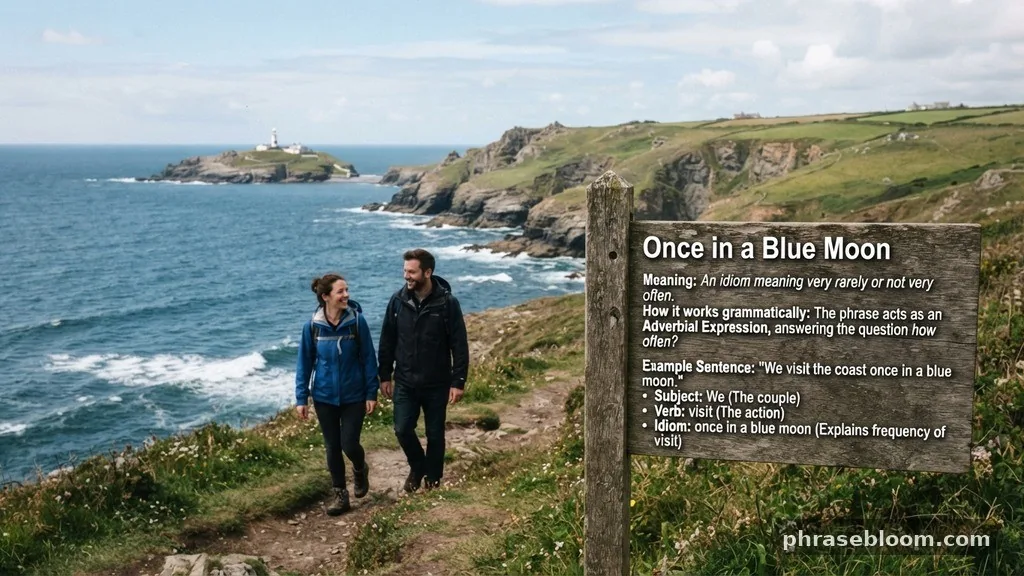
Grammatically, the phrase usually acts as an adverbial expression. In plain English, that means it gives information about how often something happens.
Consider the sentence, “We visit the coast once in a blue moon.” The subject is “we,” the verb is “visit,” and the idiom explains the frequency of the visit.
The phrase can appear at the end of a sentence, where it is most common. It can also appear at the beginning when the speaker wants to emphasize the unusual timing.
- “I call my former supervisor once in a blue moon.”
- “Once in a blue moon, the entire team works late.”
- “She takes a long vacation once in a blue moon.”
- “Once in a blue moon, we still use the old conference room.”
Because the expression describes frequency, it usually modifies a verb or the whole action rather than a noun. It is not normally used as a noun by itself.
For example, “The meeting was a once in a blue moon” does not sound correct. A natural revision would be, “The meeting was a rare event” or “The team meets once in a blue moon.”
The Origin of Blue Moon
The origin of blue moon has more than one part. The modern idiom developed from older uses of “blue moon” that described something unusual, unexpected, or extremely rare.
One historical explanation connects the phrase with old expressions involving “blue” as a symbol of something unlikely. In earlier English, unusual color terms could be used to express doubt or improbability. A blue moon was therefore associated with an event that was not expected to occur under ordinary conditions.
Another important part of the history involves the moon itself. The moon can sometimes appear bluish because of particles in the atmosphere, such as smoke or volcanic dust. That literal event is unusual, but it does not happen because the moon has permanently changed color.
The phrase later gained a more technical astronomical meaning. In one traditional usage, a seasonal blue moon is the third full moon in a season that contains four full moons instead of the usual three.
A different modern usage defines a calendar blue moon as the second full moon within a single calendar month. This definition became popular through a misunderstanding or reinterpretation of an earlier explanation, but it is now widely recognized in general public usage.
These two astronomical definitions are separate from the idiom. Someone saying, “I see my neighbors once in a blue moon,” is not making a claim about the number of full moons in a season or month.
The phrase became especially useful because the moon is familiar to everyone, yet the particular event described by “blue moon” seemed exceptional. That combination made it an effective image for an infrequent event.
For a concise explanation of the literal astronomical term, readers can consult this reference explanation of blue moons. The scientific definition and the idiomatic meaning should be kept separate when interpreting a sentence.
Astronomical Blue Moon and Figurative Blue Moon
The literal and figurative meanings of blue moon overlap in one important way: both are associated with unusual occurrences. Beyond that shared idea, they belong to different areas of language.
An astronomical blue moon is a term used to classify a full moon according to a calendar or seasonal pattern. It is not necessarily blue in color. The term describes timing, not usually appearance.
A seasonal blue moon occurs under one traditional calculation involving four full moons in a season. A calendar blue moon refers to the second full moon in one calendar month.
In contrast, the idiom “once in a blue moon” is a frequency expression in everyday speech. It does not identify a particular full moon, and it does not require the speaker to know anything about astronomy.
| Term | Meaning | Typical setting |
|---|---|---|
| Blue moon idiom | Something that happens very rarely | Conversation and figurative language |
| Astronomical blue moon | A full moon defined by a timing pattern | Astronomy and calendars |
| Seasonal blue moon | The third full moon in a season with four full moons | Traditional astronomical usage |
| Calendar blue moon | The second full moon in one calendar month | Modern popular astronomy |
Compare these two sentences: “The observatory will photograph a blue moon this month” and “I visit the observatory once in a blue moon.” The first sentence may refer to an astronomical event, while the second describes a habit that occurs very rarely.
Context usually makes the intended meaning clear. Words such as “full moon,” “calendar,” “season,” or “observatory” suggest the literal meaning. Verbs such as “visit,” “eat,” “call,” and “attend” usually introduce the idiomatic meaning.
Once in a Blue Moon in Real Sentences
The expression is flexible, but it works best when the sentence describes an action or situation that can occur with different levels of frequency. The following examples show how it appears in professional, personal, and public communication.
Company policies and workplace communication
“Employees may request an exception to the travel policy once in a blue moon, but repeated requests require manager approval.” The phrase adds a conversational tone and suggests that exceptions should be unusual.
“Once in a blue moon, the operations team holds a meeting outside normal business hours.” Placing the idiom at the beginning draws attention to the unusual timing without changing the meaning.
“The company updates this legacy procedure once in a blue moon.” This sentence is understandable, but it may sound critical because it suggests that updates are too infrequent.
Training and employee announcements
“We use the auditorium for company-wide training once in a blue moon.” The sentence says that the auditorium is used for training only on rare occasions.
“Once in a blue moon, the human resources team sends an announcement that affects every department.” The wording is suitable for informal internal communication, though “rarely” may be better in a formal policy.
“The benefits team answers questions in a live session once in a blue moon.” This example sounds natural in a workplace email, especially if the writer wants a friendly tone.
Business reports and organizational changes
“The branch generates a major customer complaint once in a blue moon.” The idiom suggests that complaints are rare, but a business report might use “infrequently” if it needs a neutral, measurable style.
“Once in a blue moon, a small process change affects every department.” The sentence works in a discussion of organizational changes because it highlights how unusual broad disruption can be.
“Our regional offices collaborate on a single project once in a blue moon.” This is clear in a presentation or conversation, but “only rarely” may be more precise in a performance report.
Technology and software rollouts
“The company replaces its internal software once in a blue moon.” The expression communicates that software replacement is not frequent, perhaps because the systems remain in use for many years.
“Once in a blue moon, a routine update causes an unexpected problem.” This sentence sounds natural in an internal technology announcement, provided the writer is not making a formal reliability claim.
“We still use the backup server once in a blue moon.” Here, the idiom modifies “use” and clearly means “very rarely.”
Marketing and public communication
“We release a limited-edition product once in a blue moon.” The phrase can make the product sound special and unusual, which may suit advertising or social media.
“Once in a blue moon, our founder joins the customer newsletter.” This example creates a personal, informal tone for a public communication.
Marketing writers should use the idiom carefully. It is familiar and vivid, but “rarely” or “occasionally” may be clearer for product availability, legal disclosures, or customer instructions.
In every example, the phrase describes frequency rather than a literal change in the moon. That is the central clue for interpreting once in a blue moon in a sentence.
Synonyms and Clear Alternatives
Several alternatives express a similar idea, but they differ in tone and strength. Choosing among them depends on whether the writing is conversational, neutral, persuasive, or formal.
- Rarely: a simple and widely useful alternative.
- Very rarely: stronger than “rarely” and close to the idiom’s usual meaning.
- Hardly ever: conversational and often close to “almost never.”
- Almost never: direct and stronger than “occasionally.”
- Infrequently: neutral and suitable for reports.
- On rare occasions: formal and useful in policies or official writing.
- Occasionally: less extreme, meaning from time to time.
- Once in a while: more frequent and less dramatic than “once in a blue moon.”
- Seldom: formal or literary in some varieties of English.
These expressions are not always interchangeable. “I call my aunt once in a while” suggests that calls happen from time to time, while “I call my aunt once in a blue moon” suggests that calls are notably rare.
For workplace communication, a direct alternative may prevent confusion. “The review happens twice a year” is more precise than “The review happens once in a blue moon,” especially if the schedule is known.
Use “once in a blue moon” when the tone can be warm, vivid, or conversational. Choose “rarely,” “infrequently,” or an exact time period when the reader needs dependable information.
| Original expression | Clearer alternative | Difference in effect |
|---|---|---|
| We meet once in a blue moon. | We meet only a few times a year. | The alternative gives measurable information. |
| She travels abroad once in a blue moon. | She rarely travels abroad. | The alternative is more neutral. |
| The system fails once in a blue moon. | The system almost never fails. | The alternative sounds more direct. |
| We review the process once in a blue moon. | We review the process infrequently. | The alternative fits a formal report. |
Common Mistakes and How to Correct Them
Because the expression is idiomatic, learners sometimes change its word order or use it in a grammatically unsuitable way. Most errors are easy to fix once the phrase is treated as one established unit.
Changing the word order
Incorrect: “I visit my hometown in a blue moon once.” Correct: “I visit my hometown once in a blue moon.” The standard expression places “once” before “in a blue moon.”
Using a literal interpretation unnecessarily
Incorrect in ordinary conversation: “I see a blue moon every time I rarely travel.” Correct: “I travel abroad once in a blue moon.” The first version mixes the astronomical image with the intended frequency meaning.
Treating the idiom as a noun
Awkward: “A once in a blue moon happened at work.” Better: “A rare event happened at work” or “Something unusual happened at work once in a blue moon.” The phrase normally modifies an action or event rather than functioning as the name of an object.
Using “company once in a blue moon” without a clear verb
Awkward: “The company once in a blue moon its employee meetings.” Correct: “The company holds employee meetings once in a blue moon.” The idiom needs a sentence structure that clearly shows what happens rarely.
Confusing rarity with occasional frequency
“Once in a while” and “once in a blue moon” are not identical. The first can describe a normal occasional habit, while the second usually emphasizes that the event is notably uncommon.
Using the idiom in a document that needs exact data
“The audit occurs once in a blue moon” is vague. “The audit occurs every three years” or “The audit occurs infrequently” may be better when readers need a reliable schedule.
The expression is not grammatically wrong in professional writing, but tone and precision matter. A formal document should not use an idiom where a specific frequency would prevent misunderstanding.
How to Choose the Right Expression
Start by asking what the reader needs. If the purpose is to tell a story, make a friendly comment, or add a familiar image, “once in a blue moon” may be the best choice.
If the purpose is to set a deadline, describe a benefit, report a risk, or explain a procedure, use a more exact expression. Business English often benefits from plain wording because employees may interpret a vague frequency differently.
Use the following practical checks before choosing the phrase:
- Identify the action or event that happens rarely.
- Decide whether the tone should be conversational or formal.
- Check whether the reader needs an exact frequency.
- Consider whether the audience will understand common English idioms.
- Replace the idiom with “rarely” or a specific schedule if ambiguity remains.
In a business email, “We review this file once in a blue moon” may sound casual and slightly critical. “We review this file only when necessary” is more diplomatic, while “We review this file every quarter” is the clearest option if that schedule is accurate.
In an employee handbook, direct language is usually preferable. A rule such as “Employees may work remotely once in a blue moon” leaves too many questions about how often remote work is allowed.
In marketing, the idiom can create a sense of scarcity. “We offer this color once in a blue moon” sounds playful, but the company should still provide exact availability details elsewhere if customers need them.
In academic writing, “once in a blue moon” may be too informal unless the paper is analyzing figurative language, popular speech, or English idioms. “Rarely,” “infrequently,” and “only on exceptional occasions” are usually safer choices.
Examples You Can Copy and Adapt
These sentences show common patterns that can be adapted for conversation, workplace communication, and general writing.
- “I eat at that restaurant once in a blue moon.”
- “Once in a blue moon, our entire department works from the same location.”
- “She calls her college roommate once in a blue moon.”
- “The company introduces a major benefits change once in a blue moon.”
- “We use the emergency generator once in a blue moon.”
- “Once in a blue moon, the chief executive answers employee questions directly.”
- “The marketing team creates a campaign for an unusual customer segment once in a blue moon.”
- “I still read printed newspapers once in a blue moon.”
- “The old conference room is used once in a blue moon.”
- “A software issue affects every office once in a blue moon.”
In each sentence, the idiom follows or introduces an action. That placement makes its adverbial role easy to see.
Some sentences can use a more precise alternative without changing the basic message. “We hold a full-company meeting once in a blue moon” could become “We hold a full-company meeting only occasionally,” while “We hold a full-company meeting twice a year” gives the reader a definite schedule.
The best choice depends on the purpose of the sentence. A personal message can sound natural with the idiom, while a policy, contract, or performance report normally benefits from direct wording.
Frequently Asked Questions
What does once in a blue moon mean?
It means very rarely or almost never. It describes an infrequent event or occasional occurrence, not a precise astronomical schedule.
Is once in a blue moon a formal expression?
It is a familiar idiom, but it is generally conversational. It can appear in light professional writing, while formal reports may be clearer with “rarely,” “infrequently,” or an exact time period.
Is once in a blue moon the same as once in a while?
No. “Once in a while” usually means sometimes, while “once in a blue moon” suggests that something happens very rarely.
Can once in a blue moon describe an astronomical event?
It can, depending on context, but the idiom usually has a figurative meaning. A calendar blue moon and a seasonal blue moon are astronomical terms with specific definitions.
Can once in a blue moon start a sentence?
Yes. For example, “Once in a blue moon, the team meets after work.” It can also appear at the end: “The team meets after work once in a blue moon.”
Is once in a blue moon used in American and British English?
Yes. The expression is widely understood in both American and British English, as well as in many other varieties of English.
Final Takeaway
Once in a Blue Moon is a familiar idiom meaning very rarely. It works naturally in conversation, stories, friendly workplace messages, and other settings where a vivid expression is more suitable than an exact statistic.
For formal writing, choose “rarely,” “infrequently,” or a specific schedule when precision matters. Understanding the difference between the figurative blue moon idiom and the astronomical term will help you use the phrase confidently, accurately, and naturally.
Related reading: Kafkaesque Meaning, Three Sheets to the Wind, “Same Difference”.
Explore more on PhraseBloom.