
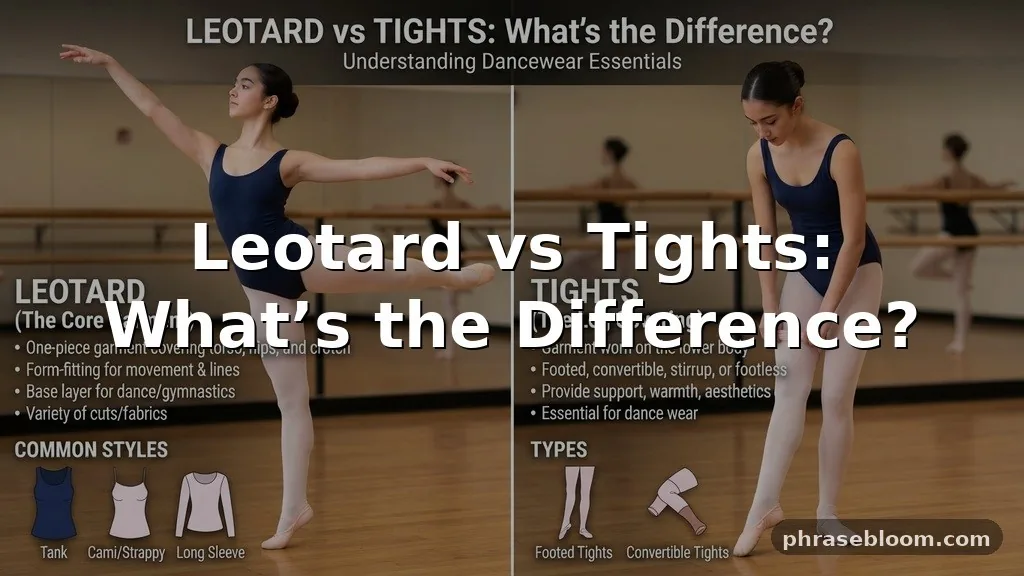
The difference in a leotard vs tights comes down to coverage and purpose. A leotard is a close-fitting one-piece garment that covers the torso, while tights are skin-tight legwear designed to cover some or all of the legs. Dancers, gymnasts, and performers often wear both together.
The right choice depends on the activity, dress code, temperature, and amount of movement involved. Understanding waistbands, gussets, foot coverage, and fabric support will help you choose dancewear that stays comfortable and secure instead of focusing only on appearance.
Leotard vs Tights: The Basic Difference
A leotard covers the body from the shoulders or upper chest down through the hips. It may have thin camisole straps, tank-style shoulder straps, short sleeves, or long sleeves, but its main feature is torso coverage. The garment fastens around the lower body and stays close to the skin during movement.
Tights primarily cover the legs. Depending on the design, they may stop at the ankles, cover the feet, or leave an opening under the arch of the foot. Unlike a leotard, a standard pair of tights does not provide a complete upper-body garment.
| Item | Spelling | Coverage | Typical use | Practical recommendation |
|---|---|---|---|---|
| Leotard | One word | Torso and hips | Dance, gymnastics, theater, acrobatics | Choose it when secure torso coverage is needed |
| Tights | One word | Legs, with styles varying by foot coverage | Ballet, dance, costumes, layering | Choose the style that matches the required foot and leg coverage |
| Leotard and tights | Two separate garments | Torso plus legs | Classes, rehearsals, performances, training | Often the most complete dancewear combination |
| Unitard | One word | Torso and legs in one piece | Dance, stage work, athletic performance | Useful when a single garment must cover the entire body |
In practical terms, a leotard is usually the foundation layer, while tights are a leg-covering layer worn underneath, over, or alongside it. A ballet student might wear a camisole leotard with pink ballet tights, while a gymnast might wear a competition leotard without tights.
There is no universal rule that says one garment is better. A leotard provides a clean line and prevents a shirt from riding up, whereas tights provide warmth, modesty, visual uniformity, or protection for the legs.
What Is a Leotard?
A leotard is a one-piece garment with a close fit through the torso, waist, and hips. It is named after Jules Léotard, a nineteenth-century French acrobat, although modern leotards are made in many styles for dance, gymnastics, circus performance, fitness, and stage work.
The lower section resembles a brief or swimsuit bottom. This design leaves the legs mostly uncovered, which allows an instructor, coach, or performer to see the alignment of the hips, knees, and legs. It also prevents loose fabric from interfering with turns, jumps, balances, or apparatus work.
Common leotard styles
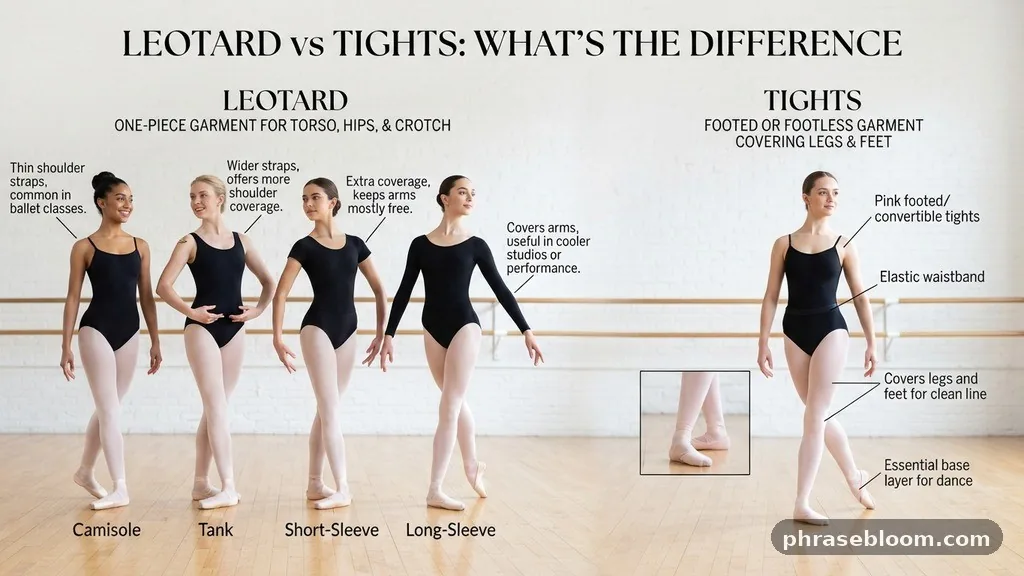
- Camisole leotard: has thin shoulder straps and is common in ballet classes.
- Tank leotard: uses wider straps and offers more shoulder coverage.
- Short-sleeve leotard: provides extra coverage while keeping the arms mostly free.
- Long-sleeve leotard: covers the arms and may be useful in cooler studios or performance settings.
- Mock-neck or high-neck leotard: covers more of the chest and neck area.
- Back-cutout leotard: uses an open-back design for visual detail or ventilation.
These styles can look quite different, but they serve the same basic purpose: keeping the torso covered while allowing unrestricted movement. A leotard may be made from cotton, nylon, polyester, elastane, or a blend that combines stretch with shape retention.
Fit matters more than decoration. The shoulder straps should not dig into the skin, the torso should not pull tightly across the chest or hips, and the leg openings should lie flat without cutting into the body.
What Are Tights?
Tights are close-fitting garments that cover the legs from the waist toward the feet. Dance tights are usually more durable and opaque than everyday fashion tights because they must withstand repeated stretching, washing, floor contact, and vigorous movement.
Some tights are made from a single layer of nylon and elastane, while others use thicker materials for warmth or coverage. Ballet tights may be pink, black, white, or a shade selected to match a school’s uniform or a production’s costume design.
Footed, footless, and convertible tights
Footed tights cover the entire foot, including the toes and heel. They create a continuous line from the leg to the foot and are widely used with ballet slippers, character shoes, and theatrical costumes.
Footless tights stop at the ankle, leaving the foot exposed. They can be practical for modern dance, jazz, conditioning, or classes where dancers need direct contact with the floor.
Convertible tights have an opening under the arch of the foot. The dancer can wear them as footed tights or pull the lower section over the heel to expose the foot without removing the garment.
The choice of tights affects more than appearance. Footed tights offer warmth and a uniform line, footless tights make bare feet accessible, and convertible tights provide flexibility between different class activities.
Some tights also include a gusset, which is a small fabric panel sewn into the crotch. A gusset can improve comfort, reinforce a high-stress area, and allow greater freedom of movement.
Why Dancers Often Wear Both
The classic dance outfit combines a leotard with tights because each garment solves a different practical problem. The leotard keeps the torso secure and visible, while the tights provide leg coverage and help create a consistent silhouette across a class or ensemble.
This combination is especially common in ballet attire. Instructors need to see posture, pelvic alignment, and leg placement, while students may need coverage during warmups or in a cool studio.
Layering also makes the outfit adaptable. A dancer might wear a leotard and tights with a wrap skirt during barre work, remove the skirt for center exercises, and add warm-up pants before or after class.
Benefits of the combination
- Secure fit: the leotard stays tucked in during jumps, stretches, and floor exercises.
- Clear body lines: instructors can observe alignment more easily than they can through loose clothing.
- Flexible coverage: tights add warmth or modesty without restricting the torso.
- Easy layering: warm-up garments can be added or removed as the body temperature changes.
- Uniform appearance: matching colors help a class or performance group look coordinated.
The exact combination varies by school and activity. Some studios require a specific leotard color for each level, while others allow dancers to choose any appropriate leotard and tights.
For a useful reference on ballet clothing, class expectations, and dance training terminology, consult the Royal Academy of Dance. Individual schools may set different rules, so their written dress code remains the final authority.
Leotard vs Tights in Ballet and Dance
In ballet, a leotard is usually worn as the main garment because it makes the dancer’s torso and hips visible. Tights are added according to the studio’s requirements, the dancer’s age, the temperature, or the desired stage appearance.
Many ballet schools prefer a fitted leotard because loose shirts can hide the back, waist, and shoulder position. Tights may be worn over the leotard, under it, or with a skirt, depending on the dress code and the style of training.
Dance tights also help protect the skin during floorwork and reduce the distraction of exposed legs in group rehearsals. They are not always mandatory, however, particularly in modern dance, contemporary dance, or classes that emphasize bare-foot movement.
Examples in dance settings
Classical ballet: a dancer may wear a tank leotard, pink ballet tights, and ballet slippers. The fitted outfit makes leg lines and posture easy to assess.
Contemporary dance: a dancer may choose a long-sleeve leotard with footless tights or leggings. The extra coverage can support warm-up work while still allowing the feet to remain uncovered.
Jazz dance: a camisole leotard may be paired with black dance tights. The outfit provides a clean line for traveling steps and turns.
Performance: costume requirements may call for skin-tone tights, colored tights, or no tights at all. Stage lighting and choreography often determine the final choice.
The garment should support the movement rather than compete with it. Seams, loose straps, slipping waistbands, and transparent fabric can become distracting during class or performance.
Leotards in Gymnastics and Other Activities
Gymnastics clothing has different demands from everyday dancewear. A gymnastics leotard must stay secure through inversions, rolls, swings, and rapid changes in body position, so fit and construction are especially important.
Gymnastics leotards often use metallic fabric, mesh panels, printed designs, or long sleeves for competition. Training leotards may be simpler, but they still need strong seams and leg openings that remain in place during movement.
Tights are less central to gymnastics than to ballet. Gymnasts may wear them during warmups, outdoor training, or certain performances, but competitive routines commonly use a leotard alone or with approved warm-up clothing.
Other activities use the leotard in different ways. Acrobats, aerial performers, figure skaters, and stage artists may select a leotard because it reduces loose fabric and shows the body’s shape during movement.
Choosing for active movement
- Check that the leg openings remain flat during deep bends and splits.
- Test the neckline and shoulder straps with arms overhead.
- Look for fabric that stretches in several directions without becoming transparent.
- Inspect the seams, especially around the gusset and leg openings.
- Choose tights with a waistband that stays in place without excessive pressure.
For children, buying a much larger size is usually not a good solution. Excess fabric can bunch, straps can fall, and the garment may become uncomfortable or unsafe during movement.
For adults, the same principle applies. A correct fit should feel close without restricting breathing, pressing painfully at the hips, or pulling the fabric into the shoulders.
How Coverage and Construction Affect Comfort
The main contrast in a leotard vs tights comparison is torso coverage versus leg coverage, but construction determines whether either garment feels good in use. Two items made from similar fabric can behave very differently because of their cut, seams, waistband, and lining.
A leotard should sit smoothly across the torso. If the fabric pulls horizontally across the chest or creates tension at the crotch, the garment may be too short in the body. If the back sags or the straps fall, it may be too large or shaped incorrectly for the wearer.
Tights should fit evenly from the waist to the ankles or feet. A waistband that rolls down can be irritating, while a waistband that is too tight may leave pressure marks and distract the dancer during class.
Important fit details
Waistband: The waistband should remain stable while allowing comfortable bending and stretching. Wide waistbands often distribute pressure more evenly than narrow elastic.
Gusset: A gusset can reduce strain in the crotch and improve range of motion. It also helps reinforce an area that receives repeated stretching.
Leg openings: On a leotard, they should not ride up excessively or cut into the hips. On tights, the lower section should stay smooth without twisting around the ankle.
Fabric opacity: Stretching can make fabric appear thinner. Test the garment in a deep plié, squat, or lunge before relying on it for class or performance.
Closures: Some leotards have a snap closure at the gusset, while others are pull-on designs. A closure may be convenient, but it should not press uncomfortably during floorwork.
Comfort is not separate from performance. A dancer who is constantly adjusting a waistband or pulling up a shoulder strap cannot give full attention to technique.
Real-Sentence Examples for Leotards and Tights
Professional and everyday writing often needs a precise description of clothing requirements. The following examples show how leotard and tights language works in realistic contexts.
Company or studio policy: “Students must wear a black leotard and pink tights for the Thursday ballet class.” This sentence names the two garments separately and makes the required colors clear.
Employee or student announcement: “Please bring a clean leotard and convertible tights to the workshop.” The wording is direct and useful for a schedule or reminder.
Training instructions: “Footless tights are recommended for the floorwork section.” This works because the instruction identifies a specific tights style that leaves the feet available.
Workplace or production email: “The costume team has ordered long-sleeve leotards for the winter performance.” The plural form is natural because the email refers to several garments.
Internal communication: “Dancers may wear a warm-up layer over their leotards during the first fifteen minutes.” The sentence gives a practical instruction without confusing the base garment with the outer layer.
Business report: “The survey found that performers preferred convertible tights because they could switch between covered and bare feet.” The sentence explains a preference and links it to a concrete feature.
Organizational or schedule change: “The revised dress code permits black tights with any approved tank leotard.” This is suitable for a handbook or formal policy because it states the permitted combination precisely.
Marketing copy: “Our new ballet tights use a soft waistband and a flexible gusset for extended rehearsals.” The sentence highlights features that matter to the customer without making an unsupported performance claim.
Technology or software rollout analogy in a training document: “The costume inventory system now records whether each item is a leotard, footed tight, or unitard.” This example uses the terms as clear inventory categories.
Company meeting or planning note: “The production meeting will confirm the color of the tights before final costume orders are placed.” This sentence sounds natural in a project update.
Benefits or care announcement: “The studio will provide a laundry guide for leotards and dance tights before the summer intensive.” The wording makes the scope of the guide obvious.
These examples work because each garment is named according to its actual function. A leotard is not used as a synonym for tights, and tights are not described as though they cover the torso.
How to Choose the Right Garment
Start with the activity’s movement requirements and dress code. A beginner ballet class may need a leotard and ballet tights, while a contemporary workshop may allow fitted tops, leggings, or bare feet.
Next, consider the desired coverage. A long-sleeve leotard covers the arms, but it does not replace tights if the legs also need coverage. Footed tights cover the feet, while footless tights may be better for work that requires direct contact with the floor.
Temperature also matters. Tights can provide warmth in a cold studio, and a long-sleeve leotard can add coverage without requiring a loose sweatshirt. In hot conditions, a camisole leotard and minimal leg coverage may feel more comfortable.
A practical selection checklist
- Read the studio, team, or production dress code before buying.
- Choose a leotard style that gives the required shoulder, chest, and arm coverage.
- Select footed, footless, or convertible tights according to the activity.
- Check the waistband, gusset, seams, and leg openings for comfort.
- Perform a few deep bends and arm movements to test the fit.
- Confirm that the fabric remains opaque when stretched.
- Choose colors that match the class uniform or costume plan.
It is also useful to think about laundering. Dancewear is washed frequently, so a garment that needs delicate handling may be less practical for intensive training than one designed for regular machine washing.
Keep a spare pair of tights if you perform or attend long training days. Tights can snag, ladder, or lose their shape, and replacing them quickly is easier when the correct color and size are already available.
Common Confusions About Leotards and Tights
People sometimes use “leotard” and “tights” interchangeably because both are associated with dance and performance. They are not the same item, however, and a dress code that requires one may not be satisfied by the other.
A leotard is not simply a top. Its lower section extends between the legs and anchors the garment, which keeps it from riding up like a regular shirt. Tights, by contrast, are legwear that generally begins at the waist and does not provide complete torso support.
Another common confusion involves leggings. Leggings cover the legs but usually stop at the ankles and have a separate waistband, so they are not automatically equivalent to dance tights. They may also use thicker fabric and a different fit.
Frequent mistakes and corrections
Mistake: “The dancers wore tights as their one-piece costume.” Correction: “The dancers wore leotards as their one-piece costumes and tights for leg coverage.” The correction distinguishes the torso garment from the legwear.
Mistake: Assuming all tights cover the feet. Correction: Specify footed, footless, or convertible tights. The type changes how the garment works with shoes and floorwork.
Mistake: Calling every fitted dance outfit a leotard. Correction: Use unitard when one garment covers both the torso and the legs. Use catsuit or another specific term if the design requires it.
Mistake: Ignoring the difference between dance tights and fashion tights. Correction: Check the fabric, opacity, durability, and construction required for the activity.
Clear vocabulary helps instructors, costume teams, retailers, and performers avoid preventable misunderstandings. The best term is the one that describes the garment’s actual construction.
Alternatives to Wearing a Leotard and Tights
A leotard and tights are traditional, but they are not the only possible combination. Modern dancewear includes unitards, catsuits, fitted tops with leggings, bike shorts, warm-up pants, and specialized performance garments.
A unitard combines torso and leg coverage in a single piece. It can be useful when a dancer wants a continuous line without managing a separate waistband or matching two garments.
Leggings with a fitted tank or athletic top may be appropriate for conditioning, adult classes, or studios with relaxed dress codes. They provide more coverage than a traditional leotard and may be easier to wear outside the studio.
For a performance, a costume designer may choose a bodysuit, catsuit, or custom garment instead. These alternatives can include built-in support, decorative panels, mesh, zippers, or specialized fabrics.
Useful wording alternatives
- One-piece dance garment: useful when the exact style is not important.
- Unitard: appropriate for a one-piece garment covering the torso and legs.
- Dance tights: clearer than simply “tights” when the context includes several types of legwear.
- Performance costume: suitable when the garment is part of a complete stage outfit.
- Fitted dancewear: useful as a broad category for tops, leotards, leggings, and tights.
Use the more specific word when the garment’s construction affects the instruction. “Wear dancewear” is broad, while “wear a black tank leotard with convertible tights” gives the reader an actionable requirement.
Care, Fit, and Shopping Advice
Always check the garment’s care label before washing. Elastane can lose its recovery when exposed to excessive heat, and rough surfaces can damage the finish of tights or create snags.
Turn tights inside out or place them in a protective laundry bag when appropriate. Wash leotards according to the fabric instructions, especially if they include metallic foil, mesh, appliqué, or printed designs.
When shopping online, compare the brand’s size chart with actual body measurements rather than relying only on age or a general small, medium, or large label. Torso length is particularly important for leotards, while height and hip measurements often affect tights fit.
Do not size down to achieve a more polished appearance. A garment that is too small may become sheer, pull at the seams, restrict movement, or cause discomfort at the waistband and leg openings.
Do not size up excessively either. Loose fabric can fold under the arms, bunch at the hips, or shift during movement, which defeats the purpose of close-fitting dancewear.
Inspect new tights in bright light before wearing them for a performance. Small snags or uneven areas may become much more visible when the fabric is stretched under stage lighting.
Frequently Asked Questions
What is the main difference between a leotard and tights?
A leotard is a one-piece garment that covers the torso and hips, while tights are close-fitting legwear. They are often worn together, but they serve different functions.
Can I wear tights without a leotard?
Yes. Tights can be worn with a fitted dance top, bodysuit, dress, skirt, or other garment if the dress code allows it. In ballet classes, however, a leotard may be required for posture and alignment checks.
Are ballet tights different from ordinary tights?
Often, yes. Ballet tights are designed for movement and may offer greater durability, stretch, opacity, and specific foot coverage. Fashion tights may not provide the same support or resistance to repeated training.
What should I wear for gymnastics?
A gymnastics leotard is the usual choice because it stays secure during inversions, rolls, and apparatus work. Tights may be used for warmups or particular performances, but the team or coach’s dress code should guide the final choice.
Are convertible tights better than footed tights?
Neither is universally better. Convertible tights are more flexible because they can expose the feet, while footed tights provide continuous coverage and a consistent line. Choose based on the class, footwear, and required floor contact.
Conclusion
The clearest way to understand leotard vs tights is to separate torso coverage from leg coverage. A leotard is a secure one-piece garment for the upper and lower torso, while tights cover the legs in footed, footless, or convertible designs.
Choose the garment required by the activity, then check fit, fabric, waistband, gusset, and foot coverage before buying. With the right combination, your dancewear or gymnastics clothing will support movement, meet the dress code, and remain comfortable through class, rehearsal, or performance.
Related reading: Unselect vs Deselect, Hassle vs Hastle, Continuous vs Continous.