
In vs within is usually a question of emphasis, not a completely different meaning. Both prepositions can describe a location, period, limit, or condition, but in is the ordinary choice for most everyday sentences, while within often highlights boundaries, a time limit, or the idea of staying inside a defined range.
The difference becomes clearer when you compare phrases such as “in the office” and “within the office,” or “in two hours” and “within two hours.” The first form often gives a general setting or expected point in time; the second stresses an enclosed area, an interval, or a deadline. The right choice depends on grammatical context, meaning, and the level of formality you want.
The Main Difference Between In and Within
In is the more common and flexible preposition. It can refer to a physical location, a general area, a period of time, a situation, or a condition: “She is in the room,” “The report arrived in May,” and “He is in trouble.”
Within also indicates being inside something, but it tends to draw attention to the limits surrounding that thing. It can mean inside a physical space, inside a particular group, or before a specified time limit: “The records are within the archive,” “The decision was made within the committee,” and “Please reply within five business days.”
In many sentences, either word may be grammatically possible, but the result will not always sound equally natural. “The manager is in the building” is a normal location statement, while “The manager is within the building” sounds more formal and places extra emphasis on the building’s physical boundaries.
A useful rule of thumb is simple: use in for ordinary location and time expressions, and consider within when you need to emphasize an internal boundary, a limited range, or a deadline. This is not an absolute rule. Context still controls the final choice.
| Expression | Typical meaning | Natural example | Style and emphasis |
|---|---|---|---|
| in | Inside, during, or as part of | The files are in the cabinet. | Common and conversational |
| within | Inside a boundary or before a limit | Submit the files within five days. | More precise or formal in many contexts |
| in two hours | After two hours have passed | The train will arrive in two hours. | Focuses on elapsed time |
| within two hours | At any point before two hours have passed | Please respond within two hours. | Focuses on a time limit |
What In Means in English Grammar
In is one of the most widely used prepositions in English. It commonly describes an enclosed space, such as a room, box, vehicle, building, or city: “The keys are in the drawer,” “They live in Chicago,” and “The passengers are in the train.”
The word can also describe participation in a situation or group. Someone may be “in a meeting,” “in a partnership,” “in the marketing department,” or “in the discussion.” Here, in does not always refer to a literal physical space. It presents the person or thing as part of an activity, structure, or circumstance.
In is also central to time expressions. We use it with months, years, seasons, and longer periods: “The project began in January,” “She graduated in 2022,” and “Sales usually increase in the summer.” It can also show how much time will pass before something happens, as in “The next update will arrive in ten minutes.”
That last example has an important meaning. “The update will arrive in ten minutes” normally means the event is expected after ten minutes have passed. It does not necessarily mean the update may arrive at any point before the ten-minute period ends.
In for location

For location expressions, in usually presents something as being inside a place without drawing special attention to the place’s edges. “The visitors are in the museum” simply tells us where they are. It does not suggest that the speaker is measuring the museum’s physical boundaries.
In can also refer to broad geographical areas. We say “in Canada,” “in the northern region,” and “in the city center.” The expression identifies a location, while the exact borders may be unimportant to the sentence.
In for time
In has several time-related uses, so readers should examine the surrounding verb. “The contract was signed in March” identifies the month during which the action happened. “The contract will be signed in three days” places the expected action three days from now.
These uses are different from the deadline meaning of within. If a supervisor says, “Send the invoice in three days,” the instruction may suggest that the invoice should be sent after three days. If the supervisor says, “Send the invoice within three days,” the invoice can be sent anytime before the three-day limit expires.
What Within Means and Why It Sounds More Precise
Within is a preposition that means inside a defined area, group, range, or period. It often makes the boundaries more visible than in does. For example, “The error occurred within the system” suggests that the error arose somewhere inside the system’s structure or operating limits.
The word is especially useful in formal English because it can express limits clearly. Policies, contracts, procedures, and professional instructions frequently use phrases such as “within seven calendar days,” “within the approved budget,” and “within the service area.”
Within may refer to physical boundaries. “The equipment must remain within the marked zone” tells people not to cross a visible or defined limit. “The bird remained within the enclosure” similarly emphasizes containment rather than merely describing a location.
It can also refer to organizational or conceptual boundaries. A proposal may be reviewed “within the department,” a dispute may be resolved “within the existing framework,” and a decision may be made “within the authority granted by the board.” These examples do not necessarily describe a physical space.
Within as a time expression
Within is particularly important when a sentence involves a time limit. “Please complete the form within ten days” means the form should be completed no later than the end of that ten-day period. The action may happen on the first day, the fifth day, or the final day, depending on the applicable deadline.
This meaning differs from “complete the form in ten days,” which can suggest that the action is expected after ten days. In casual speech, some people use the two forms loosely, but formal writing benefits from preserving the distinction.
For contracts and workplace instructions, within is often the safer word because it reduces uncertainty about timing. If the writer means “at any time before the limit,” within states that intention directly.
Within as an adverb
Within can also appear without an object when the meaning is already clear. In “The service is available nationwide, but not within,” the sentence would normally need more context, because within usually works best with a stated or understood boundary. As an adverb, it is more common in expressions such as “The answer lies within” or “The team worked from within.”
In business writing, the adverbial form often appears in phrases such as “The change was implemented companywide” or “The rule applies within.” The second example usually requires a complement, such as “within the department” or “within the stated limits,” to be complete and precise.
In vs Within for Time and Deadlines
Time expressions are where the difference between in and within matters most. Both words can occur with periods such as an hour, a week, or a year, but they frame the period differently. In often points to when something will happen, while within defines the latest acceptable point for an action.
Compare these sentences: “The technician will arrive in two hours” and “The technician will arrive within two hours.” The first usually predicts arrival after two hours. The second promises arrival no later than two hours from the relevant starting point.
That contrast is useful in customer service, project management, and formal instructions. A support team might write, “We will contact you within one business day,” because contact could occur at any time before the deadline. A calendar reminder might say, “The meeting starts in one hour,” because it identifies the time remaining before the event.
- Use in to describe a future point after a period has passed: “The review will begin in three weeks.”
- Use within to state a maximum period: “Please submit comments within three weeks.”
- Use within in policies when the exact day may vary but the final deadline must be clear.
- Check the starting point because “within five days” requires a clear understanding of when the five-day period begins.
- Specify business or calendar days if the timing has legal, financial, or operational consequences.
Within does not always indicate an urgent deadline. It can describe a broad interval: “The symptoms usually improve within a week.” The sentence means improvement is expected before one week has passed, although it does not promise an exact day.
In can also describe duration in a different structure. “The team completed the audit in four days” usually means the work took four days. “The team completed the audit within four days” emphasizes that four days was the maximum period allowed or expected.
In vs Within for Location and Physical Boundaries
For physical location, in is usually the natural everyday choice. “The documents are in the folder,” “The children are in the yard,” and “There is water in the bottle” all sound direct and ordinary. Each sentence identifies an enclosed space or general area.
Within becomes useful when the boundary itself matters. “The documents are within the secure folder” could be appropriate in a technical or procedural context because it emphasizes that the documents remain inside a defined system. “The hikers stayed within the park” highlights the park’s boundary and the instruction not to leave it.
The choice can change the tone without changing the basic location. “The device is in the building” is neutral. “The device is within the building” sounds more formal and may be used to distinguish the building from its surrounding grounds or external network.
Enclosed space and general area
In usually works well for an enclosed space that people recognize as a normal location. We say “in the office,” not “within the office,” unless the sentence has a special reason to stress internal boundaries. The shorter form is generally better for everyday workplace communication.
Within is more natural when the location has an explicit perimeter or operating range. Examples include “within the safety zone,” “within the city limits,” “within the fenced area,” and “within the designated region.” Here, the phrase tells the reader that crossing the boundary would change the meaning or violate a condition.
Abstract boundaries
Physical boundaries are not required. A company may operate “within the law,” a project may stay “within budget,” and a researcher may work “within the scope of the study.” These expressions show that within can mark abstract limits involving authority, money, rules, or subject matter.
Using in instead would sometimes sound less precise. “The project is in budget” is not the standard expression in most professional contexts. “The project is within budget” clearly means that spending has not exceeded the approved financial limit.
Grammar, Position, and Sentence Examples
Both in and within can function as prepositions, meaning they introduce a noun or noun phrase. In “The report is in the folder,” the preposition in is followed by the noun phrase “the folder.” In “The report is within the approved file,” within performs the same broad grammatical role, although the meaning emphasizes a boundary.
Placement affects interpretation. A preposition usually appears before its object, while an adverbial phrase can describe how or where an action occurs. “The team worked within the deadline” is understandable but less natural than “The team completed the work within the deadline” or “The team worked within the allotted time.”
English grammar allows both words in many contexts, but usage rules are shaped by meaning and collocation. A phrase may be grammatically possible yet sound unusual because native speakers normally use a different preposition with that noun.
| Sentence | Function | What it emphasizes |
|---|---|---|
| The files are in the cabinet. | Location expression | General interior location |
| The files are within the locked cabinet. | Location expression | Containment inside a defined object |
| The call starts in ten minutes. | Future time expression | Expected point after ten minutes |
| Please join the call within ten minutes. | Deadline expression | Maximum permitted interval |
| The policy is within the manager’s authority. | Abstract boundary | Scope of permitted power |
Predicate use after a verb
Company-wide can appear after a linking verb in “The policy is company-wide.” Here, company-wide is a predicate adjective. It describes the policy rather than directly preceding the noun as a compound modifier.
Similar examples include “The training is company-wide,” “The change was company-wide,” and “The response must be company-wide.” The hyphenated form remains clear in these sentences, and many style systems retain it because the expression functions as a single adjective.
Adverbial placement may produce a slightly different pattern: “The new system was introduced companywide” or “The new system was introduced company-wide.” Both forms may be encountered, depending on house style and dictionary preference. The writer should choose one accepted form and apply it consistently.
Practical sentence tests
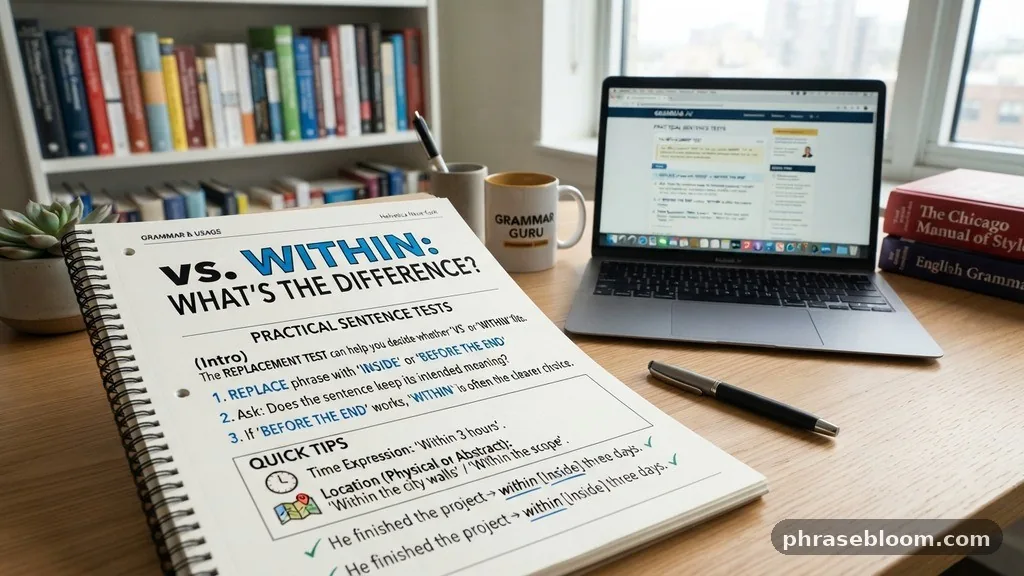
The replacement test can help you decide whether in or within fits. Replace the phrase with “inside” or “before the end of,” then ask whether the sentence keeps its intended meaning. If “before the end of” works, within is often the clearer choice for a time expression.
For location, ask whether the physical or abstract boundary matters. “In the department” presents membership or location; “within the department” highlights the department as the limit inside which an action occurs.
Formal English, Everyday English, and Style
In everyday English, in is usually more natural. People say “I’ll be in the office,” “The information is in the report,” and “We’ll finish in an hour.” Within can sound more deliberate, especially when no actual boundary or deadline is important.
Formal English uses within more often because professional documents frequently define limits. A policy may require employees to report an incident “within 24 hours.” A contract may state that notice must be delivered “within the period specified in the agreement.”
This does not make within automatically more professional in every sentence. “The director is within the office” may sound stiff when “The director is in the office” communicates the point more naturally. Good formal writing is precise, but it should not replace familiar wording without a reason.
Audience matters as well. A customer-facing website may benefit from “You’ll receive a reply within two business days,” which is clear and reassuring. An internal note might say, “We’ll reply in two days,” if the writer means the response is expected after that period.
Before making a final choice, check the relevant style guide or organizational standard. Large organizations may maintain a house style covering spelling, punctuation, capitalization, and preferred terms. Consistency within a document is often more valuable than defending one form as universally superior.
Common Mistakes with In and Within
Confusing a deadline with a future point
“The payment is due in five days” and “The payment is due within five days” can be interpreted differently. The first may identify the expected due point, while the second clearly sets a final limit. In financial or legal writing, state the deadline directly if timing could be disputed.
Using within with no meaningful boundary
Some writers choose within because they think it always sounds more formal. That can create awkward sentences such as “The manager is within the office” when the intended meaning is simply that the manager is there. Use the more ordinary in unless the internal boundary matters.
Ignoring established collocations
English has conventional combinations. We normally say “in danger,” “in control,” and “in progress,” not “within danger” or “within progress.” Within is appropriate in expressions such as “within reach,” “within limits,” “within reason,” and “within walking distance.”
Making the sentence technically possible but unclear
“The team will finish in the next week” may be understood, but “The team will finish within the next week” is clearer if the work may be completed at any point during that interval. A small preposition can change the reader’s understanding of timing.
Overlooking the starting point
“Within three days” is incomplete in some formal contexts if readers do not know when the period begins. A policy should say “within three days of receiving the request” or “within three calendar days after approval.” That wording removes a practical ambiguity that changing the preposition alone cannot solve.
Alternatives to In and Within
Sometimes the best solution is to rewrite the sentence. Alternatives can make the meaning more direct and avoid a delicate distinction between a general location and a defined boundary.
- Inside is useful for a clear physical location: “The tools are inside the cabinet.”
- Before the end of makes a deadline explicit: “Reply before the end of five business days.”
- During identifies a period rather than a maximum limit: “The issue arose during the review.”
- Throughout emphasizes coverage across an entire place or period: “The policy applies throughout the organization.”
- Across the company is natural for announcements, initiatives, and changes: “The update will be introduced across the company.”
- Under can express a limit in certain contexts: “The expense remains under the approved amount.”
- By often gives a clear deadline: “Submit the form by Friday.”
“Within the company” and “across the company” are not always interchangeable. Within may emphasize internal activity or boundaries, while across suggests distribution from one part of the organization to another. “The issue was discussed within the company” differs slightly from “The message was shared across the company.”
For time, “by Friday” may be more immediately understandable than “within the week ending Friday.” For physical location, “inside the marked area” may be clearer than “within the marked area” for a general audience.
How to Choose the Right Form in Professional Writing
Start with the intended relationship. If you are naming a normal location, use in: “The files are in the shared drive.” If you are defining a limit, use within: “The files must remain within the approved storage area.”
Next, check whether the sentence refers to an expected point or a maximum interval. “The review begins in two weeks” gives a predicted starting time. “Complete the review within two weeks” gives a deadline.
Then consider your audience and document type. A contract, safety procedure, employee handbook, or service-level commitment should favor wording that leaves little room for interpretation. An informal email can use ordinary phrasing when the timing or boundary is already obvious.
Finally, look for consistency. Do not write “within 30 days” in one section and “in 30 days” in another if both are meant to express the same deadline. If the meanings differ, make that difference visible through a complete sentence rather than relying on the reader to infer it.
Recommended workflow
- Identify whether the phrase expresses location, time, membership, scope, or a limit.
- Decide whether the reader needs a general setting or a defined boundary.
- Use in for ordinary location and expected future timing unless the context calls for more precision.
- Use within for a maximum interval, internal scope, or physical or abstract boundary.
- Read the complete sentence aloud and check whether the meaning is immediately clear.
- Apply your employer’s, publisher’s, or institution’s style guide consistently.
For additional guidance on prepositions and time expressions, consult a reputable reference such as the Cambridge Dictionary explanation of prepositions and prepositional phrases. A reference can confirm the general grammar, but your sentence’s meaning still determines the most natural choice.
Examples You Can Copy and Adapt
These examples show how grammatical context affects the choice. They are not mechanical rules, because several sentences could be rewritten in more than one acceptable way.
- The signed agreement is in the client’s folder.
- Please return the signed agreement within five business days.
- The new benefits plan will be explained in the employee meeting.
- The benefits change applies throughout the organization.
- All staff must remain within the designated training area.
- The software update will be installed in two hours.
- The software update will be completed within two hours of approval.
- The issue was discussed within the finance department.
- The announcement was distributed across the company.
- The director is in the conference room.
- The director’s authority is limited to decisions within the approved budget.
- The policy is company-wide and applies to every regional office.
Notice the difference between “in the meeting” and “within the department.” The first refers to participation in an event. The second presents the department as the organizational boundary in which discussion or action occurs.
Likewise, “in two hours” and “within two hours” should not be treated as interchangeable in a service promise. If customers may receive a response at any point before the two-hour mark, within gives them the clearer expectation.
Frequently Asked Questions
What is the difference between in and within?
In is the general preposition for location, time, participation, and condition. Within emphasizes being inside a defined boundary or completing something before a stated time limit. The correct choice depends on the sentence’s grammatical context and intended meaning.
Does within always mean before a deadline?
No. Within can describe physical or abstract boundaries, as in “within the city limits” or “within the approved scope.” With a time expression, however, it commonly means at any point before the stated period ends.
Is “in two hours” the same as “within two hours”?
Not usually. “In two hours” generally points to a future time after two hours have passed. “Within two hours” sets a maximum interval, so the event can happen anytime before the two-hour limit.
Is within more formal than in?
Within often appears more frequently in formal policies, contracts, and procedures because it expresses limits precisely. It is not automatically better, though. For ordinary location statements, in is usually more natural and clearer.
What is a good alternative to within?
Choose an alternative based on the meaning. Use “inside” for a physical space, “by” or “before the end of” for a deadline, “throughout” for coverage across a period or area, and “across the organization” for broad organizational distribution.
Conclusion
The practical difference between in vs within is mainly one of scope and emphasis. Use in for ordinary locations, participation, and expected future timing. Use within when you mean inside a defined boundary or no later than the end of a stated interval.
For clear writing, test the sentence against its intended meaning, especially when a deadline or physical limit is involved. If you’re writing for work, follow the applicable style guide and use the same pattern consistently throughout the document. A precise preposition can prevent a surprisingly large misunderstanding.
Explore more on PhraseBloom.