
<meta name=”description” content=”Pajamas vs pyjamas explained: discover the spelling, pronunciation, regional differences, origin, and best usage in English.”>
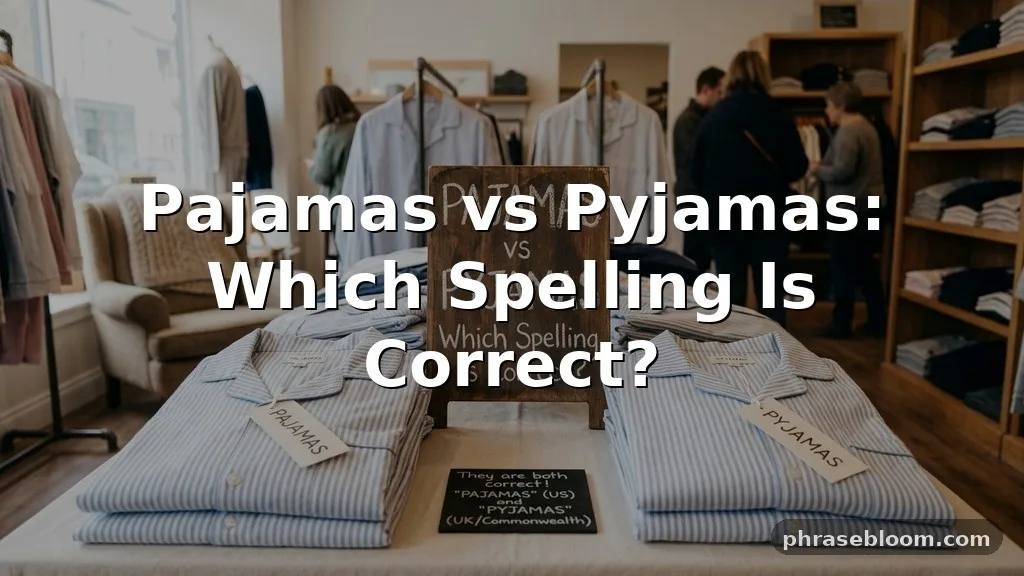
The difference in pajamas vs pyjamas is mainly regional spelling, not meaning. Pajamas is the standard form in American English, while pyjamas is preferred in British English and commonly used in Australian, New Zealand, and other varieties influenced by British spelling.
Both words describe clothing worn for sleeping or relaxing at home. The spelling you choose should match your audience, publication style, or location. Understanding the history behind the two forms also makes it easier to use the right word in emails, product descriptions, schoolwork, and everyday writing.
What Is the Difference Between Pajamas and Pyjamas?
Pajamas and pyjamas have the same dictionary definition. They refer to loose clothing worn while sleeping, usually consisting of a top and trousers or shorts. In some contexts, the word can also describe comfortable nightwear worn around the house.
The difference is the spelling of the first vowel. American English generally uses pajamas with an “a,” whereas British English generally uses pyjamas with a “y.” The pronunciation is usually very similar, although regional accents may affect the exact vowel sounds.
| Spelling | Main usage | Meaning | Example |
|---|---|---|---|
| pajamas | American English | Sleepwear or nightwear | She bought new pajamas. |
| pyjamas | British English and related varieties | Sleepwear or nightwear | He changed into his pyjamas. |
Neither spelling is automatically more correct in every English-speaking country. A writer in the United States would normally choose pajamas, while a writer in the United Kingdom would normally choose pyjamas. Both forms are established in English.
The same regional pattern appears in related words. American spelling often uses “-ize” where British spelling may use “-ise,” and American English frequently prefers forms such as “color” instead of the British “colour.” Pajamas and pyjamas belong to this broader family of spelling differences.
Pajamas Meaning and Pyjamas Meaning
The word refers to clothing designed for sleep. A traditional pair may include a buttoned shirt and matching trousers, but modern pajamas can also include T-shirts, tank tops, shorts, robes, or soft separates.
In a dictionary definition, pajamas are usually treated as a plural noun. That means writers commonly say “my pajamas are comfortable,” not “my pajamas is comfortable.” The word describes a set of garments, even when the set is understood as one outfit.
In American English, you might write, “These pajamas are made from cotton.” In British English, the equivalent sentence is, “These pyjamas are made from cotton.” The grammar remains the same even though the spelling changes.
- American English: “I packed two pairs of pajamas.”
- British English: “I packed two pairs of pyjamas.”
- General meaning: clothing worn for sleeping or relaxing.
- Related terms: sleepwear, nightwear, loungewear, and bedclothes.
The word can describe clothing for children or adults. A product page might advertise flannel pajamas, silk pyjamas, children’s sleepwear, or lightweight summer nightwear without changing the basic meaning.
There is also a wider, informal use. Someone might say, “I spent the whole morning in my pajamas,” to explain that they stayed home in sleepwear. That sentence does not necessarily mean the person was sleeping; it can simply describe relaxed clothing worn indoors.
Why Does American English Use Pajamas?
The word ultimately comes from a South Asian term associated with loose trousers. English adopted the word during the period of British involvement in India, and the spelling changed as it moved through different languages and writing traditions.
The form pyjamas became established in British English. In the United States, the spelling gradually developed into pajamas, reflecting an American preference for representing the first vowel with “a.” The change did not create a new garment or a new meaning.
American spelling has many examples in which a word differs from its British counterpart without representing a separate concept. “Pajamas” and “pyjamas” work in much the same way as “center” and “centre” or “traveler” and “traveller.”
Historical spelling does not always follow a single logical rule. Words borrowed from other languages may be adapted differently in different English-speaking communities. Pronunciation, printing conventions, dictionaries, and local usage all help shape the forms that become standard.
Readers who want to investigate the word’s history can consult the Merriam-Webster dictionary entry for pajamas. A dictionary can confirm current usage, pronunciation, and related forms, although regional preference still matters when choosing between the American and British spellings.
American, British, Canadian, and Australian Usage
American English overwhelmingly favors pajamas. This is the spelling readers generally expect in the United States, including in retail catalogs, school materials, newspapers, and workplace communication.
British English generally uses pyjamas. The same spelling is common in the United Kingdom and is familiar across many settings that follow British spelling conventions, from children’s books to clothing labels.
Australian English commonly uses pyjamas, as does much writing influenced by British English. The word may appear in product listings, casual messages, formal publications, and national retail advertising.
Canadian English can show influence from both American and British usage. Pajamas is widely recognized and common in Canada, while pyjamas may also appear, especially in contexts shaped by British spelling or individual editorial preferences.
| English variety | Common spelling | Useful note |
|---|---|---|
| American English | pajamas | The normal choice for US audiences. |
| British English | pyjamas | The traditional British spelling. |
| Australian English | pyjamas | British spelling remains common. |
| Canadian English | pajamas or pyjamas | Both may be encountered, depending on style and audience. |
These patterns describe common usage, not strict legal rules. An Australian company targeting American customers may use pajamas in product listings, while a Canadian publisher may select pyjamas to match its house style.
Audience matters more than assumptions about national identity. If a website sells sleepwear internationally, it may use one spelling consistently across all pages or localize the wording for different markets.
How to Use Pajamas or Pyjamas in a Sentence
The word usually functions as a plural noun. It can appear after a possessive, after a determiner such as “these” or “new,” or in a prepositional phrase.
Everyday examples
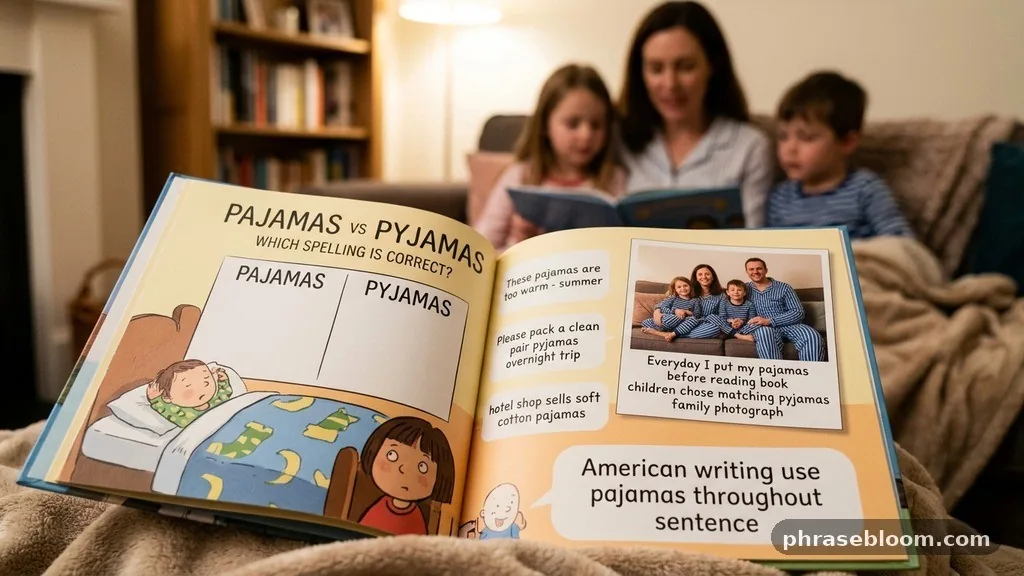
- “I put on my pajamas before reading the book.”
- “The children chose matching pyjamas for the family photograph.”
- “These pajamas are too warm for summer.”
- “Please pack a clean pair of pyjamas for the overnight trip.”
- “The hotel shop sells soft cotton pajamas.”
In American writing, use pajamas throughout the sentence. In British writing, use pyjamas throughout the sentence. The two versions should not be mixed unless you are discussing the spelling difference itself.
The expression “a pair of pajamas” is also standard. It treats the clothing as a pair of garments, much as English speakers say “a pair of trousers” or “a pair of shorts.” In British English, “a pair of pyjamas” follows the same pattern.
Professional and commercial examples
A clothing company might write, “Our lightweight pajamas are designed for warm nights.” A British retailer could use, “Our lightweight pyjamas are designed for warm nights.” Both sentences are clear, but the spelling should match the retailer’s intended market.
A hospital information sheet may say, “Bring comfortable pajamas for your overnight stay.” A British hospital could write, “Bring comfortable pyjamas for your overnight stay.” The choice is regional, not a difference in medical meaning.
Product descriptions should also distinguish between pajamas and related categories. A robe is usually worn over sleepwear, while nightwear can be a broader category that includes pajamas, nightgowns, nightshirts, and other garments.
Pajama Spelling in Formal and Informal Writing
Both spellings are acceptable in formal writing when they match the selected variety of English. The important issue is not that one form is casual and the other is formal. Instead, the decision depends on regional spelling, audience expectations, and the style guide being followed.
An American university paper would normally use pajamas if the word appears in the subject matter. A British academic paper would generally use pyjamas. Neither choice weakens the formality of the paper.
The same principle applies to business writing. An American company memo might announce a “pajama-themed charity event,” while a British company memo might announce a “pyjama-themed charity event.” The event does not change because the spelling changes.
Consistency is especially important in long documents. Changing from pajamas to pyjamas halfway through a product catalog can look like an editing mistake, even when both forms are valid.
Before publication, decide which spelling serves the intended audience. Then check heading, captions, image descriptions, product names, navigation labels, and body text for the same choice.
When brand names are involved
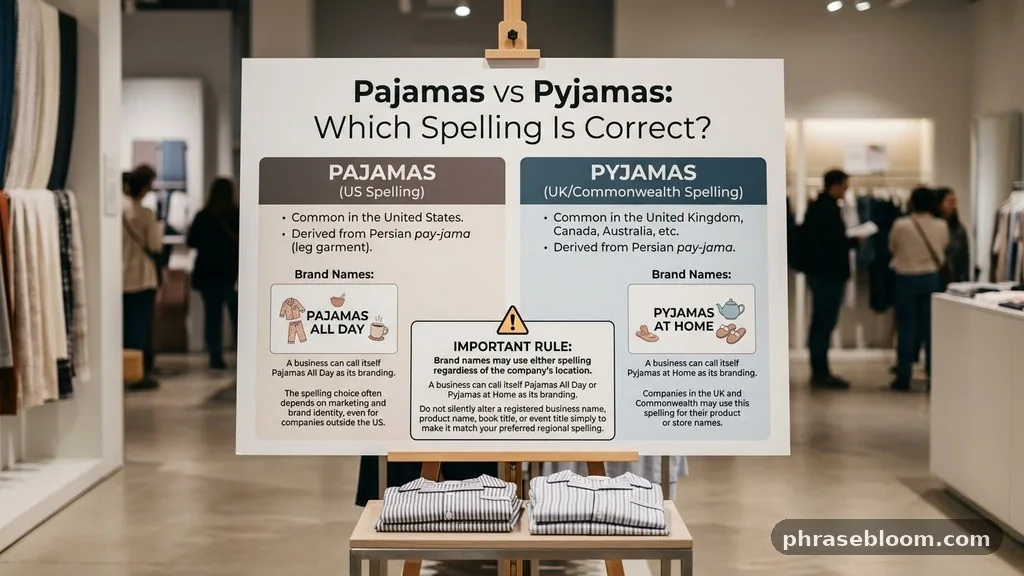
Brand names may use either spelling regardless of the company’s location. A business can call itself “Pajamas for All” or “Pyjamas at Home” as part of its branding.
Do not silently alter a registered business name, product name, book title, or event title simply to make it match your preferred regional spelling. Proper names preserve their official forms.
Outside the official name, ordinary descriptive text can still follow the publication’s preferred spelling. A British article may discuss a company called “American Pajamas” while using pyjamas in its own prose.
Related Words: Sleepwear, Nightwear, and Loungewear
Sleepwear is a broad and useful alternative to pajamas or pyjamas. It can include matching sets, nightgowns, sleep shirts, robes, and other clothing designed for bedtime.
Nightwear is also broad, but it is more strongly associated with British English and international retail language. A British clothing store may organize products under “women’s nightwear,” while an American store may use “women’s sleepwear” or “women’s pajamas.”
Loungewear describes comfortable clothing worn at home, but it does not necessarily imply bedtime. Sweatpants, knit sets, and soft cardigans may be loungewear without being pajamas.
| Term | Typical meaning | Best use |
|---|---|---|
| pajamas | American spelling for sleep clothing | US-focused writing and product descriptions |
| pyjamas | British spelling for sleep clothing | British, Australian, and related usage |
| sleepwear | A broad category of clothing for sleep | International or inclusive product language |
| nightwear | Clothing worn at night | British and international retail contexts |
| loungewear | Comfortable home clothing | Clothing worn for relaxation, not necessarily sleep |
Rewriting can help when an audience includes several English-speaking regions. For example, “The store sells comfortable sleepwear” avoids choosing between pajamas and pyjamas while preserving the general meaning.
That strategy is useful for international websites, software interfaces, travel information, and multilingual content. Still, a specific product may be better described as pajamas or pyjamas if the distinction matters to shoppers.
Common Mistakes With Pajamas and Pyjamas
The most common mistake is treating one spelling as universally correct. Pajamas is not an error in American English, and pyjamas is not an error in British English.
A second mistake is switching between forms without a reason. A document that uses “pajamas” in one paragraph and “pyjamas” in another may appear poorly edited, especially if the audience is clearly tied to one regional variety.
- Inconsistent: “The pajamas are soft, and the matching pyjamas are available in blue.”
- Consistent American English: “The pajamas are soft, and the matching pajamas are available in blue.”
- Consistent British English: “The pyjamas are soft, and the matching pyjamas are available in blue.”
Another error is assuming that sleepwear and pajamas are always exact synonyms. Sleepwear is a wider category, so a product described as sleepwear may be a nightgown, robe, or pajama set.
Writers sometimes also use a singular form incorrectly. “A pajama” usually does not describe a complete set in standard everyday English. Use “a pair of pajamas,” “a pajama top,” or “pajama trousers” when referring to a particular part.
In British usage, the equivalent expressions are “a pair of pyjamas,” “a pyjama top,” and “pyjama trousers.” The singular adjective form appears in compounds such as “pajama party” or “pyjama top.”
How to Choose the Right Spelling
A simple decision process works for most writing. First, identify the audience. If the text is intended primarily for readers in the United States, choose pajamas; if it is intended for readers in the United Kingdom or Australia, choose pyjamas.
Next, check the relevant style guide or house style. A newspaper, university, retailer, or government department may have an established spelling policy that takes priority over personal preference.
Finally, search the whole document for both forms. Consistency is easy to lose when several writers, editors, or translation tools contribute to the same project.
A practical checklist
- Identify the main regional audience.
- Check the organization’s editorial policy.
- Choose pajamas or pyjamas before drafting large amounts of copy.
- Apply the same spelling to headings, captions, and product details.
- Preserve official brand names and titles as written.
- Use sleepwear or nightwear if a broader, region-neutral term is more useful.
For an international audience, either spelling can work if it is used consistently and the surrounding language is clear. Some global brands may use both forms on separate regional websites, but each version should be edited as a coherent local experience.
If there is no formal style requirement, follow the variety of English used in the rest of the document. A text that uses “color,” “organize,” and “center” will usually fit more naturally with pajamas, while a text using “colour,” “organise,” and “centre” will usually fit with pyjamas.
Frequently Asked Questions
Is pajamas or pyjamas correct?
Both are correct regional spellings. Pajamas is standard in American English, while pyjamas is standard in British English and common in Australian English.
Is pajamas the American spelling?
Yes. Pajamas is the usual American spelling for clothing worn while sleeping. It is widely used in American books, websites, product descriptions, and everyday conversation.
Is pyjamas the British spelling?
Yes. Pyjamas is the traditional British spelling and is also common in countries and publications influenced by British English.
Which spelling should I use in formal writing?
Use the spelling that matches your audience and applicable style guide. Formal writing does not require one universal form, but it does require accuracy and consistency.
Are pajamas and pyjamas pronounced differently?
They are generally pronounced in the same way, although accents can produce small differences. The main distinction is written spelling rather than meaning or pronunciation.
Is “a pair of pajamas” correct?
Yes. “A pair of pajamas” is the usual American expression for one set of sleepwear. In British English, write “a pair of pyjamas.”
Can pajamas refer to clothing worn during the day?
Yes, especially in casual speech. A person may say they stayed in their pajamas all morning, even though the clothing was worn for relaxing rather than sleeping.
What is the best alternative to pajamas or pyjamas?
Sleepwear is the clearest broad alternative, especially for international audiences. Nightwear is another option, while loungewear is better when the clothing is intended for relaxing at home rather than sleeping.
Conclusion
The practical answer to pajamas vs pyjamas is simple: use pajamas for American English and pyjamas for British English, Australian English, and similar varieties unless a house style says otherwise. Both spellings describe the same kind of sleepwear, and neither is universally superior.
Choose one form before you begin, apply it consistently, and preserve official names exactly as written. If regional spelling does not matter, sleepwear offers a clear alternative. Once you understand the pattern, Pajamas vs Pyjamas becomes a matter of audience and editorial choice rather than a difficult grammar problem.
You may also like: Separate or Seperate: Which Spelling Is Correct? A Simple Guide · Gluing vs Glueing: Which Spelling Is Correct?
2 thoughts on “Pajamas vs Pyjamas: Which Spelling Is Correct?”