
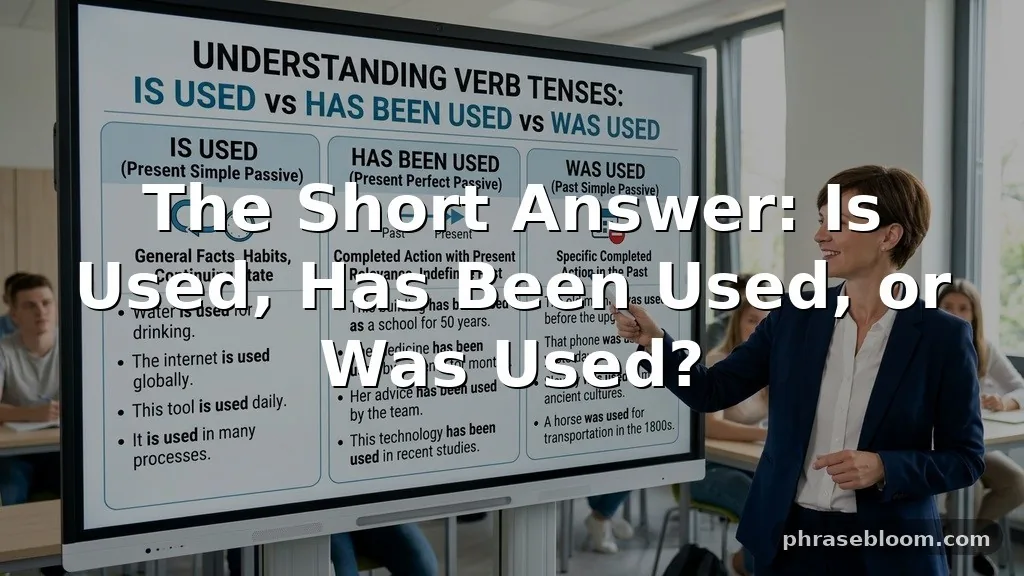
The difference between is used, has been used, and was used comes down to verb tense, grammatical aspect, and time reference. All three expressions use the passive voice, but they place an action in a different relationship to the present.
Is used usually describes a present fact, habitual action, or accepted purpose. Has been used connects a completed or repeated past action to the present, while was used describes a finished action at a specific time in the past. The right choice depends on what happened, when it happened, and whether the result still matters now.
Use is used for something that happens regularly, remains generally true, or describes the present purpose of an object, method, or system.
Use has been used when an action happened before now and has ongoing relevance, an observable result, or an unspecified time. Use was used when the action belongs to a completed past period or occurred at a stated past time.
| Expression | Grammar | Main time meaning | Example |
|---|---|---|---|
| is used | Present simple passive | Present fact or repeated action | This tool is used every day. |
| has been used | Present perfect passive | Past action linked to now | The tool has been used successfully. |
| was used | Past simple passive | Completed past action | The tool was used yesterday. |
The easiest test is to identify the time reference. If the sentence describes a general rule, choose is used.
If it emphasizes experience, results, or a period continuing up to now, choose has been used. If it tells a finished story about the past, choose was used.
These forms are not interchangeable in every sentence. Changing the auxiliary verb changes how the reader understands the action.
What “Is Used” Means
Is used is the present simple passive. It consists of the present-tense form of the be verb, is, followed by the past participle used.
The expression normally describes a current fact, a common practice, or a regular activity. The person or thing performing the action may be unknown, unimportant, or obvious from context.
- This software is used by accounting teams.
- English is used as the main language in the meeting.
- The formula is used to calculate the final score.
- This room is used for staff training every Friday.
In each example, the sentence does not focus on one isolated event. It presents a continuing arrangement, a repeated practice, or a general purpose.
Is Used for General Facts
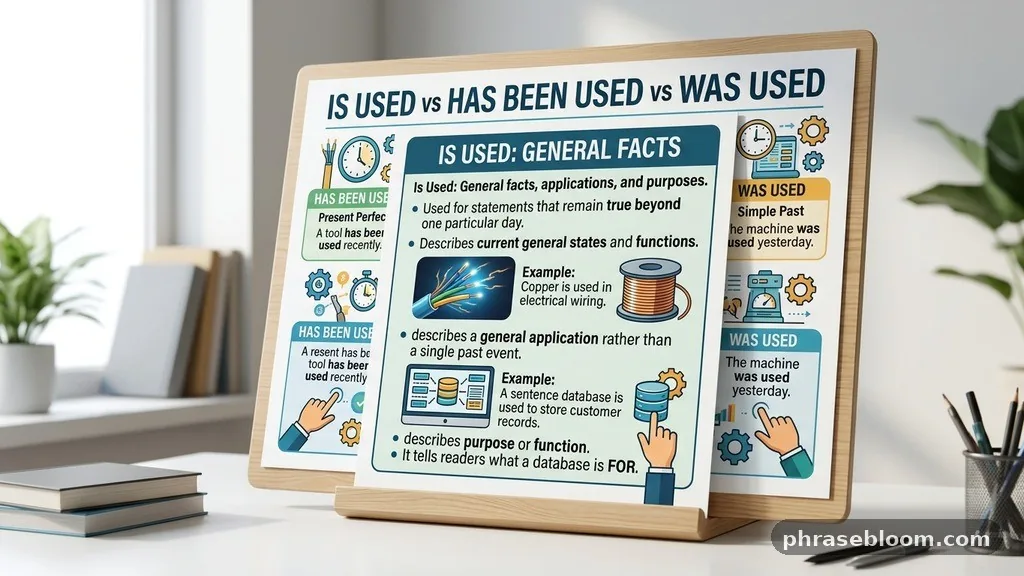
Use is used when the statement would normally remain true beyond one particular day. For example, “Copper is used in electrical wiring” describes a general application rather than a single past event.
The sentence “The database is used to store customer records” also describes purpose. It tells readers what the database does in the present, even if nobody is actively using it at the exact moment of speaking.
This form appears frequently in technical writing, instruction manuals, workplace policies, academic explanations, and product descriptions. It is concise because the writer can emphasize the process or object instead of naming the person who performs the action.
Is Used for Habits and Repeated Actions
The present simple passive can describe a routine. “The conference room is used by the marketing team on Mondays” means that the use happens repeatedly according to a schedule.
Words such as usually, often, every day, and regularly commonly support this meaning. However, the adverb is not always necessary because the present simple itself can show a habitual action.
Compare these two sentences:
- “The equipment is used for safety testing.”
- “The equipment was used for safety testing during last year’s project.”
The first sentence states a current or general purpose. The second places the use inside a completed past project.
What “Has Been Used” Means
Has been used is the present perfect passive. It uses the auxiliary verb has, the past participle been, and the past participle used.
This structure refers to an action that occurred before now but remains connected to the present. The exact time may be unknown, unimportant, or part of a period that has not ended.
For example, “The new procedure has been used successfully” tells us that people used the procedure before now and that the result matters now. The sentence does not say exactly when the use occurred.
Present Perfect Passive and Ongoing Relevance
The present perfect passive often emphasizes a present result or current experience. “The vaccine has been used in several countries” gives information that is relevant to the current discussion, even though the individual uses occurred in the past.
Similarly, “The prototype has been used by three research teams” presents a completed set of experiences that may influence a present decision. The sentence does not simply narrate an old event. It supplies background for something happening now.
The present perfect passive is especially useful in reports, project updates, research summaries, and business communication. It helps writers connect earlier activity with a current status.
Has Been Used for an Unfinished Time Period
Use has been used when the relevant time period continues into the present. “The platform has been used throughout this quarter” means the quarter is still in progress or is being treated as part of the current reporting period.
By contrast, “The platform was used throughout the last quarter” places the action in a finished period. The choice between has been used and was used can therefore depend on whether the time period is complete.
Common present perfect signals include so far, already, yet, recently, ever, and since. These words are not mandatory, but they often make the connection to the present easier to recognize.
Why “Has Been Used Yesterday” Usually Fails
A finished time expression such as yesterday, last year, or in 2018 normally requires the past simple. Therefore, standard English uses “The system was used yesterday,” not “The system has been used yesterday.”
The present perfect avoids a finished, specific past time because its meaning reaches from the past toward the present. If the writer identifies a completed point or period, was used is usually the better form.
What “Was Used” Means
Was used is the past simple passive. It consists of the past-tense form of the be verb, was, and the past participle used.
Use it for a completed action in the past, particularly when the sentence includes a definite past time or refers to a finished event. The action may have continuing consequences, but the use itself belongs to the past.
- The old system was used until December.
- The sample was used during the laboratory test.
- The conference room was used for the board meeting yesterday.
- The code was used in the original version of the application.
These examples describe completed events or completed periods. They do not necessarily tell us whether the same action happens now.
Was Used with Specific Past Times
The past simple passive works naturally with expressions such as yesterday, last month, two years ago, and during the 2022 audit.
Consider the difference between “The form has been used in several recent applications” and “The form was used in the 2022 application.” The first gives present-relevant experience without a single finished time. The second identifies one completed past case.
A sentence can also use was used when the exact date is understood from the surrounding story. “The device was used during the trial” is past simple because the trial is treated as a completed event.
Was Used Does Not Always Mean the Object Is Obsolete
Some writers assume that was used means an object is no longer used. That conclusion is not always justified.
“The main hall was used for the opening ceremony” describes one past event. The hall might still be used for other purposes today. The past tense identifies the time of the action, not necessarily the current status of the object.
If you need to show that a former practice has ended, add clear context. “The old approval process was used until June, but the company now follows a digital procedure” leaves no doubt about the change.
Is Used vs Has Been Used vs Was Used in Real Sentences
The three forms become easier to distinguish when they appear in comparable workplace and academic contexts. The subject can remain the same while the verb form changes the time reference.
| Sentence | What it communicates |
|---|---|
| The system is used to monitor inventory. | This is the system’s present or general purpose. |
| The system has been used to monitor inventory this year. | It has served that purpose during a current period. |
| The system was used to monitor inventory during the merger. | Its use occurred during a completed past event. |
Company Policies and Workplace Communication
“The policy is used to guide hiring decisions” describes a current function. It belongs in an employee handbook or policy overview when the policy remains in force.
“The policy has been used to resolve several recent cases” emphasizes experience and present relevance. This wording would fit a management report explaining how the policy has operated so far.
“The policy was used during the previous investigation” refers to a completed case. It may appear in an internal review that documents what happened at a particular time.
Training and Technology Rollouts
“The new platform is used for employee training” states a current purpose. “The new platform has been used by three departments this quarter” reports progress within an ongoing period.
“The new platform was used by the pilot group in March” identifies a finished stage of the rollout. Each sentence is grammatically correct, but each gives the reader a different timeline.
Research and Reports
Academic and technical writers often use the passive voice because the method or result matters more than the researcher. “The samples were used in the final analysis” reports a completed procedure.
“The samples have been used in several independent studies” connects past research with the present discussion. “The samples are used to validate the model” describes a general method or accepted practice.
Passive Voice, Verb Tense, and Grammatical Aspect
Understanding the grammar behind these expressions makes the choice more reliable. All three use the passive voice, meaning the grammatical subject receives the action rather than performing it.
In “The equipment is used by technicians,” equipment receives the action. The optional phrase by technicians identifies the agent, but passive sentences often omit that information because it is obvious or irrelevant.
Present Simple Passive
The structure of the present simple passive is usually subject + am, is, or are + past participle. With a singular subject, the relevant form is is used.
Examples include “The key is used to open the cabinet” and “The records are used for quality control.” These sentences describe a present function, general rule, or repeated activity.
Present Perfect Passive
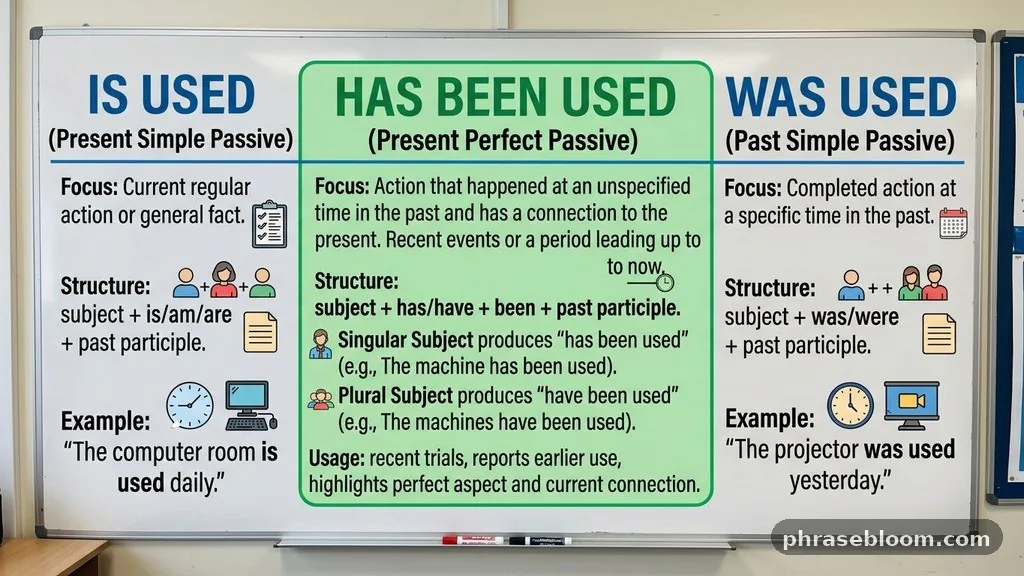
The present perfect passive follows the pattern subject + has or have + been + past participle. A singular subject produces has been used, while a plural subject produces have been used.
“The method has been used in recent trials” reports earlier use with a current connection. The perfect aspect is what creates that link between a past action and the present.
Past Simple Passive
The past simple passive uses was or were + past participle. A singular subject takes was used, while a plural subject takes were used.
“The method was used in the 2019 trial” presents the action as complete and located in the past. The past simple does not normally emphasize a present result, even if one exists.
For a fuller reference on passive constructions and tense patterns, consult the Cambridge Dictionary explanation of passive voice.
How Time Expressions Change the Choice
Time expressions provide strong clues, but they do not work mechanically in every sentence. The writer must still decide whether the focus is a general fact, an ongoing connection, or a finished event.
| Time expression | Common form | Example |
|---|---|---|
| Every day | is used | The checklist is used every day. |
| So far | has been used | The checklist has been used successfully so far. |
| Since January | has been used | The checklist has been used since January. |
| Yesterday | was used | The checklist was used yesterday. |
| Last year | was used | The checklist was used last year. |
Every day points to a habitual action, so the present simple passive is natural. So far and since January connect an earlier action to now, which favors the present perfect passive.
Yesterday and last year identify completed past times. They generally call for the past simple passive.
There are exceptions in informal speech and in varieties of English, but these patterns are dependable for formal writing. If a sentence sounds uncertain, replace the vague time reference with a clearer one.
Common Errors and How to Correct Them
Many mistakes involving these forms are not failures to understand the passive voice. They happen because writers overlook time reference or use the present perfect with a completed past time.
Using Has Been Used with a Finished Date
Incorrect in standard formal English: “The software has been used in 2020.”
Better: “The software was used in 2020.” The year is complete, so the past simple passive fits the sentence.
Using Was Used for a General Purpose
“This material was used to make furniture” may describe a historical process or a single past project. If the material still serves that purpose generally, write “This material is used to make furniture.”
The issue is not that was used is grammatically impossible. The issue is that it may give the reader the wrong time reference.
Confusing Has Been Used with Is Used
“The method is used in recent studies” sounds unnatural if the writer means that studies have already applied it. In that case, “The method has been used in recent studies” better communicates completed experience with current relevance.
Use is used if you mean that researchers generally apply the method. Use has been used if you are pointing to actual applications that have occurred.
Forgetting Subject Agreement
With a plural noun, write “The procedures are used” or “The procedures have been used.” Do not write “The procedures is used” or “The procedures has been used.”
The auxiliary verb must agree with the subject, not with the word used. This is especially important in long sentences where the subject and verb are separated by additional information.
Overusing the Passive Voice
The passive voice is useful when the action or result matters more than the actor. Still, an active sentence may be shorter and clearer: “The team used the system during the trial” is more direct than “The system was used by the team during the trial.”
Choose the passive when the actor is unknown, obvious, or less important. Choose the active voice when naming the actor improves clarity.
A Practical Decision Method
You can select the correct form by asking three questions in order. This method works for business English, academic writing, workplace communication, and everyday explanations.
- Is the sentence describing a general fact, current purpose, or habit? Use is used.
- Does a past action have a clear connection to the present? Use has been used.
- Did the action happen during a completed past time? Use was used.
Take the sentence “The reporting template ___ by the finance team.” If the template remains part of the current process, write “The reporting template is used by the finance team.”
If you are describing its experience during the current year, write “The reporting template has been used by the finance team this year.” If you are documenting a finished project, write “The reporting template was used by the finance team during the audit.”
When two options still seem possible, examine the purpose of the sentence. A policy description usually needs the present simple, a progress report may need the present perfect, and a historical account usually needs the past simple.
Choosing the Best Form in Professional Writing
Professional writing benefits from precise time reference. Readers should be able to tell whether a sentence describes a standing procedure, completed work, or current experience without reconstructing the timeline themselves.
Business Emails
Use is used for instructions and regular procedures: “The shared folder is used for final versions of all contracts.”
Use has been used for an update: “The shared folder has been used successfully by the legal team this month.” Use was used for a completed event: “The shared folder was used for the acquisition documents.”
Policies and Employee Handbooks
Policies generally state current rules, so is used is common. “The approval form is used for expenses above the department limit” describes a standing requirement.
If a policy document describes a prior case, use was used. If it evaluates results gathered up to the present, use has been used.
Reports and Presentations
Reports often need all three forms. A background section may say, “The instrument is used to measure temperature.” A results section may say, “The instrument has been used in twelve tests so far.” A project history may say, “The instrument was used during the initial trial.”
Do not select one passive form simply because it appears formal. Formal writing still requires the tense that matches the intended time reference.
Academic Writing
Academic writers use the present simple passive for established knowledge: “The process is used to separate the compounds.” The past simple passive commonly describes a completed experiment: “The samples were stored at room temperature.”
The present perfect passive is helpful in literature reviews: “This approach has been used in several recent studies.” It indicates a body of earlier work that remains relevant to the current discussion.
Examples You Can Copy and Adapt
The following examples show how small changes in verb tense alter the meaning. Replace the nouns or time expressions to fit your own context.
- The access code is used to enter the secure area.
- The access code has been used successfully by authorized staff.
- The access code was used during yesterday’s inspection.
- The dashboard is used to track monthly performance.
- The dashboard has been used by five departments this quarter.
- The dashboard was used during the previous reporting cycle.
- The training materials are used in every new-employee session.
- The training materials have been used in several regional workshops.
- The training materials were used during the 2023 orientation program.
Notice that the noun does not determine the tense by itself. The surrounding meaning does. A dashboard can be used as a general tool, as part of a current series of activities, or during a finished reporting cycle.
Here are three useful patterns for rewriting uncertain sentences:
- General purpose: “The device is used to detect leaks.”
- Current record: “The device has been used in four inspections this month.”
- Finished event: “The device was used during the inspection on Monday.”
If the sentence lacks enough context, add a time phrase. “The procedure has been used” is grammatical, but “The procedure has been used successfully in the current trial” gives the reader a clearer reason for choosing the present perfect.
Is Used vs Has Been Used vs Was Used in Questions and Negatives
The same tense distinctions apply in questions. The auxiliary verb moves before the subject, but the time meaning remains the same.
- Is the system used by all departments?
- Has the system been used in the current pilot?
- Was the system used during the previous audit?
The first asks about a general or current practice. The second asks about experience up to now. The third asks about a completed past event.
Negative forms follow the same pattern:
- The system is not used for customer billing.
- The system has not been used outside the test environment.
- The system was not used during the first phase.
“Has not been used” does not necessarily mean that the system will never be used. It means that use has not occurred up to the relevant present point. “Was not used” limits the statement to a completed past event or period.
FAQ: Is Used, Has Been Used, and Was Used
What is the difference between is used and has been used?
Is used describes a present fact, regular practice, or general purpose. Has been used describes past use that remains relevant now or occurred during a time period connected to the present.
What is the difference between has been used and was used?
Has been used avoids a finished past time and links the action to the present. Was used describes a completed past action, especially with expressions such as yesterday, last year, or during the 2020 project.
Can I use “is used” for a repeated action?
Yes. The present simple passive is appropriate for repeated or habitual actions: “The checklist is used every morning.” It can also describe a general purpose: “The checklist is used to identify safety risks.”
Can “has been used” refer to several actions?
Yes. The present perfect passive can describe repeated actions that occurred before now: “The new process has been used by several teams this month.” The current month remains connected to the present or is being treated as the relevant reporting period.
Should I avoid the passive voice in formal writing?
No. Passive voice is appropriate when the action, process, or result matters more than the person who performed it. Use active voice when naming the actor makes the sentence clearer or more direct.
Final Takeaway on Is Used vs Has Been Used vs Was Used
The practical distinction in is used vs has been used vs was used is time and viewpoint. Choose is used for present facts and habits, has been used for past actions with present relevance, and was used for completed past events.
Before submitting a sentence, check its time expression and ask whether the action is general, connected to now, or finished in the past. That quick check will make your English grammar more precise in emails, reports, academic writing, and everyday communication.