

Run Like the Wind: Meaning and Examples
The expression “run like the wind” means to run very fast, usually with great urgency. It is a vivid simile that compares a person’s speed with the movement of the wind, so the phrase is normally figurative rather than literal.
You might hear it in a sports story, a warnng, a children’s book, or an everyday instruction to hurry. Understanding the run like the wind meaning helps you recognize the difference between a direct command to sprint and a playful idiomatic expression that emphasizes speed, excitement, or escape.
The phrase can sound dramatic, humorous, encouraging, or urgent depending on the situation. The examples below show how to use it naturally, how it differs from similar expressions, and when a simpler phrase such as “run quickly” may be a better choice.
What Does “Run Like the Wind” Mean?
“Run like the wind” means to run extremely fast. It can describe someone who is trying to win a race, reach a destination, escape danger, or respond quickly to an urgent situation.
For example, if a coach shouts, “Run like the wind!” the coach is telling an athlete to increase speed and give maximum effort. If a friend says, “Run like the wind before the store closes,” the speaker is using the expression in a lighter way to mean “hurry.”
The phrase is an idiom because its full meaning is not based on a literal comparison that can be measured precisely. Wind does not have one fixed speed, and a person cannot literally run in the same way that wind moves. The image simply suggests remarkable speed and force.
| Expression | Basic meaning | Typical tone | Example situation |
|---|---|---|---|
| Run like the wind | Run very fast | Vivid, energetic, sometimes playful | A coach encourages a runner |
| Run quickly | Move at a fast pace | Neutral and direct | An instruction in a workplace or emergency |
| Sprint | Run at maximum speed for a short distance | Precise and athletic | A track-and-field description |
| Hurry | Move or act more quickly | Common and practical | A reminder before a deadline |
| Flee | Run away from danger or a threat | Serious and formal | An emergency report |
The Cambridge Dictionary entry for “run like the wind” reflects this central definition: moving or running very quickly. In ordinary conversation, the expression is often more colorful than “run quickly,” but both can communicate the same basic idea.
Why Is It Called a Simile?
“Run like the wind” is a simile, which is a comparison that uses words such as “like” or “as.” The runner is compared with the wind to create a strong mental picture of speed.
The phrase is also an example of figurative language. Figurative language uses an image or comparison to communicate more than the plain dictionary meaning of each word. A reader does not usually imagine a runner becoming wind; instead, the reader understands that the person is moving very quickly.
Some people loosely call the expression a metaphor, but simile is the more precise term because the word “like” makes the comparison directly. “He ran like the wind” is a simile, while “He was a bolt of lightning on the track” is a metaphor.
Literal and Figurative Meaning
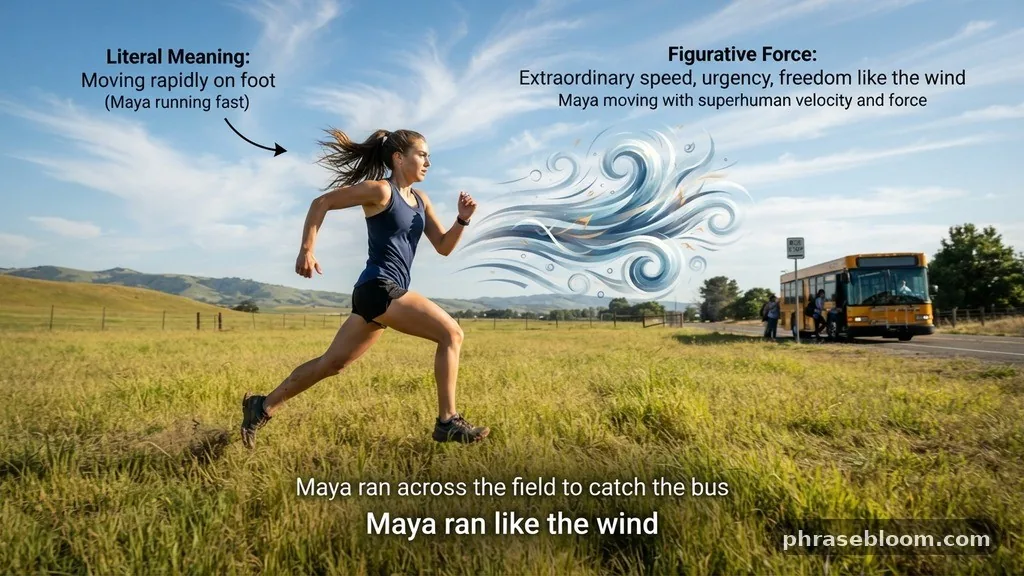
The literal meaning of “run” is to move rapidly on foot. The figurative force comes from “like the wind,” which adds the idea of extraordinary speed, freedom, force, or urgency.
Consider these two sentences:
- “Maya ran across the field to catch the bus.” This is a direct description of an action.
- “Maya ran like the wind to catch the bus.” This adds energy and emphasizes how fast she moved.
Both sentences can describe the same event. The second one creates a stronger image and sounds more expressive, which is why writers often use it in stories, speeches, sports commentary, and informal conversation.
Run Like the Wind: Definition and Grammatical Use
The run like the wind definition is simple, but the expression can appear in several grammatical forms. It commonly follows a subject and verb, as in “The children ran like the wind.” It can also appear as a command, as in “Run like the wind!”
The phrase usually works as an adverbial expression. That means it gives more information about how someone runs. In “The horse ran like the wind,” the expression explains the manner and speed of the running.
It can also appear after another verb that describes movement or an instruction. For example, “She told us to run like the wind” uses the phrase as part of an infinitive construction. The expression still describes the speed of the action.
| Form | Example | Function |
|---|---|---|
| Statement | “The runners ran like the wind.” | Describes how they ran |
| Command | “Run like the wind!” | Urges someone to run fast |
| Past description | “He ran like the wind after the dog.” | Describes a completed action |
| Infinitive phrase | “They needed to run like the wind.” | Follows “to run” |
| Storytelling | “She ran like the wind toward the finish line.” | Adds dramatic detail |
Because “like the wind” follows the verb rather than appearing directly before a noun, it does not require a hyphen. Write “He ran like the wind,” not “He ran like-the-wind.” The phrase remains a group of separate words.
Run Like the Wind Examples in Everyday English
The expression is common in casual speech and creative writing. Its tone changes according to the speaker’s purpose, so the same phrase can sound encouraging in one sentence and humorous in another.
Sports and Competition
“The coach told the final runner to run like the wind toward the finish line.”
This sentence uses the idiom to emphasize speed and effort during a race. It is energetic but not technically precise, since a sports report might use “sprint” if it needs an exact description of the athlete’s movement.
“If you run like the wind, you might catch the leader before the next turn.”
Here, the expression functions as encouragement. It suggests that the runner should move as fast as possible, but it does not necessarily mean the person must maintain maximum speed for a long distance.
Urgency and Hurry
“Run like the wind, or we’ll miss the last train.”
This example has a practical reason for the speed. The phrase adds urgency while keeping the sentence informal and conversational.
“She ran like the wind to deliver the signed document before the office closed.”
The sentence uses the idiom in a workplace-related story. In a formal report, “She hurried to deliver the document” may be more restrained, but the idiom works well in an email or narrative account.
Escape and Play
“When the sprinkler turned on, the children ran like the wind.”
This is a playful use. The children are not necessarily in serious danger, but the image makes their sudden movement easy to picture.
“The fox appeared near the campsite, and the hikers ran like the wind back to the trail.”
In this sentence, the expression suggests fear or escape. The surrounding details tell readers whether the action is funny, urgent, or genuinely dangerous.
How the Idiom Works in Different Contexts
“Run like the wind” is most natural in informal or moderately expressive writing. It fits conversation, fiction, sports features, advertisements, motivational language, and messages between coworkers who already use a relaxed tone.
It may be less suitable in technical documentation or official records. A safety instruction would usually say “evacuate immediately,” “move to the designated area,” or “leave the building quickly” because those phrases are more exact and less open to interpretation.
Workplace Communication
“Please run like the wind to the conference room. The client has joined the call early.”
This could work in a friendly internal message, especially between colleagues. It would sound informal, so a more neutral version would be “Please come to the conference room as soon as possible.”
“The support team ran like the wind to resolve the outage before the morning meeting.”
This sentence is appropriate for a conversational internal update or a company story. For a formal business report, “The support team responded quickly to resolve the outage” would communicate the same event with less figurative language.
Stories and Creative Writing
“The boy ran like the wind through the narrow streets, clutching the letter in his hand.”
The idiom works especially well in narrative writing because it supports movement and emotion. The details around it help readers understand whether the character is excited, frightened, determined, or late.
“At the sound of thunder, the horses ran like the wind toward the stable.”
This example uses the expression to give an animal scene a lively rhythm. It is vivid without requiring the writer to calculate an exact speed.
Public Communication and Marketing
“Need your order delivered fast? Our local team runs like the wind.”
An advertisement may use the idiom because it is memorable and energetic. However, a business should avoid using it as a precise delivery promise unless the company can support the claim with clear service terms.
“The new software helps your team move like the wind from idea to launch.”
This is a figurative marketing message. It suggests efficiency rather than literal running, so the surrounding product information should explain what “move” actually means.
Run Like the Wind Compared With Similar Expressions
Several expressions communicate speed, but they do not all carry the same emotional meaning. Choosing the right phrase depends on whether you want to emphasize athletic effort, urgency, escape, or simple efficiency.
- Run quickly: a plain and neutral way to describe fast movement.
- Sprint: a precise verb for running at high speed, often over a short distance.
- Hurry: means to do something faster, whether or not running is involved.
- Flee: means to escape from danger, a threat, or an unpleasant situation.
- Dash: suggests a quick, sudden movement and can sound informal.
- Race: can mean to compete or to move very quickly toward a destination.
- Move swiftly: a more formal alternative for business, academic, or official writing.
“Run like the wind” focuses on an image of speed. “Flee” focuses on escape, while “sprint” focuses on the physical type of running. These differences matter because replacing one expression with another can change the tone or meaning of a sentence.
| Sentence | What it emphasizes | Best setting |
|---|---|---|
| “Run like the wind to the finish line.” | Energy and impressive speed | Conversation or sports storytelling |
| “Sprint to the finish line.” | Maximum athletic effort | Training or competition |
| “Hurry to the finish line.” | Urgency without a specific running style | Everyday speech |
| “Flee from the finish area.” | Escape from danger | Serious or emergency context |
| “Proceed quickly to the finish line.” | Clear, formal instruction | Official communication |
The idiom is not always the strongest choice. If a reader needs an exact instruction, choose a direct verb. If the goal is to create excitement or a memorable image, “run like the wind” has more personality.
Is “Run Like the Wind” Literal or Figurative?
In most uses, “run like the wind” is figurative. The speaker does not claim that a person has the physical properties of wind. Instead, the comparison makes the person’s speed seem powerful, sudden, and almost impossible to measure.
Context can make the phrase more literal in a poetic or imaginative setting. A fantasy writer might describe a character who truly transforms into wind, but that is a special creative use rather than the normal meaning of the idiom.
The expression can also be used humorously when someone is not actually fast. A person might say, “I ran like the wind,” after moving very slowly, using exaggeration for comic effect. The listener understands the intended meaning from tone and context.
Does It Always Mean Fear?
No. The phrase can describe fear-driven escape, but fear is not part of its required definition. A child may run like the wind toward an ice cream truck, an athlete may run like the wind during a race, and a worker may run like the wind to catch an elevator.
The surrounding words usually reveal the emotional reason for the movement. Words such as “danger,” “chased,” and “escape” create a serious tone, while “race,” “finish line,” and “cheer” create a competitive one.
Common Mistakes With the Expression
Most errors involving this idiom concern tone, punctuation, or interpretation rather than basic grammar. The phrase is short, but using it well requires attention to the situation in which it appears.
Using It in an Official Instruction
“Run like the wind to the emergency exit” may sound lively, but it is not ideal for a formal safety notice. A clearer correction is “Proceed immediately to the nearest emergency exit.”
The corrected version tells readers what to do without relying on humor or exaggeration. In safety, legal, medical, and technical writing, clarity usually matters more than colorful wording.
Assuming It Means “Run Away”
“Run like the wind” does not automatically mean “run away.” The phrase means to run very fast, while the destination and context determine whether the person is moving toward something or escaping from it.
“Run like the wind toward the finish line” shows movement toward a goal. “Run like the wind away from the fire” shows escape.
Adding Unnecessary Punctuation
As an ordinary phrase, “like the wind” does not need quotation marks or special punctuation. Write, “The dog ran like the wind across the yard.”
Quotation marks are appropriate when discussing the expression itself, as in “Run like the wind” is an idiom. They are not necessary every time the phrase appears in a sentence.
Creating Incorrect Variations
Forms such as “run windly” or “run like windy” do not express the standard idiom. The established form is “run like the wind,” with “like” introducing the comparison.
Another common problem is using the phrase where “work quickly” or “respond immediately” is intended. Because the idiom specifically creates an image of running, it may sound strange in a sentence about a process that involves no movement.
When Should You Use “Run Like the Wind”?
Use the idiom when you want a sentence to sound vivid, energetic, informal, or expressive. It works particularly well when speed is central to the scene and the reader benefits from a memorable image.
Choose a direct alternative when precision, seriousness, or professional neutrality matters more. “Move quickly,” “respond immediately,” and “complete the task promptly” are usually better in formal instructions and business documents.
- Use “run like the wind” in stories, casual dialogue, sports encouragement, and playful messages.
- Use “sprint” when the physical action and athletic technique matter.
- Use “hurry” when the person may walk, drive, or work faster rather than run.
- Use “flee” when escape from danger is the central idea.
- Use “proceed quickly” or “move immediately” in formal instructions.
- Use “respond rapidly” or “act without delay” in business and technical writing.
A useful test is to ask what the reader needs from the sentence. If the reader needs an image, the idiom may be effective. If the reader needs an exact instruction, a plain verb will usually be stronger.
Copyable Examples of “Run Like the Wind”
The following sentences show how the expression can be adapted to different situations. They are intentionally varied so you can see the difference between a command, a description, a joke, and a story detail.
- “Run like the wind if you want to catch the bus.”
- “The little girl ran like the wind across the playground.”
- “The coach yelled for the team to run like the wind during the final lap.”
- “He ran like the wind when he realized he had left his passport at the hotel.”
- “The puppy ran like the wind after the bright red ball.”
- “We need to run like the wind if we’re going to make the opening act.”
- “The messenger ran like the wind through the village.”
- “She ran like the wind toward the open gate.”
- “Run like the wind and tell the others that the storm is coming.”
- “After the starting signal, the athlete ran like the wind down the track.”
Each sentence uses the expression to suggest fast movement, but the reason differs. Some examples show urgency, some show competition, and others create a lively image in a narrative.
More Formal Rewrites
“Run like the wind to the meeting room” can become “Please proceed to the meeting room immediately.” This version is better for a formal workplace notice.
“The team ran like the wind to fix the problem” can become “The team responded quickly to resolve the problem.” This rewrite removes the physical image and focuses on professional performance.
“The hikers ran like the wind from the storm” can become “The hikers moved rapidly to avoid the storm.” This version is more neutral while preserving the sense of urgency.
Frequently Asked Questions
What is the run like the wind meaning?
“Run like the wind” means to run very fast. It is usually a figurative expression that emphasizes speed, urgency, or energetic movement.
Is “run like the wind” an idiom?
Yes. It is an idiomatic expression and a simile. The phrase compares a person’s speed with the movement of wind, but it does not mean that the person literally becomes wind.
Does “run like the wind” mean to escape?
It can suggest escape when the context involves danger or pursuit, but escape is not part of the expression’s basic meaning. The central idea is fast running.
Can I use “run like the wind” in formal writing?
You can, but it may sound too informal or vivid for official instructions, technical documents, or legal writing. In those settings, “move quickly,” “proceed immediately,” or “respond rapidly” is often clearer.
What is a good alternative to “run like the wind”?
Use “run very fast,” “sprint,” “hurry,” “dash,” or “move quickly,” depending on the context. Choose “flee” only when the sentence specifically means escaping from danger or a threat.
Conclusion
The expression “run like the wind” means to run very fast, and its force comes from a vivid comparison rather than a literal description. It can encourage an athlete, add urgency to a conversation, or bring movement and energy to a story. The phrase does not always imply fear or escape, so context determines the exact tone.
Use “run like the wind” when expressive language fits the situation. For formal instructions or precise reports, choose a direct alternative such as “proceed quickly” or “respond immediately.” Once you understand the run like the wind meaning, you can use the idiom naturally and recognize when a simpler phrase will communicate more clearly.
You may also like: Worn vs Warn: Meaning, Pronunciation and Usage
Explore more on PhraseBloom.