
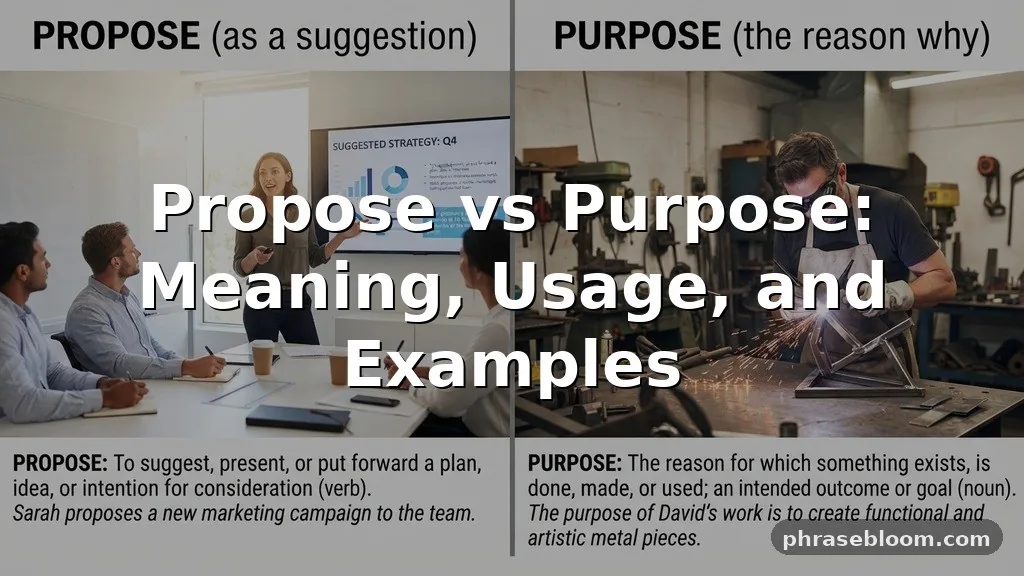
Propose vs Purpose: Meaning, Usage, and Examples
The difference between propose and purpose becomes clear once you separate action from intention. Propose is usually a verb meaning to suggest, present a plan, or ask someone to marry you, while purpose is usually a noun meaning the reason something exists or the aim behind an action.
These words look and sound similar, but they do different jobs in a sentence. Understanding the propose definition, purpose definition, pronunciation, and common sentence patterns will help you write clearer emails, essays, proposals, reports, and everyday messages.
Propose vs Purpose: The Direct Answer
Propose is most often a verb. It describes an action: someone proposes an idea, a solution, a motion, or a marriage. For example, “The committee proposed a revised schedule” means that the committee suggested or formally presented a revised schedule.
Purpose is most often a noun. It identifies a reason, intended use, aim, or objective. In “The purpose of the meeting is to approve the budget,” purpose names the reason the meeting exists.
| Word | Part of speech | Core meaning | Example |
|---|---|---|---|
| Propose | Usually a verb | To suggest, present, or put forward | The director proposed a new hiring plan. |
| Purpose | Usually a noun | The reason, aim, or intended use | The purpose of the plan is to reduce delays. |
The simplest memory aid is this: you propose an idea, but you identify its purpose. A proposal may explain the purpose of a project, but the two words are not interchangeable.
There is also a less common verb use of purpose. In formal or literary English, to purpose something can mean to intend or resolve to do it. In ordinary business English, however, writers generally use purpose as a noun and propose as a verb.
What Does Propose Mean?
The propose meaning changes slightly depending on context, but its central idea is putting something forward for consideration. You might propose a plan, propose a change, propose a solution, or propose a motion during a formal meeting.
In business writing, propose often signals that the idea is not yet final. “We propose moving the launch to September” presents a recommendation that other people may discuss, approve, revise, or reject.
Propose as a suggestion

When propose means suggest, it usually takes a direct object. The object is the idea or action being presented.
- The manager proposed a four-day training program.
- The research team proposed a different explanation for the results.
- Several employees proposed changes to the leave policy.
- The consultant proposed using smaller test groups.
These examples all involve an idea being placed before another person or group. The word sounds somewhat more formal than suggest, so it works especially well in reports, meeting minutes, academic writing, and proposal writing.
Propose in formal meetings
In parliamentary or organizational language, a person may propose a motion. “Jordan proposed that the board approve the revised budget” means Jordan formally introduced that action for discussion or decision.
The noun proposal is closely related to this use. A proposal is the plan, document, or suggestion that someone has proposed. For example, “The board reviewed the proposal” refers to the presented plan, not the act of presenting it.
Propose as a marriage question
Propose also has a familiar personal meaning: to ask someone to marry you. “He proposed during their vacation” means he asked his partner to marry him.
This meaning is easy to distinguish from the business meaning because the surrounding words provide context. A person can propose a policy, but a person proposes marriage. The pronunciation remains the same in both uses.
What Does Purpose Mean?
The purpose definition centers on reason and intention. Purpose answers questions such as “Why does this exist?” “What is this meant to do?” or “What result is someone trying to achieve?”
For example, the purpose of a fire drill is to prepare people for an emergency. The purpose of a cover letter is to introduce a job applicant and explain why the applicant fits a position.
Purpose is normally a noun, so it often appears after the, a, its, their, or another determiner. Common patterns include “the purpose of,” “for the purpose of,” “a clear purpose,” and “serve a purpose.”
- The purpose of the survey is to measure customer satisfaction.
- This tool was designed for the purpose of tracking inventory.
- The campaign has a clear purpose: to increase awareness.
- Every section of the report should serve a practical purpose.
The word can describe a broad life direction or a narrow practical function. A person may search for a sense of purpose, while a machine may have the purpose of filtering water. The meaning depends on the subject.
Purpose, aim, objective, and goal
Purpose is related to aim, objective, goal, intention, and plan, but these words are not identical. Purpose usually explains the underlying reason, while an objective is a specific result and a goal is a desired outcome.
Consider this example: “The purpose of the program is to improve access to healthcare. Its objective is to enroll 500 participants. The goal is to reduce missed appointments.” The terms work together, but each adds a different level of detail.
Purpose can also mean practical use. If someone asks, “What is the purpose of this button?” they want to know what the button does. In that question, purpose is close to function or intended use.
How Propose and Purpose Work in Grammar
Grammar helps explain why these words cannot normally replace each other. Propose is an action word, so it functions as a verb. Purpose is generally a naming word, so it functions as a noun.
A verb tells what someone does or what happens. A noun names a person, place, thing, idea, or concept.
In “The team proposed a solution,” proposed describes the team’s action. In “The purpose of the solution is to save time,” purpose names the reason behind it.
| Sentence pattern | Correct word | Why it works |
|---|---|---|
| They ___ a new procedure. | proposed | The sentence needs an action. |
| The ___ of the procedure is safety. | purpose | The sentence needs a reason or aim. |
| Her ___ was accepted by the panel. | proposal | The sentence needs a noun meaning a presented plan. |
| The project has a clear ___. | purpose | The sentence needs a noun naming the project’s aim. |
Writers sometimes confuse the words because their pronunciation is similar. They also share the first syllable “pro” in many accents. Their spelling, stress, and grammatical roles still differ enough that a substitution can make a sentence incorrect.
Related forms
The noun related to propose is proposal. The person who proposes something may be called a proposer, although that word is less common in everyday business writing. The adjective proposed means suggested but not yet approved, as in “the proposed merger.”
Purpose has fewer common everyday derivatives. Purposeful means showing determination or having a clear aim, while purposeless means lacking a useful aim or direction. The phrase “purpose-driven” is common in organizational and marketing language.
For a dependable reference on word meanings and usage, consult the Merriam-Webster dictionary when a sentence raises a spelling or definition question.
Pronunciation and Etymology
In standard American English, propose is commonly pronounced with stress on the second syllable: pro-POZE. Purpose is commonly pronounced PUR-pus, with stress on the first syllable. The final sound of propose is voiced like the sound in “rose,” while the final sound in purpose is an unaccented “pus” sound.
Pronunciation can vary by accent, particularly in the first vowel and the final unstressed syllable. Even so, listening for the stressed syllable can help learners distinguish the words in conversation.
The words also have different histories. Propose comes through French and Latin forms connected with the idea of putting something forward. Its historical sense reflects the modern meaning of presenting an idea, plan, or question.
Purpose also came into English through French from Latin. Its earlier meanings involved an intention, aim, or objective. That history explains why purpose still refers to both a reason and a planned outcome.
Pronunciation alone should not be the main test when choosing between them. Check the sentence’s meaning and ask whether you need an action, a suggestion, or the reason behind something.
Propose vs Purpose in Real Sentences
Professional communication often uses both words in the same document. A report may state that a team proposes a change and then explain the purpose of that change.
Business and workplace examples
- We propose extending the pilot program by two weeks.
- The purpose of the extension is to collect more customer feedback.
- The analyst proposed three options for reducing operating costs.
- Each option has a different purpose and level of risk.
The first and third sentences describe recommendations, so propose is the right verb. The second and fourth identify reasons or intended roles, so purpose is the correct noun.
Academic and research examples
- The study proposes a new method for analyzing coastal erosion.
- The purpose of the study is to compare two measurement techniques.
- The authors propose that sleep quality affects workplace concentration.
- The questionnaire was created for the purpose of collecting anonymous responses.
Academic writing often uses propose to introduce an argument or interpretation. Purpose appears in introductions, research questions, methods sections, and explanations of why a study was conducted.
Personal and everyday examples
- She proposed meeting earlier to avoid traffic.
- What is the purpose of this setting?
- He proposed during a family trip.
- The purpose of the note was to apologize.
These examples show the range of propose. It can introduce a practical suggestion or describe a marriage proposal, while purpose still identifies a reason or function.
Common Mistakes and How to Correct Them
The most common mistake is replacing one word with the other because they sound alike. A sentence may remain understandable, but the grammar or meaning will be wrong.
Using purpose as a verb in ordinary writing
Incorrect: “The department purposed a new schedule.” In ordinary business English, write “The department proposed a new schedule.”
Purpose can function as a verb in specialized or literary usage, but that form may distract modern readers. Unless a particular context calls for it, propose is the clearer choice for presenting an idea.
Using propose where a noun is needed
Incorrect: “The propose of the meeting is to review the contract.” The correct sentence is “The purpose of the meeting is to review the contract.”
The phrase “the purpose of” is a fixed and very common pattern. If the sentence explains why something exists or happens, purpose is probably the word you need.
Confusing proposal and purpose
Incorrect: “The purpose was approved by the committee,” if you mean a document or plan. Write “The proposal was approved by the committee.”
A proposal is something presented for consideration. A purpose is the reason for doing something. A proposal may explain a purpose, but it does not mean the same thing.
Choosing a vague phrase
Sometimes both words are technically possible, but a more precise sentence is better. “The purpose is improvement” is vague, while “The purpose of the project is to reduce response times” gives the reader a clear objective.
Likewise, “We propose progress” is unclear because it does not identify an action. “We propose adding a second support specialist” gives readers something specific to evaluate.
How to Choose the Right Word
Start by identifying the job the word performs. If you need to say what someone suggests, presents, or recommends, choose propose. If you need to name a reason, intention, function, or objective, choose purpose.
Then inspect the words around the blank. “The ___ of” almost always points to purpose, while a subject followed by a direct object often needs propose or proposed.
- Ask whether the sentence describes an action.
- Ask whether the sentence names a reason or intended result.
- Check whether the sentence needs a verb, noun, or related noun such as proposal.
- Read the sentence aloud to see whether the meaning is complete.
- Replace the word with suggest or reason as a quick test.
For example, “The committee ___ a revised plan” becomes clear if you substitute suggest. “The ___ of the revised plan” becomes clear if you substitute reason.
Writers should also consider register. Propose is useful in formal settings, but suggest may sound more natural in a casual email. Purpose is appropriate in both formal and everyday writing, although reason or point may be simpler in conversation.
Propose, Purpose, and Clear Writing
Good writing distinguishes an idea from the reason behind it. A proposal tells readers what someone wants to do, while a purpose statement tells them why the action matters.
This distinction is especially useful in proposal writing. A strong business proposal may begin with a problem, propose a solution, explain the solution’s purpose, identify an objective, and describe the expected result.
For example: “We propose replacing the current ticketing system with a shared service platform. The purpose of the change is to reduce duplicate requests and give managers better visibility.” The first sentence presents the plan; the second explains its reason.
Improving workplace communication
Use propose when you want feedback or approval. “I propose that we move the meeting to Thursday” invites discussion more clearly than “The meeting should move to Thursday,” which may sound like a final decision.
Use purpose when you need to orient readers. A short purpose statement can prevent confusion at the beginning of a project, policy, survey, presentation, or meeting.
Try to state purpose with a concrete verb. “The purpose is to improve communication” is less useful than “The purpose is to give regional teams one place to share updates.” Specific wording makes the intention easier to understand and measure.
Quick Reference for Propose and Purpose
The following guide can help you make a fast decision while editing an email, report, assignment, or presentation.
| Expression | Meaning | Typical use | Example |
|---|---|---|---|
| propose | Suggest or put forward | Verb | They propose a new schedule. |
| proposed | Suggested but not final | Adjective or past-tense verb | The proposed schedule begins in June. |
| proposal | A presented plan or suggestion | Noun | We reviewed the proposal. |
| purpose | Reason, aim, or intended use | Noun | The purpose is to improve access. |
| purposeful | Having a clear aim | Adjective | Her questions were purposeful. |
Remember that spelling is only one part of accuracy. The correct word must also match the sentence’s grammatical structure and intended meaning.
Frequently Asked Questions
What is the difference between propose and purpose?
Propose is usually a verb meaning to suggest or present an idea. Purpose is usually a noun meaning the reason, aim, or intended use of something.
Can propose and purpose be used interchangeably?
No. You propose a plan, but you explain the purpose of the plan. Their similar sounds do not make them interchangeable.
Is purpose ever used as a verb?
Yes, but the verb is uncommon and formal. In most modern business, academic, and everyday writing, use purpose as a noun and propose when you mean suggest or put forward.
What is the noun form of propose?
The usual noun is proposal. A proposal is a plan, suggestion, or document that someone has presented for consideration.
How can I remember which word to use?
Use propose for an action involving a suggestion, and use purpose for a reason or aim. A simple test is “suggest” for propose and “reason” for purpose.
Final Rule for Propose vs Purpose
The central distinction in Propose vs Purpose is straightforward: propose means to put forward an idea, while purpose means the reason or aim behind something. Use proposal for the plan itself, and use purpose when explaining why the plan, project, meeting, or action exists.
Before you finish writing, check both meaning and grammar. If the sentence describes an action, choose propose; if it identifies an intention, objective, or reason, choose purpose. That quick test will keep your emails, reports, assignments, and proposals precise.
Related: Alright vs All Right · Team That, Team Who, or Team Which · Accent vs Ascent vs Assent
Explore more on PhraseBloom.
1 thought on “Propose vs Purpose: Meaning, Usage, and Examples”