
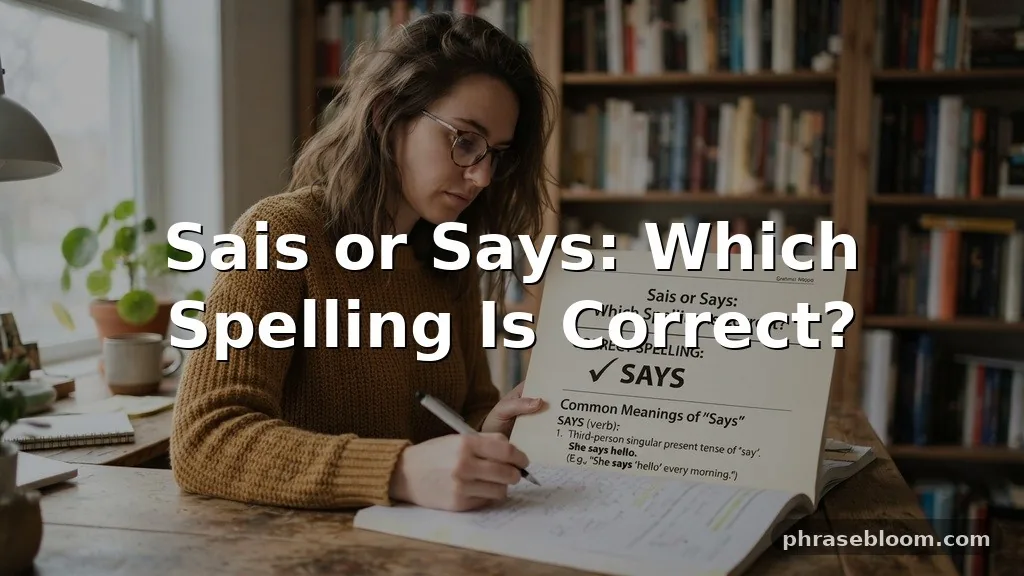
The correct English spelling is says, not sais, when you mean the third-person singular form of the verb “to say.” The word says appears in sentences such as “She says hello” and “The report says sales increased.”
The confusion exists because says has an unexpected pronunciation: /sez/, which sounds like “sez” rather than “says” or “say.” You’ll also encounter Sais as the name of an ancient Egyptian city, but that proper noun is unrelated to the ordinary English verb. Understanding the difference will help with spelling, proofreading, and everyday English grammar.
Sais or Says: The Direct Answer
Use says in standard English when the subject is he, she, it, or a singular noun. It is the present-tense, third-person singular form of say.
| Word | Correct everyday use | Meaning | Example |
|---|---|---|---|
| says | Yes | Speaks, states, or communicates | He says the meeting starts at nine. |
| sais | Usually no | Not the normal English spelling of the verb | “She sais hello” is a spelling mistake. |
| Sais | Yes, in a historical context | An ancient Egyptian city | Sais was associated with the goddess Neith. |
For most messages, essays, reports, and conversations, the choice is simple: write says. If you are writing about ancient Egyptian history, Sais may be correct because it is a place name.
The form sais can also appear in specialized foreign-language contexts, but it is not the standard spelling for the English verb. A spell checker may flag it, and in an ordinary English sentence it will usually be read as an error.
What Says Means in English
Says means “speaks,” “states,” “expresses,” or “communicates.” It can describe spoken words, written information, a visible sign, a report, or an opinion attributed to a person.
For example, “Maria says the package arrived” refers to Maria’s statement. In “The label says ‘Keep refrigerated,’” the label is not speaking, but it communicates information through writing.
The word belongs to the verb say. English uses different forms of this verb depending on the subject and tense:
- say: used with I, you, we, and they in the present tense
- says: used with he, she, it, and singular nouns in the present tense
- said: the past-tense form for all subjects
- saying: the present participle used with forms of “be” or in other verb structures
Compare “They say the office is closed” with “She says the office is closed.” The meaning is similar, but the verb changes because they is plural and she is singular.
This is an example of subject-verb agreement. In plain terms, the verb form must match the subject. The same pattern appears in “He works,” “She knows,” and “The machine runs.”
Common meanings of says

The verb can introduce a direct quotation: “The manager says, ‘Please submit the form today.’” It can also introduce reported information without quotation marks, as in “The manager says that the form is due today.”
Says can describe an opinion or claim: “The advertisement says the product is waterproof.” It can refer to evidence: “The data says otherwise,” although some editors prefer “The data indicate otherwise” in formal scientific writing because data may be treated as plural.
It may also describe instructions and information in objects. “The sign says employees must use the side entrance” is perfectly natural. The subject of says does not have to be a human being.
Why Says Is Pronounced “Sez”
The pronunciation of says surprises many learners because its spelling resembles say. The verb say is pronounced /seɪ/, like “say,” but says is normally pronounced /sez/, like “sez.”
The final letter s represents a /z/ sound in this word, while the vowel sound also changes. This is a pronunciation pattern that must be learned rather than reliably predicted from the spelling.
| Form | Pronunciation | Example |
|---|---|---|
| say | /seɪ/ | I say what I mean. |
| says | /sez/ | She says what she means. |
| said | /sed/ | She said what she meant. |
Because says sounds like “sez,” some writers spell it as sais. That spelling may feel logical if someone is writing from sound, but English spelling is not always a direct record of pronunciation.
The same issue affects other commonly confused words. A learner may hear there, their, and they’re as similar sounds, but their spellings and grammatical roles differ. Careful proofreading helps separate sound from written form.
Say and says are not pronounced the same
Use /seɪ/ for say in sentences such as “Please say your name.” Use /sez/ for says in “The customer says the order is late.”
Adding the letter s does not simply add an /s/ sound to say. Instead, the whole word has an established pronunciation. Listening practice, sentence examples, and a reliable dictionary can reinforce the difference.
For pronunciation support, the Merriam-Webster dictionary entry for “says” provides audio and usage information. A dictionary is especially useful when spelling and pronunciation do not appear to match.
Is Sais Ever a Correct Word?
Sais can be correct when it refers to Sais, an ancient Egyptian city in the Nile Delta. The name is normally capitalized because it is a proper noun, meaning the name of a specific place.
Sais became particularly important during Egypt’s Twenty-Sixth Dynasty, often called the Saite Dynasty. The city was connected with the worship of Neith, a major Egyptian goddess, and it served as a political center during that period.
A history sentence might say, “Sais was an important center during the Saite Dynasty.” Here, Sais is not a verb and has nothing to do with the English word says.
The distinction depends on context and capitalization. “The witness says the road was closed” uses a verb, while “The historian describes Sais as a major city” uses a place name.
Readers may also see sais in foreign-language writing or specialized vocabulary. A word can be valid in another language without being the correct spelling in an English sentence. If the intended meaning is “states” or “speaks,” choose says.
How context identifies the word
Look at what comes after the word. If the sentence says “She sais that the plan changed,” the subject she and the following clause show that the writer means the verb says.
If the sentence says “Sais lies in the Nile Delta,” the capital letter and the geographical context identify the ancient city. Grammar and subject matter work together to clarify meaning.
This is why a spelling mistake can sometimes pass through basic software. A program may recognize a word in a dictionary, but it cannot always determine the writer’s intended meaning. Human proofreading still matters.
Say, Says, Said, and Saying
Many errors involving says come from confusing the forms of the irregular verb say. An irregular verb does not form every tense by following a simple pattern such as adding -ed. The past tense is said, not “sayed.”
Use say with I, you, we, and they in the simple present: “I say the instructions are clear,” or “They say the store closes early.” Use says with he, she, it, or one singular noun: “The manager says the store closes early.”
Use said for the past: “The manager said the store closed early.” This form does not change with the subject, so both “I said” and “She said” are correct.
Use saying after a form of be or as a participle: “She is saying that the schedule changed.” It can also function as a noun in a phrase such as “There is an old saying about patience.”
| Subject | Present form | Sentence example |
|---|---|---|
| I | say | I say we should wait. |
| You | say | You say the file is ready. |
| We | say | We say this is the best option. |
| They | say | They say the meeting moved. |
| He, she, or it | says | She says the meeting moved. |
| Any subject in the past | said | She said the meeting moved. |
Remember that says is not interchangeable with say. “The report says” is correct because report is singular. “The reports say” is correct because reports is plural.
Common Sais and Says Mistakes
The most common error is writing sais when the sentence needs says. For example, “The notice sais the office is closed” should be corrected to “The notice says the office is closed.”
Another mistake is using says with a plural subject. “The employees says the policy is unclear” should become “The employees say the policy is unclear.” The plural subject employees takes say, not says.
- Incorrect: The customer sais the invoice is missing. Correct: The customer says the invoice is missing.
- Incorrect: The managers says the process changed. Correct: The managers say the process changed.
- Incorrect: He say the instructions are confusing. Correct: He says the instructions are confusing.
- Incorrect: She sayed the shipment arrived. Correct: She said the shipment arrived.
- Incorrect: The sign say employees must wait. Correct: The sign says employees must wait.
Writers sometimes also confuse says with sees. The sentence “She says the bird” means she speaks about the bird, while “She sees the bird” means she observes it. These words sound different, but fast speech can make them difficult for learners to separate.
Another problem occurs when writers rely entirely on a spell checker. A spell checker may identify sais as unusual, but it may not catch every subject-verb agreement error. A grammar checker may suggest a correction, but you should still read the complete sentence for meaning.
How to proofread the word
First, ask whether the word means “speaks,” “states,” or “communicates.” If it does, write says. Next, identify the subject and check whether it is singular or plural.
A useful proofreading test is to replace the sentence with a past-tense version. If “The director says the plan works” becomes “The director said the plan worked,” the present-tense form is probably says, not sais.
Reading aloud can help with grammar, although pronunciation alone cannot determine spelling. When in doubt, consult a dictionary rather than selecting the form that seems closest to the sound.
Says in Professional and Academic Writing
Says is common in business English, workplace communication, journalism, academic writing, and everyday conversation. Its level of formality depends more on the surrounding sentence than on the verb itself.
In a business report, you might write, “The survey says most employees prefer flexible scheduling.” In a more formal report, you could write, “The survey indicates that most employees prefer flexible scheduling.” Both versions can be correct, but indicates may sound more precise when discussing evidence.
Academic writers often use says when referring to an author’s argument in accessible prose: “The author says that language changes through regular use.” In a research paper, alternatives such as argues, claims, reports, or observes may communicate the relationship more exactly.
That does not make says incorrect or unprofessional. The important issue is whether the verb accurately describes the source. A chart may show a trend, a study may report a result, and a researcher may argue for an interpretation.
| Context | Natural example | Why it works |
|---|---|---|
| Workplace email | The client says the revised file is easier to use. | Reports what the client communicated. |
| Business report | The latest survey says response times improved. | Summarizes information from a survey. |
| Academic writing | The article says that pronunciation affects spelling decisions. | Introduces an author’s stated point. |
| Policy document | The policy says employees must complete the form. | Refers to written instructions. |
In professional writing, the spelling must remain says. Changing it to sais creates a visible spelling mistake and may distract readers from the content.
Sentence Examples With Says
The following examples show how says works in different sentence patterns. Each one uses the word as a present-tense verb with a singular subject.
- The supervisor says the safety briefing begins at eight.
- Our website says orders placed today will ship tomorrow.
- The employee handbook says staff members must wear identification badges.
- Jordan says the revised schedule works better for the team.
- The weather service says heavy rain is expected tonight.
- The label says the medication should be stored at room temperature.
- The contract says either party may end the agreement with written notice.
- The analyst says the quarterly figures need additional review.
- The customer says the replacement part has not arrived.
- The museum sign says the artifact dates from the third century.
These examples demonstrate that the subject can be a person, a document, a website, a sign, an organization, or another information source. The singular subject takes says even when it is not alive.
Questions also use says when the subject is singular: “What does the notice say?” Notice that the auxiliary verb does carries the third-person singular marking, so the main verb returns to the base form say.
That distinction is important. Write “What does she say?” rather than “What does she says?” The same pattern appears in “Does the report say when the project ends?”
Direct and indirect speech
Use says before a quotation: “The director says, ‘We will review the plan tomorrow.’” The comma and quotation marks show the exact words being presented.
For indirect speech, write “The director says that the team will review the plan tomorrow.” The word that introduces the reported idea, although it can often be omitted in conversational English.
Both forms are useful in workplace writing. Direct speech preserves the original wording, while indirect speech often fits more smoothly into a report or summary.
How to Choose the Correct Spelling
Choosing between sais and says is usually a matter of identifying the intended language and grammatical role. If you are writing an ordinary English sentence about speaking or communicating, use says.
Use this quick decision process:
- Ask whether the word means “speaks,” “states,” or “communicates.”
- Check whether the subject is he, she, it, or another singular noun.
- Write says for the present tense with that singular subject.
- Use say with I, you, we, and they.
- Use said when the sentence refers to the past.
- Use capitalized Sais only when referring to the ancient Egyptian city or another proper name.
Consider the sentence “The company website sais that applications are open.” The intended meaning is clear, but the spelling is wrong. The corrected version is “The company website says that applications are open.”
Now consider “The historian writes about Sais.” Here, the capital letter and historical context show that the word names a place. It is not a spelling variation of the verb.
For learners, memorizing the short group say, says, said is more useful than trying to derive every form from pronunciation. These forms are common, and repeated exposure makes the pattern easier to recognize.
Frequently Asked Questions About Sais or Says
Is “sais” or “says” correct?
Says is correct when you mean “speaks,” “states,” or “communicates” in English. Sais is usually a spelling mistake in that context, although Sais is also the name of an ancient Egyptian city.
Why is says pronounced “sez”?
Says has an established pronunciation that differs from the pronunciation of say. It is normally pronounced /sez/, while say is pronounced /seɪ/.
Is says the third-person singular form of say?
Yes. Use says with he, she, it, and singular nouns in the present tense, as in “The manager says the office is closed.”
Is Sais a real word?
Yes, when capitalized as Sais, it refers to an ancient Egyptian city. It is not the normal English spelling of the verb meaning “speaks” or “states.”
How can I avoid spelling says incorrectly?
Remember the verb forms as a group: say, says, and said. If the sentence means that a singular person, object, or organization communicates information in the present tense, choose says.
Conclusion: Choose Says for the English Verb
In ordinary English, says is the correct spelling for the present-tense form of say used with a singular subject. The unusual /sez/ pronunciation explains why writers sometimes produce the spelling mistake sais, but sound should not determine the written form.
Reserve capitalized Sais for the ancient Egyptian city or another proper name. When checking Sais or Says in your own writing, identify the meaning, check the subject, and read the sentence in context. That simple habit will improve both accuracy and confidence.
Explore more on PhraseBloom.