
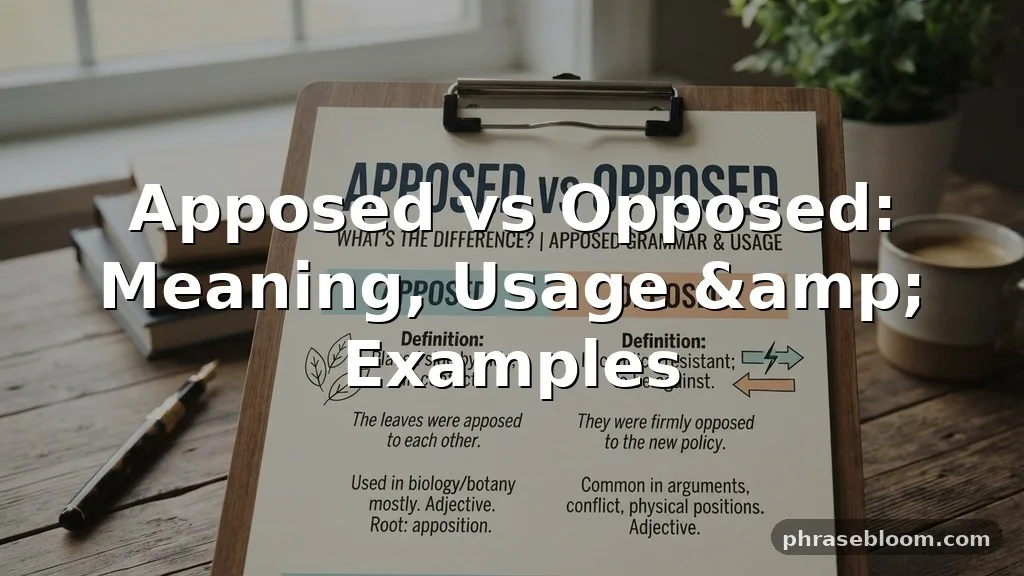
Apposed vs Opposed: Meaning, Usage & Examples
Apposed vs opposed is a useful comparison because these words look and sound similar but describe very different relationships. Apposed means placed beside something else, often for comparison or explanation, while opposed means set against something or in disagreement with it.
The difference becomes clearer when you examine sentence structure, parts of speech, and context. Once you understand apposition and opposition, you can choose the right word confidently in academic writing, professional communication, literary analysis, and everyday sentences.
Apposed vs Opposed: The Direct Answer
Apposed means positioned next to something, usually so that the two things can be compared, described, or connected. Opposed means resisting something, disagreeing with it, or standing in contrast to it.
| Word | Basic meaning | Typical relationship | Example |
|---|---|---|---|
| Apposed | Placed beside | Side-by-side connection or comparison | The two images were apposed for analysis. |
| Opposed | Set against or disagreeing | Conflict, resistance, or contrast | The residents opposed the proposal. |
In simple terms, apposed suggests beside, while opposed suggests against. The words may appear in similar discussions, especially when writers compare ideas, but their meanings are not interchangeable.
For example, two passages may be apposed when a teacher places them next to each other to show a difference in style. A group may be opposed to a policy when its members actively reject or resist it.
What Does Apposed Mean?
Apposed is the past-tense or past-participle form of appose. To appose something is to place it beside another thing, often in a deliberate arrangement that invites comparison, interpretation, or clarification.
The word is related to apposition, a grammatical and rhetorical concept involving one element being placed next to another. In grammar, an appositive is a noun or noun phrase that sits beside another noun and gives it additional information.
Consider this sentence: “Maria, the department manager, approved the request.” The phrase “the department manager” is an appositive phrase because it stands beside “Maria” and identifies her in another way.
In broader writing, apposed does not always refer to a strict grammatical appositive. It can describe two objects, statements, images, or ideas placed beside one another for a meaningful comparison.
- Two photographs were apposed to show the building before and after renovation.
- The author apposed two memories to highlight the contrast between childhood and adulthood.
- The translations were apposed so readers could compare the wording.
- The legal clauses were apposed for closer examination.
These examples share the same central idea: the items are brought together spatially or conceptually. They are not necessarily fighting, disagreeing, or resisting one another.
Apposed in Grammar
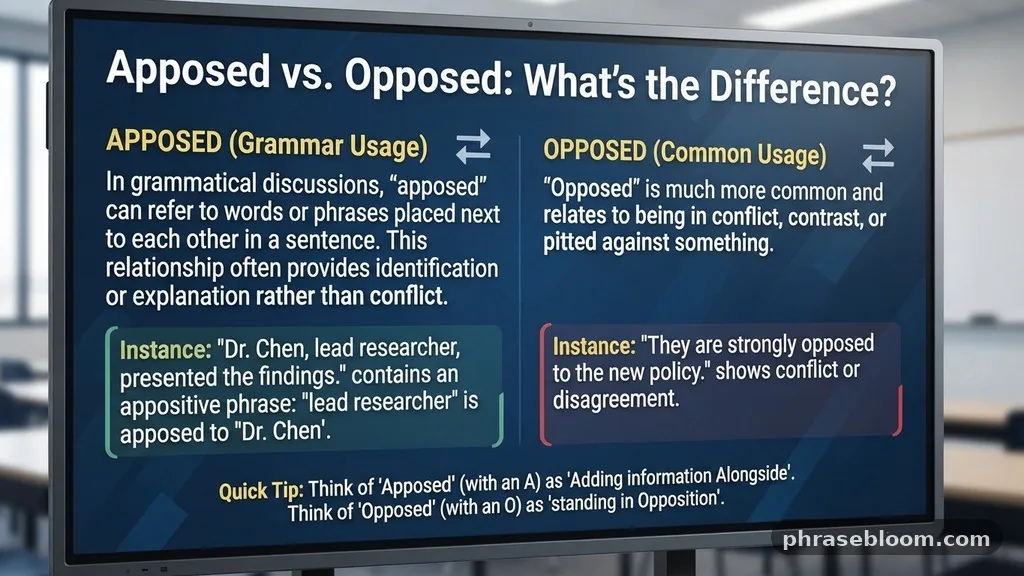
In grammatical discussions, apposed can refer to words or phrases placed next to each other in a sentence. The relationship often provides identification or explanation rather than conflict.
For instance, “Dr. Chen, the lead researcher, presented the findings” contains an appositive phrase. “The lead researcher” is placed beside “Dr. Chen” and supplies extra information about the person.
It would be inaccurate to say that “Dr. Chen” and “the lead researcher” are opposed.
They refer to the same person from two different descriptive angles. Their relationship is one of apposition.
The word apposed is less common in ordinary conversation than placed, positioned, or set beside. Writers tend to use it in academic, analytical, artistic, historical, and grammatical contexts.
What Does Opposed Mean?
Opposed is the past-tense and past-participle form of oppose. It describes resistance, disagreement, contradiction, or a position that stands against another position.
If someone is opposed to a plan, that person does not support it. If two forces are opposed, they are working against each other. If two viewpoints are opposed, they differ sharply rather than merely appearing side by side.
Examples include:
- The board was opposed to the proposed merger.
- Several researchers have opposed the interpretation.
- The novel presents two opposed political philosophies.
- The team members were opposed on the question of funding.
Opposed can describe an active disagreement, but it does not always involve open conflict. A person can quietly be opposed to a decision, while a political party can publicly oppose legislation.
The word also appears in physical or visual descriptions. Two objects may be positioned in opposed directions, such as figures facing away from each other. Here, opposed means oriented against or away from one another, not simply placed side by side.
Opposed to and Opposed With
The most common construction is opposed to. Use it when a person, group, or position resists an idea, action, policy, or proposal.
“The residents are opposed to the development” means that the residents do not support the development. “The committee opposed the development” uses opposed as a verb form and does not need to.
The phrase in opposition to has a similar meaning and often sounds more formal. It can describe a disagreement between policies, arguments, groups, or movements.
In contrast, apposed does not normally take to in this meaning. You would write “the examples were apposed for comparison,” not “the examples were apposed to the proposal” when you mean that someone resisted the proposal.
Apposed and Opposed in Sentence Structure
The clearest way to distinguish these words is to examine what relationship the sentence presents. Ask whether the sentence places two things beside each other or sets one thing against another.
Apposed often works as a descriptive adjective or participle. It tells readers that something has been positioned beside something else.
- The editor apposed the original paragraph and the revised version.
- The paintings were apposed in the gallery’s central room.
- The two definitions were apposed to clarify their different meanings.
Opposed can also function as an adjective or participle, but its meaning concerns resistance or disagreement.
- The employees opposed the reduction in benefits.
- The opposed candidates presented different economic plans.
- The witness was opposed to changing the agreement.
Placement alone does not determine the word. Two ideas can be placed beside each other without being opposed, and two ideas can be opposed even when they are never physically displayed together.
Placed Beside Versus Set Against
A useful mental test is to replace the word with a simpler phrase. If placed beside fits, apposed may be correct. If set against, in disagreement with, or resisting fits, opposed is probably the right choice.
| Original idea | Useful replacement | Likely word |
|---|---|---|
| The charts were placed beside each other. | Placed beside | Apposed |
| The union resisted the proposal. | Resisted | Opposed |
| The paragraphs were shown together for analysis. | Displayed side by side | Apposed |
| The two theories conflict. | Set against or in disagreement | Opposed |
This substitution test is especially useful for English learners because it focuses on meaning rather than spelling. The extra “p” in apposed does not tell you what the word means. The sentence’s relationship does.
Apposition, Appositive Phrases, and Comparison
The noun apposition describes a relationship in which one noun or noun phrase is placed beside another noun or noun phrase. The second element commonly renames, identifies, or explains the first.
In “Jordan Lee, the project architect, reviewed the plans,” the phrase “the project architect” is an appositive. It provides another label for Jordan Lee and is set beside the name without expressing disagreement.
An appositive can be restrictive or nonrestrictive. A restrictive appositive is necessary to identify the noun, while a nonrestrictive appositive adds information that the sentence could survive without.
Compare these examples:
- My colleague Priya led the meeting. The name identifies which colleague is meant.
- Priya, my colleague, led the meeting. The phrase “my colleague” adds information and is separated by commas.
Not every phrase placed beside a noun is called an appositive in every grammar system, and punctuation rules can vary with the intended meaning. Still, the basic concept remains stable: apposition connects related descriptions rather than opposing positions.
Writers sometimes use apposed in literary criticism to describe images or ideas placed next to each other. A critic might say that the author apposed a celebration with a funeral scene. The scenes may create a powerful contrast, but the act of placing them together is apposition; the emotional relationship may be opposition or juxtaposition.
Apposed Versus Juxtaposed
Juxtaposed is often a more familiar alternative to apposed when a writer means that two things are placed close together for contrast. It does not necessarily mean that the things are in direct disagreement.
A newspaper might juxtapose a company’s public statement with customer testimonials. The statements are presented together, but the writer has not necessarily declared that one side opposes the other.
Apposed is more closely connected to the act of placing beside. Opposed emphasizes a relationship of resistance or contradiction. Juxtaposed often falls between the two, describing side-by-side presentation that may reveal contrast.
Apposed vs Opposed in Real Sentences
Context makes the distinction practical. The following examples show how each word works in professional, academic, and everyday writing.
Academic and Analytical Writing
“The researcher apposed the two survey results to identify changes in public opinion.” Here, the results are placed together for comparison.
“The article presents two opposed explanations for the decline in enrollment.” In this sentence, the explanations conflict or lead to different conclusions.
“The author apposed a personal account with a statistical summary.” The sentence describes arrangement, not disagreement.
Workplace and Business Writing
“The finance team apposed the forecast with last year’s results before preparing the report.” The figures were placed side by side so the team could examine them.
“The department was opposed to delaying the product launch.” The department resisted the proposed delay.
“The presentation apposed customer feedback with the company’s internal performance data.” The two sets of information were brought together for analysis.
Public Communication and Policy
“The campaign apposed images of the restored park with archival photographs.” The visual arrangement helps the audience see the change over time.
“Several community groups opposed the zoning amendment.” The groups expressed disagreement with the amendment.
“The report compares two opposed approaches to housing policy.” The approaches are presented as competing positions rather than neutral examples.
Everyday Examples
“The teacher apposed the two maps on the classroom wall.” The maps were placed beside one another.
“My sister is opposed to the new parking rules.” She does not support them.
“The display apposed modern furniture with antique pieces.” The furniture was arranged together to make the contrast visible.
Each example depends on the intended relationship. If the sentence describes arrangement, comparison, or explanation, apposed may work. If it describes resistance, disagreement, or conflict, opposed is the natural choice.
Pronunciation, Spelling, and Word Forms
Apposed and opposed are spelled similarly, but their first syllables differ in both spelling and pronunciation. Apposed begins with the sound associated with “appose,” while opposed begins with the sound associated with “oppose.”
In standard pronunciation, apposed is commonly pronounced like “uh-POHZD,” while opposed is commonly pronounced like “uh-POHZD” or with a slightly different vowel quality depending on the speaker and variety of English. In speech, the words can sound very close, which makes context especially important.
The spelling difference is meaningful:
- appose, apposed, apposition, appositive relate to placement beside or grammatical connection;
- oppose, opposed, opposition relate to resistance, disagreement, or conflict.
Do not assume that the double “p” in both words makes them variants of the same term. They come from different word families and perform different semantic jobs.
For a formal reference on the less common verb appose, consult the Merriam-Webster dictionary entry for appose. A dictionary can also help confirm pronunciation, inflected forms, and examples of established usage.
Related Parts of Speech
Appose is a verb, and apposed is one of its forms. Apposition is a noun, while appositive can function as a noun or adjective in grammatical explanations.
Oppose is also a verb, and opposed is its past-tense or past-participle form. Opposition is the related noun, and opposed can work as an adjective.
| Word family | Part of speech | Meaning | Example |
|---|---|---|---|
| appose | Verb | Place beside | The editor apposed the passages. |
| apposition | Noun | Placement beside or grammatical connection | The sentence contains apposition. |
| oppose | Verb | Resist or disagree with | They oppose the measure. |
| opposition | Noun | Resistance or disagreement | The proposal met strong opposition. |
Common Mistakes and How to Correct Them
Because the words are close in appearance, writers sometimes use one when they mean the other. The error can change the sentence from a neutral comparison to a statement of conflict.
Using Opposed for Simple Placement
Incorrect: “The editor opposed the two paragraphs for comparison.” This sounds as though the editor resisted the paragraphs.
Better: “The editor apposed the two paragraphs for comparison.” The revised sentence clearly describes placing the paragraphs side by side.
Using Apposed for Disagreement
Incorrect: “The committee was apposed to the proposed rule.” Apposed does not mean against in this context.
Better: “The committee was opposed to the proposed rule.” The committee disagreed with or resisted the rule.
Confusing Apposed With Opposite
Opposite is a separate word from opposed. It can describe position, direction, meaning, or relationship, as in “the opposite side of the street” or “an opposite conclusion.”
Opposed describes a person, group, idea, or force that resists or conflicts with something else. The phrase “opposed views” refers to conflicting views, while “opposite views” can refer to views located at different ends of a spectrum.
Assuming Similar Spelling Means Similar Meaning
Apposed and opposed are not interchangeable spelling choices. Replacing one with the other can affect the logic of a sentence, especially in academic analysis and technical writing.
A useful editing step is to ask whether the sentence involves comparison or disagreement. Comparison points toward apposed, while disagreement points toward opposed.
Choosing the Right Word in Formal and Professional Writing
In formal writing, precision matters more than choosing the word that sounds more sophisticated. Apposed is appropriate when you need to describe deliberate placement or comparison, but it may be unfamiliar to some readers.
If your audience may not know apposed, a clearer phrase can be better. Instead of writing “the data were apposed,” you could write “the data were placed side by side” or “the data were presented together for comparison.”
Opposed is much more common and usually needs no replacement when the meaning is disagreement or resistance. Depending on the sentence, alternatives include against, resistant to, in conflict with, or not in favor of.
- Use apposed when the focus is on placing items beside each other.
- Use opposed when the focus is on resistance or disagreement.
- Use juxtaposed when side-by-side presentation creates a notable contrast.
- Use placed beside when plain language will help a broad audience.
- Use in opposition to when a formal noun phrase suits the sentence.
Professional writers should also consider whether the word adds clarity. A specialized term is useful when it accurately expresses a specific relationship. It is less useful when a familiar phrase would communicate the point faster.
Editing Questions to Ask
Before publishing a sentence, ask: Are the items physically or conceptually beside each other? Is one person or group resisting another idea? Would “placed beside” or “set against” make the intended meaning obvious?
These questions address meaning, not merely spelling. They also help prevent accidental ambiguity in reports, presentations, policy documents, and academic work.
For example, “The report apposes two interpretations” is concise but somewhat specialized. “The report places two interpretations side by side” is longer, yet it may be more accessible to general readers.
Apposed vs Opposed: A Practical Comparison
The following comparison brings the main distinctions together without treating the words as interchangeable.
| Feature | Apposed | Opposed |
|---|---|---|
| Core meaning | Placed beside for comparison or explanation | Set against, resisted, or disagreed with |
| Related noun | Apposition | Opposition |
| Common context | Grammar, criticism, visual analysis, comparative research | Politics, policy, disagreement, debate, resistance |
| Simple replacement | Placed beside | Against or resisting |
| Example | The editor apposed the two versions. | The editor opposed the proposed revision. |
| Potential clearer alternative | Presented side by side | Rejected or disagreed with |
The table shows why the difference is semantic rather than merely grammatical. Both words can describe relationships between people, ideas, texts, or objects, but the type of relationship changes.
One sentence can even contain both words: “The curator apposed the two sculptures, although the artists held opposed views about their purpose.” The sculptures were placed beside each other, while the artists disagreed.
Alternatives to Apposed and Opposed
Sometimes the best word is neither apposed nor opposed. Plain alternatives can make a sentence more direct, particularly in workplace communication or writing for an international audience.
Alternatives to Apposed
Use placed beside, positioned next to, shown together, presented side by side, or compared with when you want to emphasize arrangement or analysis.
“The before-and-after photographs were presented side by side” is immediately clear. “The before-and-after photographs were apposed” is concise but more specialized.
Alternatives to Opposed
Use against, resistant to, in disagreement with, not in favor of, or in opposition to when you mean resistance or conflict.
“The residents were against the proposed road” is direct and conversational. “The residents were opposed to the proposed road” is also natural and may suit formal writing better.
Choose an alternative when it improves clarity, not simply to avoid repeating a word. Repetition is often less harmful than replacing a precise term with an inaccurate one.
Frequently Asked Questions
Is apposed the same as opposed?
No. Apposed means placed beside or presented together, while opposed means resisted, rejected, or set against. They belong to different word families and should not be treated as spelling variants.
What does apposed mean in a sentence?
Apposed means that something has been placed next to something else, often for comparison or explanation. In “The editor apposed the original and revised passages,” the passages were presented side by side.
What does opposed mean in a sentence?
Opposed means against or in disagreement with something. In “The board was opposed to the proposal,” the board did not support the proposal.
Is apposed a grammatical term?
Apposed can appear in grammatical discussions because it relates to apposition, in which one word or phrase is placed beside another for identification or explanation. The related term appositive usually describes the noun or phrase that provides the additional information.
What is the easiest way to remember the difference?
Remember apposed means beside and opposed means against. If the sentence describes side-by-side comparison, choose apposed; if it describes resistance or disagreement, choose opposed.
Conclusion: Apposed vs Opposed
The central distinction in Apposed vs Opposed is simple: apposed describes something placed beside something else, while opposed describes resistance or disagreement. Apposition connects related words or ideas, whereas opposition sets people, positions, or forces against one another.
Use the substitution test during editing. If “placed beside” fits, apposed may be accurate; if “against” or “in disagreement with” fits, opposed is the better choice. When a specialized term might slow readers down, choose a clear alternative such as “presented side by side,” then check the final sentence for precise word usage.
Related: Is Summer Capitalized? Grammar Rules Explained? · Alright vs All Right · Do Not vs Don’t
Explore more on PhraseBloom.