
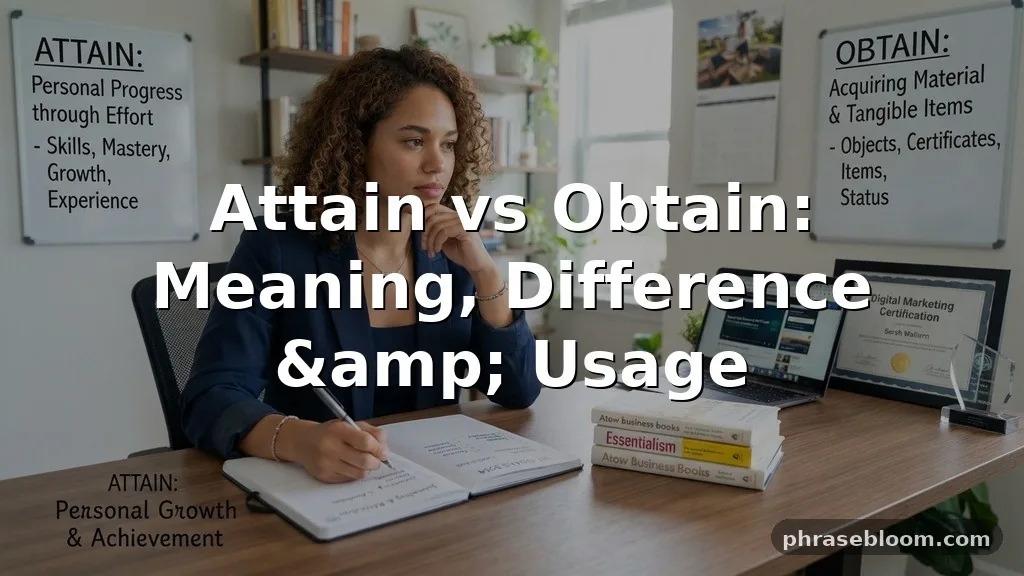
Attain vs obtain is a common vocabulary question because both verbs can describe getting something, yet they usually describe different kinds of getting. Attain generally means to reach a goal, level, condition, or achievement, while obtain usually means to get, receive, or secure something through an action or process.
The difference between attain and obtain becomes clearer when you look at the object that follows each verb. You attain a degree, attain success, or attain a milestone; you obtain permission, obtain information, or obtain a document. The examples below show how to choose the natural verb in formal English, business writing, academic work, and everyday communication.
Attain vs Obtain: The Short Answer
Attain means to reach or achieve something, often after effort, development, or progress. You can attain a goal, attain a high standard, attain independence, or attain a position that reflects advancement.
Obtain means to get or secure something, often by requesting it, purchasing it, earning it, or following a required procedure. You can obtain permission, obtain information, obtain a copy, or obtain funding.
| Verb | Core meaning | Common objects | Example |
|---|---|---|---|
| Attain | Reach a goal, level, or state | Goal, standard, success, milestone | She attained the required level of certification. |
| Obtain | Get, receive, or secure something | Permission, information, document, approval | She obtained permission to access the records. |
Both words are transitive verbs, which means they normally take a direct object. You attain something and obtain something, although the type of object and the implied process are usually different.
A simple rule helps in many cases: use attain for an outcome you reach, and use obtain for an item, fact, authorization, or resource you get. The distinction is not absolute in every sentence, but it is reliable enough to guide most professional writing.
Attain Definition and Meaning
The basic attain definition is “to reach or succeed in achieving something.” The verb often suggests movement toward a desired result, usually through effort, time, learning, discipline, or gradual improvement.
Attain is closely related to the idea of arrival. A person may work toward a goal and eventually attain it.
A company may improve its performance and attain a higher standard. A student may complete years of study and attain a qualification.
Common examples include:
- attain a goal
- attain success
- attain a higher level of accuracy
- attain financial independence
- attain professional recognition
- attain a required standard
- attain a milestone
Attain meaning often overlaps with achieve, but the two verbs are not identical in tone. “Achieve” is broad and natural in everyday speech, while “attain” can sound more formal and can emphasize reaching a condition, level, or status.
For example, “The team achieved its sales target” is ordinary business English. “The team attained the highest performance level in the program” sounds more formal and focuses on reaching a recognized level.
The object after attain is usually something that can be viewed as a destination or result. That does not mean it must be physical or measurable. You can attain wisdom, maturity, equality, stability, or independence, all of which describe states reached over time.
Attain and Personal Progress
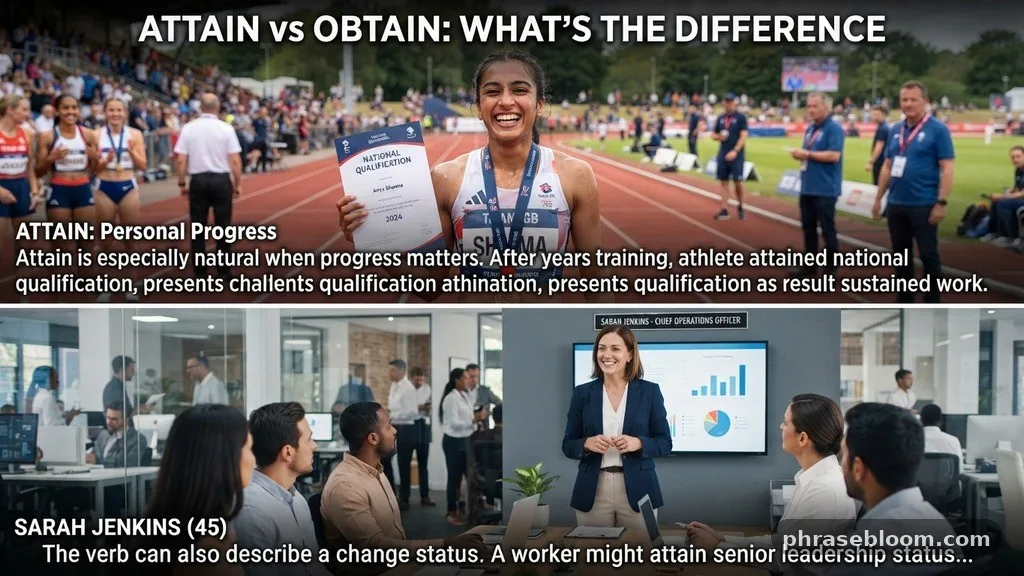
Attain is especially natural when progress matters. “After years of training, the athlete attained national qualification” presents qualification as the result of sustained work.
The verb can also describe a change in status. A worker might attain senior leadership status, or a developing organization might attain full accreditation. In both examples, the subject reaches a position that was not held at the beginning.
Attain does not necessarily promise that the result was easy. In fact, the word often carries an implication of difficulty, persistence, or a standard that must be met. That implication makes it useful in academic, legal, institutional, and formal business contexts.
Obtain Definition and Meaning
The obtain definition is “to get, receive, or secure something.” Obtain usually focuses on possession or access rather than arrival at a personal or organizational level.
You might obtain a document from an office, obtain approval from a manager, or obtain information from a reliable source. In each case, the subject takes steps to get something that already exists or can be provided.
Typical obtain examples include:
- obtain permission
- obtain approval
- obtain information
- obtain a license
- obtain a copy of a contract
- obtain funding
- obtain consent
Obtain meaning is close to “get,” but obtain is more formal. A colleague might say, “Can you get the figures?” A report might say, “The analyst obtained the figures from the finance department.” The underlying action is similar, but the register changes.
Obtain often implies a source, procedure, request, exchange, or authorization. You obtain records from an archive, obtain a permit from a government agency, and obtain consent from a participant.
The word does not necessarily imply struggle or long-term development. Obtaining a password reset link may take only a minute. Obtaining regulatory approval may take months, but the verb still emphasizes securing approval rather than reaching a personal state.
Obtain in Formal and Professional Writing
Obtain is common in policies, reports, contracts, research papers, and workplace instructions. A policy may state that employees must obtain approval before purchasing equipment.
Academic writers use obtain to describe the collection of evidence or results. For example, “The researchers obtained responses from 240 participants” explains how the data was collected without suggesting that the researchers reached a goal.
Business writing also uses obtain for materials and permissions. “The project manager obtained revised cost estimates” is precise because the estimates were received from another source.
If you replace obtain with attain in that sentence, the meaning changes. “The project manager attained revised cost estimates” sounds incorrect because cost estimates are obtained, not normally reached as a level or condition.
The Difference Between Attain and Obtain
The central difference between attain and obtain is the relationship between the subject and the object. Attain presents the object as a goal, level, condition, or achievement; obtain presents it as something acquired, received, or secured.
| Situation | Natural verb | Why |
|---|---|---|
| Reach a performance standard | Attain | The standard is a level the subject reaches. |
| Get written authorization | Obtain | Authorization is secured from another person or body. |
| Reach financial independence | Attain | Independence is a condition developed over time. |
| Get a business license | Obtain | The license is issued through an application process. |
| Reach a career milestone | Attain | The milestone represents progress or achievement. |
| Get a copy of a report | Obtain | The report is received from a source. |
Consider the contrast between “The company attained profitability” and “The company obtained a loan.” Profitability is a business condition reached through performance; a loan is a financial resource secured from a lender.
Another useful contrast is “She attained fluency in Spanish” and “She obtained a Spanish dictionary.” Fluency is a developed ability, while the dictionary is an object she acquired.
The difference is sometimes subtle because both verbs can describe something desirable. A person may obtain a degree in one context, especially when the focus is on receiving the credential, but “attain a degree” emphasizes completing the educational path and reaching that qualification.
Achieve vs Attain
Achieve and attain are closer in meaning than attain and obtain. Both can describe reaching a goal or desired result, but achieve is more common in ordinary conversation.
“The department achieved its annual target” sounds direct and natural. “The department attained its annual target” is grammatical, but it has a more formal or deliberate tone.
Attain is often strongest with conditions and levels: attain maturity, attain stability, attain equality, or attain a high standard. Achieve is more flexible with tasks and outcomes: achieve an objective, achieve success, or achieve a breakthrough.
Do not use attain merely because a sentence sounds formal. Choose it when the object genuinely represents a level, condition, status, or milestone that the subject reaches.
Attain Usage in Real Sentences
Attain usage is easiest to understand through realistic contexts. The following examples show how the verb works in workplace communication, education, public administration, and personal development.
- “The department attained its quality target three months ahead of schedule.”
- “Applicants must attain a minimum score before entering the advanced program.”
- “The organization attained charitable status after completing the required review.”
- “Her research helped the team attain a more accurate estimate.”
- “The company hopes to attain carbon neutrality within its published target period.”
- “By the end of the course, participants should attain basic competence in data analysis.”
In each sentence, attain introduces a result, threshold, status, or condition. The subject does not simply receive an object from someone else.
Attain also works well in formal descriptions of development. A report may say that a project “attained operational readiness” after testing, training, and review.
For a personal statement, “I attained my goal of becoming a licensed counselor” is grammatically correct and formal. In a conversational email, “I achieved my goal” would usually sound more relaxed.
Attain a Goal and Reach a Milestone
The phrase attain a goal is correct, although “achieve a goal” is more frequent in everyday business English. Attain a goal sounds especially suitable when the goal required sustained effort or when the writing has an official tone.
You can also attain a milestone, but “reach a milestone” is often more idiomatic. For example, “The company reached a milestone by opening its hundredth location” sounds natural and accessible.
These alternatives are not evidence that attain is wrong. They simply show that English offers several verbs with overlapping meanings, and the best choice depends on tone, object, and context.
Obtain Usage in Real Sentences
Obtain usage is common whenever a person or organization gets something through a source, request, purchase, application, or formal process. The word is particularly useful when “get” feels too casual for the document.
- “Please obtain written approval before changing the production schedule.”
- “The auditor obtained supporting invoices from the supplier.”
- “Researchers obtained informed consent from every participant.”
- “The legal team obtained a certified copy of the filing.”
- “The customer must obtain a replacement access card from reception.”
- “The project cannot begin until the contractor obtains the required permit.”
These examples involve items, evidence, authorization, or records that come from an identifiable source. That is the central pattern behind obtain.
Obtain is also useful when the process matters. “The company obtained financing after submitting a revised proposal” tells readers that financing was secured through an application or negotiation.
The verb may appear in passive constructions as well. “The records were obtained from the public archive” focuses on the records and their source rather than the person who retrieved them.
Obtain Permission and Obtain Information

The phrases obtain permission and obtain information are standard formal expressions. Permission comes from an authority, while information comes from a source, database, person, or document.
For example, “Employees must obtain permission before recording a meeting” is appropriate in a workplace policy. “The consultant obtained information from interviews with regional managers” is suitable for a report.
Attain would not normally work in either sentence. Permission and information are not levels that the subject reaches; they are things the subject secures or receives.
Formal English, Tone, and Grammatical Choice
Both attain and obtain belong comfortably in formal English, but they signal different relationships. Attain is associated with progress toward an outcome, while obtain is associated with acquisition or access.
In a university application, “I attained a distinction in the final examination” emphasizes the result achieved. “I obtained a copy of my transcript” emphasizes receiving an official document.
Business writers should also consider whether the noun is a result or a resource. A company can attain growth, attain stability, or attain a target. It can obtain capital, obtain approval, or obtain market data.
Legal and policy documents often favor obtain because they describe required actions. “The contractor shall obtain all necessary permits” is clearer than “The contractor shall attain all necessary permits,” which suggests that permits are goals rather than authorizations issued by an authority.
Academic writers should avoid choosing a verb only because it sounds sophisticated. Precision is more important than formality. A plain verb such as “get,” “reach,” “receive,” or “achieve” may be better if it expresses the relationship accurately.
| Writing situation | Preferred wording | Reason |
|---|---|---|
| Employee handbook | Obtain approval before submitting expenses. | The employee receives authorization. |
| Performance report | The team attained its service target. | The target is a level reached through performance. |
| Research paper | The study obtained responses from participants. | Responses were collected from a source. |
| Career statement | I attained professional certification. | Certification represents a qualification reached. |
For reference, writers can compare definitions and usage notes in the Merriam-Webster Dictionary. A dictionary is useful for confirming a word’s core sense, but the sentence context still determines which synonym sounds most natural.
Common Errors and How to Correct Them
The most common mistake is treating attain and obtain as interchangeable synonyms in every context. Their meanings overlap around the general idea of getting something, but their normal objects differ.
Using Obtain for a Goal
“She obtained her goal of becoming department director” is understandable, but it is not the most natural choice. Write “She attained her goal” or, in everyday business English, “She achieved her goal.”
Obtain is better if the object is a document or resource connected with that goal. She might attain the position and obtain a formal appointment letter.
Using Attain for Permission
“The manager attained permission to access the files” sounds unnatural because permission is granted or secured. The clearer sentence is “The manager obtained permission to access the files.”
Confusing a Result with an Object
“The research team attained the survey responses” uses the wrong verb if the intended meaning is that the team collected responses. Write “The research team obtained the survey responses.”
By contrast, “The research team attained a higher level of accuracy” is appropriate because accuracy is a level the team reached.
Overusing Formal Vocabulary
Replacing every instance of “get” with obtain can make workplace writing stiff. “Please obtain the latest invoice” is appropriate in a formal request, but “Can you get the latest invoice?” may be better in a quick internal message.
Likewise, replacing every instance of “achieve” with attain does not automatically improve a report. Use attain when it adds a precise sense of reaching a standard, condition, or status.
How to Choose the Right Verb
When you are deciding between attain and obtain, identify what follows the verb. Ask whether the object is a destination or achievement, or whether it is something received, collected, purchased, or authorized.
- Use attain for a goal, level, standard, condition, status, or milestone.
- Use obtain for permission, information, approval, evidence, funding, or a document.
- Use achieve when you want a common, flexible verb for success or results.
- Use reach when the idea of arriving at a point, level, or milestone should sound natural and direct.
- Use get in informal communication when a formal alternative is unnecessary.
Next, consider the source of the object. If another person, office, agency, or database supplies it, obtain is often the right choice. If the subject develops, progresses, or performs until reaching a result, attain is more likely.
Finally, read the complete sentence aloud. “The applicant obtained a degree” may be acceptable if the focus is on receiving the credential, while “The applicant attained a degree” emphasizes completing the course of study and reaching the qualification.
There is no need to force a distinction where another verb is clearer. “The team reached its target” may be better than either attain or obtain if your audience prefers plain business English.
Attain vs Obtain in Business and Academic Writing
In business reports, the choice often depends on whether the sentence describes performance or resources. “The division attained a 95 percent customer-satisfaction score” describes a result, while “The division obtained customer feedback through quarterly surveys” describes collected information.
Internal communications should match the level of formality required. A short email might say, “Please get approval from Finance,” while a procedure might say, “Employees must obtain approval from Finance before committing funds.”
Company policies typically use obtain for compliance requirements. Examples include obtaining consent, obtaining authorization, obtaining a license, and obtaining records.
Strategic plans often use attain for desired conditions. A plan may aim to attain operational independence, attain a specified growth rate, or attain a stronger position in a market.
Academic writing requires particular care because both verbs appear frequently. Researchers obtain data, obtain consent, obtain samples, and obtain results from an experiment. They attain proficiency, attain statistical significance only in carefully framed contexts, or attain a level of reliability through a method.
Even here, conventional collocations matter. “The experiment produced statistically significant results” is usually better than “The experiment attained statistically significant results.” The second sentence may be understandable, but it does not use the most natural academic phrasing.
Useful Editing Questions
Editors can ask three quick questions before approving the sentence. Is the subject reaching something, receiving something, or simply producing something? Does the noun after the verb normally function as a goal, or does it come from a source?
The final question is whether a simpler verb would improve the sentence. Clear writing does not require the most formal possible word; it requires the word that accurately describes the action.
Attain and Obtain: Related Alternatives
Several related verbs can replace attain or obtain, but each carries its own emphasis. Achieve usually describes success or completion, while reach emphasizes arriving at a point or level.
Acquire is close to obtain, especially when something is gained over time or added to a collection. A company may acquire equipment, expertise, or another business. Obtain is more natural for permission, information, and official documents.
Receive emphasizes the fact that something was given or delivered. “The office received the completed forms” does not necessarily say that staff actively requested or secured them.
Secure suggests successful effort, negotiation, or protection. A company may secure financing, secure approval, or secure a contract. It can often replace obtain when the writer wants to emphasize the effort involved.
| Verb | Best used for | Example |
|---|---|---|
| Achieve | Success, objectives, results | The team achieved its quarterly objective. |
| Reach | Points, levels, milestones | The project reached the testing stage. |
| Acquire | Assets, skills, businesses, collections | The firm acquired specialist software. |
| Receive | Items or messages delivered by another party | The office received the signed form. |
| Secure | Resources or agreements gained through effort | The nonprofit secured additional funding. |
Choosing an alternative can make the sentence more natural. “The business attained a contract” is weaker than “The business secured a contract,” while “The business obtained a contract” is formal but less expressive of negotiation or competition.
Examples Readers Can Copy and Adapt
The following sentences show practical patterns for professional, academic, and everyday writing. Each example uses the verb that best matches the object and intended emphasis.
- “The candidate attained the required professional standard.”
- “The candidate obtained a copy of the application guidelines.”
- “Our team attained its customer-service target in the final quarter.”
- “Our team obtained updated contact details from the regional offices.”
- “Employees must obtain written approval before accessing restricted data.”
- “The training program helped employees attain a higher level of technical confidence.”
- “The researcher obtained consent before conducting the interviews.”
- “The researcher attained a clearer understanding of the underlying pattern.”
- “The organization hopes to attain long-term financial stability.”
- “The organization obtained a grant to support the new program.”
- “After several revisions, the proposal attained the level of detail required by the committee.”
- “After several revisions, the writer obtained approval from the committee.”
Notice that a single situation can involve both verbs. A team may obtain funding and then attain its development target. A student may obtain research materials and attain a qualification.
That combination illustrates why the difference matters. The verbs describe separate actions within the same project, rather than two spellings of one interchangeable word.
Frequently Asked Questions
What is the difference between attain and obtain?
Attain means to reach or achieve a goal, level, condition, or status. Obtain means to get, receive, or secure something such as permission, information, funding, or a document.
Is “attain a goal” correct?
Yes. “Attain a goal” is correct and has a formal tone. “Achieve a goal” is more common in everyday speech, while “reach a goal” is also natural and direct.
Is “obtain permission” correct?
Yes. “Obtain permission” is a standard formal expression because permission is secured from another person or authority. “Attain permission” is generally not the natural choice.
Can attain and obtain be used interchangeably?
Not reliably. They overlap in the broad idea of getting something, but attain normally describes reaching a result and obtain normally describes receiving or securing an object, resource, fact, or authorization.
Which word should I use in formal writing?
Use the word that accurately matches the action. Choose attain for a goal, standard, condition, or milestone; choose obtain for permission, information, approval, evidence, or a document. If neither sounds natural, consider achieve, reach, receive, acquire, or secure.
Conclusion
The practical lesson from attain vs obtain is simple: attain points to a result or level you reach, while obtain points to something you get or secure. You attain success, independence, a standard, or a milestone; you obtain permission, information, funding, or an official document.
When the choice feels uncertain, identify the object and ask whether it is a destination or a resource. That quick test will resolve most cases, and a trusted dictionary can confirm unusual usage. Once you understand the difference between attain and obtain, your formal English will become more precise without sounding unnecessarily complicated.
Explore more on PhraseBloom.