
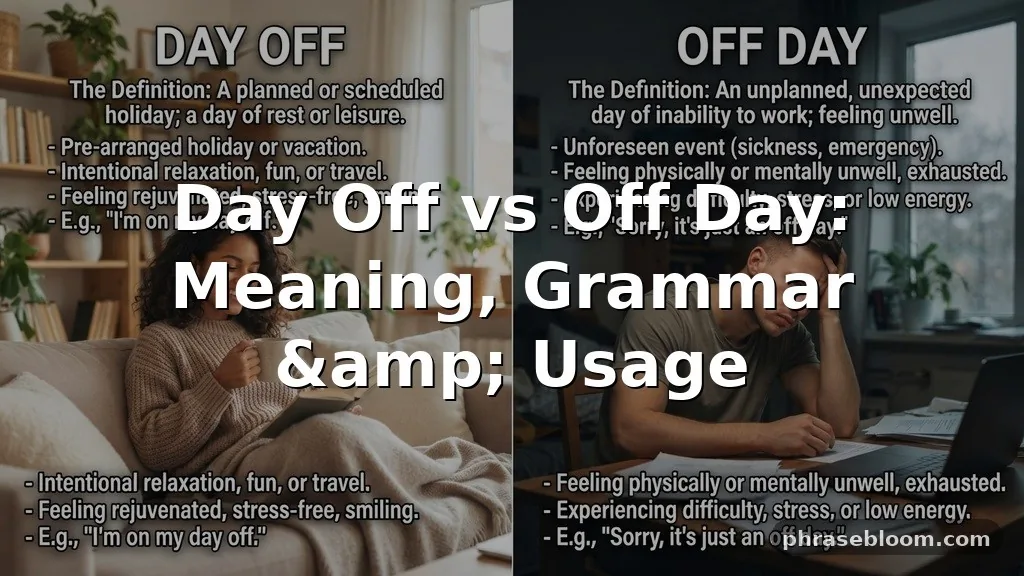
Day Off vs Off Day describes two phrases that look similar but refer to very different situations. A day off is a planned period away from work or another regular duty, while an off day is usually a day when someone performs below their normal standard or simply feels out of sorts.
The distinction matters in workplace communication, schedules, sports reports, and everyday English. Confusing the phrases can turn a request for leave from work into a comment about poor performance, so the examples below show how grammar, context, and tone determine the right choice.
The Quick Difference Between Day Off and Off Day
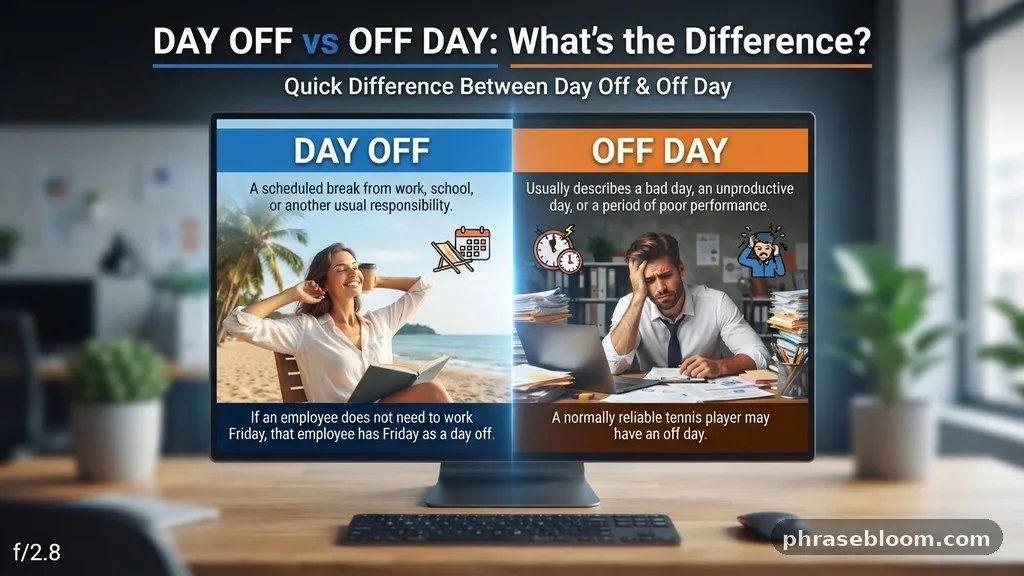
A day off is a scheduled break from work, school, or another usual responsibility. If an employee does not need to work on Friday, that employee has Friday as a day off.
An off day usually describes a bad day, an unproductive day, or a period of poor performance. A normally reliable tennis player may have an off day, or a writer may say, “I’m having an off day,” after struggling to concentrate.
| Phrase | Meaning | Typical grammar | Example |
|---|---|---|---|
| day off | A planned break from work or duty | Noun phrase | I have a day off tomorrow. |
| off day | A day of poor performance or low energy | Noun phrase | The team had an off day. |
| off | Not working, functioning, or feeling normally | Adjective | I feel off today. |
The simplest rule is practical: use day off for time away from work, and use off day for a disappointing or unusual day. The word order changes the meaning because each phrase developed as a different expression.
What Does Day Off Mean?
The phrase day off means a day when someone is not required to work or carry out a normal duty. It can refer to a regular rest day in a work schedule, a vacation day, a personal day, a public holiday, or another approved period of leave from work.
In “I’m taking a day off,” the noun phrase a day off functions as the object of the verb taking. In “Monday is my day off,” it functions as a subject complement that identifies Monday as the speaker’s scheduled break.
A day off does not automatically mean the person is relaxing. Someone may use a day away from work to attend a medical appointment, care for a family member, complete errands, or handle an administrative task.
- Rest day: a planned break intended to provide recovery from work, training, or another demanding activity.
- Vacation day: an approved day taken from an employee’s vacation allowance.
- Personal day: time away from work used for a personal matter, depending on the employer’s policy.
- Holiday: a nationally or culturally recognized day when many workplaces close, although usage varies by country.
- Leave from work: a broader term that may cover one day, several days, or a longer approved absence.
These related expressions are not always interchangeable. A person can have a day off because it is part of a rotating schedule, while a personal day usually requires a request and approval.
What Does Off Day Mean?
The phrase off day usually means a day when someone is not performing normally. The person may be tired, distracted, ill, emotionally unsettled, or simply unable to produce their usual results.
For example, “The goalkeeper had an off day” suggests that the goalkeeper made unusual mistakes. It does not normally mean that the goalkeeper was absent or had a scheduled break.
The expression can also describe a general mood. Someone might say, “I’m having an off day,” to explain that they feel less energetic or focused than usual, even if nothing dramatic has happened.
In this meaning, off is an adjective modifying day. The phrase is a noun phrase, just like a difficult day or a productive day.
Context can soften the phrase. Saying that a colleague had an off day may acknowledge a temporary lapse without judging the person’s overall ability. Still, in a formal performance review, a specific description such as “the report contained several errors” is usually clearer and more professional.
Day Off vs Off Day in Grammar
The two phrases use the same words but place them in different grammatical roles. In day off, off follows the noun and helps describe the day as a period free from work or duty. In off day, off comes before the noun as an adjective phrase or adjective-like modifier.
This difference in position is common in English. Compare “a break from work” with “a difficult break” or “a night out” with “an outdoor night event.” Word order can signal a different relationship between the words.
| Sentence | Phrase function | Intended meaning |
|---|---|---|
| I have a day off. | Noun phrase | I am not scheduled to work. |
| I had an off day. | Adjective plus noun | I performed or felt below normal. |
| The office gives staff a day off. | Noun phrase as object | The office provides a break from work. |
| The office had an off day. | Adjective plus noun | The office operated poorly that day. |
Grammar alone does not explain every use, because idiomatic expressions carry established meanings. The most reliable approach is to look at the intended idea first, then choose the phrase that English convention associates with it.
How to Use Day Off in Workplace English
Use day off when discussing a work schedule, approved absence, or planned rest period. The phrase is natural in business emails, staff conversations, employee handbooks, and scheduling systems.
“I have a day off next Tuesday” tells colleagues that the speaker will not be working. “Could I take next Friday as a day off?” is a request for leave, although a workplace may require the more specific term vacation day or personal day.
The phrase can be singular or plural. “I have two days off after the conference” refers to two scheduled breaks, while “She gets Sundays off” describes a regular work arrangement.
Examples for emails and schedules
- “I’ll be out of the office because I have a day off on Thursday.”
- “Please confirm whether my requested day off has been approved.”
- “The revised work schedule gives each employee two days off per week.”
- “I’m taking a personal day off to attend an appointment.”
- “The support team will have a scheduled day off after the overnight deployment.”
In a formal message, state the date and practical consequence. “I’ll be on leave Friday” may be more useful than “Friday is my day off” if coworkers need to know when a response will be delayed.
How to Use Off Day in Conversation and Reports
Use off day when the central idea is unusual weakness, low energy, poor performance, or a temporary failure to meet a normal standard. It is common in casual conversation, sports commentary, reviews, and personal reflection.
“The sales team had an off day” suggests that results were worse than expected. It does not identify the cause, and it should not be used as a substitute for evidence in a serious business report.
In personal conversation, the phrase can refer to emotions or concentration. “I’m having an off day, so I may need more time to finish this” is a tactful way to communicate reduced productivity without giving private details.
Examples of off day in context
- “The chef had an off day, and the timing of the dishes was uneven.”
- “I’m having an off day and can’t seem to focus on the spreadsheet.”
- “The pitcher had an off day but recovered in the next game.”
- “The presentation felt rushed, although the speaker usually communicates clearly.”
- “Even experienced teams can have an off day during a demanding project.”
Be careful with the phrase in workplace communication. Describing an entire department as having an off day may sound dismissive if the real problem was inadequate staffing, unclear instructions, or a technical failure.
Common Confusions and Incorrect Substitutions
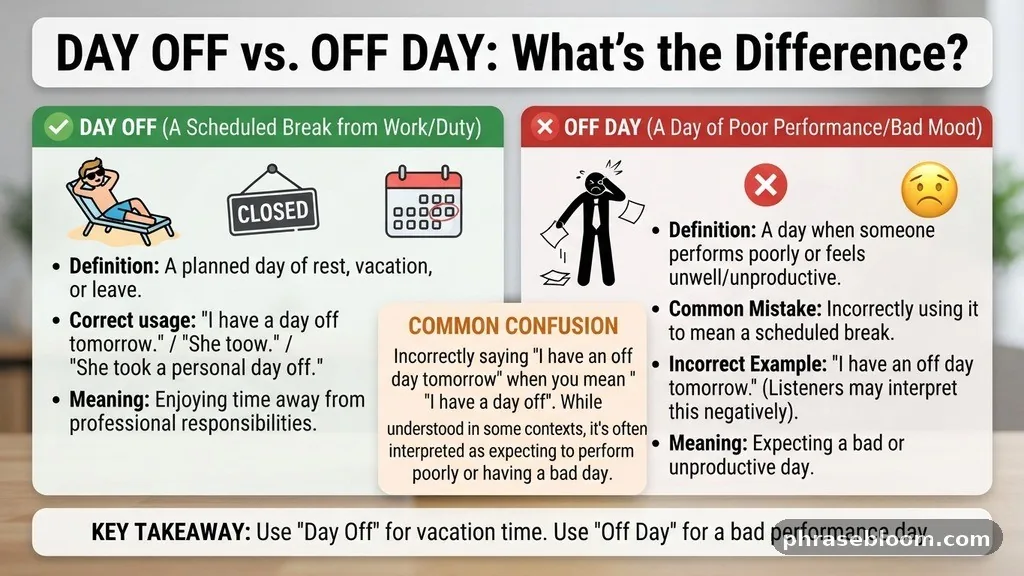
The most common mistake is using off day to mean a scheduled break. “I have an off day tomorrow” may be understood in some contexts, but many listeners will interpret it as “I expect to perform poorly tomorrow” or “tomorrow may be a bad day.”
For scheduled time away, say “I have a day off tomorrow” or “I’m off work tomorrow.” The second version is especially natural in conversation.
The opposite mistake also occurs. “The team had a day off” means the team did not work or compete, while “The team had an off day” means the team performed badly or below expectations.
| Potential sentence | Likely interpretation | Clearer version |
|---|---|---|
| I have an off day tomorrow. | Tomorrow may be a bad or unproductive day. | I have a day off tomorrow. |
| The staff had a day off in the meeting. | The staff were absent or not working. | The staff had an off day in the meeting. |
| She is taking an off day. | Unclear, possibly a poor-performance day. | She is taking a day off. |
| He took a day off during the match. | He stopped participating or left duty. | He had an off day during the match. |
Another problem is treating the phrases as interchangeable because both contain day and off. Their meanings are close in form but separate in normal English usage.
Day Off, Off Day, and Other Useful Alternatives
Sometimes a different expression is clearer than either phrase. If you mean a scheduled break from a job, leave from work, time off, a scheduled break, or a nonworking day may suit a formal document better.
If you mean poor performance, alternatives include a bad day, a difficult day, a low-energy day, or an unproductive day. Each carries a slightly different tone.
| Intended meaning | Useful expression | Best setting |
|---|---|---|
| No work is scheduled | Day off | Everyday and workplace English |
| Approved absence | Time off or leave | Policies and formal requests |
| Temporary poor performance | Off day | Conversation, sports, informal reports |
| Low productivity | Unproductive day | Self-assessment and professional writing |
| Feeling physically or emotionally unusual | Bad day or difficult day | Personal conversation |
“I’ll be away from work on Monday” removes ambiguity completely. Likewise, “The team’s performance was below expectations” is more precise than “The team had an off day” in a formal evaluation.
The best alternative depends on what the listener needs to know. A schedule needs a date and availability, while a performance note needs an observable result and, ideally, a reason.
Day Off vs Off Day in American and British English
Both expressions are used in American English and British English. The core distinction remains broadly stable: day off concerns time away from work or duty, while off day generally concerns performance, mood, or condition.
Regional vocabulary can affect nearby terms. British speakers may commonly discuss “annual leave,” while American speakers often say “vacation time” or “a vacation day.” Both groups use “day off,” but workplace policies may prefer different official labels.
“Holiday” also deserves care. In American English, a holiday often refers to a public or religious observance, while in British English it can also mean a vacation. A British employee may say, “I’m on holiday,” whereas an American employee may say, “I’m on vacation.”
Neither regional variety makes off day a reliable substitute for day off. A writer addressing an international audience should choose wording that identifies the practical meaning directly.
For formal writing, consult a recognized reference such as the Cambridge Dictionary when you want to check a phrase’s definition, example usage, or regional labeling. An employer’s house style still takes priority for internal documents if it establishes a preferred vocabulary.
How Grammar Changes the Meaning in a Sentence
The phrase day off commonly appears after verbs such as have, take, get, and schedule. “We scheduled a day off after the project launch” describes a planned break, while “She took a day off to recover” describes an absence from normal duties.
The phrase off day commonly appears after verbs such as have, be, and experience. “The department had an off day” comments on performance, and “It was an off day for the department” uses the phrase after the linking verb was.
| Verb pattern | Example with day off | Example with off day |
|---|---|---|
| Have | I have a day off on Friday. | I had an off day at work. |
| Take | She took a day off for an appointment. | Less natural when meaning poor performance. |
| Be | Friday is my day off. | Monday was an off day for the team. |
| Schedule | We scheduled a day off after the event. | We cannot normally schedule an off day to mean poor performance. |
Notice the last contrast. A company can schedule a day off, but it cannot normally schedule an off day when off day means poor performance. The phrase describes what happened, not an approved item on a work calendar.
Professional Writing Guidance
In a business email, use day off for availability. “I’ll be taking a day off on June 12” is clear, direct, and appropriate for most professional settings.
In an employee handbook, use the organization’s formal terminology. If the policy distinguishes vacation days, personal days, sick leave, and holidays, name the correct category instead of relying on the broader phrase day off.
In a performance report, avoid off day unless the document has an informal tone. Replace it with measurable language such as “response times increased,” “three deadlines were missed,” or “the team completed fewer tasks than planned.”
In a workplace conversation, either phrase can be natural if the context is obvious. “I’m off tomorrow” means the speaker is not working, while “I’m feeling off today” means the speaker does not feel normal.
- Business email: use “day off,” “time off,” or “leave” for absence.
- HR policy: use the employer’s official terms for leave categories.
- Schedule: list a “day off” or “nonworking day,” not an “off day” if absence is intended.
- Performance report: describe specific results rather than labeling a day “off.”
- Casual conversation: use “off day” for mood or performance and “day off” for rest from work.
Professional writing benefits from clarity more than cleverness. If a reader could reasonably interpret the phrase in two ways, rewrite the sentence.
Examples You Can Copy and Adapt
The following examples show how small changes in word order change the message. Read each sentence with its surrounding context rather than treating the phrases as isolated vocabulary items.
- “I have a day off on Wednesday, so I’ll respond to the request on Thursday.”
- “The retail schedule gives Maya one day off after every three closing shifts.”
- “Please submit your vacation request before adding a day off to the shared calendar.”
- “The engineering group had an off day after a week of overnight releases.”
- “I’m having an off day, but I expect to finish the draft this afternoon.”
- “The goalkeeper’s off day affected the result, although the defense also made mistakes.”
- “The store will be closed on the public holiday, which gives staff a day off.”
- “She took a personal day rather than using a regular scheduled day off.”
- “The team’s unproductive day was linked to a system outage, not a lack of effort.”
- “I’m off work tomorrow, but I’ll check urgent messages before my day off begins.”
These sentences also show why a precise alternative can help. “The team had an off day” is brief, but “the team completed fewer tasks because the shared system was unavailable” gives readers information they can act on.
In a calendar, label the event “Day off,” “Vacation,” “Personal day,” or “Holiday” according to its actual status. In a personal message, “I’m off tomorrow” is usually more natural than “I have an off day tomorrow.”
Frequently Asked Questions
What is the difference between day off and off day?
A day off is a planned break from work, school, or another duty. An off day is usually a day of poor performance, low energy, unusual mistakes, or an unsettled mood.
Is “day off” correct for a scheduled break?
Yes. “I have a day off Friday” and “I’m taking Friday off” are standard ways to say that you will not be working. In formal documents, leave, vacation day, or personal day may be more specific.
Can “off day” mean a day away from work?
It can be understood that way in some workplace contexts, but it is not the clearest choice. Many readers interpret off day as a bad or unproductive day, so use day off when you mean scheduled absence.
Is “off day” used for poor performance?
Yes. “The team had an off day” means the team performed below its usual standard. “I’m having an off day” can also mean that the speaker feels tired, distracted, or emotionally out of balance.
What should I use in professional writing?
Use day off for a scheduled break and state the date or type of leave when useful. Use more precise language than off day in formal performance documents, especially when you need to explain what went wrong.
Conclusion
The practical difference in Day Off vs Off Day is simple: a day off is time away from work or duty, while an off day is a day when performance, energy, or mood is below normal. Word order carries the meaning, so replacing one phrase with the other can create confusion.
Use “I have a day off” for your schedule and “I’m having an off day” for your condition or performance. If the situation is formal, add the exact type of leave or describe the measurable problem. That small choice makes workplace communication clearer.
Explore more on PhraseBloom.