
For All the Marbles: Meaning, Origin and Examples
The phrase “for all the marbles” describes a final contest or decisive moment in which the winner receives the ultimate prize. It usually suggests high stakes, an all-or-nothing situation, or a last chance to achieve victory. You may hear it in sports, business, politics, entertainment, and everyday conversation.
Its literal meaning comes from a children’s marbles game, but its modern use is almost always figurative. This article explains the idiom meaning, phrase origin, tone, grammar, synonyms, and practical usage examples so you can recognize it and use it naturally.
What “For All the Marbles” Means
“For all the marbles” means that everything is at stake in one final contest or important decision. The person who wins gets the full reward, while the person who loses receives nothing or fails to achieve the main objective.
In ordinary English, the expression often means “for the ultimate prize” or “with victory or defeat decided by this event.” It does not usually refer to actual marbles. Instead, the marbles represent whatever valuable result the participants are competing to obtain.
For example, a sports commentator might say, “The two teams meet tonight for all the marbles.” The sentence means that the game will decide the championship, not that either team is literally playing with glass marbles.
The phrase can describe a single event, a final round, or a decision with unusually serious consequences. It can also describe a situation in which someone decides to risk everything rather than settle for a partial result.
- Literal meaning: competing to win all the marbles in a children’s game.
- Figurative meaning: competing for the entire reward or facing a decisive outcome.
- Tone: informal, vivid, and often dramatic.
- Typical setting: sports, competitions, negotiations, elections, business, and casual speech.
The expression is generally positive or neutral in tone, although it can sound dramatic if used for a relatively minor matter. Saying that a routine office meeting is “for all the marbles” may be humorous because the stakes are clearly not that serious.
The Idiom’s Literal and Figurative Meanings
The literal image behind the expression is simple. In a traditional marbles game, players might compete for one another’s marbles, so the winner could leave with the entire collection. A final round played for every remaining marble would therefore be a contest for the complete prize.
That image gives the idiom its central idea: the participants are not competing for a small advantage. They are competing for everything. The marbles function as a concrete symbol of the ultimate prize.
The figurative meaning became more useful than the literal one because it can apply to almost any field. A championship game, a final job interview, a merger vote, and a political runoff can all be described as contests “for all the marbles” if the outcome determines the main reward.
Still, the expression does not necessarily mean that the loser will suffer permanent harm. Context matters.
In a sports article, it may simply describe a title-deciding game. In a business conversation, it may suggest that a company is making a bold final attempt to secure a contract.
The idiom also carries an element of excitement. “For the championship” is direct and precise, while “for all the marbles” adds energy and suspense. It frames the event as a decisive moment rather than an ordinary stage in a longer process.
All-or-nothing does not always mean reckless
Because the phrase suggests an all-or-nothing contest, some readers associate it with risk. That association is often reasonable, but the idiom itself does not require reckless behavior. A team can reach a final match through careful planning and still play “for all the marbles.”
Likewise, a company can enter a final negotiation with strong evidence, clear financial limits, and a well-prepared proposal. The expression describes the importance of the outcome, not necessarily the quality of the strategy.
Phrase Origin and the Marbles Game
The phrase is connected to marbles, a children’s game in which players use small glass or clay balls in contests of skill. Depending on the rules, a player could win another player’s marbles, creating the literal possibility of playing for the entire collection.
The exact first use of “for all the marbles” is not always identified with certainty in general references. What is clear is the connection between the idiom and the idea of winning every marble in a contest. The phrase reflects a broader pattern in English, where objects from games become metaphors for prizes, risks, and competition.
Marbles are especially effective as an image because they are small, visible, and easy to gather into one prize. A child who has lost every marble has lost the whole stake. That physical picture makes the expression more memorable than a plain phrase such as “for the entire reward.”
For readers interested in checking a concise reference definition and usage information, the Merriam-Webster entry for “for all the marbles” is a useful starting point.
The phrase origin also explains why the idiom sounds somewhat playful even when the subject is serious. It combines the language of a children’s game with the pressure of a major contest. That contrast gives speakers room to sound dramatic without using extremely formal or grim language.
Similar expressions have developed from other games and competitions. English speakers talk about “the home stretch,” “the final round,” “the finish line,” and “the winner-take-all match.” Each image emphasizes a different part of competition, while “for all the marbles” emphasizes the size of the prize.
How to Use “For All the Marbles” in a Sentence
“For all the marbles” usually appears after a verb such as “play,” “compete,” “go,” or “fight.” It can also follow a noun that identifies the event. The expression is most natural when the surrounding sentence makes the stakes clear.
| Example sentence | Context | Meaning |
|---|---|---|
| The finalists will meet Friday for all the marbles. | Competition | Friday’s contest will decide the full prize. |
| The seventh game is for all the marbles. | Sports | The game determines the championship. |
| After months of negotiations, the vote became a fight for all the marbles. | Business or politics | The vote could determine the entire outcome. |
| She treated the final interview as a chance to go for all the marbles. | Career | She made a strong final effort to win the position. |
| The new product is the company’s attempt to win all the marbles in the market. | Business strategy | The company hopes to gain the dominant reward or position. |
The phrase can appear in headlines, commentary, speeches, and informal professional writing. It is less common in highly technical reports where precision matters more than color. A formal report may say “the final vote will determine control of the project,” while a news headline may say “The Final Vote Is for All the Marbles.”
Company and workplace examples
In workplace communication, the idiom works best when a project, negotiation, or presentation genuinely has a final outcome. For example, “Tomorrow’s client presentation is for all the marbles” suggests that the presentation could determine whether the company wins the account.
Another natural example is, “The last round of talks is effectively for all the marbles.” Here, the phrase signals that no major negotiation stage remains after the final meeting.
Use it more carefully in employee communication. A manager who writes, “This quarter’s review is for all the marbles,” may create unnecessary anxiety if the review is simply a routine check-in. The expression should match the actual level of risk.
Sports and competition examples
Sports is one of the most familiar settings for the idiom. A broadcaster might say, “The rivals have one more match for all the marbles,” or “The final race will decide who takes all the marbles.” Both sentences describe a winner-take-all result.
The phrase can also describe a tournament’s last stage even if the winner receives a trophy, title, or ranking rather than literal objects. The marbles stand for the championship and the recognition attached to it.
In a less formal sports story, a writer might use the expression to create suspense: “The underdog survived every round and now faces the favorite for all the marbles.” The wording highlights both the final contest and the pressure surrounding it.
“For All the Marbles” in Formal and Informal Writing
The expression is an idiomatic expression, so it is more colorful than a literal statement. It belongs comfortably in conversation, journalism, opinion writing, sports coverage, marketing copy, and speeches. It can also appear in business writing when the writer wants a vivid but familiar phrase.
Formal academic writing requires more judgment. An essay about competition, risk, or popular language can use “for all the marbles” as an example of an idiom. However, a research paper explaining a legal procedure should usually state the facts directly rather than describe a ruling as a fight for all the marbles.
Professional writing often benefits from matching tone to adiece. An internal email to a creative team may say, “This pitch is our chance to go for all the marbles.” A regulatory filing would normally replace that wording with an exact description of the decision and its consequences.
The expression is not incorrect in formal writing. It is simply marked by informality and imagery. Writers should ask whether the phrase adds useful emphasis or merely makes a serious point sound less precise.
- Use it freely: sports commentary, casual conversation, headlines, speeches, and lively workplace messages.
- Use it selectively: business reports, investor communication, public statements, and executive presentations.
- Explain or replace it: legal documents, scientific writing, technical instructions, and policies requiring exact wording.
When precision matters, alternatives such as “the decisive vote,” “the final stage,” or “the outcome-determining event” may communicate the point more efficiently. When energy matters, the idiom may be the better choice.
Similar Expressions, Synonyms, and Related Phrases
Several expressions overlap with “for all the marbles,” but they are not identical in tone or emphasis. Choosing among them allows you to control how dramatic, formal, or direct the sentence sounds.
| Expression | Main emphasis | Example |
|---|---|---|
| For all the marbles | The entire prize is at stake | The final match is for all the marbles. |
| Winner-take-all | Only one side receives the reward | The teams face a winner-take-all final. |
| All-or-nothing | No partial success or compromise | It was an all-or-nothing proposal. |
| High stakes | The consequences are serious | The high-stakes vote begins at noon. |
| The deciding moment | The event determines the result | The interview was the deciding moment. |
| Last chance | No later opportunity is expected | This is our last chance to qualify. |
“Winner-take-all” is often more precise when the rules formally give the whole reward to one participant. “For all the marbles” is broader and can describe an informal struggle in which one side hopes to secure the most important outcome.
“All-or-nothing” focuses on the absence of a middle result. A negotiation can be all-or-nothing even when there is no competition between two players. By contrast, “for all the marbles” usually suggests a contest, rivalry, or effort to win.
“High stakes” describes risk but does not necessarily imply a final event. A long project can remain high stakes for months. “For all the marbles” more strongly suggests that the decisive moment has arrived.
Other useful alternatives include “the final showdown,” “the championship round,” “the ultimate prize,” “the whole prize,” “the deciding contest,” and “the point of no return.” Each has a slightly different emotional effect, so the best option depends on the sentence and audience.
Common Mistakes and Misunderstandings
One common mistake is treating the phrase as a literal reference to marbles when the context clearly concerns an abstract result. In most modern sentences, readers understand that the expression is figurative. Explaining the game is useful only when discussing the phrase origin or teaching the idiom.
Another mistake is using the idiom for every important event. If a meeting is significant but does not decide the outcome, “for all the marbles” may exaggerate the situation. “An important step” or “a key meeting” may be more accurate.
Confusing “for all the marbles” with “all the marbles”
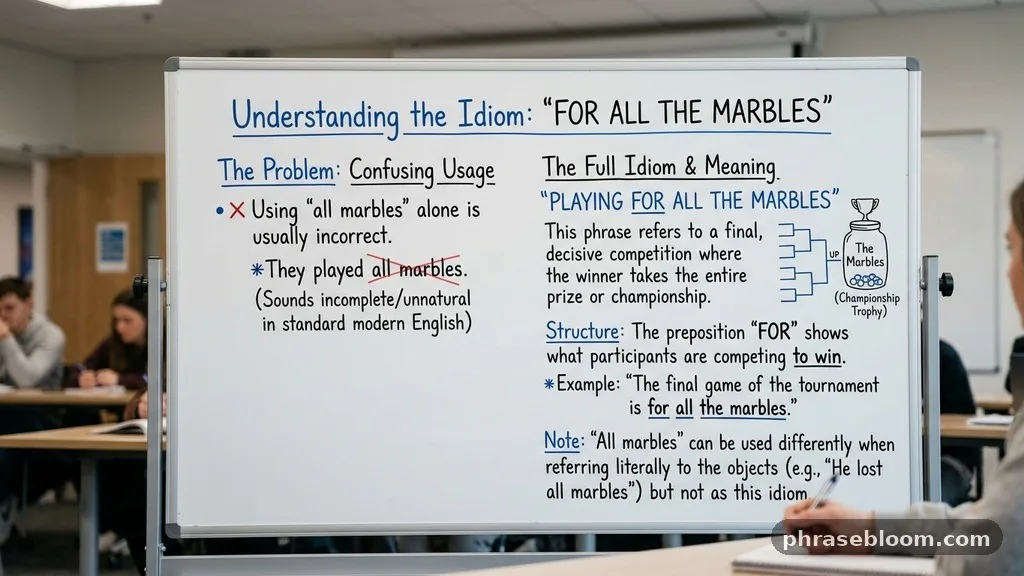
The full idiom is usually “for all the marbles.” The preposition “for” shows what the participants are competing to win. A sentence such as “They played all the marbles” sounds incomplete or unnatural in standard modern English.
You can use “all the marbles” in a different structure when the phrase refers to the complete prize. For example, “The winner took all the marbles” is understandable, but “They played for all the marbles” is the more established idiomatic form.
Using the phrase where there is no contest
The idiom works most naturally when someone is competing, deciding, or making a final effort. It is less suitable for a passive situation. “The weather forecast is for all the marbles” does not make sense unless the sentence establishes a contest or unusually playful metaphor.
Try to identify the implied competitors and prize. If neither is clear, the expression may confuse readers. A direct phrase will usually be stronger.
Assuming it always means permanent consequences
The expression signals a decisive or high-stakes moment, but it does not guarantee that failure will cause permanent damage. A team may lose one championship opportunity and compete again next season. The phrase describes the current contest, not every future possibility.
That distinction matters in business and workplace writing. Use the idiom to communicate urgency, but do not let its drama imply consequences you have not established.
How the Phrase Works Grammatically
“For all the marbles” is a prepositional phrase used idiomatically. The word “for” introduces the prize or objective, while “all the marbles” serves as the object of the preposition. Together, the words form a fixed expression whose meaning goes beyond the literal nouns.
The phrase often follows a verb of competition. Consider the sentence, “The finalists are playing for all the marbles.” The verb “playing” describes the contest, and the idiom identifies what is at stake.
It can also follow a noun that names the event. In “The final is for all the marbles,” the phrase functions as a complement after the verb “is.” The adjective-like description tells us what kind of final it is in terms of importance.
Writers sometimes place the phrase at the beginning for emphasis: “For all the marbles, the two candidates faced one another in the final debate.” This construction is possible, but it can sound more literary or dramatic than the usual placement at the end of a sentence.
Active and descriptive constructions
Active constructions usually sound the most natural: “The teams will compete for all the marbles.” This form makes the participants and their objective clear.
Descriptive constructions can be shorter: “The championship game is for all the marbles.” Here, the sentence focuses on the event rather than the people competing.
Both structures are grammatically sound. Choose the active form when you want to emphasize effort or strategy, and choose the descriptive form when the importance of the event is the main point.
When the Idiom Sounds Natural in Everyday English
Native speakers often use “for all the marbles” when a situation has reached its final stage. The phrase may appear during a playoff game, a board election, a sales pitch, or a friendly argument about a competition. Its meaning is usually clear from the surrounding context.
For example, friends might say, “One more round, and we’ll settle this for all the marbles.” They may be talking about a board game, a trivia contest, or a casual challenge. The expression adds mock seriousness to an otherwise ordinary activity.
In conversation, the idiom can also show determination. “I’ve made it to the final interview, so I’m going for all the marbles” means the speaker intends to make the strongest possible effort to win the job.
The phrase may sound old-fashioned to some speakers, especially in highly casual conversations where shorter expressions such as “everything’s on the line” are more common. That does not make it incorrect. It gives the sentence a recognizable, slightly colorful style.
Speakers should also consider regional and personal preferences. A sports fan may use the expression regularly, while someone who prefers plain language may choose “the final contest” or “the deciding game.” Both choices are valid when they accurately express the situation.
Usage Examples for Business, Media, and Public Life
Business writers can use the phrase to describe a final attempt to win a contract, approve a merger, or secure a major investment. For example, “The last presentation is our opportunity to compete for all the marbles” conveys urgency without stating that the company literally risks every asset.
Still, business readers may interpret dramatic language differently. A manager writing to employees should explain the concrete stakes somewhere in the message. “Tomorrow’s client meeting is for all the marbles because the contract will be awarded afterward” is clearer than the idiom alone.
Media writers often use the expression as a headline or closing phrase because it creates a sense of narrative completion. A report might describe a semifinal first, then state that the finalists will meet “for all the marbles” in the championship.
Political commentators may use the phrase for a final debate or election. The wording can be effective, but it should not imply that one event controls every future issue if that is not true. Political outcomes often involve several stages and institutions.
In entertainment, the idiom can describe a finale, award decision, or last performance. A reviewer might write, “After weeks of close performances, the finalists returned for all the marbles.” The wording is especially natural for reality competitions and tournament-style programs.
- “The sales team has one final proposal for all the marbles.”
- “Tonight’s debate may be the contest for all the marbles.”
- “The finalists are preparing for a high-stakes performance for all the marbles.”
- “The board’s next vote could decide the merger once and for all.”
- “After surviving the early rounds, the players are ready to risk everything in the final.”
These examples show that the idiom can fit several fields, but each sentence supplies a recognizable contest or decision. That supporting context keeps the expression from sounding empty or exaggerated.
How to Decide Whether to Use It
Before using “for all the marbles,” identify three things: the contest, the prize, and the finality of the moment. If the sentence makes all three reasonably clear, the idiom will probably work.
Next, consider your audience. A general audience will usually understand the figurative meaning, but international readers or learners of English may benefit from a brief explanation. In a technical document, a literal alternative may communicate faster.
Finally, judge the tone. The phrase is energetic and familiar, yet it is not completely neutral. It can make a sentence sound like sports commentary, even when the subject is a contract or organizational decision.
| Question | If the answer is yes | Recommended approach |
|---|---|---|
| Is there a contest or rivalry? | The phrase has a clear foundation. | “For all the marbles” may fit naturally. |
| Does one event determine the main reward? | The situation is genuinely decisive. | Use the idiom or “the deciding contest.” |
| Is the document highly technical or legal? | Precision is more important than color. | Use a direct description instead. |
| Could readers misunderstand the stakes? | The idiom alone may be too vague. | Add a concrete explanation. |
| Is the tone playful or conversational? | The image may add useful energy. | Use the phrase with confidence. |
A good rule is to use the idiom when it makes the stakes easier to picture. Replace it when the image distracts from the exact facts. Strong writing is not about choosing the most colorful phrase every time; it is about choosing the phrase that serves the reader.
Frequently Asked Questions
What is the meaning of “for all the marbles”?
“For all the marbles” means competing for the entire prize or facing a decisive contest in which the outcome matters greatly. It is usually figurative rather than literal.
Is “for all the marbles” an idiom?
Yes. It is an idiomatic expression whose meaning comes from the image of winning every marble in a children’s game. Modern speakers generally use it to mean “for the ultimate prize” or “with everything at stake.”
Where does the phrase come from?
The phrase is associated with marbles games in which players could compete for one another’s marbles. The exact earliest use is not always certain, but the underlying image is a contest for the entire collection.
Can “for all the marbles” be used in professional writing?
Yes, especially in business emails, presentations, sports coverage, speeches, and lively internal communication. In legal, scientific, or highly technical writing, a direct phrase such as “the deciding vote” or “the final opportunity” may be clearer.
What are good alternatives to “for all the marbles”?
Useful alternatives include “for the ultimate prize,” “winner-take-all,” “all-or-nothing,” “with everything at stake,” “the deciding contest,” “the final showdown,” and “the last chance.” Choose one based on whether you want to emphasize the prize, the risk, or the final stage.
Conclusion
“For all the marbles” is a vivid idiom for a final contest in which the entire prize or most important outcome is at stake. Its literal image comes from a marbles game, but its modern meaning applies to sports, business, careers, politics, and everyday challenges.
Use it when the situation is genuinely decisive and the tone can support a little drama. If precision matters more than imagery, choose a direct alternative such as “the final contest” or “the deciding vote.” Used with the right context, For All the Marbles adds energy while keeping the central idea clear.
You may also like: Die vs Dice: Meaning, Plural, and Usage Explained
Explore more on PhraseBloom.