
When people compare unregister vs deregister, they usually want to know whether the verbs mean the same thing and which one belongs in a particular form, website, or official notice. Both describe removing something from a registration, list, account, system, or record, but the best choice depends on context.
Unregister is common for software, devices, events, services, and user actions. Deregister often sounds more formal and is widely used for official records, company registration, vehicles, domains, and institutional enrollment. The sections below explain the overlap, the differences in tone, and the safest wording for professional communication.
Unregister vs Deregister: The Short Answer
Both unregister and deregister generally mean to remove a person, organization, object, or account from a registration or recorded list. Neither word has one universal definition that applies identically in every field.
Use unregister when the action is practical, technical, or user-driven. For example, a person may unregister a device from an application, unregister for an event, or unregister software from a computer.
Use deregister when the action involves formal records, official status, institutional procedures, or an administrative decision. A company may be deregistered from a corporate register, a vehicle may be deregistered, and a student may deregister from a course.
| Term | Typical meaning | Common contexts | Practical guidance |
|---|---|---|---|
| Unregister | Remove from a registration or system | Software, devices, events, accounts, services | Best for ordinary technical or user-facing instructions |
| Deregister | Remove from an official or formal register | Companies, vehicles, domains, schools, legal records | Best for administrative, regulatory, or formal contexts |
| Unregister from | Withdraw from something previously entered | Courses, events, subscriptions, programs | Natural when describing a person’s action |
| Deregister from | Formally withdraw or end registration | Universities, professional bodies, official services | Use when the organization’s terminology supports it |
The distinction is not always strict. A software company might use “deregister a device,” while another uses “unregister a device” for the same process. In those cases, the product’s established wording matters more than a general dictionary rule.
What Unregister Means
Unregister means to remove something from a registration, list, service, event, application, or database entry. It often suggests that the item was previously registered and is now being taken out of that system.
The word is especially common in technology. A help page might tell users to unregister a phone before transferring an account, or an administrator might unregister a computer from an organization’s device-management platform.
- Unregister a device from an account before selling it.
- Unregister software before moving a license to another computer.
- Unregister for a conference if you can no longer attend.
- Unregister a user from a service or mailing list.
- Unregister a domain feature from a hosting or management platform.
In user instructions, unregister often sounds direct and understandable. “Select Remove device, then unregister the old tablet” describes a practical sequence without implying that a government agency or formal authority is involved.
The word can also refer to withdrawing from an activity. A participant may unregister from a training session, although “cancel your registration” or “withdraw from the session” may sound more natural in some notices.
Unregister does not necessarily mean that all related data has been deleted. Removing a device from an account may leave billing records, support history, or audit information in place.
That distinction matters in privacy and account-management language. If the intended action is permanent account removal, say “delete the account” or “request account removal” rather than assuming unregister communicates complete deletion.
What Deregister Means
Deregister means to remove a person, entity, vehicle, domain, or other item from an official, formal, or maintained register. It often carries a more administrative tone than unregister.
A regulator may deregister a company that no longer meets legal requirements. A vehicle owner may deregister a vehicle that is permanently removed from use, while a university may allow a student to deregister from a course or program.
Deregister is also common in international business English and formal institutional writing. It appears in notices about company registration, tax records, professional licensing, vehicle registration, and university enrollment.
The word can describe either a person’s voluntary action or an authority’s action. “The student deregistered from the module” presents withdrawal as the student’s decision, while “the authority deregistered the company” presents an official action.
Formal status and administrative records
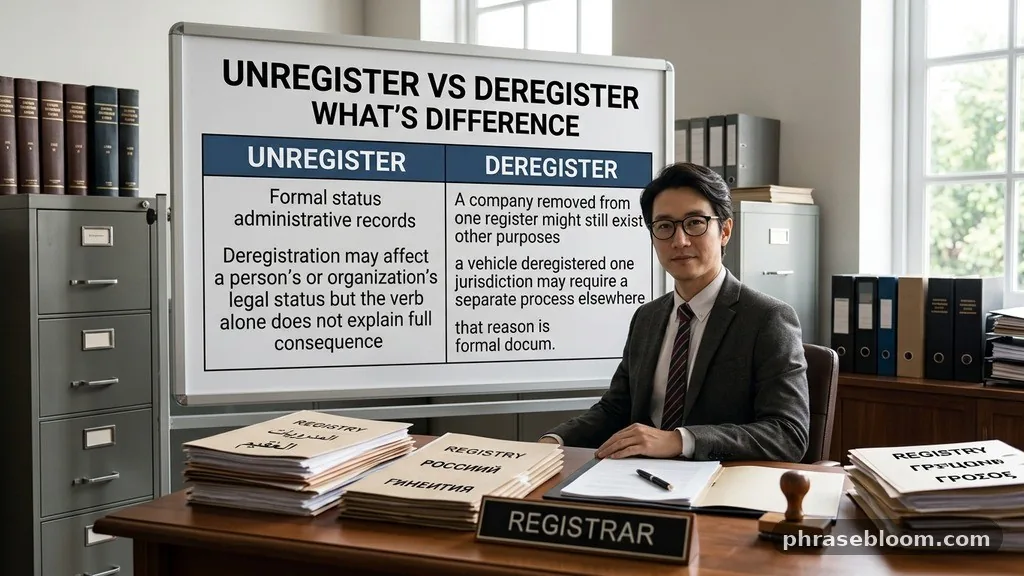
Deregistration may affect a person’s or organization’s legal status, but the verb alone does not explain the full consequence. A company removed from one register might still exist for other purposes, and a vehicle deregistered in one jurisdiction may require a separate process elsewhere.
For that reason, formal documents should name the relevant register and consequence. “The company was deregistered from the national business register” is more precise than “the company was deregistered.”
The same principle applies to education. “The student deregistered from the course” may mean withdrawal from one class, not withdrawal from the university itself.
Deregister therefore tends to be a better choice when the reader needs to understand that an official record, status, or institutional relationship has changed. It does not automatically mean cancellation, deactivation, uninstallation, or destruction of all related records.
Is Company Registration, Vehicle Registration, or Software Registration Different?
The object being removed strongly influences the preferred verb. Registration is a broad concept, but a company register, a vehicle database, and a software license system operate under different rules.
For company registration, deregister is often the more formal term because the action may involve a government or corporate register. A notice might state that a company has been deregistered after liquidation, noncompliance, or an approved request.
For vehicle registration, both terms may appear, but deregister commonly fits official administrative language. A motorist might ask how to deregister a vehicle, while a consumer application might say “unregister this vehicle from your account.” The first concerns official records; the second concerns a user profile.
For software registration, unregister is often more natural. Software may be unregistered from a computer when a license is transferred, a product key is released, or an installation is removed from an account.
Domain registration creates another useful distinction. A registrar may use “cancel domain registration,” “delete the domain,” or “remove the domain from the account,” while a registry or formal policy may use “deregister.” The precise action matters because cancellation, expiration, transfer, and deletion are not always identical.
- Official company record: deregister the company.
- Vehicle authority record: deregister the vehicle.
- App or account profile: unregister the device.
- Software license: unregister the installation.
- Domain service: cancel, transfer, delete, or deregister according to the provider’s terminology.
Before choosing a verb, identify the actual system involved. A user account, a government register, and a license server may all contain registration information, but the correct customer-facing language can differ.
Unregister and Deregister in Real Sentences
Examples make the distinction easier because the surrounding nouns often reveal the intended tone. The following sentences use both verbs in realistic workplace, educational, technical, and administrative settings.
Technology and software
“Please unregister the old laptop before adding the replacement device.” Here, unregister describes an account-management action performed in a software interface.
“The technician deregistered the endpoint from the organization’s security platform.” This version sounds more formal and emphasizes removal from an administered system.
“You must unregister the application before reinstalling it under a different license.” The sentence concerns software registration, not the deletion of every file associated with the application.
Education and training
“Students may unregister from the workshop up to two business days before it begins.” The word suits a participant withdrawing from an event or training session.
“Students who deregister from the course after the deadline may receive a withdrawal notation.” Deregister fits the institutional policy because the university is describing a formal enrollment process.
Neither example proves that the other verb would be impossible. A school’s handbook may use one consistently, and that established usage should normally be followed.
Business and organizational communication

“The administrator will unregister inactive users from the client portal.” This is clear for an internal technical procedure.
“The regulator may deregister the company if the annual filing is not submitted.” The second sentence concerns legal status and an official register, so deregister is the stronger choice.
“Please cancel your event registration rather than unregister through the mobile app.” Sometimes a noun phrase is clearer than either verb, especially when the reader may confuse account removal with event cancellation.
Subscriptions and services
For a subscription, “cancel your subscription” is usually clearer than “unregister your subscription.” Deregister may sound unnecessarily formal unless the service itself uses that term in its customer documentation.
For a mailing list, “unsubscribe” is more specific than either unregister or deregister. Good business writing chooses the verb that identifies the actual action instead of selecting a broader word merely because it sounds official.
Can Unregister or Deregister Be Used After a Verb?
Yes. Both words can appear after a main verb, but their grammatical roles may change depending on the sentence.
In “The user unregistered the phone,” unregistered is the main verb in the past tense. The user performed an action on the phone.
In “The account was deregistered by the administrator,” deregistered is a past participle in a passive construction. The sentence focuses on the account and presents the administrator as the actor.
The forms can also follow a verb as a complement or appear in an adverbial phrase. Consider these examples:
- “The policy is company-specific, and the device is now unregistered.”
- “The applicant chose to deregister from the program.”
- “The new system was rolled out across the department after the old devices were unregistered.”
- “The vehicle was formally deregistered after it was exported.”
“Unregister” and “deregister” are verbs, so they can take an object in sentences such as “unregister the account” or “deregister the vehicle.” They can also be used with “from,” as in “unregister from the event” or “deregister from the course.”
Do not confuse the verb with the result. Unregistering a device may remove its database entry from one service, while deactivation may stop access, and uninstallation may remove local software. If the process has several stages, name each stage separately.
Unregister vs Deregister in American and British English
There is no reliable rule that makes unregister exclusively American or deregister exclusively British. Both forms occur in international English, and both can be understood by readers in the United States, the United Kingdom, and other English-speaking regions.
Regional preference can still influence the impression a word creates. Deregister may sound more familiar in certain British, Commonwealth, academic, or regulatory settings, while unregister is especially common in software interfaces and consumer technology.
Those are tendencies, not fixed boundaries. A British software company can use unregister, and an American university or regulator can use deregister.
House style often has more practical force than national variety. If an organization’s forms say “deregister from the program,” changing the wording to “unregister” may create unnecessary inconsistency even if both expressions are understandable.
Writers working for an international audience should prioritize clarity over assumptions about nationality. Name the action and the record precisely, then use the organization’s preferred term.
For formal writing, consult the relevant dictionary entry for deregister alongside your organization’s style guide. A dictionary can show established usage, but it may not determine the terminology used by a particular registrar, university, regulator, or software provider.
Companywide, Domain Registration, and Other Specialized Uses
Specialized fields frequently develop their own terminology. That is why a word that sounds natural in one context can feel unusual in another.
In domain registration, a provider may distinguish between a domain being active, expired, transferred, suspended, or deleted. “Deregister the domain” may be technically meaningful in one system but too vague in another. A customer instruction should identify whether the user is ending renewal, removing the domain from an account, or requesting deletion from a registry.
In university enrollment, deregister often appears in formal policies about withdrawal, deadlines, tuition, and academic records. “A student may deregister from a module before the final withdrawal date” identifies an institutional procedure.
In workplace software, unregister is usually more approachable. “Unregister the printer from the office dashboard” tells an employee how to remove an item from a management interface.
Government records require extra care. Deregistration may change legal status, tax obligations, licensing, or eligibility, while unregistering from an online portal may only remove a login or device association.
The same difference appears in professional memberships. A member may unsubscribe from email, cancel a subscription, withdraw from a course, or deregister from a regulated register. Each verb describes a different relationship and should not be substituted casually.
- Withdrawal: leaving a course, program, application, or process.
- Cancellation: ending an appointment, subscription, booking, or request.
- Deactivation: turning off access or functionality without necessarily deleting records.
- Uninstallation: removing software from a device.
- Account removal: deleting or closing a user account.
- Deregistration: formal removal from a register or recorded status.
These terms overlap only partly. Choosing the narrower term can prevent a user from taking the wrong action or misunderstanding the consequences.
Common Mistakes and Better Alternatives
The most frequent mistake is treating unregister and deregister as interchangeable in every sentence. They often overlap, but context determines whether the wording sounds technical, ordinary, formal, or legally significant.
Using the wrong level of formality
“Please deregister your forgotten password” is incorrect because a password is not normally registered in the relevant sense. Write “reset your password” or “remove the saved password,” depending on the intended action.
“Please unregister your company from the official corporate register” may be understandable, but deregister is usually more suitable for a formal company-registration process.
Confusing removal with deletion
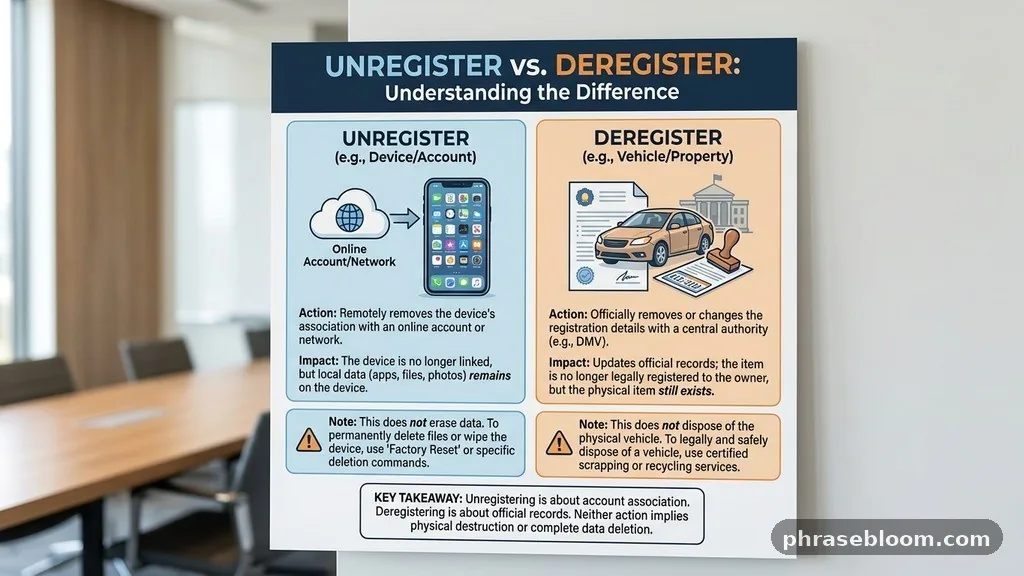
“Unregister the device” may remove its association with an account without erasing its local data. If users need to delete files, wipe a device, or close an account, state that separately.
Likewise, deregistering a vehicle may alter official records but does not necessarily dispose of the physical vehicle. The legal and practical consequences should be described in the surrounding policy.
Inventing awkward forms
Unregister and deregister are established verbs. Forms such as “unregisteration” and “deregistering process” often make the writing clumsy.
Use “unregistration” only when it is accepted by the relevant product or organization, and use “deregistration” for the formal noun where appropriate. In many cases, “removal from the register” is clearer than forcing a nominal form.
Ignoring established terminology
A service that labels its button “Unregister device” should not be described in a support article as “Deregister endpoint” unless the technical meaning is genuinely different. Matching interface language reduces confusion for users who are following instructions.
Similarly, a university that officially calls the process “deregistration” should use that term across forms, emails, and policy documents. Consistency is part of accuracy in organizational communication.
How to Choose the Right Word
A simple decision process can resolve most cases. First, identify what is being removed and who controls the relevant record.
- Name the object: Is it a device, software installation, event place, student enrollment, vehicle, company, domain, or legal record?
- Identify the system: Is the action taking place in a user account, a database, a government register, a university system, or a licensing platform?
- Assess the tone: Does the sentence belong in a button label, support article, policy, legal notice, or formal report?
- Check house style: Look at existing forms, help pages, contracts, and internal documentation.
- State the consequence: Clarify whether the action means withdrawal, cancellation, deactivation, deletion, or formal status change.
- Use the same term consistently: Do not alternate between unregister and deregister for the same process without explaining a real difference.
Choose unregister for a straightforward user action such as removing a device from an app. Choose deregister for a formal process involving an official register, institutional enrollment, or legal status.
If neither word feels precise, rewrite the sentence. “Remove the device from your account,” “withdraw from the course,” and “cancel the subscription” may be more useful than either technical verb.
Professional Writing Guidance
Business emails should favor direct, familiar language. “Please unregister the old phone from your account” is suitable for a help desk, while “Please deregister the subsidiary from the corporate register” suits a legal or administrative message.
Employee handbooks should follow the organization’s established vocabulary. If the policy describes withdrawal from benefits, use “cancel coverage” or “withdraw from the plan” if those expressions accurately describe the process.
Legal and policy documents need more than a formal-sounding verb. Define the relevant register, deadline, authority, and consequence so readers understand what the action changes.
Business reports can use deregister when discussing formal status. For example, “Three inactive entities were deregistered during the reporting period” is appropriate if the entities were actually removed from an official register.
Websites and software interfaces should use the label that matches the actual control. A button called “Unregister device” should not silently perform account deletion, and a button called “Deregister” should explain the administrative consequence in nearby text.
Academic writing should reflect the terminology of the institution or field. “Participants could withdraw from the study” may be better than either registration verb if the research process concerns participation rather than a formal register.
Marketing copy usually benefits from plain alternatives. “Remove your old device,” “cancel your registration,” and “leave the program” are often clearer to general readers than formal administrative vocabulary.
Examples You Can Copy and Adapt
The following examples show how the terms work across common situations. Replace the nouns and deadlines with details that match the actual process.
- “Open Account Settings and unregister the device before you transfer ownership.”
- “Students may deregister from the course through the enrollment portal.”
- “The administrator unregistered the inactive tablet from the company network.”
- “The agency deregistered the vehicle after receiving proof of export.”
- “Please cancel your event registration if you can no longer attend.”
- “The installer will unregister the software license from the old computer.”
- “The company was deregistered from the official register after the required review.”
- “You can remove the printer from your profile without deleting the printer’s service history.”
- “A student who withdraws after the deadline may be subject to the university’s fee policy.”
- “The domain remains active until the cancellation and transfer process is complete.”
Notice that the alternatives are not merely stylistic. “Cancel,” “withdraw,” “remove,” and “deactivate” identify different outcomes.
When writing a procedure, put the action in the same order the user will perform it. For example: “Open Devices, select the old laptop, choose Unregister, and confirm removal.” That instruction is clearer than “Deregister the laptop,” unless the interface itself uses deregister.
For a formal notice, explain authority and effect: “The organization will deregister the vehicle from the national registration record once the export documents are approved.” The sentence tells the reader what record changes and when.
Frequently Asked Questions
Is unregister or deregister correct?
Both are correct established verbs. Unregister is common for technical systems, devices, software, and events, while deregister is often preferred for official records, institutions, and formal administrative processes.
Is deregister one word?
Yes. Deregister is normally written as one word, with no space or hyphen. Its noun form is commonly written as deregistration.
Can I use unregister after a verb?
Yes. You can write “The administrator unregistered the device” or “The user chose to unregister from the event.” The exact construction depends on whether the object is being removed or the person is withdrawing.
Is deregister more formal than unregister?
Often, yes, but not always. Deregister tends to sound more administrative, especially in company, vehicle, university, and regulatory contexts. A software provider may still use deregister as ordinary product terminology.
What is the best alternative to unregister or deregister?
Choose a verb that names the actual result. Use “remove from the account,” “cancel the registration,” “withdraw from the course,” “deactivate the account,” “uninstall the software,” or “delete the record” when one of those is more precise.
Conclusion
The practical difference in Unregister vs Deregister is usually context and tone rather than a completely different core meaning. Unregister fits many user-facing and technical actions, while deregister is a strong choice for formal records, institutional enrollment, vehicle registration, company registration, and changes to official status.
Before publishing, check the organization’s house style and identify the exact consequence of the action. If the wording still feels unclear, replace the verb with a direct phrase such as “remove from the account,” “cancel the registration,” or “withdraw from the program.”
Related reading: Unselect vs Deselect, Hassle vs Hastle, Continuous vs Continous.