
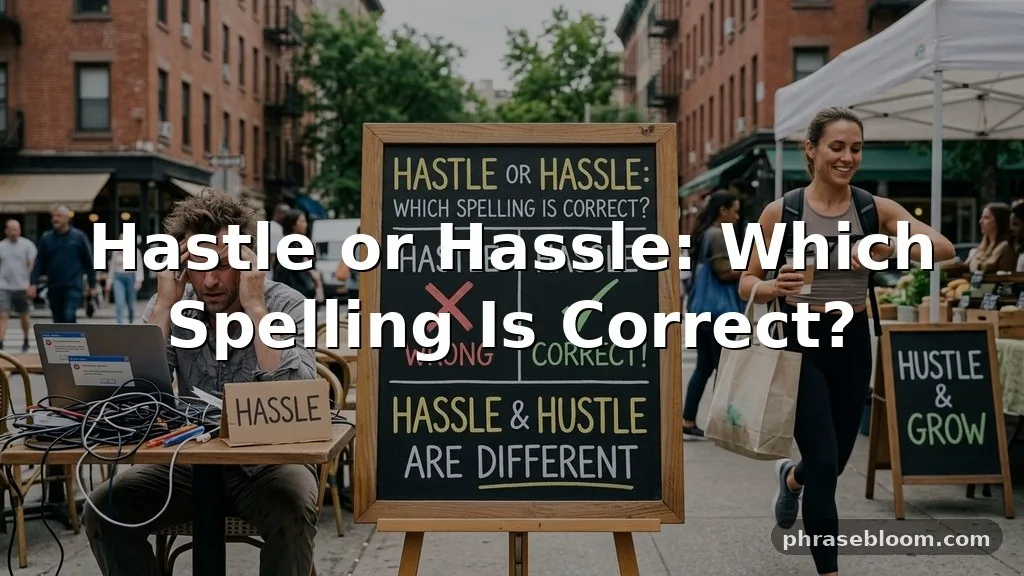
“Hastle or hassle” has a clear answer: hassle is the correct spelling in standard English. “Hastle” is a common misspelling, usually caused by writing the word as it sounds or confusing it with words such as “hasty.”
The noun hassle means an annoying difficulty, inconvenience, or irritating situation. As a verb, it means to bother, pressure, or repeatedly annoy someone. This article explains the hassle spelling, its definition, pronunciation, grammar, history, and practical use in American and British English.
Hassle Is the Correct Spelling
The correct spelling is hassle, with an “s” before the final “le”: h-a-s-s-l-e. The form “hastle” is not the standard spelling of the word and should be treated as a typographical error or spelling mistake.
For example, you should write, “Registering for the service was a hassle,” not “Registering for the service was a hastle.” You should also write, “I don’t want to hassle you,” rather than “I don’t want to hastle you.”
The doubled “s” is the detail that causes the problem. English spelling does not always match pronunciation perfectly, and “hassle” is pronounced with a clear “s” sound that can make the middle of the word easy to overlook when writing quickly.
The distinction matters in professional writing because spellcheck may not catch every error. Some software recognizes “hastle” as a misspelling, but relying only on automatic correction can leave mistakes in emails, reports, customer messages, and published content.
| Form | Status | Example |
|---|---|---|
| hassle | Correct spelling | The delay created a hassle. |
| hastle | Common misspelling | Use only when discussing the error itself. |
| hassle-free | Correct compound form | We offer hassle-free returns. |
A useful rule is simple: if you mean an annoyance or to annoy someone, spell it hassle. The incorrect form “hastle” has no normal role in standard English as a variant spelling of this word.
Hassle Meaning and Dictionary Definition
The central hassle definition is “an irritating difficulty” or “a troublesome situation.” A hassle may be minor, such as filling out an unnecessarily complicated form, or more persistent, such as dealing with repeated delays from a service provider.
As a noun, hassle identifies the problem itself. In the sentence “Returning the damaged item was a hassle,” the word names the unpleasant process. The inconvenience may involve time, effort, confusion, or repeated communication.
As a verb, hassle describes an action directed at another person. In “The salesperson kept hassling me,” the word means that the salesperson repeatedly pressured or bothered the speaker.
- Noun: “The paperwork was a hassle.”
- Verb: “The constant calls began to hassle the customer.”
- Adjective in a compound: “The company promises hassle-free installation.”
- Related phrase: “We completed the process without any hassle.”
The word often carries an informal tone. Someone may describe a delayed flight as “a hassle,” while a formal report might call the same matter “an administrative inconvenience” or “a procedural difficulty.” Neither choice is automatically better; the appropriate wording depends on the audience and purpose.
Major English dictionaries, including Merriam-Webster’s entry for hassle, recognize the word as both a noun and a verb. Dictionary entries also help distinguish the established word from “hastle,” which is generally treated as an error rather than an accepted alternative.
In everyday business English, hassle often appears in phrases such as “avoid the hassle,” “save the hassle,” “a major hassle,” and “hassle-free service.” These expressions are widely understood, but writers should still consider whether a more formal synonym is suitable for a legal, academic, or highly technical document.
Why “Hastle” Is a Common Misspelling
“Hastle” is a common misspelling because the incorrect form seems plausible. English contains many words ending in “-tle,” including “castle,” “hustle,” “bustle,” and “whistle,” so writers may unconsciously place the “t” into hassle.
Sound also contributes to the error. In normal speech, the word is not pronounced as separate letters, and the middle consonants may blend together. Someone who has heard the word often but has rarely seen it written may reasonably, but incorrectly, guess “hastle.”
The correct spelling contains two consecutive “s” letters and no “t”: has-sle. It does not follow the pattern of “hustle,” even though the two words look and sound somewhat similar.
Hassle and Hustle Are Different Words
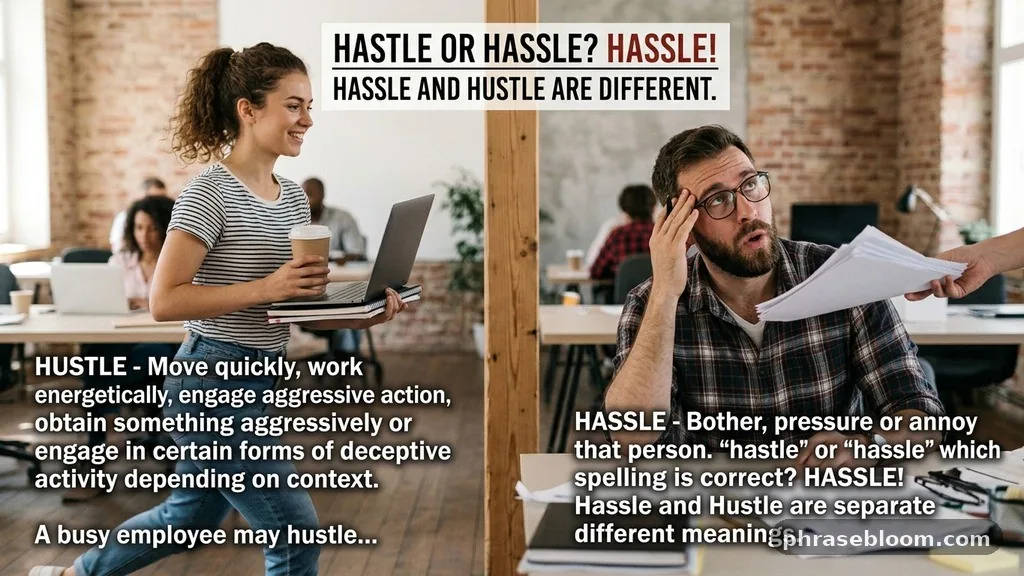
Hassle and hustle are separate words with different meanings. To hustle can mean to move quickly, work energetically, obtain something aggressively, or engage in certain forms of deceptive activity depending on context.
To hassle someone means to bother, pressure, or annoy that person. A busy employee may hustle to finish a project, while an aggressive caller may hassle the employee with repeated demands.
Keeping these words separate helps prevent several errors at once. “Hastle” is not the correct spelling of hassle, and it is not a standard spelling of hustle either.
Memory Aids That Actually Help
One practical memory aid is to connect hassle with the phrase “a small stress.” Both words contain the idea of irritation, and remembering the repeated “s” in “stress” can prompt you to write “hassle” correctly.
Another method is to remember the phrase “hassle-free.” This familiar compound always uses hassle with two “s” letters. If you can picture a sign saying “hassle-free service,” the spelling becomes easier to retrieve.
You can also associate hassle with “bother.” If the word means a bother or something that bothers you, it is hassle. The spelling “hastle” should be flagged as a likely mistake during proofreading.
Hassle Pronunciation and English Grammar
The usual hassle pronunciation is HAS-uhl, with the first syllable receiving the primary stress. The word has two syllables, and the final “e” does not create a long vowel sound.
The spelling and pronunciation do not correspond perfectly letter by letter. The final “le” forms an unstressed syllable, much as it does in words such as “little” and “bottle.” This is one reason a reader may know the spoken word without immediately knowing its written form.
In English grammar, hassle can function as a countable noun. You can say “a hassle,” “several hassles,” or “too many hassles.” The plural form is hassles, not “hassles” with any change to the original double “s” pattern.
Examples include “The new procedure caused several hassles” and “I have dealt with enough hassles this week.” The noun can also appear after determiners such as “the,” “that,” “this,” and “another.”
The Noun Hassle
The noun usually refers to an inconvenient task, a source of annoyance, or a troublesome experience. It can describe something concrete, such as a difficult return, or something more general, such as the hassle of coordinating several schedules.
Common noun patterns include “a hassle,” “the hassle of,” “without the hassle of,” and “avoid the hassle.” For example, “The online portal eliminates the hassle of mailing paper forms” uses hassle to identify the inconvenience being removed.
The noun can be modified by adjectives. Writers might use “unnecessary hassle,” “minor hassle,” “constant hassle,” “administrative hassle,” or “considerable hassle.” The best modifier depends on the exact type and degree of inconvenience.
The Verb Hassle
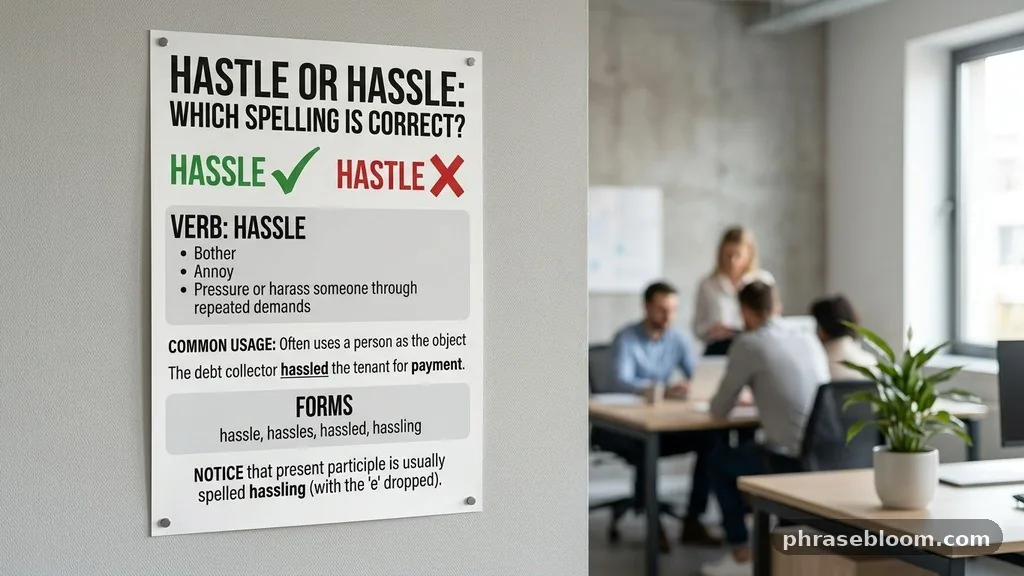
The verb hassle means to bother, annoy, pressure, or harass someone through repeated demands. It is commonly used with a person as the object: “The debt collector hassled the tenant about the payment.”
Its forms are “hassle,” “hassles,” “hassled,” and “hassling.” Notice that the present participle is usually spelled hassling, with the final “e” removed before adding “-ing.”
Examples include “Please don’t hassle the support team,” “Several customers hassled the manager,” and “The reporter was hassling the official for a response.” In serious contexts involving threats or sustained abuse, “harass” may be a more precise and formal word than “hassle.”
How to Use Hassle in a Sentence
“Hassle” works naturally in casual conversation, workplace communication, advertising, and general nonfiction. It often communicates annoyance more directly than a formal synonym, which can make a sentence sound friendly and human.
For example, a workplace email might say, “To avoid the hassle of submitting two separate forms, please use the combined request.” The sentence is clear, practical, and appropriate for ordinary internal communication.
A customer-service message could read, “We’ll replace the item without any hassle.” Here, the word reassures the customer that the process will be simple rather than burdensome.
- “The parking shortage was a daily hassle for employees.”
- “Please don’t hassle the technician while the repair is underway.”
- “The updated portal removes the hassle of manual data entry.”
- “We want the cancellation process to be hassle-free.”
- “Coordinating three vendors became more of a hassle than expected.”
- “The manager asked staff not to hassle customers about optional upgrades.”
The word can sound too informal in some contexts. A research paper might refer to “administrative burdens” rather than “administrative hassles,” while a contract might use “inconvenience,” “obligation,” or “procedural difficulty.”
That does not make hassle incorrect in formal writing. It means that tone and precision should guide the decision. A formal document can use the word if it accurately expresses the intended degree of annoyance and the organization’s style permits conversational language.
Hassle-Free as an Adjective
Hassle-free is a compound adjective meaning easy, convenient, or free from annoying complications. The hyphen helps show that the two words operate together before a noun, as in “hassle-free installation” or “hassle-free returns.”
After a linking verb, the hyphen is often retained in established usage: “The installation was hassle-free.” Style preferences can vary, but keeping the familiar form is usually clear and consistent.
Marketing language uses hassle-free frequently, although writers should not use it as a vague promise. If a company claims to offer “hassle-free returns,” the actual return process should support that description with clear instructions and reasonable requirements.
Hassle in American and British English
Hassle is used in both American English and British English. The basic meaning is not restricted to one national variety, and “hastle” is not an accepted regional alternative in ordinary standard usage.
Pronunciation may vary slightly by speaker and region, as it does with many everyday words. The main stress remains on the first syllable, and the word is generally recognizable across English-speaking communities.
British and American writers may differ in preferred vocabulary surrounding the word. For instance, a British writer might choose “faff” in an informal context for a tiresome task, while an American writer may be more likely to say “hassle.” These choices reflect regional vocabulary, not a different spelling of hassle.
Formal style can also influence frequency. A British government document, an American corporate policy, and an international software manual may all prefer “inconvenience” or “difficulty” because those terms sound more neutral. In a personal email or customer message, hassle may be more natural.
Why the Regional Question Causes Confusion
People sometimes assume that unusual spellings must belong to a different English variety. That assumption is unreliable here. “Hastle” is best understood as a misspelling, not as a British form, American form, or informal regional spelling of hassle.
Some speakers may write the word incorrectly because they have heard it more often than they have read it. Others may confuse it with “hustle” or “castle.” Neither situation creates a legitimate alternate spelling.
If your audience is international, choose the word based on meaning and tone rather than attempting to change its spelling by region. Use hassle when you want the familiar informal word, or replace it with “inconvenience” when a more neutral expression would travel better across formal settings.
Formal Writing, Workplace Use, and Alternatives
In professional writing, hassle is acceptable when the tone is conversational and the meaning is clear. It works particularly well in employee emails, help-center copy, customer support messages, onboarding materials, and internal announcements.
For legal documents, academic writing, technical specifications, and executive reports, a more precise alternative may be preferable. “Inconvenience” describes the effect on a person, while “administrative burden” identifies a workload or procedural problem.
| Context | Natural wording | More formal alternative |
|---|---|---|
| Customer email | We’ll fix this without any hassle. | We’ll resolve this promptly. |
| Internal message | This change should reduce the hassle of approvals. | This change should reduce the approval burden. |
| Academic paper | Usually too conversational | This process creates an administrative burden. |
| Marketing copy | Enjoy hassle-free setup. | Enjoy a simplified setup process. |
| Policy document | Potentially informal | The procedure minimizes inconvenience. |
Useful alternatives include inconvenience, difficulty, problem, burden, complication, and irritation. Each carries a slightly different emphasis, so substitution should not be automatic.
- Use inconvenience for an interruption or difficulty that affects someone.
- Use burden for a demanding responsibility or amount of work.
- Use complication for an issue that makes a process harder.
- Use irritation for the emotional response to an annoying situation.
- Use difficulty when you want a broad, neutral term.
Rewriting can also improve tone without replacing the idea. Instead of “The process is a hassle,” write “The process requires several additional steps.” That version gives the reader concrete information and may be better suited to a report.
Common Errors and Proofreading Tips
The most obvious error is writing “hastle” when you mean hassle. Search for both spellings during proofreading if you suspect the mistake has appeared repeatedly, because a document can contain the correct form in one paragraph and the incorrect form in another.
A second error is confusing hassle with hustle. “Hustle” may describe energetic activity, while “hassle” describes annoyance or pressure. Replacing one with the other can change the meaning of an entire sentence.
A third problem is using hassle when a more exact word is needed. Calling a serious dispute “a hassle” may minimize the matter, particularly in a complaint, workplace investigation, safety report, or legal statement.
Typical Mistakes
- Incorrect: “The refund process was a hastle.” Correct: “The refund process was a hassle.”
- Incorrect meaning: “We hustled the customer for payment.” Better: “We hassled the customer for payment.”
- Too informal: “The audit was a huge hassle.” Formal alternative: “The audit created a substantial administrative burden.”
- Unclear: “The procedure is hassle.” Correct: “The procedure is a hassle.”
- Incorrect compound: “We offer hassle free returns.” Preferred: “We offer hassle-free returns.”
Spellcheck is useful but not perfect. A spellchecker may fail to flag a word if it appears in a custom dictionary, a product name, a person’s name, or a technical database.
Read the sentence for meaning as well as spelling. If the intended idea is annoyance, inconvenience, or repeated pressure, confirm that the word is hassle and not hustle, hastle, or an unrelated term.
Quick Guide to Remembering the Correct Form
Use this short decision process whenever you hesitate between “hastle” and “hassle.” First, identify the meaning. If you mean an annoying problem or the act of bothering someone, the answer is hassle.
Next, check the letters. The correct form has two “s” letters and no “t”: h-a-s-s-l-e. Finally, read the whole sentence aloud to make sure the word fits grammatically as a noun, verb, or part of the compound adjective hassle-free.
- Ask whether the meaning involves annoyance, inconvenience, or pressure.
- Write “hassle” with two “s” letters.
- Check whether the sentence needs a noun or a verb.
- Use “hassle-free” when describing something without complications.
- Replace the word with “inconvenience” if a formal tone requires it.
The phrase “a hassle” needs the article “a” because hassle is a countable noun in that construction. You can say “It was a hassle,” but not normally “It was hassle.” By contrast, the verb appears directly after an auxiliary or subject: “Don’t hassle me” and “They hassled the driver.”
Remembering related forms makes the spelling more stable. The same base appears in “hassles,” “hassled,” “hassling,” and “hassle-free,” although normal spelling rules affect the endings.
Examples You Can Copy and Adapt
These examples show how hassle works in ordinary English across several contexts. They also demonstrate the difference between the noun and verb forms.
- “The revised form should eliminate the hassle of entering the same information twice.”
- “Please don’t hassle the front-desk staff about an appointment that has already been confirmed.”
- “We designed the pickup service to make returns less of a hassle.”
- “The vendor’s repeated billing errors created an unnecessary hassle for our finance team.”
- “The instructions promise hassle-free installation, but customers should still review the system requirements.”
- “I’d rather pay online than deal with the hassle of mailing a check.”
- “Several callers said that the automated menu was more of a hassle than a solution.”
- “The supervisor told the team not to hassle new employees while they were learning the process.”
- “A short checklist can prevent the hassle of correcting avoidable filing errors.”
- “The report describes the delay as an inconvenience rather than using the more informal word hassle.”
In a workplace email, you might write, “To avoid any hassle, please upload the signed form before Friday.” The sentence is friendly and direct, although “To prevent delays, please upload the signed form before Friday” would sound more neutral.
In a policy, a writer might say, “Employees may submit requests through the online portal to reduce administrative inconvenience.” That wording is less conversational and more appropriate if the policy uses formal terminology throughout.
In marketing copy, “hassle-free” can be effective because it is familiar and compact. Still, a specific claim such as “no paperwork is required” gives readers more useful information than the general promise alone.
Frequently Asked Questions About Hastle or Hassle
Is “hastle” a correct spelling?
No. Hassle is the correct spelling for an annoyance, inconvenience, or act of bothering someone. “Hastle” is a common misspelling.
What does hassle mean?
As a noun, hassle means an irritating difficulty or inconvenience. As a verb, it means to bother, pressure, or annoy someone repeatedly.
How do you pronounce hassle?
Hassle is usually pronounced “HAS-uhl,” with the stress on the first syllable. It has two syllables, and the final “e” is silent.
Is hassle formal or informal?
Hassle is standard English but often has a conversational or informal tone. It is suitable for many emails, customer messages, and workplace conversations, while “inconvenience,” “burden,” or “difficulty” may fit better in highly formal writing.
Is “hassle-free” hyphenated?
Yes, “hassle-free” is normally written with a hyphen when it functions as a compound adjective, as in “hassle-free returns.” Keeping the hyphen makes the two words easier to read as one descriptive unit.
Final Answer on Hastle or Hassle
Between “hastle or hassle,” choose hassle. It is the correct spelling in American English, British English, and standard international usage, whether you mean an annoying problem or the act of bothering someone.
Use “hassle” in conversational and professional contexts when its informal tone fits. If your sentence belongs in a formal report or academic paper, consider “inconvenience,” “difficulty,” or “administrative burden” instead. Remember the double “s,” and you’ll avoid the most common hassle spelling mistake.
1 thought on “Hastle or Hassle: Which Spelling Is Correct?”