
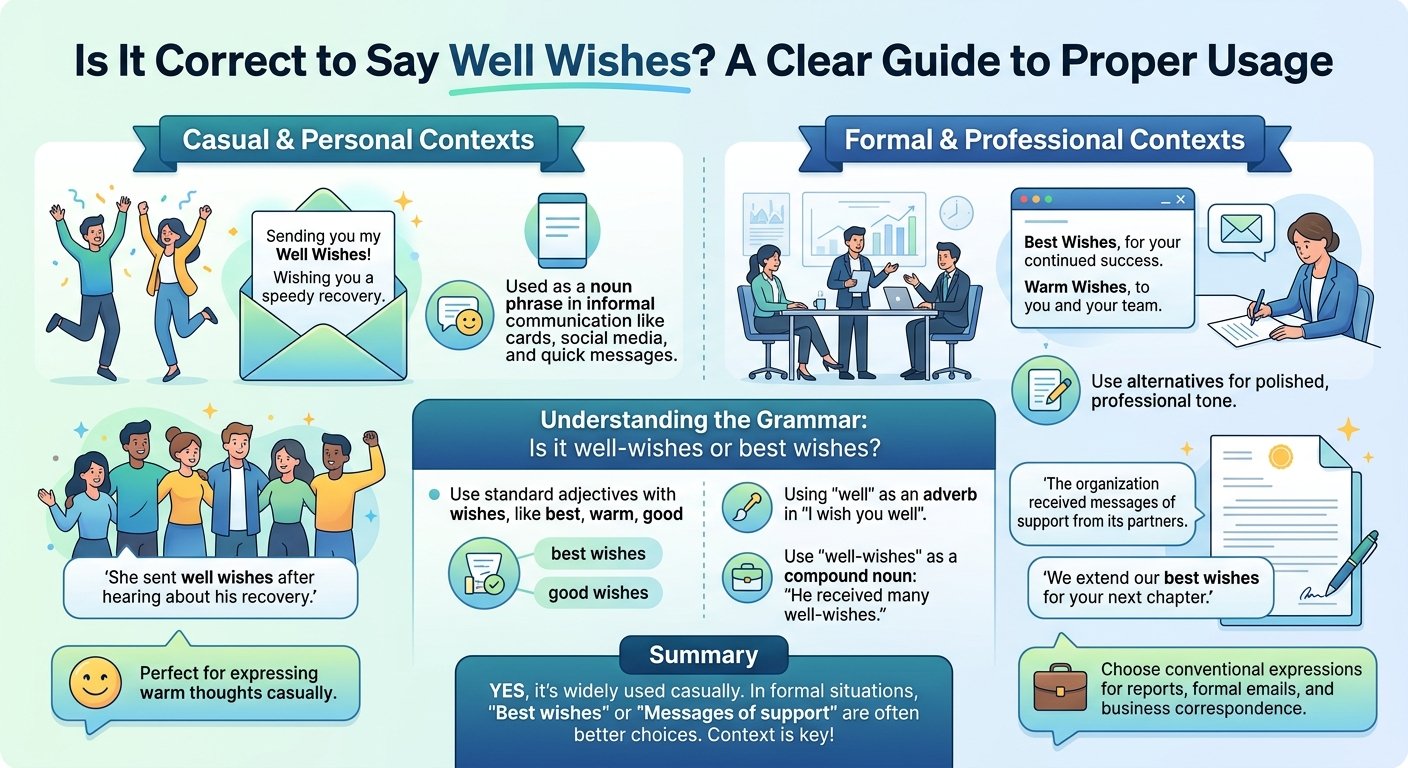
Is it correct to say well wishes? The short answer is yes, but with some context. The phrase is understandable and widely used, especially in casual speech, social media, cards, and personal messages. However, standard English often favors best wishes, good wishes, or the verb phrase wish someone well.
The confusion usually comes from the role of the word “well.” When you say, “I wish you well,” well functions as an adverb because it describes the act of wishing. When you use well-wishes as a noun, the two words form a compound noun.
Therefore, choosing the right expression depends on how you use it in a sentence. For example, “I wish you well” is natural, while “Please accept my best wishes” works especially well as a closing.
Is It Correct to Say Well Wishes: Why Does the Confusion Exist?
The phrase creates confusion because English uses both well and good in closely related expressions. Grammatically, however, they do different jobs.
In “I wish you well,” the word well describes how someone is doing. In “best wishes,” the word best is an adjective modifying the noun wishes.
Another issue is hyphenation. Some writers use “well wishes,” while others write “well-wishes.” When the expression functions as a compound noun, the hyphenated form can make the meaning clearer.
Modern informal English frequently uses “well wishes” as two words. Still, if you want polished writing, alternatives such as “best wishes” or “messages of support” are often safer.
See Also: Any Problem or Any Problems: Understanding the Difference
Why It Matters in Professional Settings
Professional writing requires clear and conventional language. Although readers will usually understand “well wishes,” it can sound slightly casual or less polished in a business letter, report, academic paper, or formal email.
For example, instead of writing, “The organization received well wishes from its partners,” you could write, “The organization received messages of support from its partners.”
Similarly, a formal email might end with “Best wishes” rather than “Well wishes.” These choices improve the tone without changing the intended meaning.
Is It Correct to Say Well Wishes: Which One Is Correct?
The correct choice depends on the grammatical function.
Use wish someone well when you need a verb phrase:
I wish you well in your new position.
Use best wishes when you need a conventional closing:
Best wishes, Daniel.
Use well-wishes when referring to goodwill or kind messages as a compound noun:
The patient received many well-wishes after the surgery.
You can also choose good wishes, warm wishes, sincere wishes, or wishes for your well-being, depending on the situation.
Consequently, there is no single answer that makes every use of “well wishes” right or wrong. Context determines the most natural expression.
What Does “Well Wishes” Mean? Origins, Definition, and Usage
The expression well wishes refers to positive thoughts, kind intentions, goodwill, or supportive messages directed toward someone.
People commonly use the phrase when someone is experiencing an important life event. These events might include starting a new job, recovering from an illness or surgery, celebrating an achievement, or going through a difficult period.
For instance:
She sent her well-wishes after hearing about his recovery.
In everyday communication, the meaning is easy to understand. However, formal writers may prefer more established expressions.
Definition of Well Wishes
The basic meaning of well wishes is good or positive thoughts expressed toward another person.
Depending on the context, it can mean:
- kind thoughts
- good intentions
- supportive messages
- expressions of goodwill
- hopes for someone’s well-being
- positive wishes for someone’s future
The phrase can therefore overlap with best wishes, good wishes, and messages of support.
Origins of the Word “Well Wishes”
The expression developed from the broader idea of wishing someone well. The verb wish has long been used to express a desire for a particular outcome, while well can describe a person’s good condition or circumstances.
The phrase “wish someone well” is therefore older and grammatically straightforward. The noun form “well-wishes” developed as a way to describe the good intentions or supportive sentiments themselves.
Today, both forms can appear in English, although their grammatical roles differ.
Why Well Wishes Is a Commonly Used Expression
Many speakers naturally transform the familiar verb phrase “wish someone well” into the noun-like expression “well wishes.” That makes the phrase intuitive, even when style preferences differ.
Social media and informal communication have also helped popularize expressions such as “sending well wishes” and “sending my well wishes.”
Still, popularity does not always mean a phrase is the best choice for every context. Formal English tends to favor conventional expressions.
Exploring the Significance of Well Wishes in Everyday Communication
Well wishes are commonly associated with kindness and encouragement. They can help people communicate positive feelings without making a message overly emotional.
For example, someone might write:
Sending well-wishes for your speedy recovery.
The same idea can be expressed more naturally in some contexts as:
Wishing you a speedy recovery.
The second version uses a direct verb and sounds especially smooth in a card or personal message.
Role of Well Wishes in a Professional Setting
In professional communication, word choice should match the relationship and purpose of the message.
For a colleague leaving a company, “Best wishes for your next chapter” sounds natural. For a formal announcement, “We extend our best wishes for your continued success” is more polished.
Meanwhile, a report could use expressions of goodwill or messages of support instead of the more casual noun phrase.
The goal is not to avoid “well-wishes” completely. Rather, the goal is to select language appropriate to the audience.
Common Reasons for the Well Wishes Misspelling
One common misconception is that “well wishes” is always a spelling error. It is better described as a question of usage, grammar, and style.
Another issue involves well-wishes versus well wishes. When the expression acts as a compound noun, many writers prefer the hyphenated form because it clearly joins the two words.
For example:
The team received many well-wishes.
However, language changes over time, and spelling conventions can vary among dictionaries, publications, and style guides.
A second common mistake is confusing well and good. “Good wishes” uses an adjective modifying the noun “wishes,” while “wish someone well” uses “well” as an adverb.
A third mistake is using a casual expression in a highly formal context. In those situations, “messages of support” or “expressions of goodwill” may communicate the same idea more effectively.
See Also: “A Hilarious or An Hilarious”: Understanding the Difference
Side-by-Side Comparison: Well Wishes, Well-Wishes, Best Wishes, and Wish Someone Well
| Expression | Grammatical role | Typical use | Example |
|---|---|---|---|
| well wishes | noun phrase | Casual communication | She sent well wishes. |
| well-wishes | compound noun | Running text | He received many well-wishes. |
| best wishes | noun phrase/closing | Cards, emails, letters | Best wishes, Maria. |
| good wishes | noun phrase | General goodwill | All good wishes for your future. |
| warm wishes | noun phrase/closing | Friendly, personal messages | Warm wishes to everyone. |
| wish someone well | verb phrase | Direct action | I wish you well. |
| messages of support | noun phrase | Formal writing | We received messages of support. |
| expressions of goodwill | noun phrase | Formal contexts | The group sent expressions of goodwill. |
This comparison shows why there is no need to treat every form as interchangeable. Each expression has a slightly different tone and grammatical function.
Everyday Examples of Well Wishes in Language
The phrase often appears in personal communication.
Sending well-wishes for your speedy recovery.
A more conventional alternative is:
Wishing you a speedy recovery.
For a new job, you could say:
Best wishes on your new job.
For a formal email:
Please accept my best wishes for your continued success.
For a friendly message:
Warm wishes to you and your family.
When referring to supportive messages as a noun:
She received many well-wishes after the announcement.
These examples demonstrate how context, tone, and parts of speech influence the best choice.
How to Spell “Well Wishes” and Remember the Correct Spelling
If you are wondering how to spell “well wishes”, remember that there are two commonly encountered forms: “well wishes” and “well-wishes.”
When the expression functions as a compound noun in running text, well-wishes clearly signals that the two words work together.
However, many modern informal sources use “well wishes” without a hyphen. Therefore, the important issue is not simply spelling but choosing the form that fits your writing style and grammatical context.
If you are writing a formal message, you can avoid the hyphenation question altogether by using best wishes, good wishes, messages of support, or expressions of goodwill.
Practice Sentences
Try these examples:
I wish you well in your new job.
Please accept my best wishes for your continued success.
The patient received many well-wishes after surgery.
We are sending warm wishes to the newly married couple.
The organization received messages of support from the community.
Notice how each sentence uses a different expression for a specific purpose.
Literature and Media Mentions: Correct Usage of Well Wishes
Expressions involving wishes appear frequently in books, journalism, films, television, greeting cards, and online communication.
“Best wishes” is especially common because it functions as a traditional closing. Similarly, “wish someone well” is an established idiomatic expression that appears naturally in both American and British English.
The noun well-wisher is another related term. A well-wisher is a person who expresses goodwill or hopes for someone’s success.
For example:
Many well-wishers attended the celebration.
This form is useful because it refers directly to the person offering the goodwill rather than the message itself.
American and British English generally understand well wishes, well-wishes, best wishes, and wish someone well. Differences are mainly related to style, register, and individual publication preferences rather than basic comprehension.
In American English, “Best wishes” is common in professional correspondence, while “Sending well-wishes” may appear in informal communication.
British English also commonly uses “Best wishes” and “With best wishes,” particularly in letters and cards.
Frequently Asked Questions About Well Wishes
What’s the correct way to spell “well wishes”?
Both “well wishes” and “well-wishes” appear in English. For a compound noun, “well-wishes” clearly shows that the words function together.
Is “well wishes” a French word?
No. “Well wishes” is an English expression formed from the English words “well” and “wishes,” meaning positive thoughts or goodwill.
Why is spelling “well wishes” correctly important?
Correct usage improves clarity and professionalism. In formal writing, conventional alternatives such as “best wishes” often sound more polished and natural.
Is “wish you well” better than “send well wishes”?
Usually, yes. “I wish you well” is a clear verb phrase, while “best wishes” is often preferable when expressing goodwill as a noun.
Should “well wishes” be hyphenated?
When used as a compound noun, “well-wishes” is a clear choice. However, “well wishes” also appears frequently in informal modern English.
Conclusion: Why It’s Important to Use “Well Wishes” Correctly
Is it correct to say well wishes? Yes, the expression is understandable and commonly used, particularly in informal communication. However, context matters. Use wish someone well when you need a verb phrase, and choose best wishes or warm wishes for cards and email closings. When referring to supportive messages as a noun, well-wishes can clearly show the compound form. For formal writing, messages of support and expressions of goodwill are often better choices. Ultimately, selecting the right expression makes your writing clearer, more natural, and better suited to your audience.
Related: How to Use “My Question Is” Correctly
2 thoughts on “Is It Correct to Say Well Wishes? A Clear Guide to Proper Usage”