
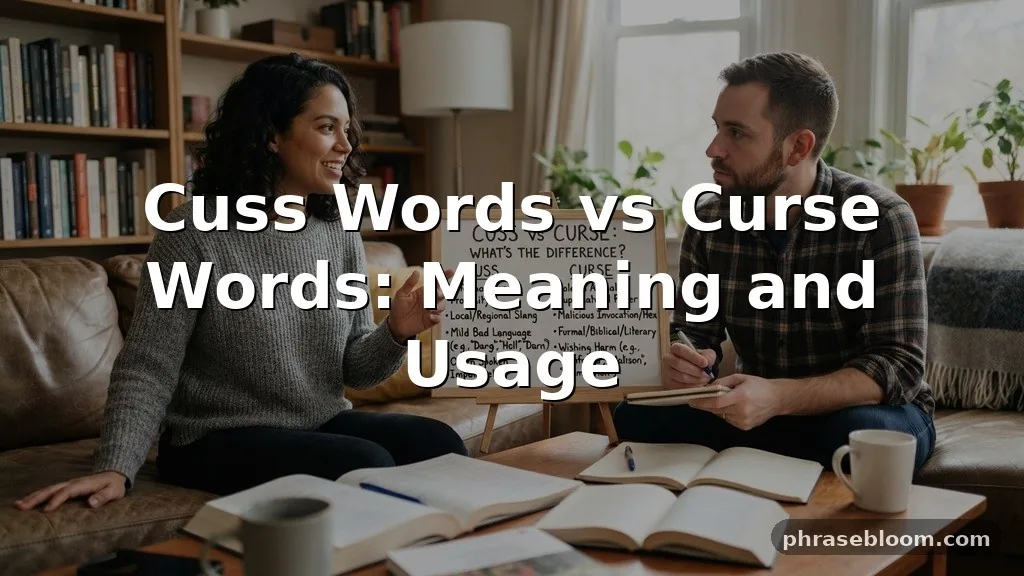
The difference between cuss words and curse words is usually smaller than people expect. Both terms commonly describe swear words, profanity, or other language considered offensive, vulgar, or socially unacceptable in a particular setting.
The main distinction is tone and context: “cuss words” sounds more casual and conversational, while “curse words” can sound broader or slightly more serious. Some people also use “curse” for a spoken imprecation or supernatural spell, so the surrounding sentence matters. This article explains how the terms overlap, where they differ, and how words such as “profanity,” “expletive,” “obscenity,” and “slur” fit into the picture.
The Short Answer: Cuss Words and Curse Words
In ordinary American English, cuss words and curse words generally mean the same thing: words or expressions used to swear, insult, express anger, or shock someone. “Swear words” is another common term, and “profanity” is the more formal word often used in workplace, educational, media, and legal discussions.
“Cuss” is an informal American variation of “curse.” It often appears in everyday speech, family conversations, and humorous descriptions of strong language. “Curse” has the same meaning in many contexts, but it can also refer to a verbal wish that harm, misfortune, or punishment will come to someone.
| Term | Typical meaning | Tone or use | Important note |
|---|---|---|---|
| Cuss words | Offensive or rude words used in speech | Informal and conversational | Especially common in American English |
| Curse words | Swear words or words used to curse | General, informal, or slightly serious | Can also suggest a spoken malediction |
| Swear words | Words used for strong emotion, insult, or taboo expression | Common and widely understood | “Swear” has other meanings, including making a solemn promise |
| Profanity | Language regarded as offensive, irreverent, or taboo | Formal and neutral | Useful in policies, reports, and media descriptions |
| Expletives | Strong words used to express emotion | Formal or analytical | Not every expletive functions as a direct insult |
There is no universal list of cuss words or curse words. A term may be offensive in one culture, mild in another, or acceptable among close friends but inappropriate in a workplace meeting. Meaning depends on the word itself, the speaker’s intent, the audience, the relationship between the speakers, and the setting.
What Does “Cuss Word” Mean?
A cuss word is an informal term for a word or phrase considered rude, offensive, or inappropriate. “Cuss” is traditionally associated with American speech, although people elsewhere understand it easily through films, television, music, and online communication.
The word “cuss” developed as a shortened or altered form of “curse.” In modern conversation, it is often chosen because it sounds less formal and sometimes less harsh than “curse.” For example, a parent might say, “Please don’t use cuss words at the dinner table,” while a school policy might refer to “profanity” or “offensive language.”
Cuss words can serve several functions. A speaker might use one to show anger, intensify a complaint, express surprise, add humor, insult another person, or create a deliberately rough style in dialogue.
- Emotional reaction: A speaker uses a strong word after being hurt or startled.
- Insult: A term is directed at another person to demean or provoke them.
- Emphasis: A swear word intensifies an otherwise ordinary statement.
- Humor: A speaker uses taboo language for comic effect or exaggerated frustration.
- Group identity: Friends or communities may use certain words informally within a shared relationship.
- Characterization: A writer uses cuss words to suggest a character’s background, personality, mood, or social environment.
These functions are not equally harmless. A word used casually among friends may become threatening or abusive when directed at a stranger, subordinate, child, or member of a targeted group. Context and intent affect interpretation, but they do not erase the possible impact on listeners.
What Does “Curse Word” Mean?
A curse word can mean a swear word, but “curse” has a wider range of meanings than “cuss.” As a verb, “to curse” may mean to use offensive language, call down harm, condemn someone, or speak a malediction. As a noun, a “curse” may refer to a harmful spell or a spoken wish for misfortune.
That older or supernatural meaning appears in stories, religious writing, folklore, and fantasy. A character might place a curse on a kingdom, speak an imprecation against an enemy, or suffer under a family curse. In everyday conversation, however, “curse word” usually means the same thing as “swear word.”
The term can also sound slightly more serious than “cuss word.” Compare these sentences:
- “He used a few cuss words after dropping the box.”
- “The film contains several curse words.”
- “The wizard placed a curse on the castle.”
The first sentence sounds casual and conversational. The second describes strong language in a neutral way, while the third uses “curse” in its supernatural sense. The words around “curse” usually make the intended meaning clear.
“Curse” can also appear in the phrase to curse someone, which does not always mean merely to swear at them. It may suggest condemnation or a wish that something bad will happen. A person who says, “I curse the day we met,” is expressing intense hostility, but the statement may be figurative rather than a literal magical act.
Cuss Words, Curse Words, and Swear Words
Swear words is probably the broadest everyday label among the three common expressions. It is widely understood in American English and British English, and it avoids some of the extra meanings attached to “curse.” In a content warning, for example, “contains strong language and swear words” is immediately clear to most readers.
“Swear” itself has multiple meanings. Someone may swear an oath, swear that a statement is true, or swear at another person. The phrase “swear word” depends on context to show that the subject is offensive language rather than a solemn promise.
Profanity is more formal. It can describe language that treats something sacred or religiously important with disrespect, but it is also commonly used for offensive language more generally. A workplace rule might say, “The company prohibits harassment, threats, and profanity,” because the term fits a professional policy better than “cuss words.”
Expletive is an analytical term for a strong word or expression used to release emotion. An expletive may be profane, but the word focuses on its role in a sentence rather than on a particular moral judgment. A linguist, editor, or journalist might describe a character’s expletives without repeating them.
Vulgar language emphasizes rudeness or a lack of social refinement. Offensive language focuses on the likely effect on an audience. Taboo language points to words that a community restricts because they involve sensitive subjects, bodily functions, sexuality, religion, death, identity, or social status.
The Merriam-Webster definition of profanity is useful when a formal definition is needed, but no dictionary can determine whether every use of a word will offend every audience. Dictionaries describe usage; speakers and communities determine how language functions in a specific situation.
Profanity, Obscenity, and Offensive Language
People often use “profanity,” “obscenity,” “vulgarity,” and “offensive language” as if they were exact synonyms. They overlap, but each term highlights a different feature of the language.
Profanity
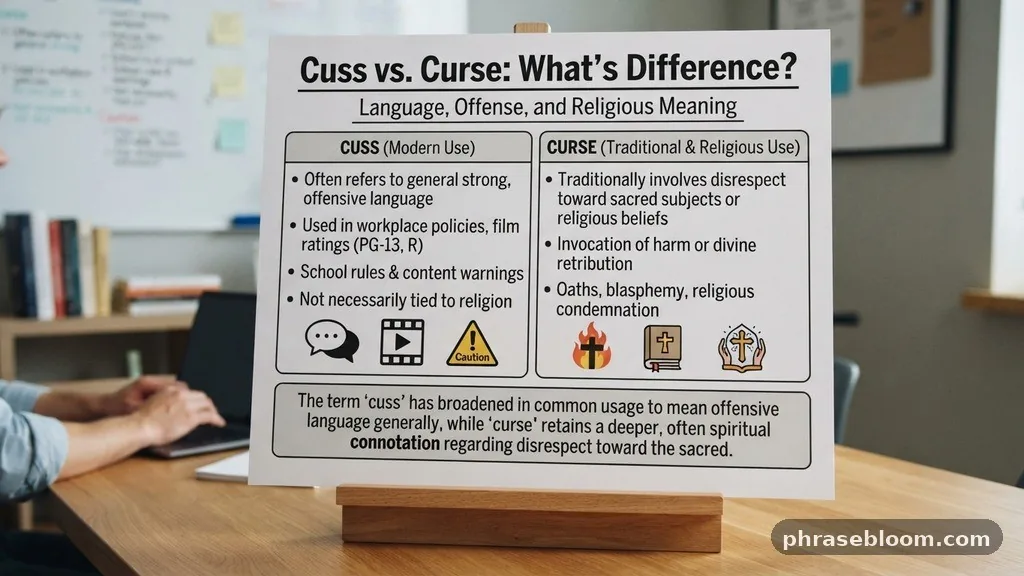
Profanity traditionally involves disrespect toward religious beliefs or sacred subjects. In modern general use, it often means strong or offensive language, whether or not the language is religious. This broader meaning is common in workplace policies, film ratings, school rules, and content warnings.
Obscenity
Obscenity is a more technical and legally sensitive term. It may refer to material considered extremely offensive, especially in relation to sexual content, but legal definitions vary by jurisdiction and situation. It should not be used casually as a perfect synonym for every cuss word.
Vulgarity
Vulgarity describes language viewed as crude, coarse, or socially low in style. A vulgar expression may be offensive without being a curse in the supernatural sense. It can also describe behavior, humor, gestures, or subject matter rather than words alone.
Slurs and insults
An insult is language intended to demean, criticize, or provoke another person. A cuss word can be an insult, but it can also be a general exclamation that is not aimed at anyone. A slur is more specific: it targets a person or group based on identity, such as race, ethnicity, religion, disability, gender, or sexual orientation.
Slurs should not be treated as ordinary swear words. Their history, social target, and power are different, and repeating them can cause harm even when a speaker claims to be joking. A professional discussion should usually describe the term rather than reproduce it.
Why Context and Intent Matter
The same expression can have different effects depending on who says it, who hears it, and where it appears. A mild euphemism may be considered unacceptable in one household, while a much stronger expression may be normal within a particular group of friends. Workplace communication creates additional expectations because employees may not share the same culture, age, background, or tolerance for taboo language.
Intent matters, but it is only one part of meaning. A speaker may intend humor while a listener experiences humiliation, especially if the words involve a personal identity or unequal power relationship. The fact that a person “didn’t mean anything by it” does not automatically make the language harmless.
Consider the difference between these situations:
| Situation | Likely function | Why interpretation changes |
|---|---|---|
| A driver mutters a strong word after missing a turn | Emotional release | No specific person may be targeted |
| A manager directs a profanity at an employee | Possible insult or intimidation | Power and workplace expectations increase the seriousness |
| Friends use a reclaimed term among themselves | Group bonding or informal identity | Outsiders may not share the same permission or relationship |
| A character uses repeated profanity in a novel | Voice and characterization | The language belongs to a constructed narrative context |
| A public advertisement includes a curse word | Attention, humor, or brand positioning | The message reaches a broad and unpredictable audience |
Writers should also distinguish a word’s dictionary meaning from its pragmatic meaning. Pragmatic meaning is what an expression communicates in a particular situation, including attitude, sarcasm, aggression, solidarity, or emotional intensity. That is why a neutral dictionary definition cannot fully predict how an audience will react.
Cuss Words and Curse Words in Professional Communication
Professional writing usually favors precise descriptions over casual labels. In a company policy, “profanity,” “abusive language,” “harassment,” “threatening language,” or “offensive language” may be more appropriate than “cuss words.” The best choice depends on what the policy actually prohibits.
A rule against profanity is not automatically a rule against every insult, threat, or slur. A person can harass someone without using a curse word, and a person can use a mild swear word without threatening anyone. Policies should identify the conduct that matters rather than rely on a vague label.
In an employee handbook, these examples are clearer:
- Less precise: “No cuss words are allowed.”
- More precise: “Employees must not use threatening, abusive, or discriminatory language toward coworkers, customers, or visitors.”
- Content warning: “This training video contains profanity and references to violence.”
- Editorial note: “The quotation includes strong language that has been retained for accuracy.”
The revised versions explain the concern instead of assuming that every reader defines “cuss words” in the same way. That distinction is especially important in legal, human resources, education, customer service, and public-facing communication.
Business writers may still use “cuss words” in an informal email or conversation. For example, a team leader might write, “Let’s keep the meeting professional and leave the cuss words out of the presentation.” The phrase is natural there because the tone is conversational, not regulatory.
Euphemisms and Minced Oaths
People often avoid cuss words by using a euphemism, a milder expression substituted for a stronger or more sensitive one. A euphemism can soften profanity, refer indirectly to death or illness, or make a statement more socially acceptable.
A minced oath is a particular kind of softened expression. It changes or disguises a religious oath or taboo word so that it sounds less offensive. Expressions such as “gosh” for a religious exclamation or “darn” for a stronger word are traditional examples of this process.
Euphemisms serve different purposes. A child may use one because an adult has said a word is forbidden, while an adult may choose one to maintain politeness in a public setting. Writers also use euphemisms to suggest that a character is upset without printing explicit language.
They can, however, become confusing if the audience does not recognize the intended reference. A business document should not rely on playful substitutes when a direct, neutral description would be clearer. “Offensive language” is usually more useful than an informal phrase such as “bad words.”
Some euphemisms also change over time. An expression that once sounded polite can become old-fashioned, humorous, or even offensive in a new context. Language changes because speakers continually adjust how they discuss subjects that carry social or emotional pressure.
How Dictionaries Describe These Terms
Dictionaries usually show that the words overlap without treating them as identical in every situation. A dictionary entry may label “cuss” as informal, define “curse” both as offensive speech and as a wish for harm, and describe “swear word” as an offensive or taboo expression.
The Oxford English Dictionary is especially valuable for tracing historical development and earlier meanings. It can show how “curse” has long carried religious, magical, condemnatory, and profane senses. Modern general dictionaries are often more useful for quick guidance on current everyday usage.
Dictionary labels matter. Terms such as “informal,” “offensive,” “vulgar,” “taboo,” and “archaic” tell readers how a word is likely to function. They do not mean that a term is forbidden in every setting, but they warn that the word may require careful judgment.
Definitions also cannot settle every disagreement about a particular expression. A word may be neutral in one community, offensive in another, or acceptable only when members of a group use it about themselves. Usage notes, example sentences, and cultural context help explain those differences.
Cuss Words vs Curse Words in Writing and Media
Authors use cuss words and curse words as part of voice, realism, pacing, and characterization. A character who never swears may sound restrained, formal, frightened, or carefully controlled. A character who swears constantly may seem aggressive, comic, impulsive, exhausted, or deliberately rebellious.
Strong language should serve a purpose. If every line contains profanity, the language can lose its force and make characters sound alike. If a serious character suddenly uses one carefully chosen expletive, the change may communicate more emotion than a page of repeated swearing.
Editors consider audience, genre, publication standards, and narrative purpose. A children’s book may use euphemisms or invented expressions, while an adult novel may reproduce explicit language. A screenplay may include strong language because actors and directors will deliver it aloud, whereas a corporate report should normally state the underlying issue directly.
Public communication requires another layer of judgment. A marketing campaign may use one cuss word to appear bold or relatable, but the choice can alienate customers, limit distribution, or distract from the product. A public statement should never assume that an attempt at humor will be understood uniformly by a broad audience.
Writers can ask three practical questions before including a questionable expression:
- What specific purpose does the word serve?
- Could a clearer or less distracting expression achieve the same effect?
- How might the intended audience interpret the language outside the writer’s personal experience?
These questions do not create a universal ban on profanity. They encourage deliberate usage rather than accidental offense or empty repetition.
Common Confusions About the Terms
Are cuss words always curse words?
In everyday usage, usually yes. “Cuss word” is generally a casual label for a swear word, while “curse word” can also refer to language that expresses a curse or malediction. The categories overlap, but “curse” has the broader range of meanings.
Are swear words always insults?
No. An expletive may express pain, surprise, or frustration without targeting another person. An insult directly attacks someone, while a swear word can function as a general emotional reaction.
Is every offensive word profanity?
No. A slur, threat, discriminatory expression, or sexually explicit term may be offensive without fitting every definition of profanity. Use the most precise label available, especially in formal writing.
Is “bad language” the same as profanity?
“Bad language” is an informal, broad phrase. It may refer to profanity, insults, vulgarity, threats, or any speech a speaker considers inappropriate. It is understandable, but it is less precise than “profanity” or “offensive language.”
Can a curse word be acceptable?
Acceptability depends on audience, relationship, purpose, and setting. A word may be tolerated in private conversation but inappropriate in a classroom, workplace, broadcast, formal letter, or customer-facing message.
Choosing the Right Term
Choose cuss words when the tone is informal and conversational. The phrase works well in family discussions, casual explanations, humorous articles, and ordinary speech, particularly in American English.
Choose curse words when you want a familiar general expression or when the words are connected to the idea of cursing someone. Remember that the term may also evoke spells, imprecations, or supernatural harm, especially in fiction.
Choose swear words when you want the most broadly recognizable everyday term. Choose profanity for formal or institutional writing, and choose “slur,” “threat,” “harassment,” or “abusive language” when one of those more specific descriptions is accurate.
| Writing situation | Recommended wording | Reason |
|---|---|---|
| Casual conversation | Cuss words or swear words | Natural and easy to understand |
| School or workplace policy | Profanity, abusive language, or discriminatory language | More precise and professional |
| Film or television description | Strong language or profanity | Suitable for content guidance |
| Literary analysis | Expletives, profanity, taboo language, or vulgarity | Allows a more specific discussion of function |
| Fantasy or religious context | Curse, imprecation, or malediction | Preserves the supernatural or condemnatory meaning |
The simplest rule is to match the label to the setting. Informal words are not automatically wrong, and formal words are not automatically better. Precision and audience awareness matter more than choosing the most serious-sounding term.
Frequently Asked Questions
What is the difference between cuss words and curse words?
They usually refer to the same type of offensive or taboo language. “Cuss words” is more casual, while “curse words” can also mean words used to call down harm or express a malediction.
Which is more common, cuss words or curse words?
Both are common, but usage varies by region, age, family background, and context. “Cuss words” sounds especially conversational in American English, while “curse words” is widely understood in both casual and explanatory writing.
Are cuss words the same as profanity?
Usually, but “profanity” is the more formal term. It can also have a narrower religious meaning, so context determines whether the words are being used as exact synonyms.
What is the difference between a curse word and a slur?
A curse word may express emotion or rudeness without targeting a group. A slur targets a person or group based on identity and carries a distinct history and harm, so it should not be treated as an ordinary swear word.
What should I say in formal writing?
Use “profanity,” “offensive language,” “abusive language,” or a more specific term such as “threatening language” or “discriminatory language.” These choices are clearer and more appropriate for policies, reports, academic work, and professional communication.
Final Takeaway
Cuss Words vs Curse Words is mainly a question of overlap, tone, and context rather than a strict difference in meaning. Both expressions usually refer to swear words or offensive language, but “cuss” sounds more informal, while “curse” can also suggest a spoken wish for harm or a supernatural spell.
Use the term that fits your audience and purpose. “Cuss words” works in casual speech, “curse words” is a broad familiar option, and “profanity” is usually best for formal writing. If a word is specifically a slur, threat, or form of harassment, name that conduct directly instead of hiding it under a general label.
Related reading: Unselect vs Deselect, Hassle vs Hastle, Continuous vs Continous.