
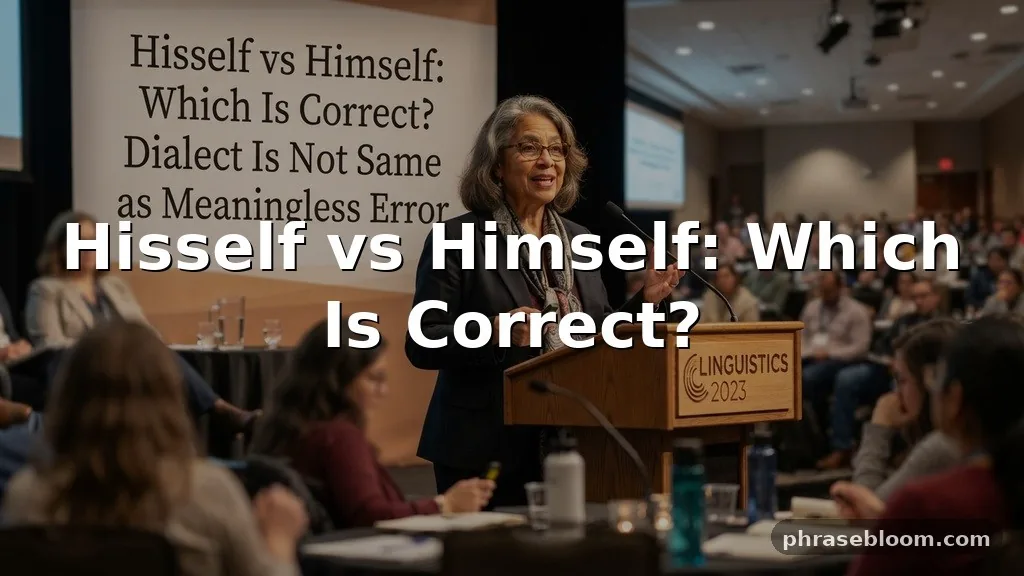
The choice between hisself vs himself matters because the two forms do not have the same status in standard English. Himself is the accepted reflexive pronoun for a male person, while hisself is generally treated as nonstandard English, a dialect form, or an informal regional variant.
You will usually want “himself” in professional writing, academic work, edited publications, and formal conversation. “Hisself” can still appear in speech, historical writing, quotations, fiction, or particular dialects, so recognizing it helps you understand the word without assuming it is the preferred form for general use.
Hisself vs Himself: The Direct Answer
Himself is the standard form. Use it as the reflexive pronoun that refers back to a singular male person or a masculine noun, as in “He prepared himself for the interview” or “The dog injured himself.”
Hisself is not normally used in standard formal English. It appears in some regional dialects, varieties of informal speech, and older or nonstandard usage. A speaker may say “He did it hisself,” but edited writing would usually change that sentence to “He did it himself.”
| Form | Grammatical status | Typical meaning | Best general use |
|---|---|---|---|
| himself | Standard English reflexive and intensive pronoun | He or a masculine noun referring back to itself | Professional, academic, formal, and everyday standard writing |
| hisself | Nonstandard, dialectal, or regional form | Usually the same intended meaning as “himself” | Dialogue, quotation, dialect representation, or historical context |
The difference is mainly one of grammatical standard and social context, not basic meaning. In most sentences, a reader who sees “hisself” understands that the writer means “himself,” but the unusual form may distract readers or suggest that the sentence was not edited.
If you need a safe choice, use “himself.” That rule works across business English, school assignments, reports, workplace communication, and most published writing.
What “Himself” Means in English Grammar
“Himself” is a reflexive pronoun, which means it normally refers back to another word in the same sentence. The related personal pronoun is “he” or “him,” and the pronoun usually refers to a male person, animal, or thing described with masculine language.
Consider the sentence “Marcus reminded himself to call the client.” The subject is “Marcus,” and “himself” points back to that subject. The action of reminding returns to the person who performs it.
“Himself” can also refer back to an object or organization treated with masculine grammar in a particular context, although this is less common in modern business writing. The central idea remains the same: the pronoun connects to a singular masculine antecedent, meaning the earlier noun or pronoun it represents.
- He blamed himself for the missed deadline.
- The actor introduced himself before the performance.
- Daniel bought himself a new laptop.
- The horse lifted himself over the fence.
- He told himself to remain calm during the presentation.
These examples use “himself” as an object of a verb or preposition. In each case, the pronoun agrees with a singular masculine subject or noun.
“Himself” may also function as an intensive pronoun, sometimes called an emphatic pronoun. In “The director himself approved the proposal,” the word adds emphasis to “the director,” rather than serving as the necessary object of “approved.”
This distinction is useful. In “The director approved himself,” “himself” receives the action. In “The director himself approved the proposal,” it emphasizes who performed the action.
Why “Hisself” Appears
“Hisself” is not random noise or a meaningless spelling mistake. It developed as a nonstandard form by combining the possessive-looking word “his” with the ending “-self,” following a pattern that may feel natural in speech.
English has several reflexive pronouns that end in “-self” or “-selves,” including “myself,” “yourself,” “ourselves,” “themselves,” and “itself.” A speaker who notices “his” in “himself” may produce “hisself” by analogy, especially in a dialect where the form has been heard for generations.
Regional variation also plays a role. Forms that are marked as nonstandard in edited American English may be ordinary features of informal speech in a particular community, family, or local dialect.
That does not make “hisself” the best choice for every setting. A word can be meaningful, systematic, and culturally recognizable while still being unsuitable for formal writing.
Writers should also distinguish between a speaker’s natural dialect and careless grammar. If a character says “He fixed it hisself,” preserving that form may be important because it communicates voice, background, age, or social setting. If the same sentence appears in a company policy, “himself” is the appropriate standard form.
Dialect Is Not the Same as Meaningless Error

Calling “hisself” nonstandard describes its position in formal English, but it does not erase its use in real speech. Linguists often study dialect forms because they reveal how communities use grammar and vocabulary differently.
For readers, the practical point is simple: understand the form, but choose the audience carefully. Use “himself” for neutral standard English unless you have a clear reason to represent a particular voice.
Reflexive Pronoun Rules: Himself in a Sentence
A reflexive pronoun generally refers to the subject of the clause. The subject performs the action, and the reflexive pronoun receives that action or points back to the subject for emphasis.
- Correct: “He taught himself to use the software.”
- Correct: “The manager herself reviewed the figures.”
- Correct: “He introduced himself to the new team.”
- Correct: “The patient said he felt himself becoming weaker.”
In the first example, “he” teaches and “himself” receives the teaching. In the third, “he” introduces and “himself” identifies the person receiving the introduction.
Reflexive pronouns should not usually replace ordinary object pronouns. “The supervisor spoke with him” is standard, while “The supervisor spoke with himself” changes the meaning and suggests that the supervisor spoke to his own reflection or inner self.
The same principle applies to “hisself.” If a writer uses it as a reflexive pronoun in a dialect, its intended reference may be clear, but standard English expects “himself.” Pronoun agreement still matters: a singular masculine subject generally pairs with “himself,” not “herself,” “themselves,” or “hisself” in formal usage.
Reflexive and Intensive Uses
Compare these two sentences: “He repaired the machine himself” and “He repaired himself after the accident.” In the first sentence, “himself” emphasizes that he, rather than someone else, did the repair. In the second, “himself” is the object of the verb and refers back to “he.”
An intensive pronoun can often be removed without destroying the basic grammar. “The president herself signed the letter” becomes “The president signed the letter.” A reflexive object usually cannot be removed so easily: “He shaved himself” does not mean the same thing as “He shaved.”
Understanding this difference helps prevent a common mistake: treating every “-self” word as interchangeable with an ordinary object pronoun. The form and position of the pronoun affect the sentence’s meaning.
Is “Hisself” Ever Acceptable?
“Hisself” may be acceptable when the goal is to reproduce authentic speech, dialect, or a historical source. A novelist might write, “He built the cabin hisself,” if the character’s voice requires that form.
It can also appear in a direct quotation. If an interviewee says, “He told me he would handle it hisself,” an editor may preserve the wording to accurately represent the speaker, although a publication may use brackets, an explanatory note, or a standardized transcript depending on its policies.
In ordinary professional writing, however, “hisself” is usually a poor choice. It may be interpreted as a spelling error, distract from the message, or make the writer appear unfamiliar with standard English grammar.
Examples of contexts where “hisself” might reasonably remain include:
- Dialogue in a novel, screenplay, or short story
- A quotation that must preserve the speaker’s exact wording
- Historical documents or commentary about language
- Academic discussion of dialect or regional variation
- Informal writing intended to imitate a known speech pattern
Even in those contexts, the writer should use the form deliberately. Dialect spelling can easily become exaggerated or inconsistent if an author adds unusual forms without understanding how the speech pattern works.
Hisself vs Himself in Professional and Academic Writing
In professional writing, “himself” is the clear default. Use it in employee announcements, business reports, legal correspondence, customer messages, project documentation, and workplace emails.
- “The technician confirmed that he had inspected the equipment himself.”
- “The applicant described himself as an experienced project manager.”
- “The employee should contact the supervisor himself if the issue continues.”
- “The researcher identified himself as the study’s lead author.”
Each sentence uses a form that readers expect in standard written English. The wording is neutral, and it does not draw attention away from the information.
Academic writing also favors “himself.” A paper might discuss a historical speaker who used “hisself,” but the author’s own prose should normally use the standard form unless the paper is analyzing dialect features.
Legal and policy documents require particular care because wording can affect interpretation. “The employee must submit the form himself” may indicate that the employee must personally submit it, while “The employee must submit the form” leaves that detail less emphasized.
That example shows why “himself” is not merely decorative. As an intensive pronoun, it can establish personal responsibility or direct involvement. Replacing it with “hisself” would add a nonstandard feature without adding legal clarity.
For an accessible reference on the standard form and its grammatical uses, consult the Merriam-Webster entry for “himself”. A dictionary can confirm pronunciation, definitions, and examples, but the surrounding context still determines whether a reflexive or intensive use is intended.
American English, British English, and Regional Usage
There is no reliable rule that makes “hisself” exclusively American or “himself” exclusively British. “Himself” is standard across major varieties of English, while “hisself” has appeared in regional and dialectal speech in different English-speaking communities.
American and British editors may differ in preferences about punctuation, spelling, and some compound words, but both generally recognize “himself” as the standard reflexive pronoun. Neither broad national variety requires “hisself” in normal formal writing.
Historical usage complicates the picture. Older texts may contain forms that are uncommon today, and regional writers may use “hisself” to reflect speech. A reader should consider the date, location, genre, and purpose of a source before judging the form.
House style also matters. A publisher producing dialect fiction may permit nonstandard forms, while a newspaper, university, or government agency may standardize them during editing.
| Context | Likely preferred form | Reason |
|---|---|---|
| American business email | himself | Expected standard English |
| British academic essay | himself | Standard reflexive pronoun in formal writing |
| Dialect dialogue | himself or hisself | Depends on the intended voice and authenticity |
| Historical quotation | Original wording may remain | Accuracy may require preserving the source |
| Language research | Either, with explanation | The form may itself be the subject of analysis |
Regional variation should not be confused with a difference in the basic meaning. In most contexts, “hisself” and “himself” point to the same person. The difference lies in standardness, style, and the social or regional signal created by the form.
Common Mistakes and Better Corrections
The most common mistake is using “hisself” in a formal sentence without realizing that the form is marked. The correction is usually simple: replace it with “himself.”
- Less suitable for formal writing: “He completed the report hisself.”
- Standard correction: “He completed the report himself.”
Another mistake is treating “hisself” as a possessive pronoun. The possessive forms related to “he” include “his” and “his own,” not “hisself.” In “He brought his own tools,” “his own” shows possession, while “himself” would emphasize or receive an action.
- Incorrect meaning: “He checked hisself tools.”
- Clear correction: “He checked his own tools.”
Writers sometimes use “hisself” simply because they have heard it in conversation. Spoken language and edited writing follow different expectations, so a form that feels familiar may still need revision in a report or application.
Another issue is pronoun agreement. “The employee submitted the form herself” is appropriate for a female employee, while “The employee submitted the form himself” is appropriate for a male employee. If the person’s gender is unknown or not relevant, rewrite the sentence with a plural or gender-neutral construction rather than forcing an unsuitable pronoun.
- “The employee submitted the form personally.”
- “Employees must submit the forms themselves.”
- “The applicant must submit the form directly.”
Finally, do not assume that a nonstandard form becomes correct merely because readers understand it. Meaning and acceptability are related but different questions. “Hisself” can communicate the intended meaning while remaining inappropriate for a formal audience.
Examples of Himself in Real Sentences
Natural examples make the difference easier to recognize. The following sentences show how “himself” works across ordinary contexts.
Workplace and Business Examples
“The chief executive himself addressed the staff after the merger.” Here, “himself” is an intensive pronoun that emphasizes the chief executive’s personal involvement.
“The analyst taught himself how to build the financial model.” In this sentence, “himself” is reflexive because the analyst is both the learner and the person receiving the action.
“The consultant introduced himself to the client before the meeting began.” The pronoun refers back to the subject “the consultant,” so “himself” is required in standard English.
Everyday Examples
“He reminded himself to lock the door.” The person doing the reminding and the person being reminded are the same.
“Tom cut himself while preparing dinner.” The reflexive pronoun identifies who was injured.
“He said he would handle the repair himself.” This use emphasizes that he would do the work personally rather than ask someone else.
Contrast With Hisself
“He fixed the bicycle hisself” may sound natural in a regional or informal dialect. In neutral edited English, write “He fixed the bicycle himself.”
“The witness said, ‘He told me he did it hisself’” may preserve the original speech in a transcript or story. If the sentence is a reporter’s own wording, “He told me he did it himself” is the safer version.
The key question is not whether the reader can understand the sentence. The key question is whether the form suits the writer’s purpose, audience, and chosen level of standard English.
How to Choose the Right Form
Choosing between “hisself” and “himself” usually takes only a moment. Start by asking whether you are writing your own standard English or representing someone else’s speech.
- Use “himself” by default. It is the standard reflexive and intensive pronoun.
- Check the context. Fiction, historical writing, and dialect research may justify “hisself.”
- Consider the audience. Professional and academic readers generally expect standard grammar.
- Check the house style. An employer, publisher, or instructor may have rules for quotations and dialect.
- Preserve quotations carefully. Do not silently change a speaker’s wording if exact wording matters.
- Rewrite for clarity when possible. “Personally,” “directly,” or a sentence without the pronoun may be cleaner.
For a business email, choose “himself.” For a novel character whose speech includes “hisself,” retain the dialect form only if it contributes to characterization and remains consistent with the character’s voice.
In a formal report, avoid making a stylistic experiment with a pronoun. Clear standard English is usually more valuable than a form that makes readers pause.
Alternatives to Himself and Hisself
Sometimes the best solution is to rewrite the sentence. This can avoid a pronoun question entirely and may make the meaning more direct.
- “He completed the task himself.” Standard and emphatic.
- “He completed the task personally.” Clear alternative with the same emphasis.
- “He completed the task without assistance.” Useful when independence matters.
- “He completed the task on his own.” Natural in everyday and workplace English.
- “The task was completed by him.” Grammatically possible, though often less direct.
“Personally” works well when the point is individual responsibility. “On his own” is more conversational, while “without assistance” sounds more precise in a report or policy.
Do not replace “himself” automatically. If the sentence needs to show that the subject acted on or affected himself, the reflexive pronoun carries information that an alternative may not preserve.
Frequently Asked Questions
Is “hisself” or “himself” correct?
“Himself” is the standard form in modern formal English. “Hisself” appears in some dialects, informal speech, historical sources, and fictional dialogue, but it is generally considered nonstandard for professional writing.
Is “hisself” ever acceptable?
Yes, it can be appropriate when accurately representing a dialect, quotation, or character’s speech. Use it deliberately rather than treating it as the normal replacement for “himself.”
What does “himself” mean?
“Himself” is a reflexive pronoun referring back to a singular masculine subject, as in “He blamed himself.” It can also be an intensive pronoun that emphasizes a person, as in “The manager himself approved the request.”
Why do people say “hisself”?
“Hisself” is associated with regional variation, dialect, and informal speech. It may develop naturally from the pattern of possessive forms such as “his” plus the ending “-self,” but standard English uses “himself.”
What should I use in professional writing?
Use “himself” unless you are quoting or intentionally representing a dialect. It is the safest choice for business English, academic writing, workplace communication, reports, and formal documents.
Conclusion: Choose Himself for Standard English
The practical answer to hisself vs himself is straightforward: choose himself in standard English. It is the accepted reflexive and intensive pronoun, while “hisself” is mainly a dialectal, regional, historical, or informal form.
Keep “hisself” when the voice or source genuinely requires it, but do not use it by accident in professional writing. If you are unsure, replace it with “himself,” check the surrounding sentence, and consider whether “personally” or “on his own” expresses the idea more clearly.
Related reading: Unselect vs Deselect, Hassle vs Hastle, Continuous vs Continous.