
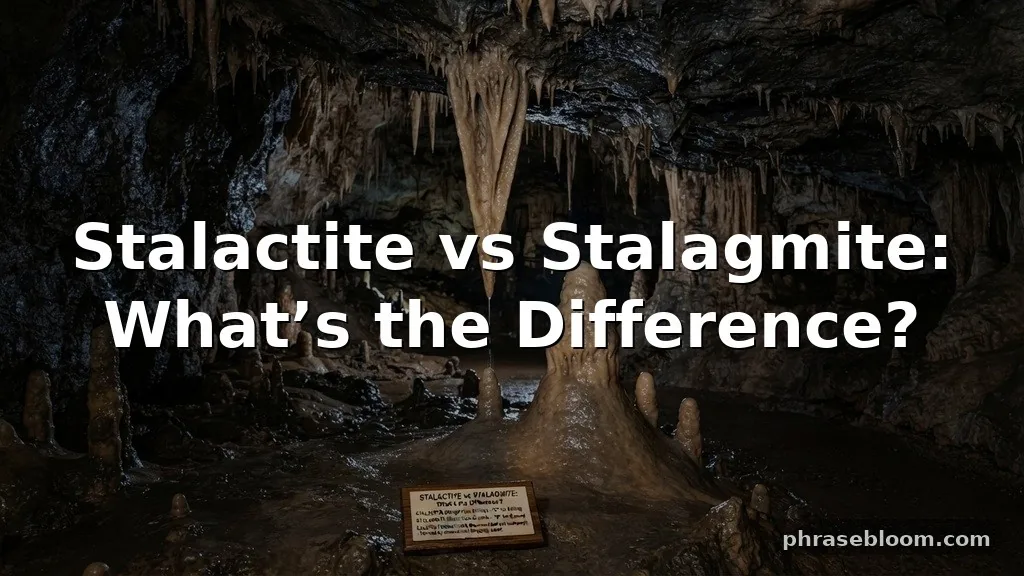
Stalactite vs stalagmite becomes much easier once you focus on location: a stalactite hangs from a cave ceiling, while a stalagmite rises from the cave floor. Both are cave formations created by mineral deposits left behind as water droplets move through limestone. Their names look similar because they develop through related processes, but their positions are opposite.
The difference matters in geology, cave tours, schoolwork, and everyday conversation. This article explains how each formation grows, why calcium carbonate is usually involved, how to identify them quickly, and why some caves contain connected columns, delicate soda straws, and other types of dripstone.
The Direct Answer: Ceiling Versus Floor
A stalactite is a mineral formation that grows downward from the ceiling of a cave. A stalagmite grows upward from the cave floor. Both usually form in limestone caves, although similar formations can develop in other settings where mineral-rich water repeatedly deposits material.
| Formation | Location | Direction of growth | Simple description |
|---|---|---|---|
| Stalactite | Cave ceiling | Downward | Hanging ceiling formation |
| Stalagmite | Cave floor | Upward | Rising floor formation |
| Column | Ceiling to floor | Both directions meet | Connected cave formation |
The most useful memory aid is “C hangs from ceiling.” The word stalactite contains a “c,” which can remind you that it hangs from the ceiling. A stalagmite has a “g,” which can suggest the ground, where it grows upward from the cave floor.
That mnemonic is not a scientific explanation, but it is reliable for quick identification. If you are looking at a formation above your head, it is a stalactite. If it rises beneath a dripping point on the floor, it is a stalagmite.
Both formations belong to a broader group called speleothems. A speleothem is a mineral deposit formed inside a cave, usually through groundwater movement and precipitation of dissolved minerals. Stalactites and stalagmites are among the best-known speleothems, but they are only two members of a much larger family.
How Stalactites and Stalagmites Form
The formation process begins above or near the cave. Rainwater enters soil, where it absorbs carbon dioxide from the atmosphere and from decaying organic material. This produces a weak acid called carbonic acid, which can dissolve small amounts of limestone as the groundwater moves through cracks.
Limestone is largely made of calcium carbonate. As slightly acidic water passes through the rock, it can carry dissolved calcium and carbonate compounds into underground spaces. Over time, those spaces become cave passages, chambers, and openings where mineral-rich water can emerge as individual water droplets.
When a droplet reaches a cave ceiling, some of its carbon dioxide escapes into the cave air. That change reduces the water’s ability to hold dissolved calcium carbonate, so a thin mineral residue remains around the point where the droplet falls. Repeated dripping gradually builds a stalactite.
The same droplet may land on the cave floor and splash outward. As more carbon dioxide leaves the water, calcium carbonate can collect on the floor. Layer after layer builds a stalagmite directly beneath the drip point.
Growth is usually extremely slow, but there is no single rate that applies to every cave. Water chemistry, temperature, humidity, drip frequency, rock structure, and seasonal rainfall all influence how quickly a formation develops. Some deposits grow visibly over long periods, while others may remain almost unchanged for many years.
- Rainwater enters the ground and absorbs carbon dioxide.
- Carbonic acid helps dissolve limestone along fractures and pores.
- Groundwater carries dissolved calcium carbonate into a cave.
- Water droplets release carbon dioxide when they enter the cave air.
- Calcite or another mineral is deposited on the ceiling or floor.
- Repeated deposition creates a recognizable speleothem.
The process is not simply water dripping through a hole. It depends on a balance between dissolution above the cave and mineral precipitation inside it. A cave can contain abundant groundwater yet produce few visible formations if the chemistry or airflow does not favor deposition.
Why Limestone, Calcite, and Calcium Carbonate Matter
Many familiar stalactites and stalagmites form in limestone because limestone contains abundant calcium carbonate. The mineral most often associated with these deposits is calcite, a crystalline form of calcium carbonate. When dissolved material comes out of solution inside the cave, calcite can accumulate in thin layers.
The rock above a cave influences the chemistry of the water entering it. Soil thickness, vegetation, rainfall, and the presence of cracks can change how much carbon dioxide the water absorbs and how much mineral material it carries. Two nearby caves may therefore have very different formations even if both are made of limestone.
Water chemistry also helps determine a formation’s appearance. Calcite deposits can be pale, translucent, cream-colored, or tinted by impurities. Iron compounds may produce reddish or orange tones, while other minerals and organic materials can create darker shades.
The cave environment affects the final shape as well. A steady, narrow drip may produce a slender tube, while water spreading across a surface can create a curtain or flowstone. Irregular cracks can divide the flow and produce branching structures.
For a broader introduction to caves and their geological features, the National Park Service overview of caves provides useful background on cave environments, formations, and conservation.
Calcite is common, but not universal
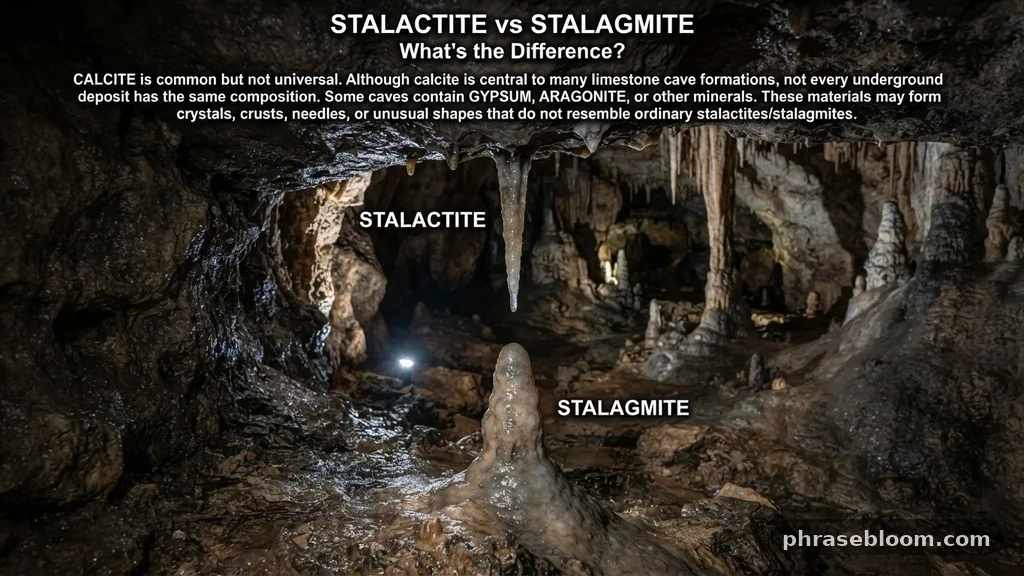
Although calcite is central to many limestone cave formations, not every underground deposit has the same composition. Some caves contain gypsum, aragonite, or other minerals. These materials may form crystals, crusts, needles, or unusual shapes that do not resemble ordinary stalactites and stalagmites.
The word stalactite generally describes a shape and location rather than a guarantee about one exact mineral. In ordinary cave geology, however, the term most often refers to a calcite-rich formation hanging from a ceiling.
Water controls more than size
Water does not merely determine whether a formation exists. It also controls texture, color, symmetry, and growth direction. A thin stream may create a smooth flowstone, while scattered droplets can make a stalagmite lumpy or rounded.
If groundwater flow changes, a formation may develop layers or interruptions. Dry periods can leave visible bands, while renewed dripping may add a brighter or darker layer on top of older material.
Stalactite Versus Stalagmite in Cave Geology
In cave geology, the distinction between stalactites and stalagmites is based primarily on where the deposit grows. A stalactite is attached to the ceiling or another overhead surface. A stalagmite is attached to the floor, usually beneath a source of dripping water.
The two formations often develop together because they share the same water source. A ceiling drip may create a stalactite above and a stalagmite below. If both continue growing along the same path, they can eventually meet and form a column, also called a pillar in some descriptions.
Not every formation above a cave floor is a stalactite, and not every upward-growing deposit is a stalagmite. Flowstone can cover walls or floors with sheets of mineral material, while soda straws are thin, hollow stalactites formed when water flows along the outside edge of a tiny tube.
A formation’s shape can change after it begins. A stalactite may become thicker when water spreads over its surface.
A stalagmite may broaden at the base when droplets land over a wider area. If the drip point shifts, the resulting deposit may become crooked, offset, or layered.
This is why location is more dependable than appearance. A pointed formation on the ceiling is still a stalactite, but a stalactite does not have to be sharp. A stalagmite may be pointed, rounded, flat-topped, or irregular depending on the water supply and the cave floor.
| Feature | Stalactite | Stalagmite |
|---|---|---|
| Attached to | Ceiling or overhead surface | Floor or lower surface |
| Growth direction | Downward | Upward |
| Typical water source | Water entering from above | Droplets falling from above |
| Possible result | May join a stalagmite | May join a stalactite |
These terms describe visible relationships within a cave. They do not necessarily tell you how old a formation is, how fast it grew, or whether it is still active. A dry, ancient stalactite and a wet, currently growing stalactite can look similar at first glance.
Easy Ways to Remember the Difference
The classic mnemonic is “stalactites hold tight to the ceiling.” It connects the final part of stalactite with the idea of gripping or hanging overhead. Another version uses the letters: the “c” in stalactite points to the ceiling, while the “g” in stalagmite points to the ground.
These memory aids work because the words are otherwise easy to mix up. Both begin with “stalac” or “stalag,” both refer to mineral deposits, and both are commonly seen in the same cave. The location-based rule cuts through the similarity.
- Stalactite: ceiling, clings, comes down.
- Stalagmite: ground, grows up, gets higher.
- Column: a stalactite and stalagmite that have joined.
Picture a ceiling-mounted icicle made of stone. That image represents a stalactite. For a stalagmite, imagine a small mineral hill building upward each time a water droplet lands in the same place.
Using the terms in a sentence
Here are natural examples: “The tour guide pointed out a long stalactite hanging above the passage.” The word works because the formation is attached to the ceiling.
“A broad stalagmite rose from the cave floor beneath a steady drip.” This sentence identifies the formation by its location and makes the relationship between the two formations clear.
“The stalactite and stalagmite eventually joined to create a stone column.” The sentence uses both terms accurately and shows how one ceiling formation and one floor formation can become a single connected structure.
“The chamber contains curtains, flowstone, and hundreds of small stalagmites.” This example is useful because it avoids treating every cave deposit as one of the two most familiar types.
Common Cave Formations Related to Stalactites
Stalactites and stalagmites are part of a larger vocabulary used to describe cave formations. Learning a few related terms helps explain why cave interiors vary so much from chamber to chamber.
Soda straws
A soda straw is a narrow, hollow stalactite. Water flows along the inside or outside edge of a tiny tube, depositing calcite in a ring. If the tube becomes blocked or begins collecting water over a wider area, it may thicken into a more conventional stalactite.
Flowstone
Flowstone forms when mineral-rich water moves across a wall or floor instead of falling as separate droplets. It can look like a frozen waterfall, a smooth sheet, or a series of rippling layers. Flowstone is often made of calcite, but its appearance reflects the path of moving water.
Cave curtains
Cave curtains are thin, draped deposits that form on sloping ceilings or walls. They may develop ridges and folds as water follows several adjacent paths. Some are called draperies because their shape resembles hanging fabric.
Rimstone and dams
Rimstone forms when flowing water deposits mineral material around the edges of small pools. The raised edges can create terraces or tiny dams. These structures show that cave formation is not limited to vertical drips.
Helictites
Helictites are unusual formations that grow in curved or seemingly gravity-defying directions. Capillary forces, narrow passages, and changing water paths can influence their growth. They are often delicate and should never be touched.
These examples show why “stalactite versus stalagmite” is only one part of cave geology. The broader term dripstone generally refers to deposits formed from dripping water, while speleothem includes a wider range of mineral formations inside caves.
What Cave Erosion and Karst Landscapes Have to Do With It
Cave formations are linked to the wider landscape above and around the cave. In a karst landscape, soluble bedrock such as limestone is gradually shaped by groundwater. Sinkholes, disappearing streams, springs, underground channels, and caves can all be part of the same drainage system.
Cave erosion and cave deposition happen together, although they work in opposite directions. Water can dissolve and enlarge cracks in limestone while also depositing calcite inside a chamber. The same underground water system may therefore create a passage in one location and a stalagmite in another.
Surface conditions influence what happens below ground. Heavy rainfall can increase the amount of water entering a cave, but a large volume of water does not always mean faster formation. The chemistry of that water, its route through the rock, and the amount of carbon dioxide it carries are equally important.
Vegetation and soil can contribute carbon dioxide to infiltrating water. Seasonal changes may cause some cave formations to receive more water during wet periods and very little during drought. Scientists can sometimes study growth layers in cave deposits to learn about past environmental conditions.
The cave itself may also change airflow and evaporation. A well-ventilated chamber can cause water to lose carbon dioxide more quickly, encouraging mineral deposition. A humid chamber may slow evaporation and create different growth patterns.
These processes take place over long periods, but a cave is not a static museum display. Water continues to dissolve rock, transport minerals, and reshape deposits. A formation that appears stable may be responding to changes in rainfall, land use, construction, groundwater pumping, or climate.
How to Identify Each Formation Without Guessing
Start with the attachment point. If the formation is connected to the ceiling, call it a stalactite.
If it is connected to the floor, call it a stalagmite. If it spans the space between them, it may be a column or another combined structure.
Next, look for evidence of water movement. A stalactite often forms beneath a crack, seam, or small opening where groundwater enters the cave. A stalagmite may sit below a ceiling deposit, although the original drip point can shift or disappear over time.
Do not rely only on a sharp point. Some stalactites have blunt ends, and some stalagmites have broad, rounded tops. Shape can suggest a formation’s history, but the ceiling-versus-floor distinction is the most dependable basic test.
- Check whether the deposit is attached above or below.
- Look for a matching drip point or mineral trail.
- Notice whether the surface is layered, smooth, ridged, or hollow.
- Consider whether the feature might be flowstone, a curtain, or a helictite.
- Do not touch the formation to test it.
Touching cave formations can damage them. Skin oils and dirt may block active mineral surfaces, while even small impacts can break thin soda straws or fragile stalactites. In protected caves, visitors should remain on marked paths and follow instructions from guides.
Photography can also be misleading. A low camera angle may make a stalagmite look like a ceiling formation, while shadows can hide the point where a deposit connects to the cave wall. In uncertain cases, a guide or geologist can identify the feature more accurately.
Why These Formations Need Protection
Many cave formations grow so slowly that damage cannot be repaired on a human timescale. A broken stalactite does not simply grow back in a few months. Even if water continues to drip from the same location, rebuilding the original shape may take far longer than the life of a visitor, a building, or a park program.
Physical contact is one concern, but caves can also be affected by lighting, construction, altered drainage, litter, and changes in air circulation. Large numbers of visitors may introduce dust, heat, and carbon dioxide into a cave environment. Managers must balance public access with the conditions that preserve cave geology.
Some cave formations are still active, while others are inactive because the water path has changed. A wet surface does not necessarily mean rapid growth, and a dry surface may preserve evidence of an older climate or a former groundwater route.
Conservation rules are therefore practical, not merely ceremonial. Staying on a trail protects floor deposits, avoiding contact protects mineral surfaces, and keeping food and trash outside helps preserve the cave’s chemistry and biological communities.
The distinction between stalactites and stalagmites also has scientific value. Their layers can preserve information about water flow and environmental change, but that record can be disturbed by breakage, contamination, or careless sampling.
FAQ: Stalactite vs Stalagmite
What is the main difference between a stalactite and a stalagmite?
A stalactite grows downward from a cave ceiling, while a stalagmite grows upward from the cave floor. Both usually form when mineral-rich water deposits calcium carbonate inside a cave.
Which one hangs from the ceiling?
The stalactite hangs from the ceiling. Remember the “c” in stalactite as a reminder of the ceiling.
Which one grows from the ground?
The stalagmite grows from the cave floor or ground. The “g” in stalagmite can remind you of the ground.
Can a stalactite and stalagmite join together?
Yes. If the ceiling and floor formations continue growing along the same drip path, they may meet and form a column or pillar.
Are stalactites and stalagmites made of calcium carbonate?
Many are made largely of calcite, a form of calcium carbonate, especially in limestone caves. Other cave formations can contain different minerals, so composition is not identical in every cave.
Conclusion: Remember the Location First
The clearest answer to stalactite vs stalagmite is simple: stalactites hang from the ceiling, and stalagmites rise from the ground. Their similar names reflect a related formation process involving groundwater, carbonic acid, mineral deposits, and repeated water droplets, but their attachment points distinguish them.
Use “stalactite” for the ceiling formation and “stalagmite” for the cave floor formation. The “C for ceiling” and “G for ground” mnemonic will usually prevent the mix-up. If you visit a limestone cave, observe without touching, and look beyond these two terms for flowstone, soda straws, curtains, and other signs of active cave geology.
Related reading: Unselect vs Deselect, Hassle vs Hastle, Continuous vs Continous.