
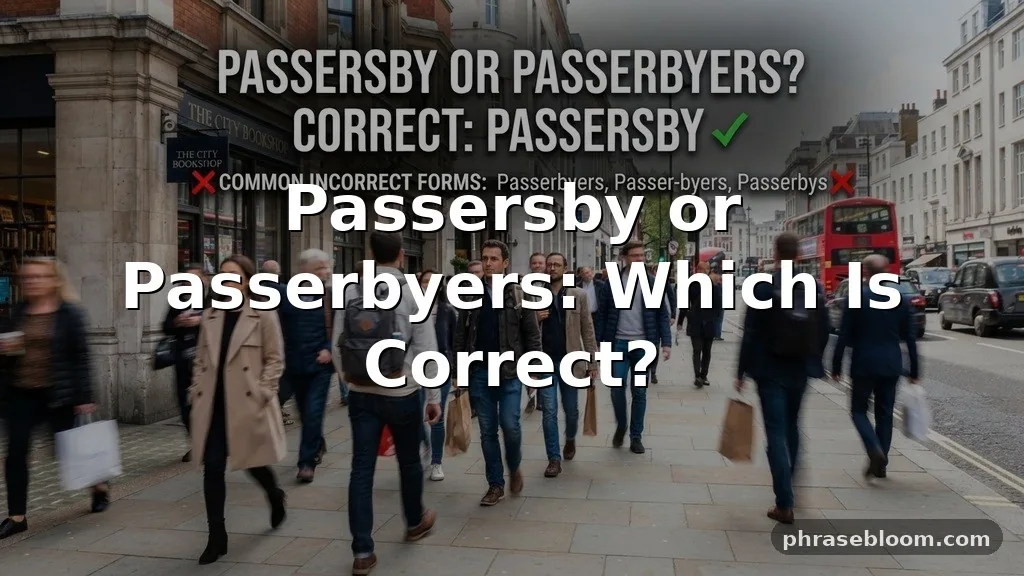
Passersby or Passerbyers: Which Is Correct?
The correct plural is passersby, not passerbyers. A passerby is a person who walks or travels past a particular place, and the plural form changes the word “passer” to “passers” while keeping “by” at the end.
The spelling can look unusual because passerby is a compound noun, not a regular noun that simply takes -s. Once you understand how the word is built, the difference between passersby, passerbyers, passer-bys, and passer-byes becomes much easier to remember and apply.
The Correct Plural Is Passersby
Passersby is the standard plural form of passerby. Use it when you mean two or more people who are passing a location, moving through an area, or happening to be nearby.
For example, you could write, “Several passersby stopped to watch the street performer.” The singular form refers to one person, while the plural form refers to several people.
| Form | Meaning | Correct usage |
|---|---|---|
| passerby | One person who passes by | “A passerby called for help.” |
| passersby | More than one person who passes by | “Passersby gathered near the entrance.” |
| passerbyers | Nonstandard attempted plural | Avoid this form. |
| passer-bys | Unusual and generally nonstandard plural | Avoid this form in edited writing. |
| passer-byes | Incorrect plural spelling | Do not use this form. |
The plural is formed inside the compound noun. In simple terms, passersby means “people who pass by,” so the first part receives the plural ending.
This pattern may seem less familiar than adding -s to the final word, but it is established English usage. Major dictionaries, including Merriam-Webster, list passerby and its plural form passersby as standard vocabulary.
What Passerby Means
A passerby is someone who passes a person, building, event, or scene. The word often describes a person who is not directly involved in what is happening but happens to be in the area.
Consider the sentence, “A passerby noticed smoke coming from the window.” The person may not live in the building or know anyone inside. Their role in the sentence comes from being present while passing by.
The word can describe people on foot, but it is not limited to pedestrians. Depending on the context, a passerby might be someone traveling in a vehicle, walking through a station, cycling along a road, or moving past an outdoor event.
- A passerby offered directions to the lost tourist.
- Two passersby helped move the fallen branch.
- The shop window caught the attention of several passersby.
- One passerby reported the damaged traffic signal.
These examples show that the word is neutral. It does not automatically suggest that the person helped, interfered, or stayed for a long time.
The related phrase passers-by may also appear, especially in older writing or in publications that retain an open or hyphenated form. Modern usage commonly favors the closed singular passerby and the closed plural passersby, but style preferences can vary by publication.
Why the Plural Is Passersby
Passerby is a compound noun made from passer and by. A compound noun combines two or more words to create one established noun, such as toothbrush, classroom, or passerby.
When a compound noun describes a person whose role appears in the first part, English often places the plural ending on that first part. That is why the plural of passerby is passersby, rather than passer-bys.
The same general pattern appears in several familiar expressions:
| Singular | Plural | Reason for the plural form |
|---|---|---|
| mother-in-law | mothers-in-law | The main noun is “mother.” |
| attorney general | attorneys general | The main noun is “attorney.” |
| runner-up | runners-up | The main noun is “runner.” |
| passerby | passersby | The person who passes is the “passer.” |
These words are sometimes called irregular plural nouns because they do not form their plural by simply adding -s to the end. The label is useful, but you do not need advanced grammar terminology to use the word correctly.
A practical memory aid is to think of the plural as “people who pass by.” The word passers identifies the people, while by preserves the original relationship.
Why Passerbyers Is Incorrect
Passerbyers is an incorrect plural because it adds a new ending to a word that is already built from the idea of passing by. The ending -ers does not belong to the plural form of passerby.
A writer might create passerbyers by treating passerby as if it were an ordinary singular noun such as worker or customer. That approach produces a form that may look logical at first, but it does not match established English usage.
The problem is not pronunciation alone. In many accents, passerby and passersby are easy to recognize when spoken, but the written plural must follow the conventional noun form.
Common incorrect forms
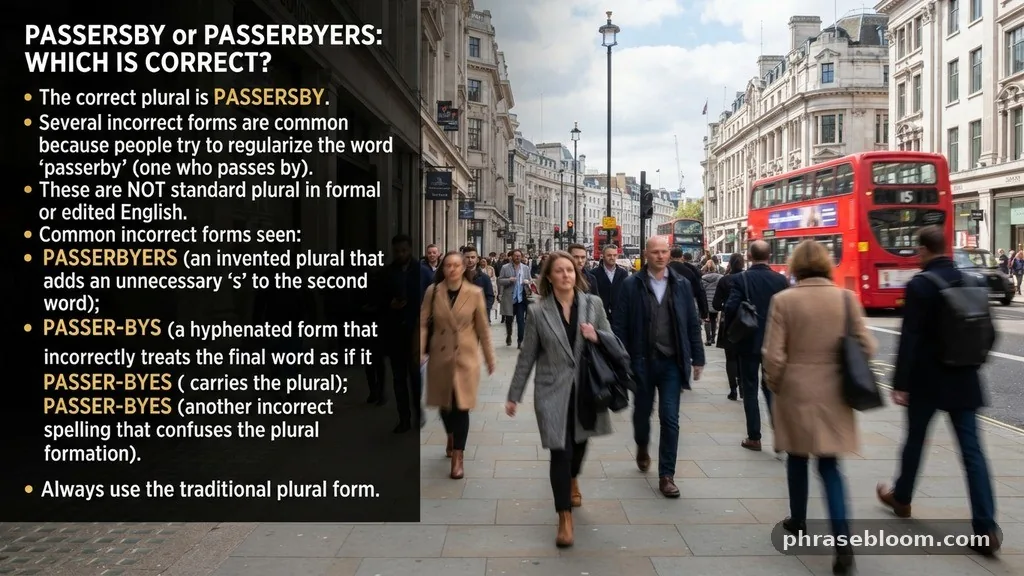
Several spellings appear because people try to regularize the word. They are not the standard plural in formal or edited English.
- Passerbyers: an invented plural that adds an unnecessary ending.
- Passer-bys: a hyphenated form that treats the final word as if it carried the plural.
- Passer-byes: an incorrect spelling that changes the sound and structure of the word.
- Passer-byes: a variation that does not represent the accepted plural noun.
The correct choice is simple: write passerby for one person and passersby for more than one. If you are writing for a publication with a particular style guide, check whether it prefers an older hyphenated form, but do not replace the plural with passerbyers.
Passersby in Real Sentences
Natural examples make the word easier to use because its grammatical role changes slightly from sentence to sentence. It can function as the subject of a sentence, the object of a verb, or part of a phrase that identifies where an action occurred.
Everyday events
“Passersby gathered outside the theater after the alarm sounded.” Here, passersby is the subject because the people are performing the action of gathering.
“The cyclist thanked a passerby who helped retrieve her phone.” In this example, passerby is singular because only one person helped.
“The loud music attracted passersby from the neighboring blocks.” The plural noun is the object of attracted, and the sentence describes several people who came near the music.
News and public safety
“Police asked passersby to avoid the intersection while crews repaired the signal.” This is a natural use in a public announcement because it refers to everyone moving through the area.
“A passerby called emergency services after seeing the collision.” The singular form works because the sentence identifies one person.
“Witnesses and passersby described the scene to investigators.” The word is paired with another plural noun and refers broadly to people who happened to be nearby.
Business and public spaces
“The café placed a small sign outside to attract passersby.” The sentence describes people walking or traveling past the business.
“A passerby paused to read the museum’s exhibition poster.” The singular form is appropriate because one person paused.
“The new storefront design was intended to make the brand more visible to passersby.” This use is common in marketing and commercial writing because it focuses on people outside a shop or venue.
In each example, the word keeps the same basic meaning. The surrounding verb determines whether the noun should be singular or plural.
Passersby, Passerby, and Passer-Bys
Modern English generally treats passerby as a closed compound, meaning the two parts are written as one word. Its standard plural is therefore passersby, also written as one word.
Some readers may encounter passer-by or passers-by in older books, newspapers, or regional publications. That spelling is understandable and may reflect historical usage, but it is less common in current American professional writing.
| Variant | Current status | Best practical use |
|---|---|---|
| passerby | Standard singular closed compound | Use for one person. |
| passersby | Standard plural closed compound | Use for two or more people. |
| passer-by | Established but less common variant | Use only if a house style requires it. |
| passers-by | Older or alternate plural spelling | Follow the publication’s stated preference. |
| passer by | Usually a phrase, not the standard noun spelling | Use only when “passer” and “by” have separate grammatical roles. |
The phrase passer by can occur in a different grammatical structure. For instance, “The passer walked by” is not the same noun as passerby. In that sentence, passer is a noun and by is part of the verb phrase.
That distinction matters because spelling should reflect meaning and grammatical function. If you mean a person who happens to pass a place, passerby is the established compound noun.
American and British English Usage
American and British English both recognize passerby and passersby. The main difference readers may notice involves the occasional use of a hyphen, not a completely different meaning or pluralization system.
British publications may preserve passer-by or passers-by more often than some American publications, especially in traditional or formal house styles. However, it would be inaccurate to claim that one spelling belongs exclusively to British English and the other exclusively to American English.
Dictionary entries and editorial preferences change over time. A word may begin as an open phrase, develop a hyphen, and later become a closed compound as readers become more familiar with it.
How to handle regional variation
If you are writing for an American audience and no style guide says otherwise, passerby and passersby are safe choices. They are concise, widely recognized, and suitable for business writing, school assignments, websites, and general communication.
If you are writing for a British publication, check its internal style guide or examine recent articles from the same publication. Consistency within one document matters more than trying to force a universal rule across every variety of English.
- Use the spelling preferred by your employer, publisher, or institution.
- Keep the singular and plural forms consistent.
- Do not switch between passersby and passers-by without a reason.
- Use the closed forms when you need a neutral choice for an international audience.
Regional variation affects style, but it does not make passerbyers correct. That form is not the normal British alternative or the normal American alternative.
Professional and Formal Writing
In professional writing, passerby and passersby are appropriate when the people being described are relevant to an event, location, safety issue, or customer experience. The words can appear in reports, workplace emails, public notices, incident summaries, and marketing copy.
A security report might say, “Two passersby reported the damaged fence at approximately noon.” A facilities manager could write, “The temporary barrier should protect passersby during construction.” Both sentences use the standard forms clearly.
In formal writing, avoid unusual variants simply because they seem more regular. Passerbyers can distract readers and may make the writer appear uncertain about the noun’s accepted spelling.
Examples for workplace communication
“The company installed brightr lighting to improve safety for employees and passersby.” This sentence works in a facilities memo because it identifies people who may be walking near the property.
“Please report any loose equipment that could injure a passerby.” The singular form is generic here, referring to any one person who might happen to be nearby.
“The event team moved the display away from the main entrance so passersby could enter the building safely.” This is suitable for an internal event plan because the plural describes everyone who might use the entrance.
These examples also show that the word is not limited to dramatic incidents. It can describe ordinary interactions involving traffic flow, customer access, advertising, and public safety.
Alternatives to Passersby
Although passersby is correct, another expression may sometimes sound more natural or precise. The best alternative depends on whether you mean pedestrians, customers, visitors, witnesses, or people in a broader area.
| Alternative | Best used when | Example |
|---|---|---|
| people passing by | You want plain, conversational wording | “People passing by noticed the sign.” |
| pedestrians | You specifically mean people traveling on foot | “The barriers protect pedestrians.” |
| people nearby | The people may not have been moving past | “People nearby heard the alarm.” |
| bystanders | You mean people watching an event | “Bystanders helped direct traffic.” |
| visitors | The people are entering or attending a place | “Visitors can use the side entrance.” |
People passing by is often the easiest option for English learners because it follows ordinary sentence structure. It also avoids the irregular plural noun entirely.
Pedestrians is more specific than passersby. A pedestrian is traveling on foot, while a passerby may be in a car, on a bicycle, or simply moving through an area.
Bystanders is not always interchangeable with passersby. A bystander is usually someone observing an incident, while a passerby may continue walking without stopping or watching.
Common Mistakes with the Word
The most frequent mistake is writing passerbyers. Correct it to passersby, because the accepted plural changes passer to passers rather than adding -ers to the entire word.
Another mistake is using passer-bys. Although readers may understand it, the spelling does not follow the usual modern form of this compound noun.
Writers also sometimes treat passerby as a verb or use a nonexistent adverb such as passerbyly. The word is a noun, so rewrite the sentence if you need to describe movement.
| Incorrect | Correction | Explanation |
|---|---|---|
| Several passerbyers complained. | Several passersby complained. | Use the established plural noun. |
| The passer-bys watched the parade. | The passersby watched the parade. | Use the closed plural form in current standard usage. |
| A passerbyer called the office. | A passerby called the office. | The singular form is passerby. |
| The store attracted many passer-byes. | The store attracted many passersby. | Do not add “-yes” to the compound. |
| The passerbyly crowd moved on. | The crowd of people passing by moved on. | Passerby is not an adverb. |
Do not confuse a spelling mistake with a difference in meaning. Passersby and the less common passers-by refer to the same general group of people. The difference is mainly one of spelling convention and editorial preference.
How to Choose the Right Form
Choosing the correct form takes only a few steps. First, decide whether you mean one person or more than one. Then select passerby for the singular and passersby for the plural.
Next, consider your audience and the style guide that governs your writing. A newspaper, university, government agency, or employer may have a preferred form, especially if it follows a particular regional or editorial tradition.
- Use passerby for one person.
- Use passersby for two or more people.
- Check whether your organization prefers a hyphenated variant.
- Keep the chosen spelling consistent throughout the document.
- Replace the term with “people passing by” if that wording is clearer for your audience.
For most business emails, reports, websites, and school assignments, passersby is the safest plural choice. It is concise and widely accepted in contemporary English.
If your sentence sounds unnatural, do not force the word into it. “People passing by the entrance” may be clearer than “passersby near the entrance,” especially for readers learning English or for documents intended for a broad international audience.
Examples You Can Copy and Adapt
“Several passersby stopped to read the public notice.” This works when multiple people notice information displayed in a public place.
“A passerby alerted the staff after seeing water on the floor.” Use the singular form when one unidentified person reported the problem.
“The new signs should be visible to passersby approaching from both directions.” This sentence fits a facilities, retail, or marketing context.
“Employees should keep the walkway clear for visitors and passersby.” The plural noun describes people who may move past the workplace without entering it.
“One passerby offered to carry the box inside.” This example uses the singular form as the subject of the sentence.
“The street performer drew a small crowd of passersby.” The phrase crowd of passersby is natural when several people gather briefly.
“People passing by may not understand the temporary road markings.” This alternative is useful when a plain phrase is preferable to an irregular plural noun.
“The report includes statements from employees, customers, and passersby.” This structure is suitable for an incident report or public relations document.
Frequently Asked Questions
Is passersby or passerbyers correct?
Passersby is correct. Passerbyers is an incorrect plural form and should not be used in standard English.
What is the singular form?
The singular form is passerby. Write “A passerby helped the injured cyclist,” not “A passersby helped the injured cyclist.”
Is passerby one word?
Yes. Passerby is commonly written as one word, and its plural is passersby. Some publications may use the hyphenated forms passer-by and passers-by.
Is passer-bys ever correct?
It may appear as an older or alternate spelling, but passersby is the safest modern plural in most professional and academic writing. Follow a publication’s style guide if it specifically requires the hyphenated form.
What does passerby mean?
A passerby is a person who passes a particular place or happens to be nearby. The plural, passersby, refers to two or more such people.
Final Rule for Passersby or Passerbyers
The correct choice in the Passersby or Passerbyers question is clear: use passerby for one person and passersby for more than one. Do not form the plural as passerbyers, passer-bys, or passer-byes.
For most current writing, the closed forms are the practical choice. If a publisher, employer, or academic institution follows a different style guide, match that preference consistently. When clarity matters more than brevity, “people passing by” is a dependable alternative.
You may also like: Brite vs Bright: Which Spelling Is Correct?
Explore more on PhraseBloom.