
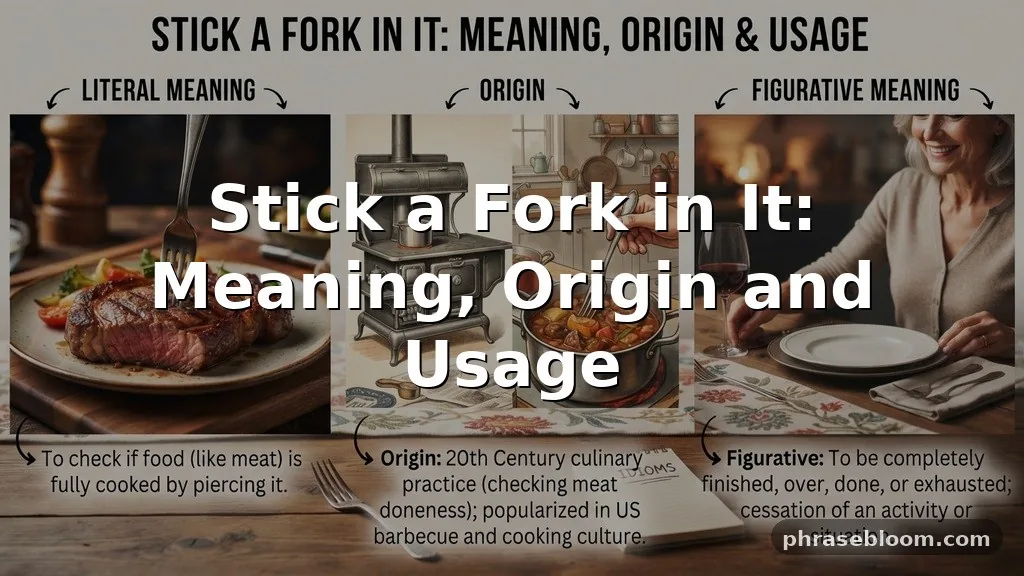
The expression “Stick a Fork in It” means that something is finished, completed, or no longer worth continuing. It comes from a cooking metaphor: a person tests roasted meat by inserting a fork, suggesting that the food is done and ready to serve.
Today, the phrase is an informal English idiom used for projects, arguments, sports seasons, political campaigns, and many other situations. Its tone can be practical, humorous, decisive, or dismissive, depending on context. The history behind the phrase is less certain than its meaning, but the cooking image explains why it became so easy to understand.
What “Stick a Fork in It” Means
In ordinary American English, “stick a fork in it” means finish it, end it, or accept that it is over. The implied full sentence is often “Stick a fork in it, it’s done,” although speakers frequently use the shorter version by itself.
The phrase can describe an object, an activity, a plan, or a situation. If someone says, “We can stick a fork in the campaign,” they mean the campaign is effectively finished. If a manager says, “Let’s stick a fork in this report,” the manager probably means that the report is complete and should not receive more revisions.
Its meaning is figurative rather than literal in most modern uses. Nobody usually wants another person to insert a fork into a project, meeting, or argument. The fork represents a doneness test, while “done” supplies the real meaning.
- Finished: “Stick a fork in the presentation. It’s ready to send.”
- Ended: “The team’s playoff hopes are finished, so stick a fork in the season.”
- Abandoned: “The proposal failed twice. We should stick a fork in it.”
- Settled: “The contract is signed, so we can stick a fork in the negotiations.”
- Dismissed: “Stick a fork in that rumor. The company has denied it.”
These examples show an important feature of the idiom: the phrase does not always mean that a task was successfully completed. It can also mean that an effort has reached its practical end, even if the result is disappointing.
The expression is usually conversational. It fits a workplace discussion, a sports broadcast, a casual article, or a humorous social media post more naturally than a formal legal document or academic argument.
Why a Fork Represents Completion
The literal image behind the idiom is a cook checking food with a fork. A fork test can help reveal whether meat is tender, whether a vegetable is soft enough, or whether a dish has reached the desired stage of cooking.
That image is not a precise scientific test for every food. Cooking times, temperatures, and recommended methods vary, and a fork can release juices from meat or damage delicate foods. Still, the action is familiar enough to create a vivid phrase meaning “check it and determine whether it is done.”
The cooking metaphor works because it compresses a longer thought into a few words. Instead of saying, “We have reached the point at which further work is unnecessary,” a speaker says, “Stick a fork in it.” The listener supplies the missing idea: the job is finished.
The phrase also carries a sense of finality. Once roasted meat has passed its doneness test, the cook normally stops cooking it and serves it. That makes the fork a symbol of closure, not merely inspection.
Literal meaning versus figurative meaning
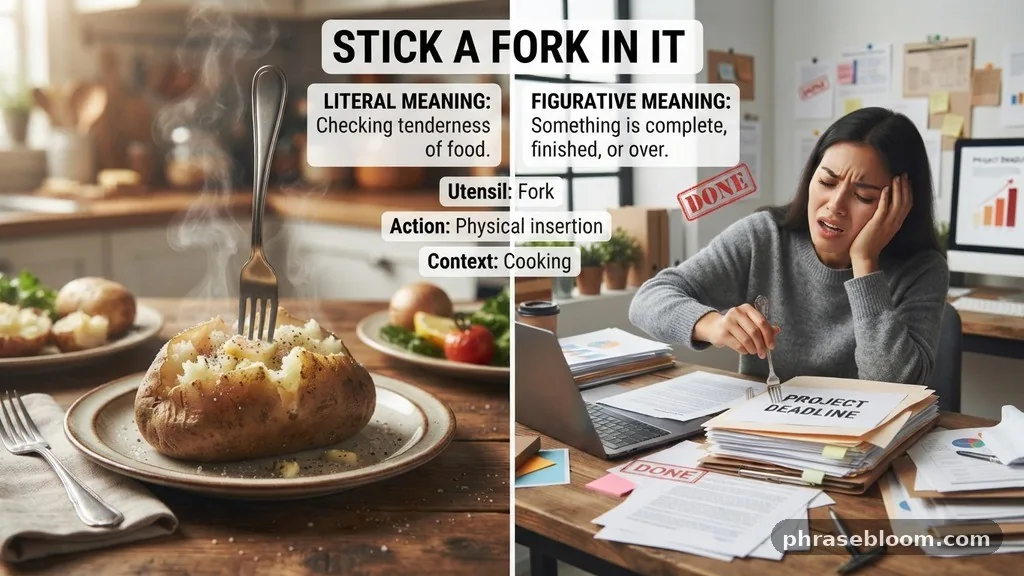
In a literal sentence, a fork is an actual utensil and “stick” describes a physical action. For example, “Stick a fork in the potatoes to test whether they are tender” is a straightforward cooking instruction.
In the idiomatic expression, the words operate together as figurative language. “It” may refer to a project, a game, a dispute, a business plan, or an entire season. The phrase meaning comes from the relationship between the fork and the idea of doneness, not from the physical action itself.
That distinction matters for language learners. Translating each word separately can produce a confusing result, while learning the phrase as a complete expression makes its use much easier to recognize.
Stick a Fork in It: Origin and Phrase Etymology
The phrase’s origin is generally connected with cooking, especially the practice of testing food to see whether it is done. The basic logic is simple: insert a fork, assess the food, and stop cooking once it has reached the desired condition.
The exact first use of “stick a fork in it” as an idiom is not firmly established. People often repeat stories about a particular television program, advertisement, chef, or public figure popularizing it, but popularization is not the same as documented invention.
For that reason, a careful explanation should separate the phrase’s likely source from its precise historical beginning. The cooking metaphor is clear, while the exact moment when the expression became a widely recognized idiom remains part of an origin debate.
Reference works can help readers compare definitions and examples. For a current dictionary treatment of the expression, consult Merriam-Webster’s entry for “stick a fork in it”.
Why the exact origin is difficult to prove
Colloquial phrases often circulate in speech before anyone records them in a newspaper, book, transcript, or dictionary. A phrase may be used locally for years and then spread through comedy, sports commentary, advertising, or workplace conversation.
Another difficulty is variation. Speakers may say “stick a fork in it,” “put a fork in it,” or “stick a fork in that.” A related phrase can appear in print before the exact wording becomes standard, which makes it difficult to identify a single starting point.
The expression may also be confused with other cooking-based phrases about completion, including “it’s done” and “take it off the heat.” Those related ideas support the same metaphor without proving that one specific source created the idiom.
The safest historical conclusion is therefore modest: “Stick a fork in it” developed from a familiar cooking action and became a figurative way to announce completion. The phrase’s broad meaning is certain even though its precise phrase etymology is not.
How the Idiom Works in a Sentence
“Stick a fork in it” usually appears as an imperative expression. Grammatically, it looks like a command, but the speaker is not necessarily giving a literal order. The sentence functions as a concise judgment that something has reached its endpoint.
The pronoun “it” refers to the thing being completed or ended. Context supplies that noun. In “The merger is approved, so stick a fork in it,” “it” refers to the merger process or the remaining work connected with it.
The phrase can appear at the beginning, middle, or end of a sentence. Its position affects the rhythm and tone, but not the central meaning.
- “Stick a fork in it. The audit is complete.”
- “We can stick a fork in the launch plan after today’s approval.”
- “The debate is over, so stick a fork in it.”
- “Once the client signs, we’ll stick a fork in the project.”
- “The final score makes it clear: stick a fork in the season.”
The first example sounds abrupt and decisive. The second and fourth are more practical because they identify a specific condition that must occur before the work is considered complete.
What tone does it create?
The phrase often sounds informal and confident. It may communicate efficiency, but it can also sound impatient if another person believes the work still needs attention.
In a friendly setting, “Let’s stick a fork in it” can be a light way to end a long meeting. In a sensitive discussion, “Stick a fork in it” may seem dismissive because it closes the conversation without acknowledging unresolved concerns.
Writers should consider who has authority in the situation. A senior manager may use the expression to signal a decision, while a junior employee may need a more neutral phrase such as “We can consider this complete.”
Real-Sentence Examples in Work and Everyday Communication
The idiom appears in many professional settings, but the best examples connect it to a clear result. A reader should know what has ended and why.
Company policies and employee announcements
“The revised travel policy has been approved, so we can stick a fork in that update.”
This sentence works in an internal conversation because the approval provides a concrete reason to declare the policy finished. It is less suitable as the final wording of a formal policy itself.
“Stick a fork in the old attendance procedure. The new process begins Monday.”
Here, the expression marks a change from one procedure to another. The short sentence has an energetic internal-communication tone, but a formal employee announcement might replace it with “The old procedure is now retired.”
Training and workplace emails
“Once everyone completes the safety module, we can stick a fork in the training rollout.”
The phrase works because it refers to a defined project milestone. It tells colleagues that the remaining work is limited to completion of the module.
“Thanks for the final edits. I’ve attached the approved version, so let’s stick a fork in this email campaign.”
This workplace email sounds casual and collaborative. In a message to an external client, “We can now consider the campaign finalized” would usually be safer.
Business reports and organizational changes
“The pilot produced no usable results, and the committee voted to stick a fork in the proposal.”
This example shows that the idiom can describe cancellation rather than success. The proposal has reached an end because the evidence did not support continuing it.
“After the two departments merge, the company can stick a fork in the old reporting structure.”
The wording is understandable, but it is slightly playful for a report about organizational change. A more formal alternative would be “The old reporting structure will be discontinued after the merger.”
Technology, meetings, and public communication
“The software rollout is stable across all offices, so we can stick a fork in the implementation phase.”
This sentence uses the idiom for a technology milestone. It is natural in a project meeting, especially when the team has already completed testing and deployment.
“We’ve covered every item on the agenda. Let’s stick a fork in the meeting.”
This is a humorous way to close a meeting, although “Let’s wrap up” is more conventional. The image works because the meeting is treated like a task that has reached its endpoint.
“The campaign has run its course, and the organizers are ready to stick a fork in it.”
In public communication, the phrase can add personality, but it may be too casual for a serious corporate statement. Marketing teams sometimes use it deliberately when an informal brand voice is part of the message.
When the Phrase Fits and When It Does Not
“Stick a fork in it” is strongest when the audience understands that the phrase is playful or conversational. It suits informal speech, team chats, brainstorming sessions, sports commentary, and light workplace messages.
It is less suitable when the subject involves grief, safety failures, layoffs, legal disputes, or a serious public apology. The phrase can make a sensitive event sound trivial because its cooking metaphor treats the matter as something quickly removed from the heat.
| Context | Example | Suitability | Clearer formal alternative |
|---|---|---|---|
| Team meeting | “Let’s stick a fork in the agenda.” | Usually natural | “Let’s close the agenda.” |
| Internal project email | “We can stick a fork in the rollout.” | Suitable for a casual team | “We can consider the rollout complete.” |
| Business report | “The committee stuck a fork in the proposal.” | Often too informal | “The committee rejected the proposal.” |
| Employee announcement | “Stick a fork in the old benefits plan.” | Potentially insensitive | “The old benefits plan will end on June 30.” |
| Marketing copy | “Stick a fork in boring leftovers.” | Possible with a playful brand voice | “Say goodbye to boring leftovers.” |
The table illustrates a practical point: an idiom can be grammatically correct and still be a poor communication choice. Formal writing values directness, while informal writing has more room for humor and personality.
Professional alternatives
Writers who want the meaning without the cooking metaphor have several choices. The best replacement depends on whether the subject is complete, canceled, concluded, or simply no longer useful.
- Complete: “The review is complete.”
- Conclude: “The committee concluded its discussion.”
- Finalize: “We finalized the contract.”
- Discontinue: “The company will discontinue the program.”
- Close: “We can close this request.”
- End: “The negotiations have ended.”
- Retire: “The team will retire the old system.”
These alternatives are not perfect substitutes in every sentence. “Finalize” implies completion, while “discontinue” often implies stopping something before it achieves its intended result.
Literal Cooking Uses and Related Expressions
The phrase can still be used literally, although the idiomatic use is much more common in ordinary conversation. A cook might say, “Stick a fork in the roast to check whether it’s tender,” and mean exactly that.
In literal cooking, a fork test is only one possible way to judge doneness. A recipe may instead recommend checking internal temperature, texture, color, cooking time, or the appearance of juices.
That distinction gives the idiom some flexibility. The speaker does not need to know anything about cooking for the expression to work because most listeners recognize the general image of testing food before declaring it ready.
Related cooking metaphors
English contains many expressions that transfer kitchen experiences into other areas of life. “Half-baked idea” describes an idea that has not been developed fully. “On the back burner” refers to a lower priority, while “take something off the table” means remove it from consideration.
“Stick a fork in it” belongs to the same family of figurative language, but its focus is finality. It does not merely say that an idea needs more work. It says that the work, discussion, or effort should now be treated as over.
The phrase can also overlap with “call it a day.” That expression usually means stop working for now, while “stick a fork in it” often suggests a more permanent ending. Context determines whether the difference matters.
How the Expression Changed Beyond the Kitchen
Once a cooking phrase enters everyday speech, its meaning can expand far beyond food. Speakers use “stick a fork in it” for elections, sports seasons, product launches, court cases, negotiations, and personal plans.
Sports commentary provides a natural setting because a game or season can suddenly appear finished before the official clock reaches zero. A commentator might say, “Stick a fork in this game,” after one team takes an overwhelming lead.
Political and business discussions use the phrase in a similar way. A failed campaign, rejected merger, or abandoned product may be described as something that has had a fork stuck in it, even though the legal or administrative work may continue.
This broader use reveals how idioms behave. The original physical image remains available in the background, but speakers no longer need to think about roasted meat every time they use the expression.
Completion is not always success
One subtle point is that “done” does not necessarily mean “good.” A cake can be done and burned, a project can be finished with serious flaws, and a proposal can be ended because it failed.
That is why the idiom can sound blunt. It focuses on the end of an activity rather than the quality of the result. If the result matters, writers should state that separately.
For example, “We can stick a fork in the redesign, but the client still has concerns” communicates closure while acknowledging a problem. Without the second clause, the sentence might incorrectly suggest that everyone is satisfied.
Common Mistakes and Better Choices
Most errors involving this idiom concern tone, reference, or overuse rather than grammar. Because the expression is familiar, writers sometimes use it without checking whether it accurately describes the situation.
Using it for a temporary pause
“Stick a fork in the meeting” can imply that the meeting is finished, not merely paused for lunch. If participants will return later, write “Let’s pause the meeting” or “Let’s reconvene at two.”
Using it when the subject is still unresolved
“Stick a fork in the dispute” sounds as though the dispute has ended. If the parties have only reached a temporary agreement, say “We’ve reached an interim agreement” instead.
Assuming it always signals successful completion
“The product launch failed, so stick a fork in it” is logical because the launch has been abandoned. A writer who wants to praise the result should add a positive description, such as “The product launch succeeded, so we can stick a fork in the project.”
Treating the phrase as formal language
The idiom is not incorrect in a report, but it can weaken a formal tone. Replace “The board stuck a fork in the initiative” with “The board terminated the initiative” when precision and institutional tone matter more than personality.
Changing the wording unnecessarily
Forms such as “stick a fork into it” may be understood, but they are less recognizable as the established idiom. “Stick a fork in it” is the conventional wording in the expression.
Writers should also avoid inventing adverbs such as “forkedly” or treating the phrase as a technical term. It is an idiomatic expression whose strength comes from its familiar, compact form.
How to Use “Stick a Fork in It” Well
A strong use of the phrase usually has three features: a clear subject, a real endpoint, and a tone that matches the audience. If readers have to guess what “it” refers to, the sentence loses much of its force.
Before using the expression, ask whether the matter is genuinely complete or simply delayed. Then consider whether the audience will welcome an informal cooking metaphor or prefer direct professional language.
- Name the subject: Replace a vague “it” with “the report,” “the campaign,” or “the negotiations” when the reference is not obvious.
- Confirm the endpoint: Use the idiom only when the task, process, or situation has actually ended or been abandoned.
- Check the tone: Avoid playful wording in sensitive announcements or messages involving serious consequences.
- Choose the right verb: If you mean “pause,” “reject,” “approve,” or “finalize,” consider using that exact word.
- Read the sentence aloud: The phrase should sound like a natural decision, not a forced attempt to add personality.
These steps are especially useful for intermediate English learners. Idioms are not interchangeable with ordinary verbs in every context, even when the general meaning seems similar.
Copy-and-adapt examples
“The final files are approved, so we can stick a fork in the project.”
“After three rounds of testing, the team decided to stick a fork in the old design.”
“The season is effectively over. Stick a fork in it.”
“We’ve answered all outstanding questions, so let’s stick a fork in this discussion.”
“The client has signed the agreement, and we can finally stick a fork in the negotiation.”
Each sentence makes the object of the idiom easy to identify. The surrounding details also explain why completion, cancellation, or closure is justified.
Frequently Asked Questions
What does “stick a fork in it” mean?
It means that something is finished, ended, abandoned, or ready to be treated as complete. The phrase comes from the idea of testing cooked food with a fork to see whether it is done.
Is “stick a fork in it” an idiom?
Yes. It is an English idiom because the phrase has a figurative meaning that goes beyond the literal act of inserting a fork into an object.
Is the phrase always humorous?
No. It often has a playful tone, but speakers also use it as a blunt way to announce that a project, argument, or effort is over. The surrounding context determines whether it sounds funny, efficient, or dismissive.
Can I use it in professional writing?
You can use it in informal workplace communication, team emails, presentations, and meetings when the audience is comfortable with conversational language. For formal reports, legal documents, sensitive announcements, and academic writing, a direct alternative such as “conclude,” “complete,” or “discontinue” is usually clearer.
Is the origin of “stick a fork in it” known for certain?
The cooking source is clear, but the exact first use of the idiom is not firmly documented. Claims about one person or program inventing it should be treated cautiously unless supported by reliable historical evidence.
Conclusion: Using “Stick a Fork in It” Clearly
“Stick a Fork in It” is a vivid colloquial phrase meaning that something is done, over, or no longer worth continuing. Its cooking metaphor comes from testing food with a fork, while its modern use reaches into business, sports, technology, politics, and everyday conversation.
Use it when the audience will understand an informal announcement of closure and when the situation truly has reached an endpoint. For serious or formal communication, choose a precise alternative such as “complete,” “conclude,” or “discontinue.” Knowing the meaning and limits of “Stick a Fork in It” lets you use the idiom with confidence rather than simply repeating a phrase that sounds familiar.
Related reading: Kafkaesque Meaning, Three Sheets to the Wind, “Same Difference”.
Explore more on PhraseBloom.