
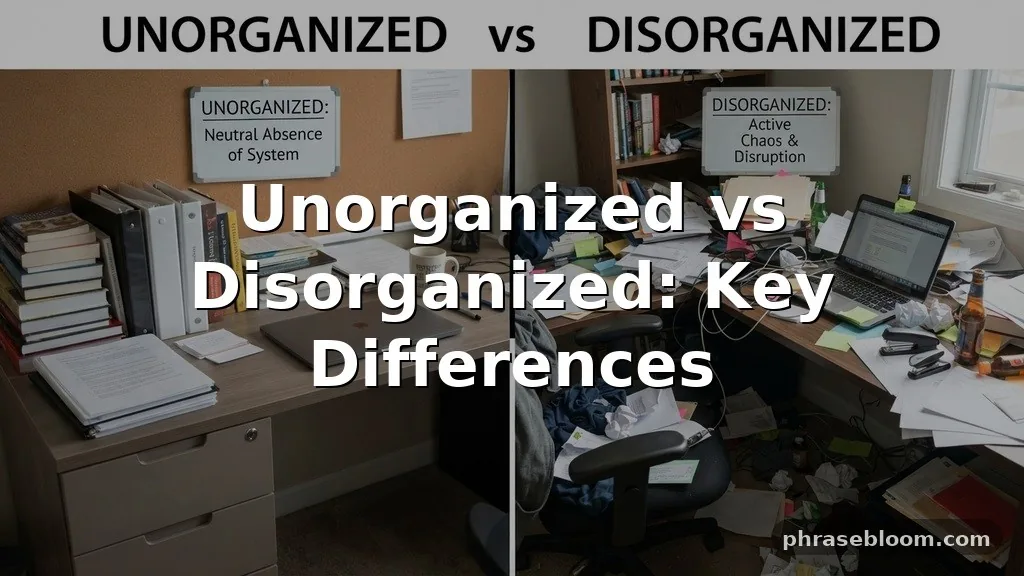
The difference between unorganized vs disorganized is usually a matter of emphasis, not a completely different meaning. Both words can describe a person, place, system, or collection that lacks order, but unorganized often points to the absence of a clear structure, while disorganized can suggest that order has broken down or that poor planning is causing practical problems.
Choosing between them depends on context. You can use this distinction to describe clutter, workplace organization, personal habits, project planning, and behavior more precisely without treating the two adjectives as strict opposites or pretending that English usage is more rigid than it is.
The Short Answer: Unorganized or Disorganized?
Both “unorganized” and “disorganized” are correct English words. In many sentences, they are interchangeable synonyms for “not organized.” The most natural choice depends on what you want to emphasize.
Use unorganized when you mean that something has not been arranged, classified, or structured. For example, an unorganized file cabinet may simply lack labeled folders. Nothing necessarily went wrong; the system may never have been created.
Use disorganized when you want to emphasize disorder, confusion, poor time management, weak planning, or a failure to keep an existing system under control. A disorganized project team may miss deadlines, lose information, and change priorities without warning.
| Word | Basic idea | Typical emphasis | Example |
|---|---|---|---|
| Unorganized | Not organized | Lack of structure or arrangement | The records were unorganized. |
| Disorganized | Not orderly or well managed | Disorder, confusion, or poor planning | The team became disorganized after the manager left. |
| Organized | Arranged or managed systematically | Structure, order, and preparation | The department keeps organized records. |
There is no universal rule requiring one word in every situation. If you are describing a person’s work habits, disorganized is often the more idiomatic choice. If you are describing materials that lack an arrangement, unorganized may sound more neutral.
Unorganized Definition and Disorganized Definition
The unorganized definition is “not organized.” The prefix un- commonly creates a direct negative, so unorganized describes the absence of organization without necessarily explaining why the organization is missing.
An unorganized bookshelf contains books that have not been sorted by author, subject, or size. An unorganized set of notes may include useful information, but the ideas have not been grouped into a logical sequence.
The disorganized definition is also “not organized,” but the word often carries a stronger sense of disorder or ineffective management. The prefix dis- can suggest separation, reversal, or a breakdown of an expected condition.
A disorganized office may contain misplaced documents, overflowing surfaces, and supplies that no one can find. A disorganized meeting may have no agenda, unclear responsibilities, and several people speaking about unrelated issues.
These definitions overlap because both words describe a lack of organization. The distinction is a useful shade of meaning rather than a hard grammatical boundary.
Neutral absence versus active disorder
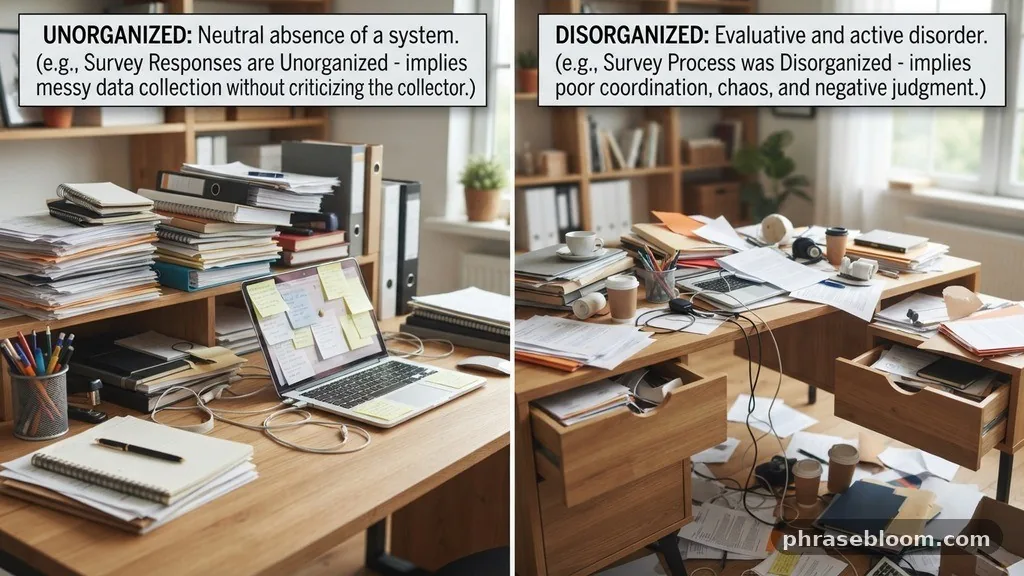
Unorganized can sound more neutral and descriptive. Saying “the survey responses are unorganized” tells the reader that the responses lack a system, but it does not necessarily criticize the people who collected them.
Disorganized can sound more evaluative. Saying “the survey process was disorganized” may imply poor coordination, missed steps, duplicated work, or confusion among the staff.
That difference matters in professional writing. A neutral description may be appropriate in a report, while a performance review may need the more specific wording “the project lacked a documented process and deadlines were missed” instead of simply calling someone disorganized.
Key Differences in Meaning and Tone
The main difference between unorganized and disorganized is often the source of the problem. Unorganized usually focuses on structure that is missing. Disorganized often focuses on structure that is weak, inconsistent, or failing in practice.
Consider two storage rooms. One room has boxes placed wherever there was space, but the staff has not yet created a storage plan.
Calling it unorganized is straightforward. If labels have fallen off, inventory records conflict, and employees repeatedly search for the same items, disorganized better communicates the resulting disorder.
The words can also differ in tone. Unorganized may sound less personal and less judgmental, especially when applied to information, files, or materials. Disorganized is frequently used for people and can suggest poor habits or weak control over tasks.
- Unorganized schedule: The schedule has not been arranged into a clear sequence.
- Disorganized schedule: The schedule keeps changing, contains conflicts, or reflects poor planning.
- Unorganized data: The data lacks categories, labels, or formatting.
- Disorganized data: The data may contain inconsistencies, duplicates, or errors that make it difficult to use.
- Unorganized workspace: The space has no clear arrangement.
- Disorganized workspace: The space is cluttered, inefficient, or difficult to manage.
These examples are tendencies, not absolute rules. A writer may use either adjective if the intended meaning is simply “not organized.” The surrounding nouns and verbs usually tell readers how strong the criticism is.
When to Use Each Word
Use unorganized when the central idea is a missing system. It works well for information, collections, records, notes, materials, and spaces that have never been arranged in a deliberate way.
Examples include “unorganized survey data,” “an unorganized collection of receipts,” and “unorganized meeting notes.” Each phrase describes the condition of the material rather than assigning a personal judgment to the person responsible for it.
Use disorganized when the issue involves confusion, disorder, poor coordination, or ineffective behavior. It is especially natural with people, departments, projects, meetings, and daily routines.
Examples include “a disorganized employee,” “a disorganized department,” “a disorganized launch,” and “disorganized personal habits.” These expressions suggest that the problem affects performance or creates avoidable difficulty.
Examples from everyday situations
“Her desk is unorganized” suggests that the desk lacks a clear arrangement. “Her desk is disorganized” more strongly suggests that papers, supplies, and unfinished tasks are interfering with her work.
“The instructions are unorganized” means the instructions are not presented in a logical order. “The instructions are disorganized” may additionally suggest contradictions, repeated steps, or confusing changes in direction.
“The files are unorganized” is suitable when files have not been sorted. “The files are disorganized” is stronger if files are regularly misplaced, mislabeled, or stored in several competing locations.
When the difference is important, describe the specific problem instead of relying on either adjective alone. “The project folder contains duplicate drafts and no version labels” gives readers more useful information than “the folder is disorganized.”
Unorganized vs Disorganized in the Workplace
Workplace communication often requires careful word choice because an adjective can sound like a judgment about a person. Calling an employee “disorganized” may imply a recurring performance problem, while saying that a workflow is “unorganized” may identify a process that needs structure.
For example, “The onboarding materials are unorganized” points to a problem with the materials. “The onboarding process is disorganized” may indicate that managers, human resources staff, and new employees are not coordinating effectively.
Professional writing becomes clearer when you connect the adjective to observable facts. Instead of writing, “The team is disorganized,” write, “The team has no shared project calendar, and action items are not assigned after meetings.” That version identifies the lack of planning without making a vague personal accusation.
Useful workplace examples
Policy writing: “The current records are unorganized, so the compliance team will create a central index.” This sentence treats the records as materials that need structure.
Manager feedback: “The project became disorganized after the scope changed.” Here, the word describes a breakdown in coordination rather than a permanent personality trait.
Business reporting: “The original dataset was unorganized and required standard labels before analysis.” The wording focuses on data preparation.
Team communication: “The meeting felt disorganized because the agenda was not shared and several decisions were revisited.” This example explains the specific causes of disorder.
Performance documentation: “The employee submitted disorganized work that omitted required sections.” The word is supported by a concrete result, which makes the statement more precise and defensible.
For workplace organization, the most useful question is not simply which adjective sounds better. Ask whether you are describing missing structure, a breakdown in an existing process, or behavior that produces disorder.
Grammar, Grammatical Usage, and Related Words
Both unorganized and disorganized are adjectives. An adjective modifies a noun by describing it, as in “unorganized notes” or “a disorganized workflow.” They can also appear after a linking verb, as in “The notes are unorganized” or “The workflow became disorganized.”
The words can modify physical things, abstract ideas, and people. They may describe a room, a database, a schedule, an argument, a department, a student, or a manager.
In “The filing system is unorganized,” the adjective describes the system’s condition. In “The staff worked in a disorganized way,” the adjective appears in an adverbial phrase that explains how the staff worked.
English also uses related nouns and adverbs. Organization names the quality or process of arranging things, while disorganization names a condition of disorder or poor coordination. The adverb disorganizedly exists but is uncommon and awkward in most professional writing, so rewriting is usually better.
For example, replace “The team worked disorganizedly” with “The team worked without a clear plan.” Replace “She responded unorganizedly” with “She responded without organizing the information first.” Natural phrasing matters more than forcing a form that dictionaries may technically permit.
Synonyms and antonyms
Useful synonyms depend on the intended shade of meaning. For a lack of structure, try unsorted, unstructured, unordered, or roughly arranged. For confusion or poor management, try chaotic, scattered, messy, confused, or poorly coordinated.
The most direct antonym for both words is organized. Other antonyms include orderly, structured, systematic, coordinated, and well planned.
Do not treat every synonym as equally strong. Cluttered usually refers to too many objects in a physical or visual space. Chaotic suggests a more serious lack of order. Unstructured may be neutral, especially when a flexible format is intentional.
American English, Formal Writing, and Style
In American English, both words are established and widely understood. Usage does not divide neatly into one word for the United States and another for a different region. Writers choose between them mainly according to meaning, tone, and context.
Formal writing often benefits from unorganized when the writer wants a neutral description of materials or information. A research report might say that “the responses were unorganized and required coding.” That wording does not automatically blame the research team.
Formal writing may use disorganized when the evidence concerns workflow, coordination, or performance. A report could state that “the response process was disorganized, with duplicate requests sent to several departments.” The explanation makes the judgment concrete.
Business English also favors precise alternatives when the two adjectives feel too broad. “The process lacks a documented sequence” may be more useful than “the process is unorganized.” “The department has inconsistent approval procedures” may be clearer than “the department is disorganized.”
Writers should also consider audience and tone. In a casual message, “My notes are disorganized” is ordinary. In an academic paper, “The notes were not arranged into thematic categories” may sound more objective.
For guidance on formal usage and word meanings, consult a reputable reference such as the Merriam-Webster dictionary. A dictionary can confirm that both forms are legitimate, but context still determines which one communicates your intended idea best.
Common Mistakes and Better Revisions
One common mistake is assuming that unorganized and disorganized have completely separate meanings. They overlap substantially, so a sentence is not automatically wrong because it uses one instead of the other.
A second mistake is using disorganized as a personal label without identifying the behavior behind it. “The coordinator is disorganized” may be understandable, but “The coordinator has missed three deadline reminders and has not maintained the shared calendar” is more professional and actionable.
A third mistake is using unorganized when the problem is actually a lack of planning. “The event was unorganized” may understate a situation in which speakers were not scheduled, equipment was missing, and attendees received conflicting information. “The event was poorly planned and disorganized” is clearer.
| Less precise wording | Improved wording | Why it works |
|---|---|---|
| The files are disorganized. | The files are unorganized and have not been sorted by client. | It identifies the missing structure. |
| The manager is disorganized. | The manager often changes deadlines without updating the team calendar. | It describes observable behavior. |
| The launch was unorganized. | The launch was disorganized because responsibilities were not assigned. | It names the cause of the disorder. |
| The data is chaotic. | The data contains duplicate entries and inconsistent labels. | It replaces a broad judgment with specific facts. |
Another error is inventing an adverb such as unorganizedly or relying on disorganizedly when a simple phrase would sound more natural. Write “without a clear system,” “in a scattered way,” or “without proper coordination.”
Finally, do not confuse a temporary condition with a fixed personal quality. A person may submit disorganized work during a particularly difficult week without being permanently disorganized. Context and evidence keep the wording fair.
How to Choose the Best Word
Start by identifying what is actually missing. If the object has no categories, sequence, labels, or system, unorganized is often a good choice. If the situation involves confusion, disruption, poor time management, or a failed process, disorganized may be more accurate.
Next, consider whether the sentence describes a thing or a person. “Unorganized research notes” is neutral and natural. “A disorganized researcher” is stronger and may need supporting details.
Then check the sentence’s purpose. A workplace report, academic paper, or formal complaint should usually identify the specific condition rather than depend on a broad adjective. Precision helps readers understand what should change.
- Choose unorganized for missing arrangement or structure.
- Choose disorganized for disorder, confusion, or ineffective coordination.
- Use organized when the positive condition is clear and relevant.
- Use unstructured when a system lacks a formal framework but is not necessarily messy.
- Use poorly planned when planning, rather than physical order, is the main issue.
- Use poorly coordinated when several people or departments are failing to work together.
Read the finished sentence aloud. If the adjective sounds like an unfair judgment, replace it with a description of the actual behavior, arrangement, or result.
Examples You Can Copy and Adapt
“The unorganized receipts were placed in separate folders before the audit.” This sentence presents the receipts as materials that needed sorting.
“The finance team became disorganized after two approval steps were added without updating the workflow.” Here, the issue is a breakdown in an existing process.
“The student’s notes were unorganized, but they contained useful observations.” The contrast makes unorganized sound neutral rather than severely negative.
“The student appeared disorganized because assignments were missing from the planner.” This example connects the word to behavior and poor planning.
“The company received unorganized feedback from several departments.” The feedback had not been grouped or formatted consistently.
“The response effort became disorganized when three departments contacted the same customers.” The sentence shows confusion and duplicated action.
“The report presents an unorganized collection of facts.” This works when the information lacks a clear structure.
“The report is disorganized and repeats the same conclusion in four sections.” The word now refers to a flaw in the document’s structure and editing.
“His workspace is unorganized, so we are adding labeled storage areas.” This is a practical description focused on arrangement.
“His workspace is disorganized, and he regularly loses documents needed for client calls.” The added consequence supports the stronger word.
These examples show why the best choice cannot be made by spelling alone. The surrounding details determine whether the reader hears a neutral absence of structure or a broader condition of disorder.
Frequently Asked Questions
Is “unorganized” or “disorganized” correct?
Both are correct. They are often synonyms, but unorganized commonly emphasizes missing structure, while disorganized can emphasize confusion, disorder, or poor management.
Is “unorganized” more neutral than “disorganized”?
Often, yes. “Unorganized files” may simply lack a sorting system, while “disorganized files” can suggest that the filing process is causing confusion or repeated mistakes.
Is “disorganized” better for describing a person?
It is usually more natural, especially for habits, schedules, and work behavior. Still, support the description with specific examples rather than using the word as an unsupported personal judgment.
Can I use “unorganized” in formal writing?
Yes. It is appropriate in formal writing when it accurately describes information, materials, records, or a system without implying more disorder than the evidence supports.
What is a good alternative to both words?
Choose a more specific phrase such as “unsorted,” “unstructured,” “poorly planned,” “poorly coordinated,” or “lacking a clear system.” The best alternative depends on the problem you want to identify.
Conclusion: Choosing Between Unorganized and Disorganized
The practical rule for unorganized vs disorganized is simple: use unorganized for something that lacks a clear arrangement, and use disorganized for disorder, confusion, poor planning, or a breakdown in coordination. Both forms are correct, and the difference is usually one of emphasis rather than basic meaning.
In professional writing, support either word with concrete details. If a reader can see exactly what is missing or failing, your wording will be clearer than a broad label. Choose the form that matches the context, tone, and evidence.
Explore more on PhraseBloom.