
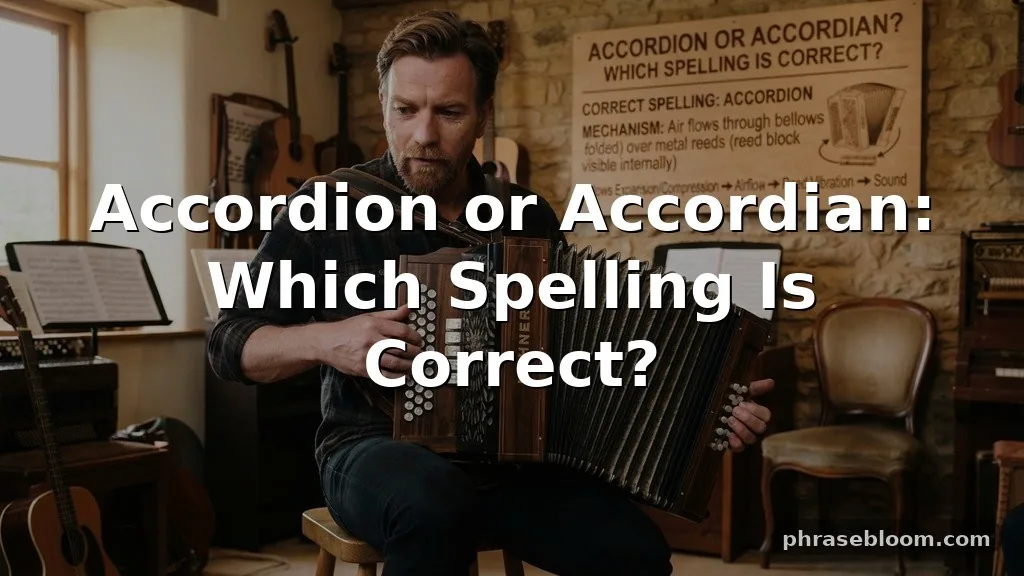
Between “accordion” and “accordian,” accordion is the correct spelling in standard English. “Accordian” is a common misspelling, although it appears often enough online to create genuine uncertainty.
The word names a musical instrument with bellows, reeds, and a keyboard or buttons. Understanding the accordion definition, its pronunciation, its history, and its related terms will help you use the correct spelling confidently in writing, conversation, and searches.
Accordion or Accordian: The Direct Answer
Accordion is the dictionary spelling. It refers to a portable free-reed instrument that produces sound when air moves through reeds as the player expands and compresses its bellows.
Accordian is not the standard spelling of the instrument’s name. It is a spelling mistake, usually caused by the natural tendency to connect the word with “accord,” “according,” or similar words that contain the letters “ia” in a familiar pattern.
| Form | Status | Example |
|---|---|---|
| accordion | Correct standard spelling | She plays the accordion. |
| accordian | Common misspelling | Use accordion instead. |
| accordionist | Correct word for a player | The accordionist performed a solo. |
| accordions | Correct plural | The store displays several accordions. |
The spelling matters in practical situations. A musician searching for lessons, a writer describing folk music, or a retailer labeling products should use “accordion” so that the word matches dictionaries, catalogs, search systems, and professional usage.
The pronunciation does not rescue the misspelling. Both written forms may be pronounced similarly by someone reading them aloud, but only one has the accepted spelling in English.
What Does Accordion Mean?
An accordion is a musical instrument in the free-reed family. The player operates bellows in the center of the instrument, pushing and pulling air through metal reeds to create musical tones.
Many accordions have a piano-style keyboard on one side and buttons on the other. Other models use buttons for both the melody and accompaniment, so the exact appearance depends on the instrument’s design and musical tradition.
The accordion definition is broader than “a small keyboard.” Its characteristic sound comes from the combination of air pressure, reeds, bellows, and the player’s control of phrasing. Pressing a key or button opens a valve, while the bellows supply the moving air.
How the instrument works
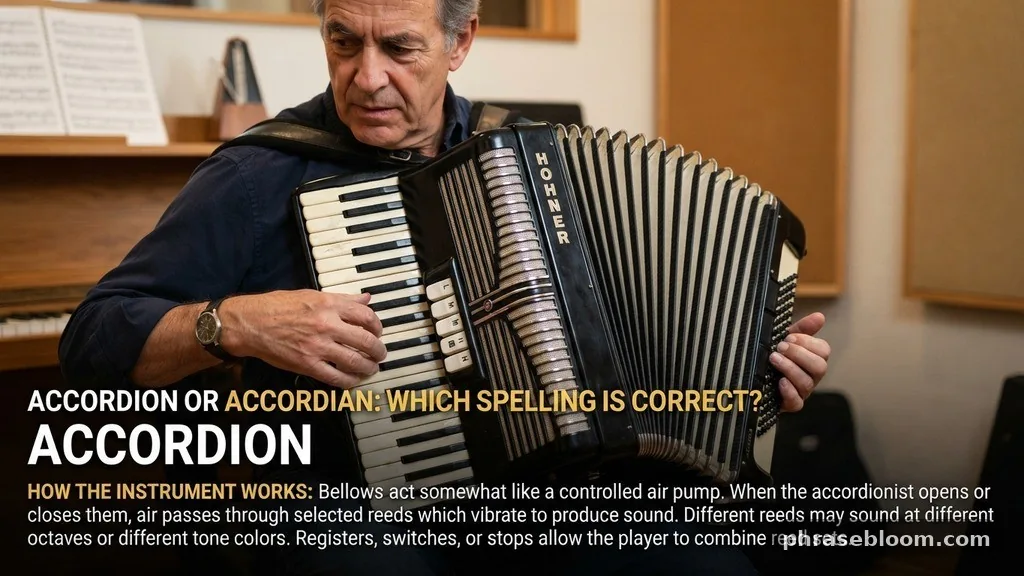
The bellows act somewhat like a controlled air pump. When the accordionist opens or closes them, air passes through selected reeds, which vibrate and produce sound.
Different reeds may sound at different octaves or with different tone colors. Registers, switches, or stops allow the player to combine reed sets, which is why one accordion can produce several distinct timbres.
The left-hand section often supplies bass notes and chords, while the right-hand section usually carries the melody. This arrangement lets one performer provide both harmonic support and a lead line.
Accordions appear in many musical settings, including folk music, tango, jazz, classical compositions, polka, zydeco, musette, and popular music. The instrument’s role changes significantly from one tradition to another.
Why Accordion Is the Correct Spelling
The accepted English word is spelled a-c-c-o-r-d-i-o-n. After “accord,” the word uses “ion,” not “ian,” giving the final sequence “dion.”
The spelling is not based on the word “accordian.” That form may look plausible because English contains many words ending in “-ian,” including “musician,” “Canadian,” and “librarian,” but those patterns do not determine the spelling of every borrowed noun.
“Accordian” is best understood as a common misspelling rather than a separate type of instrument. It does not normally indicate a different model, regional design, or musical technique.
Why people write accordian
Several factors can encourage the error. The first is pronunciation: in some accents, the middle vowels may be reduced, making the written difference difficult to hear.
The second is visual analogy. Writers may associate the instrument with “accord” and then add “-ian,” creating a form that resembles other English nouns and adjectives.
The third is repetition. If someone sees “accordian” on an informal website, social media post, product listing, or message, the wrong spelling can become familiar through exposure.
Familiarity does not make the form correct. A dictionary search for the instrument should use “accordion,” and formal writing should use the same spelling.
Accordion Etymology and Dictionary Usage
The word accordion entered English as a name for a relatively modern instrument. Its history is connected with European free-reed instruments and with the German word “Akkordion,” which relates to “Akkord,” meaning a chord or harmony.
The name reflects the instrument’s ability to produce chords as well as individual notes. That feature helped distinguish early accordion designs from some other free-reed instruments.
Exact details about the instrument’s development involve several related inventions and national traditions. Early nineteenth-century Europe saw rapid experimentation with free-reed instruments, and the modern accordion developed through that broader history rather than from one single moment or inventor.
For current English word usage, the important point is straightforward: established dictionaries record accordion, not “accordian,” as the standard noun. Reference works such as Merriam-Webster and the Oxford English Dictionary document the accepted spelling and the word’s historical development.
Readers who want background on the instrument’s construction and history can consult this Encyclopaedia Britannica overview of the accordion. A reputable reference is especially useful when a spelling question overlaps with questions about the object itself.
Dictionary spelling versus search frequency
Search results can make “accordian” look more legitimate than it is. A common misspelling may appear on many pages because users repeat it, websites fail to edit it, or search engines display related results.
Frequency alone does not establish a preferred dictionary spelling. In professional writing, the accepted form remains “accordion,” even if a search query using “accordian” produces results.
Accordion Pronunciation and Word Form
In common American English, accordion is usually pronounced with the stress on the middle syllable: uh-KOR-dee-un. The first vowel is often weak, and the final syllable sounds like “un” or “uhn.”
Pronunciation can vary slightly by speaker, accent, and musical community. Those variations do not change the spelling, just as regional pronunciation differences do not normally create separate written forms.
The word has several related forms. The person who plays the instrument is an accordionist, and the plural of the instrument is accordions.
| Word | Meaning | Example |
|---|---|---|
| accordion | The instrument | He repaired an old accordion. |
| accordionist | A person who plays it | The accordionist joined the band. |
| accordions | More than one instrument | The collection includes three accordions. |
| accordion music | Music performed with the instrument | Accordion music filled the hall. |
“Accordianist” follows the same misspelled pattern as “accordian,” so it should also be avoided. The correct professional term is “accordionist.”
People sometimes ask whether “accordion” can function as an adjective. It commonly modifies another noun in phrases such as “accordion music,” “accordion lesson,” “accordion case,” and “accordion player.”
Types of Accordion and Related Instruments
Not every accordion looks or sounds the same. Two broad categories often discussed in English are the keyboard accordion and the button accordion.
Keyboard accordion
A keyboard accordion has piano-style keys on the right-hand side. Its layout may feel familiar to a pianist, although the player must also coordinate bellows movement and the left-hand accompaniment system.
Keyboard accordions are used in classical arrangements, popular music, folk traditions, and many teaching contexts. The size, number of reeds, and bass configuration can vary considerably.
Button accordion
A button accordion uses rows of buttons rather than piano-style keys for the melody side. Some button systems are diatonic, meaning they are organized around particular scales and may produce different notes depending on the direction of the bellows.
Other button accordions are chromatic and provide a broader note system. Button designs are strongly associated with particular regional styles, including musette, Cajun, Irish, and other folk traditions.
Accordion and concertina
The concertina is a related free-reed instrument, but it is not simply another spelling or another name for an accordion. Concertinas usually have buttons at both ends and a different shape and internal layout.
The bandoneon is another related instrument, especially important in tango. It resembles an accordion in using bellows and reeds, but its design, button arrangement, and musical history are distinct.
These distinctions matter because “accordion” should not be used as a catch-all term for every bellows-operated free-reed instrument. In everyday conversation, people may use broad descriptions, but technical writing benefits from naming the specific instrument.
- Accordion: a bellows-driven free-reed instrument with keys, buttons, or both.
- Keyboard accordion: an accordion with piano-style melody keys.
- Button accordion: an accordion that uses buttons for melody, accompaniment, or both.
- Concertina: a related free-reed instrument with a different structure and playing system.
- Bandoneon: a related instrument strongly associated with tango music.
Correct spelling remains important across all these terms. A product description that calls an accordion a concertina may create a technical error, while a listing that says “accordian” contains a spelling error.
Accordion in a Sentence
Seeing the correct spelling in realistic sentences makes it easier to remember. The examples below cover ordinary conversation, music writing, education, and professional description.
Everyday and descriptive examples
“My grandfather taught me to play the accordion.” Here, “accordion” is the direct object of the verb “play,” and the sentence uses the standard noun form.
“The accordion has a warm, reedy sound.” The word functions as the subject of the sentence, while “has” introduces a description of the instrument.
“We heard accordion music outside the theater.” In this phrase, “accordion” modifies “music,” identifying the type of music rather than naming a separate instrument in the sentence.
Professional and educational examples
“The music school offers beginner accordion lessons on Saturdays.” This wording is natural for a website, brochure, or registration page because “accordion” directly identifies the subject of the lessons.
“The program features a keyboard accordion and a string quartet.” The phrase distinguishes the instrument from other performers and uses “keyboard” as a modifier for the type of accordion.
“The researcher compared button accordion traditions in three regions.” This sentence is appropriate for an academic or cultural report because it identifies a specific instrument category without using the misspelled form.
Music journalism and event announcements
“An award-winning accordionist will lead the workshop.” The correct word for the performer is “accordionist,” not “accordianist.”
“The festival’s evening program includes tango, folk dance, and accordion performance.” This sentence works in event copy because “accordion” describes the performance category.
“The band’s accordion player added a bright countermelody to the chorus.” The phrase “accordion player” is clear and widely understood, especially for general audiences who may not know the more specialized term “accordionist.”
In each example, the spelling stays the same whether “accordion” is the subject, object, modifier, or part of a longer compound expression. Its grammatical role may change, but “accordian” does not become correct in any of those positions.
Accordion Plural and Related Word Forms
The plural of accordion is accordions. It follows the ordinary English pattern of adding “s,” as in “one accordion” and “two accordions.”
There is no need to change the internal spelling for the plural. The final “n” remains, and the word does not become “accordia,” “accordians,” or “accordionss.”
| Singular or plural | Correct form | Example |
|---|---|---|
| Singular noun | accordion | She bought an accordion. |
| Plural noun | accordions | The shop sells accordions. |
| Player noun | accordionist | The accordionist tuned the reeds. |
| Descriptive phrase | accordion music | They recorded accordion music. |
The word “accordionist” uses the suffix “-ist,” which often identifies a person associated with an art, activity, or instrument. It is formed from “accordion,” not from the misspelled “accordian.”
Writers sometimes use “accordion player” instead of “accordionist.” Both are understandable, but “accordionist” is shorter and more precise when the context is formal music writing.
For a general audience, “accordion player” may sound more familiar. For a concert program, review, biography, or music reference work, “accordionist” is often a useful choice.
Common Spelling Mistakes Involving Accordion
The main error is replacing the “io” sequence with “ia.” That produces “accordian,” a form that may look reasonable but does not match the standard dictionary spelling.
A second mistake is carrying the error into related words. If a product page describes an “accordian player,” the correct version is “accordion player” or “accordionist.”
Incorrect: accordian
Incorrect: “He bought a vintage accordian.”
Correct: “He bought a vintage accordion.” The instrument’s name ends in “-dion,” not “-dian.”
Incorrect: accordianist
Incorrect: “The accordianist performed a solo.”
Correct: “The accordionist performed a solo.” The performer’s title is built from the correctly spelled instrument name.
Incorrect: accordion’s for sale
Incorrect: “Accordion’s for sale.”
Correct: “Accordions for sale.” An apostrophe does not form a regular plural. It normally signals possession or a contraction.
Unclear or overly broad usage
Less precise: “The band used a concertina and accordion interchangeably.”
Clearer: “The band used a concertina for one piece and an accordion for another.” The revised sentence identifies two related but distinct instruments.
Not every problem is a spelling mistake. Sometimes the issue is word choice, punctuation, or technical precision. Good editing checks all three.
How to Choose the Correct Form
For ordinary writing, the decision is simple: choose accordion. Use “accordian” only when discussing the misspelling itself, such as in a lesson about common errors or in a quotation that must be reproduced exactly.
A reliable editing process can prevent the error from returning. Check the spelling when you first write the word, then search the document for likely variations before publishing.
- Use accordion for the instrument.
- Use accordionist for a person who plays it.
- Use accordions for more than one instrument.
- Use accordion music or accordion player in descriptive phrases.
- Replace “accordian” everywhere in formal copy unless it is an intentional quotation.
For students and English learners
English learners can remember the spelling by dividing the word into sound and letter groups: ac-cor-di-on. The middle section contains “di,” followed by “on,” producing “dion.”
It also helps to connect the word with a familiar phrase such as “accordion music.” Writing the complete phrase several times is more useful than memorizing the isolated word without context.
For editors and professionals
Editors should check headings, captions, image descriptions, product names, metadata, and alt text. A single misspelling can remain visible in several places even after the body copy has been corrected.
Organizations that publish music education materials or sell instruments may also want a small internal word list. Including “accordion,” “accordionist,” “button accordion,” and “keyboard accordion” can reduce inconsistent usage across teams.
Consistency matters because readers often treat repeated spelling as evidence of authority. Correcting the word once is helpful; correcting every occurrence is professional.
Accordion or Accordian in Formal and Informal Writing
Formal writing should always use “accordion” unless the writer is analyzing the incorrect form. This includes academic papers, museum labels, concert programs, news articles, product descriptions, grant applications, and instructional materials.
Informal messages may contain “accordian,” especially when someone is typing quickly or relying on memory. The meaning may still be understood, but informal acceptance does not make the spelling suitable for published work.
Search engines and spellcheckers can help, but they should not replace knowledge of the correct word. Some systems automatically correct “accordian,” while others merely show related results without clearly explaining the error.
When accuracy matters, a dictionary remains the better authority. Look for the headword “accordion,” its pronunciation, its part of speech, and its plural form.
Writing about music
Music writers should distinguish between the instrument, the performer, and the musical style. “Accordion,” “accordionist,” and “accordion music” serve different purposes and should not be treated as interchangeable.
For example, “The accordionist performed accordion music on a button accordion” contains three related but distinct ideas. The performer is identified first, the music second, and the instrument type third.
Writing product and event copy
Retailers should use “accordion” in product titles, specifications, and category labels. A customer searching for a “button accordion” may miss a product if its title uses the misspelled form.
Event organizers should also use the correct spelling in schedules and promotional materials. “Accordion workshop” and “accordion concert” are clear, searchable phrases that readers immediately understand.
Frequently Asked Questions
Is accordion or accordian correct?
Accordion is correct. “Accordian” is a common misspelling of the musical instrument’s name.
Is accordian ever an acceptable spelling?
It may appear when someone is quoting an original text or discussing the spelling mistake itself, but it is not the standard form for ordinary writing.
How do you pronounce accordion?
It is commonly pronounced uh-KOR-dee-un in American English, with the main stress on the middle syllable. Accents may produce small variations.
What is the plural of accordion?
The plural is accordions. For example, “The museum displays several accordions.”
What do you call someone who plays the accordion?
A person who plays the instrument is an accordionist. “Accordion player” is also clear and natural, especially for general audiences.
Final Rule for Accordion or Accordian
Use accordion for the musical instrument, accordionist for its performer, and accordions for the plural. The form “accordian” is a common spelling mistake, not a separate accepted version with a different meaning.
Once you remember the “dion” ending, the choice becomes easy. Whether you are writing about a keyboard accordion, a button accordion, a concertina comparison, or a live performance, the correct spelling is accordion.
Explore more on PhraseBloom.