
There Has Been vs There Have Been: Which Is Correct?
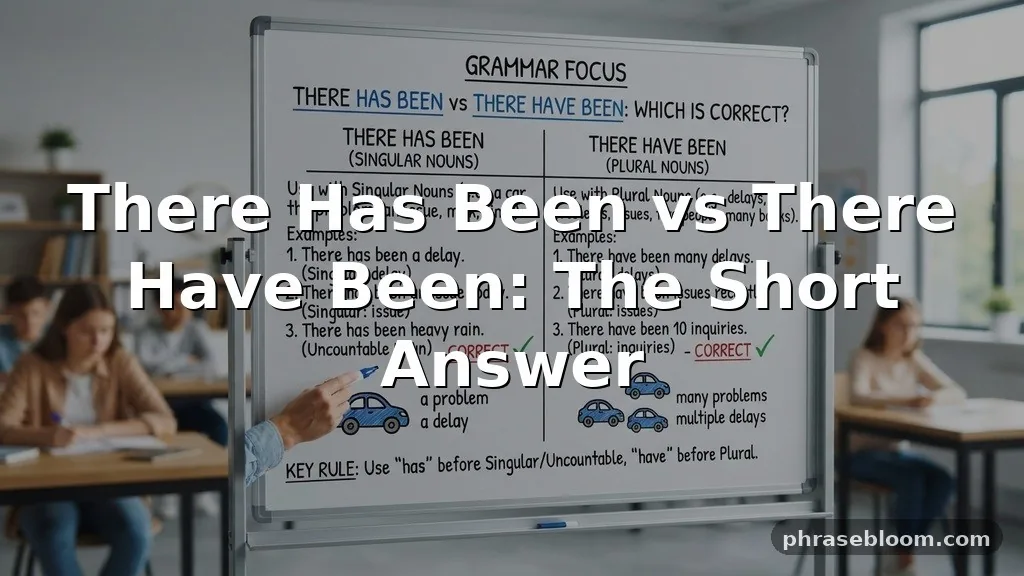
There Has Been vs There Have Been is mainly a question of subject-verb agreement. Use there has been with a singular noun or an uncountable noun, and use there have been with a plural noun. The unusual part is that the sentence begins with existential there, which acts as a dummy subject while the real grammatical subject appears later.
That distinction matters in emails, reports, academic writing, and everyday speech because the wrong helping verb can make an otherwise clear sentence sound careless. Once you identify the noun that follows the verb, the choice between has vs have becomes much easier.
Use there has been when the noun after the verb is singular or uncountable. Use there have been when that noun is plural.
| Expression | Use it with | Example |
|---|---|---|
| There has been | A singular noun or uncountable noun | There has been a delay. |
| There have been | A plural noun | There have been several delays. |
The noun after been determines the verb form. In “There has been a problem,” problem is singular, so has is correct. In “There have been problems,” problems is plural, so have is required.
The word there does not change the basic agreement rule. It introduces the existence or occurrence of something, but the noun that follows still controls the grammatical number of the verb.
For a detailed reference on agreement and sentence structure, consult the Cambridge Dictionary explanation of there is and there are. The same principle extends naturally from present forms such as there is and there are to perfect forms such as there has been and there have been.
What “There Has Been” Means
There has been tells us that one thing has existed, occurred, or happened. It uses the present perfect tense, which connects a past event or situation with the present.
For example, “There has been a change in the schedule” means that one change has occurred and that the change is relevant now. The sentence does not necessarily say exactly when the change happened.
- There has been a mistake in the invoice.
- There has been an update to the software.
- There has been significant progress this month.
- There has been little interest in the proposal.
- There has been one complaint from a customer.
In each example, the noun or noun phrase is singular or uncountable. Mistake, update, and complaint are singular countable nouns, while progress and interest are uncountable nouns in these meanings.
The word been is the past participle of be. It works with the helping verb has to form the present perfect construction. The sentence therefore follows this pattern: there + has + been + singular or uncountable noun.
“There has been” can refer to physical presence, an event, a development, or a condition. Compare “There has been a visitor at reception,” “There has been a meeting,” and “There has been confusion about the instructions.”
What “There Have Been” Means
There have been introduces two or more things that have existed, occurred, or happened. The plural helping verb have agrees with the plural noun that follows.
Consider the difference between “There has been a complaint” and “There have been complaints.” The first sentence reports one complaint, while the second reports more than one.
- There have been several delays this week.
- There have been three changes to the policy.
- There have been many questions about the new process.
- There have been some improvements since January.
- There have been two interviews for the position.
The construction follows this pattern: there + have + been + plural noun. The plural noun may be separated from have by an adverb or another phrase, but its grammatical number does not change.
For example, “There have recently been several complaints” remains plural because complaints is the real subject. The adverb recently comes between the helping verb and the past participle, but it does not affect agreement.
In formal English, writers sometimes avoid the construction because the delayed subject can make agreement less obvious. That is not a reason to avoid it entirely. It is a common and useful structure in professional writing when the sentence is clear.
Why Existential “There” Causes Confusion
The there in these sentences is called existential there. It does not refer to a location, as it does in “The files are over there.” Instead, it introduces the existence or occurrence of something.
Because existential there appears first, it can look like the subject. Grammatically, however, it is often described as a dummy subject or introductory subject. The noun that follows the verb carries the important number information.
Compare these sentences:
- There has been a problem.
- There have been problems.
- There is a problem.
- There are problems.
The same singular and plural distinction appears in both the present and present perfect forms. This is why understanding there is vs there are also helps you understand there has been vs there have been.
One reliable technique is to temporarily remove there and identify the noun phrase. In “There have been several errors,” the key noun is errors. Since it is plural, have is appropriate.
Intervening phrases can make the structure harder to see. In “There has, despite the earlier warnings, been a serious breach,” the phrase between has and been adds information, but a serious breach remains singular.
Subject-Verb Agreement in Real Sentences
Subject-verb agreement means that the verb form matches the grammatical number of the subject. With existential constructions, the subject appears after the verb, so writers must look beyond the opening word.
Singular nouns
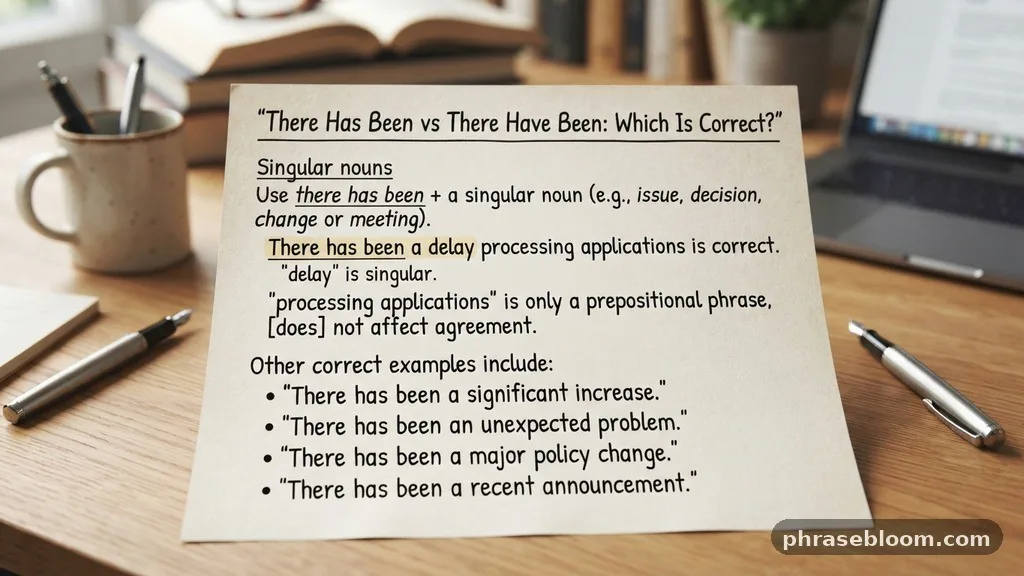
Use there has been with a singular noun such as issue, decision, change, or meeting.
“There has been a delay in processing the applications” is correct because delay is singular. The phrase “in processing the applications” is only a prepositional phrase and does not affect the agreement.
Other correct examples include “There has been an unexpected expense,” “There has been one confirmed case,” and “There has been a noticeable improvement in response times.”
Plural nouns
Use there have been with plural nouns such as issues, decisions, changes, or meetings.
“There have been several delays in processing the applications” is correct because delays is plural. The words that follow the noun do not change that fact.
Other examples include “There have been two unexpected expenses,” “There have been several confirmed cases,” and “There have been noticeable improvements in response times.”
Uncountable nouns
Uncountable nouns usually take a singular verb in English. Therefore, write “There has been enough information” and “There has been considerable confusion,” not “There have been enough information” or “There have been considerable confusion.”
Common uncountable nouns in this structure include advice, information, equipment, research, progress, traffic, and work. If you want a plural verb, change the noun to a countable expression, such as “There have been several pieces of information.”
There Has Been or There Have Been in Professional Writing
Business English uses both forms constantly. The correct choice depends on whether the writer is reporting one development, a general uncountable condition, or multiple events.
In a project update, write “There has been a change to the delivery schedule” when one change is being announced. Write “There have been several changes to the delivery schedule” when the update covers multiple revisions.
In an employee email, the following patterns are natural:
- There has been an update to the benefits portal.
- There have been several questions about open enrollment.
- There has been some confusion about the deadline.
- There have been minor changes to the training materials.
Formal reports often include time expressions such as since the last review, over the past quarter, or in recent weeks. These expressions work naturally with the present perfect because they connect earlier events to the current situation.
For example, “There have been fewer customer complaints since the support team expanded” describes a change that began in the past and remains relevant. “There has been steady growth over the past quarter” treats growth as an uncountable process, so the singular form is correct.
Legal and policy writing requires extra care because agreement errors can distract from precise obligations. If a sentence becomes difficult to read, rewrite it as “The review identified several changes” or “The department reported one significant issue.”
There Has Been vs There Have Been with Difficult Nouns
Some nouns create uncertainty because their grammatical number is not obvious. Collective nouns, compound subjects, quantities, and long noun phrases deserve special attention.
Collective nouns
A collective noun names a group, such as team, committee, staff, or government. In American English, these nouns are often treated as singular when the group acts as one unit.
Therefore, “There has been a committee meeting” is correct because meeting is singular. In a sentence such as “There has been disagreement among the committee members,” disagreement is an uncountable noun and takes has.
Compound subjects
When two nouns are joined by and, the resulting subject is usually plural. “There have been a manager and two assistants in the conference room” treats the combined group as more than one person.
However, awkward compound subjects are often better rewritten. “A manager and two assistants have been in the conference room” is more direct and avoids the delayed subject structure.
Quantities and measurements
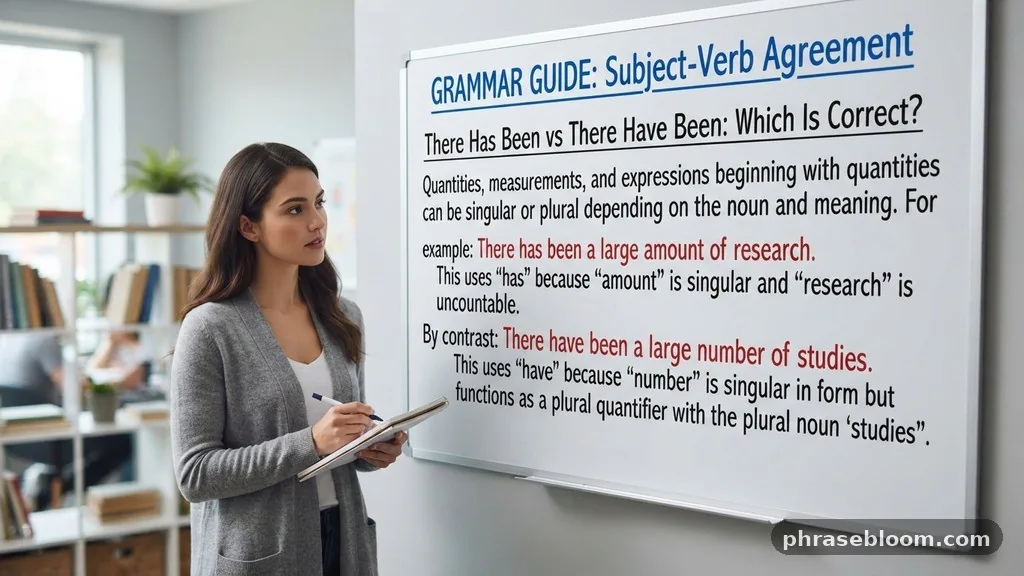
Expressions beginning with quantities can be singular or plural depending on the noun and meaning. “There has been a large amount of research” uses has because amount is singular and research is uncountable.
By contrast, “There have been a large number of studies” uses have because number is singular in form but the phrase a large number of studies conventionally refers to plural studies and takes a plural verb in this construction.
If the structure feels uncertain, replace it with a direct sentence. “Researchers have published a large number of studies” is easier to process than a long existential construction.
There Has Been in Questions and Negative Sentences
The same agreement rule applies when the sentence is negative or interrogative. Only the word order changes.
Examples include “Has there been a response?” and “Have there been any updates?” The singular noun response requires has, while the plural noun updates requires have.
- Has there been a change in the contract?
- Have there been any changes in the contract?
- There has not been enough time to complete the review.
- There have not been enough meetings to resolve the issue.
- There has never been a formal complaint.
- There have never been formal complaints from that department.
Contractions are common in speech and informal workplace communication. “There hasn’t been a decision” and “There haven’t been any decisions” are both standard, provided the noun agrees with the contraction.
Writers sometimes choose the wrong contraction because there appears first. The safe method is still to identify the noun: a decision requires hasn’t, while any decisions requires haven’t.
There Was vs There Were and Related Forms
The past forms follow the same principle. Use there was with a singular or uncountable noun, and use there were with a plural noun.
“There was a problem during the launch” describes one past problem. “There were several problems during the launch” describes more than one.
| Time or aspect | Singular or uncountable | Plural |
|---|---|---|
| Present | There is a concern. | There are concerns. |
| Past | There was a concern. | There were concerns. |
| Present perfect | There has been a concern. | There have been concerns. |
The difference between there was and there has been also involves tense. The simple past usually presents a completed past situation, while the present perfect connects a past situation with the present.
Compare “There was a power outage yesterday” with “There has been a power outage.” The first sentence gives a finished event at a specific past time, while the second focuses on the current relevance of the outage.
Future forms work similarly but use will be for both singular and plural nouns in standard English. Write “There will be a meeting” and “There will be several meetings.”
Common Grammar Mistakes
The most common error is choosing the verb based on there rather than on the noun that follows. A sentence such as “There has been several updates” is incorrect in standard formal writing because updates is plural.
Another frequent error is allowing an intervening phrase to distract from the real subject. “There have, according to the latest report, been a serious error” should be “There has, according to the latest report, been a serious error.”
Typical incorrect patterns
- Incorrect: There has been many complaints.
Correct: There have been many complaints. - Incorrect: There have been a delay.
Correct: There has been a delay. - Incorrect: There have been useful information.
Correct: There has been useful information. - Incorrect: There has been several pieces of information.
Correct: There have been several pieces of information.
Writers also sometimes confuse the present perfect with the simple past. “There has been a meeting yesterday” is generally unsuitable because yesterday identifies a finished past time. Use “There was a meeting yesterday” instead.
A further mistake is using there when a direct subject would be clearer. “There have been concerns raised by employees” is grammatical, but “Employees have raised concerns” is shorter and more active.
How to Choose the Correct Form Quickly
You can solve most cases with a simple three-step method. First, locate the noun that follows been.
Second, decide whether that noun is singular, plural, or uncountable. Third, check whether the sentence is describing a past event with present relevance.
- Find the delayed subject after been.
- Use has for a singular or uncountable noun.
- Use have for a plural noun.
- Check the tense and time expression.
- Rewrite the sentence if the structure remains difficult to read.
Apply the method to “There ______ been several revisions since March.” The noun is revisions, which is plural, so the answer is “There have been several revisions since March.”
Now consider “There ______ been considerable progress since March.” Progress is uncountable in this meaning, so the correct sentence is “There has been considerable progress since March.”
Reading the sentence aloud can help, but grammatical analysis is more reliable when the noun phrase is long. In professional writing, do not let natural speech alone decide the agreement if the sentence contains several intervening phrases.
When a Direct Rewrite Is Better
Existential constructions are useful when introducing new information, but they are not always the clearest choice. A direct subject can make responsibility, timing, and action more explicit.
“There have been delays in reviewing the applications” reports a condition. “The review team has delayed the applications” assigns responsibility, although it changes the meaning slightly. Choose the rewrite only when it accurately represents what happened.
Here are practical alternatives:
- There has been a change to the plan. → The team has changed the plan.
- There have been several complaints. → Several customers have complained.
- There has been confusion about the deadline. → Employees have misunderstood the deadline.
- There have been improvements in response time. → Response time has improved.
Rewriting is especially useful in reports, instructions, and executive summaries. It can reduce repetition and make the actor or cause visible.
Still, a direct sentence is not automatically superior. “There has been a power failure in the building” may be the best choice when the event matters but its cause or responsible party is unknown.
Examples You Can Copy and Adapt
The following examples show how the construction works in common settings. Each sentence uses the present perfect to connect an earlier event with the current situation.
Workplace communication
There has been an update to the employee handbook. There have been several questions about the revised leave policy.
There has been a delay in issuing access cards. There have been unexpected delays in the onboarding process.
Reports and presentations
There has been steady growth in customer retention. There have been three significant changes in the quarterly results.
There has been limited progress on the regional rollout. There have been measurable improvements in service quality.
Academic writing
There has been considerable research into the relationship between sleep and memory. There have been several studies with different conclusions.
There has been renewed interest in the historical record. There have been competing interpretations of the evidence.
Customer service
There has been a problem with your order. There have been several reports of damaged packaging.
There has been no confirmation from the supplier. There have been no further complaints since the replacement was sent.
Questions and answers
Has there been a response from the client? Have there been any updates from the legal department?
These examples also show why the noun matters more than the nearby words. In “There have been several reports of damaged packaging,” reports controls the plural verb, not packaging.
Frequently Asked Questions
Is “there has been” or “there have been” correct?
Both are correct, but they apply to different grammatical numbers. Use there has been with a singular or uncountable noun, and use there have been with a plural noun.
Which is correct: “There has been several” or “there have been several”?
Use there have been several because the noun that follows is plural, even if it appears later in the sentence. For example, write “There have been several complaints.”
Can I use “there has been” with an uncountable noun?
Yes. Uncountable nouns normally take a singular verb, so write “There has been enough information” or “There has been considerable progress.”
Does “there have been” work with one noun?
Not when that noun is singular. Write “There has been one problem,” but “There have been two problems.” The number of the noun determines the helping verb.
What is the difference between “there was” and “there has been”?
There was usually describes a completed past event, while there has been links an earlier event or condition to the present. A specific finished time often favors the simple past: “There was a meeting yesterday.”
Final Rule for There Has Been vs There Have Been
The practical rule for There Has Been vs There Have Been is simple: look past there and identify the noun after been. Use has with a singular or uncountable noun, and use have with a plural noun.
Remember that existential there is a dummy subject, not a reason to ignore subject-verb agreement. If the sentence feels crowded, rewrite it with a direct subject, then proofread the final version for tense, clarity, and grammatical number.
Related: Any Problem or Any Problems · Do Not vs Don’t · Team That, Team Who, or Team Which
Explore more on PhraseBloom.