
Wonder vs Wander: Meaning, Difference and Usage
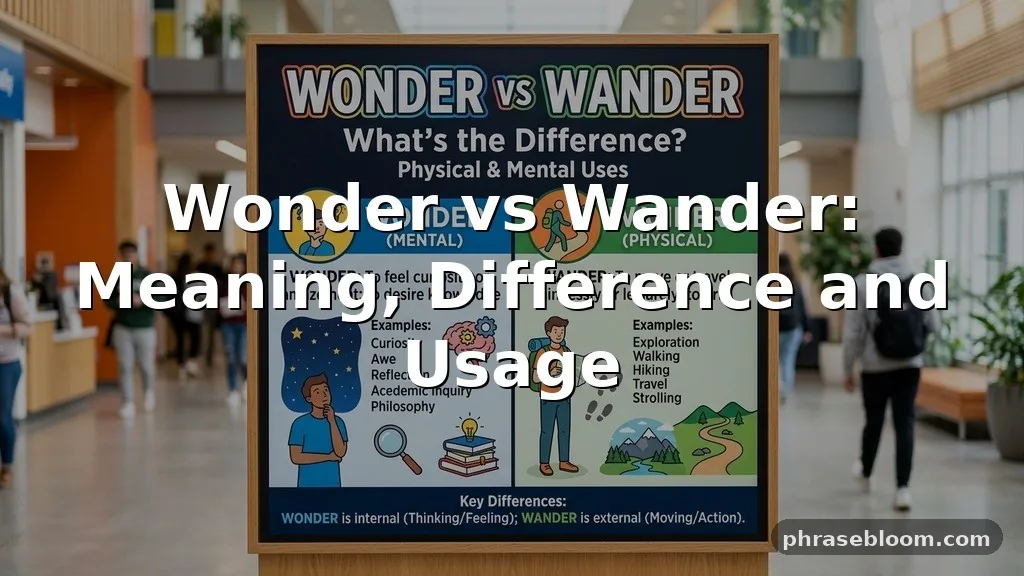
The difference between wonder and wander is simple once you connect each word to its core idea: wonder concerns curiosity or amazement, while wander concerns moving without a fixed direction. The words sound similar, but they describe different actions and experiences.
Understanding Wonder vs Wander helps you choose the right word in conversation, essays, workplace writing, and creative descriptions. You’ll learn the meaning, pronunciation, parts of speech, common phrases, and memorable examples that show exactly when each word belongs.
The Difference Between Wonder and Wander
Wonder usually refers to curiosity, amazement, or a feeling of surprise. As a verb, it can mean thinking about something because you want to know the answer, as in “I wonder where she went.” As a noun, it can describe something remarkable or a feeling of amazement, as in “The child stared at the night sky in wonder.”
Wander usually refers to physical movement without a clear destination or fixed route. Someone may wander through a park, wander around a city, or wander from room to room. The word can also describe thoughts that lose focus, as in “My mind began to wander during the long lecture.”
| Word | Central idea | Typical function | Example |
|---|---|---|---|
| Wonder | Curiosity or amazement | Verb and noun | I wonder what happened. |
| Wander | Unplanned movement or unfocused thought | Verb and noun | We wandered through the old town. |
A useful memory aid is this: you wonder with your mind, and you wander with your feet. The distinction is not absolute because wander can describe mental movement and wonder can describe a feeling, but the basic contrast remains reliable.
For a conventional dictionary reference, the Merriam-Webster entry for wonder shows how the word covers both questioning and admiration. Comparing that definition with the meaning of wander makes the difference easier to see.
Wonder Definition and Meaning
The wonder definition has two closely related sides. First, wonder can mean a desire to know or understand something. Second, it can mean a feeling of amazement caused by something beautiful, unusual, surprising, or difficult to explain.
As a verb, wonder often introduces an indirect question. “I wonder why the store closed early” means “I would like to know why the store closed early.” The sentence does not necessarily express strong amazement, although the speaker may also be surprised.
Wonder can also express polite uncertainty. “I wonder whether the manager has approved the request” sounds softer than “Has the manager approved the request?” This use appears frequently in professional emails because it asks for information without sounding abrupt.
As a noun, wonder describes an emotional response. A person may feel wonder while watching a meteor shower, entering an enormous cathedral, or seeing an unfamiliar landscape. In this sense, wonder is close to amazement, though it often includes curiosity and thoughtful attention.
- Curiosity: “I wonder how the machine works.”
- Surprise: “No wonder the team celebrated after the result.”
- Amazement: “The scale of the canyon filled us with wonder.”
- Polite inquiry: “I wonder if you could send the revised file.”
The word can also appear in the phrase “a wonder,” meaning something remarkable or extraordinary. For example, “The restored theater is a wonder of modern design” presents the theater as an impressive achievement.
Wander Definition and Meaning
The wander definition centers on movement without a definite destination, route, or purpose. A traveler may wander through a market, a hiker may wander along a forest path, and a child may wander around a garden while exploring.
Wander does not always mean that the person is lost. Someone can deliberately wander because they want to explore slowly rather than follow a planned route. “We wandered through the neighborhood after dinner” suggests relaxed, informal movement, not necessarily confusion.
The word can also mean to move away from a proper course or position. A conversation may wander from its main topic, a speaker’s attention may wander, and a person’s eyes may wander across a crowded room. These uses extend the idea of physical movement into mental or conversational movement.
As a noun, wander is less common than the verb, but it is still possible. A “wander” may refer to a period of casual walking or roaming. In ordinary English, however, writers often choose a phrase such as “a walk,” “a stroll,” or “a period of wandering” instead.
Wander is related to the idea of roaming, but the tone can differ. Roam often suggests broad, free movement across an area, while wander may suggest a less purposeful route, a slower pace, or a temporary lack of direction.
Physical and mental uses
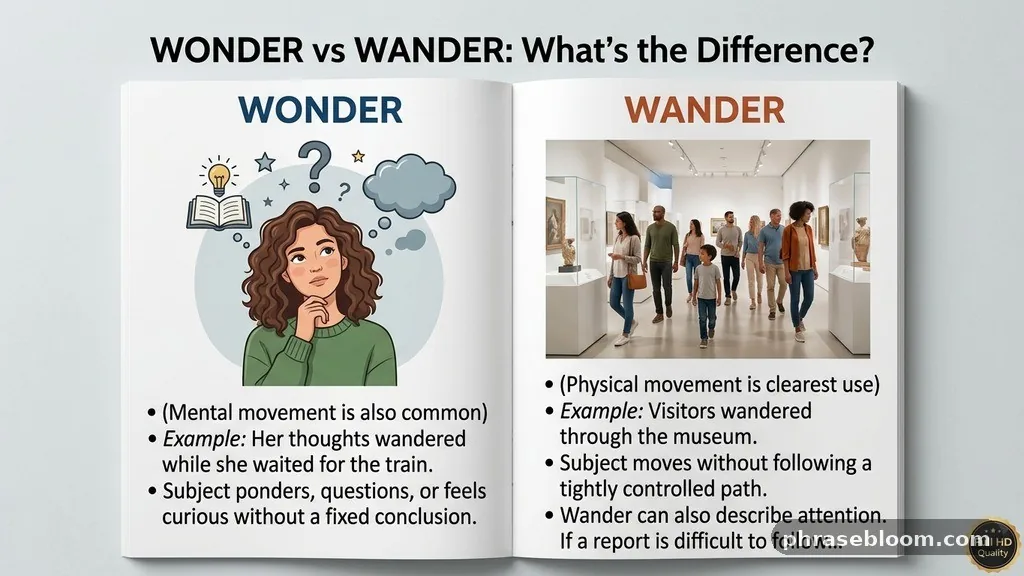
Physical movement is the clearest use: “The visitors wandered through the museum.” Mental movement is also common: “Her thoughts wandered while she waited for the train.” In both sentences, the subject moves without following a tightly controlled path.
Wander can also describe attention. If a report is difficult to follow because it shifts between unrelated subjects, a reviewer might say that the writing wanders. That criticism concerns organization, not spelling, and it is completely different from wondering about a question.
Wonder as a Verb and a Noun
Wonder as a verb usually relates to thinking, questioning, or being curious. Common structures include “I wonder why,” “I wonder whether,” “I wonder if,” and “I wonder about.” Each structure invites a question or expresses uncertainty.
- “I wonder why the delivery arrived early.”
- “She wondered whether the invitation was still valid.”
- “We’re wondering if the schedule has changed.”
- “He often wonders about the history of the building.”
In these sentences, wonder does not mean physically moving. The speaker’s mind is examining a possibility, seeking information, or considering an explanation. That mental curiosity separates wonder from wander.
Wonder as a noun can refer to an emotion, an object, or an event. “The scientist spoke with wonder about the discovery” describes an emotional reaction. “The bridge is an engineering wonder” uses wonder to describe something impressive.
The noun also appears in expressions such as “full of wonder,” “a sense of wonder,” and “no wonder.” The phrase “no wonder” means that a fact or result is understandable given the circumstances. For example, “No wonder the roads were quiet after the storm” means that the storm explains the quiet roads.
Wonder can sometimes suggest doubt rather than admiration. “I wonder whether that plan will work” is a neutral expression of uncertainty. The surrounding words and situation determine whether the feeling is curiosity, skepticism, surprise, or amazement.
Wander as a Verb and a Noun
Wander as a verb describes movement that is not tightly directed. “The dog wandered into the kitchen” means that the dog entered without a clearly stated destination. “They wandered around the downtown streets” presents the people as exploring casually rather than following a planned itinerary.
The verb can take several related forms. In the past tense, wander becomes wandered, and the present participle is wandering. The spelling keeps the “a,” which helps distinguish it from wonder in both writing and meaning.
- Present: “I wander through the park on weekends.”
- Past: “We wandered along the river.”
- Continuous: “She is wandering through the craft market.”
- Figurative: “His explanation wandered away from the main issue.”
Wander as a noun is less frequent, but it can describe an informal journey or period of walking. “After lunch, we went for a wander” is natural in some varieties of English, especially in casual speech. In more formal American English, “We went for a walk” may sound more familiar.
The word can also suggest traveling without a destination. A novelist might write that a character wandered across the country, while a travel writer might describe wandering through side streets. These examples emphasize discovery, uncertainty, or freedom from a fixed plan.
Wonder Pronunciation and Wander Pronunciation
Wonder pronunciation and wander pronunciation are similar, which explains why people sometimes confuse the words in writing. In many varieties of English, the first syllable of each word contains a short vowel sound, but the initial vowel differs enough to matter.
Wonder is commonly pronounced like “WUN-der.” Its first syllable sounds like the vowel in “sun” or “under.” Wander is commonly pronounced like “WON-der,” with a vowel closer to the sound in “on” in many accents.
Regional accents can reduce the difference. Some speakers may pronounce the vowels in a way that makes the words sound especially close, while others preserve a clearer distinction. Spelling therefore plays an important role, particularly in formal writing.
| Word | Approximate pronunciation | Sound association | Meaning |
|---|---|---|---|
| Wonder | WUN-der | Similar to “under” | Question, curiosity, or amazement |
| Wander | WON-der | Similar to “on” in many accents | Unplanned movement |
A pronunciation memory trick is to connect the opening vowel with the meaning. Wonder begins with the sound associated with “what” or “why” in your mind, while wander begins with a sound that can remind you of walking on a route.
Wonder vs Wander in Real Sentences
Context usually makes the correct choice obvious. If the sentence involves a question, uncertainty, amazement, or surprise, wonder is likely the right word. If it involves walking, roaming, drifting, or losing focus, wander is usually the correct choice.
Examples with wonder
“I wonder whether the library is open on Sundays.” Here, wonder introduces a question that the speaker has not answered. It does not mean that the speaker is walking anywhere.
“The visitors looked at the ancient sculpture in wonder.” In this example, wonder is a noun describing amazement. The visitors are impressed by what they see.
“No wonder Maya left early after working a double shift.” The phrase no wonder means that Maya’s early departure is understandable. It does not refer to curiosity or movement directly.
“The manager wondered why several customers had received the wrong invoice.” Wondered introduces a question about a past situation. The sentence belongs naturally in a workplace report or email.
Examples with wander
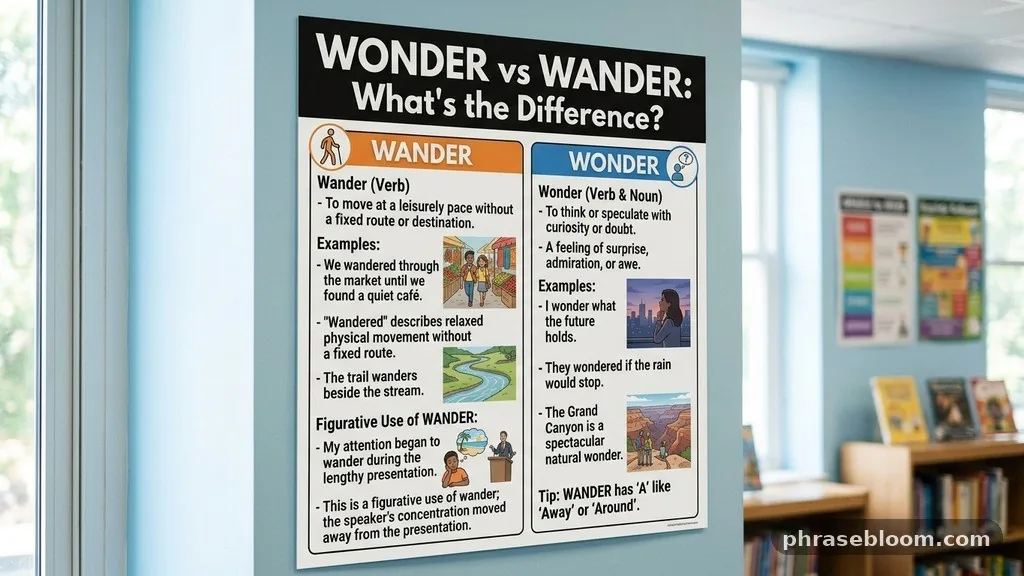
“We wandered through the market until we found a quiet café.” Wandered describes relaxed physical movement without a fixed route.
“My attention began to wander during the lengthy presentation.” This is a figurative use of wander. The speaker’s concentration moved away from the presentation.
“The trail wanders beside the river before climbing into the hills.” Here, wander describes the shape of the trail, not the behavior of a person.
“He wandered into the wrong meeting room by mistake.” The sentence suggests that he entered without carefully checking where he was going.
One common error is writing “I wandered what she meant.” The correct sentence is “I wondered what she meant,” because the speaker is asking mentally rather than moving physically.
Common Phrases and Collocations
Learning common word combinations can make the difference between wonder and wander easier to remember. Wonder often appears near question words, while wander frequently appears near places, paths, streets, and descriptions of attention.
| Expression | Meaning | Example |
|---|---|---|
| wonder why | Question the reason | I wonder why the meeting was canceled. |
| wonder if | Consider a possibility | She wondered if the train had left. |
| a sense of wonder | A feeling of amazement | The exhibit gave children a sense of wonder. |
| wander through | Move casually around a place | They wandered through the historic district. |
| wander off | Move away from a person or place | The toddler wandered off toward the garden. |
| mind wanders | Attention loses focus | My mind wanders when I’m tired. |
The phrase “wonder about” normally introduces a subject of thought. “I wonder about the future of the project” expresses curiosity or concern. By contrast, “wander about” means to move around without a definite purpose, as in “The tourists wandered about the village.”
These collocations are useful because they show grammar and meaning working together. If the following word is “why,” “whether,” or “if,” wonder is probably needed. If the following phrase names a street, park, building, or path, wander may be the better choice.
Why the Confusion Happens
The confusion exists mainly because wonder and wander are short, closely related-looking words with similar pronunciation. Both begin with “w” and end with “-nder,” so a rushed speaker or writer can easily substitute one for the other.
The words also appear in similar sentence positions. Both can function as verbs, and both can be followed by additional phrases. “I wonder about the result” and “I wander about the room” have nearly identical grammatical shapes, even though their meanings are completely different.
Spelling mistakes often occur when people rely only on sound. This is especially likely in phrases such as “I wonder what happened,” where a writer may remember the pronunciation but not the vowel. Reading the sentence for meaning is more reliable than choosing the word by sound alone.
Another source of confusion is figurative language. Wander can describe thoughts, while wonder can describe a reaction to an idea or sight. Because both words can relate to the mind, their meanings may seem closer than they really are.
- If the subject is asking internally, choose wonder.
- If the subject is amazed, choose wonder.
- If the subject moves without a clear route, choose wander.
- If attention loses focus, choose wander.
- If the sentence describes a remarkable thing, choose wonder as a noun.
When editing, ask one practical question: is the word connected to a question or amazement, or is it connected to movement or drifting? That test resolves most cases quickly.
Word Forms, Grammar, and Related Expressions
Wonder and wander follow different grammatical patterns. Wonder as a verb often takes an indirect question, such as “She wonders where the keys are.” Wander as a verb often takes a preposition connected to location, such as “They wandered around the plaza.”
Wonder can be transitive in some constructions, although it is commonly followed by a clause or prepositional phrase. “I wonder the reason” is not standard natural English for most contexts; “I wonder about the reason” or “I wonder why” is clearer.
Wander can be followed by “through,” “around,” “across,” “along,” or “into.” Each preposition adds a slightly different picture. “Wander through the woods” suggests movement inside an area, while “wander into the office” suggests entering a place, perhaps unexpectedly.
The adjective wondrous means remarkable or inspiring wonder. The adjective wonderful commonly means excellent, pleasing, or impressive. Wander has related forms such as wandering and wanderer, the latter referring to a person who travels or moves without a fixed destination.
Do not create the form wonderer when you mean a person who wanders. A person who wanders is a wanderer. A person who wonders might be described as curious, questioning, or thoughtful instead.
The expressions “wondering” and “wandering” are particularly easy to confuse. “I’m wondering where the bus is” describes uncertainty. “I’m wandering near the bus station” describes physical movement.
Practical Ways to Remember the Difference
The simplest memory device is the question-versus-motion test. If you can replace the word with “ask myself” or “feel amazement,” use wonder. If you can replace it with “roam,” “walk aimlessly,” or “move without a destination,” use wander.
Visual associations can help too. Imagine a question mark floating above your head for wonder.
Imagine footsteps leading along an uncertain path for wander. These images connect each spelling with its central meaning.
- Wonder: What? Why? How? Amazing!
- Wander: Where? Around? Along? Away from the path?
Try testing the sentence “I ___ what happened.” The correct answer is wonder because the speaker wants information. Now test “We ___ through the old streets.” The correct answer is wandered because the group moved through the streets without a tightly planned route.
Another useful technique is to examine the tense. “I wondered whether he had called” still concerns a question. “I wandered around the house” still concerns movement. Changing the verb form does not change the central distinction.
In proofreading, highlight every appearance of wonder, wander, wondering, and wandering. Read the surrounding sentence and identify the underlying idea. This quick check is particularly useful in essays, personal statements, travel writing, and narrative fiction.
Wonder and Wander in Formal and Creative Writing
Both words are appropriate in formal writing, but they do different jobs. Wonder is useful in research discussions, reports, and reflective writing when an author describes uncertainty or a striking result. Wander is useful when a report describes movement or when a writer criticizes an unfocused argument.
In an academic essay, “The findings raise questions about how memory develops” is often more direct than “The findings make us wonder how memory develops.” Both can be grammatical, but the first version has a more formal tone. In reflective or literary writing, however, wonder may be exactly the right choice.
Business writing uses wonder in polite requests. “I was wondering whether you could review the attached draft” is a conventional way to make a request. It sounds less forceful than “Review the attached draft,” though the writer should still make the requested action clear.
Wander can describe poor structure in formal writing. A reviewer might say, “The discussion wanders into unrelated examples.” A more direct revision would be, “The discussion includes several examples that do not support the main argument.”
Creative writing often benefits from the full emotional range of both words. A character may wander through an unfamiliar town while wondering whether to return home. The contrast lets the writer show physical movement and inner thought at the same time.
Choose the word for the action or feeling you actually mean. Formality does not change the definitions, although formal writing may favor more direct alternatives in some sentences.
Examples Readers Can Copy and Adapt
The following examples show how each word works in common situations. They can be adapted for school assignments, workplace messages, personal writing, or everyday conversation.
Examples using wonder
- “I wonder whether the revised deadline applies to our department.”
- “The young visitors watched the demonstration in wonder.”
- “She wondered why the automatic reminder had not been sent.”
- “No wonder the support team received so many calls after the update.”
- “The scale of the festival filled the first-time visitors with wonder.”
- “I’m wondering if you have a few minutes to discuss the proposal.”
Examples using wander
- “We wandered along the waterfront after the conference ended.”
- “The child wandered away from the picnic table but stayed within sight.”
- “My thoughts tend to wander when I read late at night.”
- “The report begins clearly but wanders during its final section.”
- “The narrow road wanders through the hills before reaching the village.”
- “They spent the afternoon wandering around the book fair.”
Compare these two sentences: “I wonder where the guide went” and “I wandered where the guide had gone.” The first sentence is standard because it expresses a question. The second would normally be incorrect if the intended meaning is uncertainty, because wander does not introduce that kind of question.
Now compare “The tourists wondered through the museum” with “The tourists wandered through the museum.” The second sentence is correct because it describes movement through the museum. The first would suggest that the tourists questioned their way through the building, which is not the intended meaning.
Frequently Asked Questions
What is the difference between wonder and wander?
Wonder refers to curiosity, questioning, or amazement. Wander refers to moving without a fixed direction, although it can also describe thoughts or attention that lose focus.
Is wonder a verb or a noun?
Wonder can be both. As a verb, it means to think about something with curiosity, as in “I wonder what happened.” As a noun, it means amazement or something remarkable, as in “The discovery was a wonder.”
Is wander only used for physical movement?
No. Wander commonly describes physical movement, but it can also describe mental or conversational drift. “My mind wandered” and “The discussion wandered from the main issue” are standard figurative uses.
How can I remember which word to use?
Use wonder for questions and amazement. Use wander for roaming, walking without a destination, or losing focus. The shortcut is “wonder with the mind, wander with the feet.”
Are wonder and wander pronounced differently?
They are commonly pronounced differently, although regional accents may make them sound close. Wonder is often pronounced “WUN-der,” while wander is often pronounced “WON-der.”
Conclusion
The practical lesson from Wonder vs Wander is clear: choose wonder for curiosity, questions, surprise, or amazement, and choose wander for unplanned movement or drifting attention. Their similar spelling and pronunciation cause confusion, but the meanings separate them reliably.
Before submitting an email, essay, or story, replace the word with “ask myself” or “roam” to test your choice. If the sentence still feels uncertain, read it aloud and check whether the subject is thinking or moving. That small habit will make Wonder vs Wander much easier to handle.
Related: City vs Town vs Village · A Chip Off the Old Block · Dog and Pony Show Meaning
4 thoughts on “Wonder vs Wander: Meaning, Difference and Usage”