
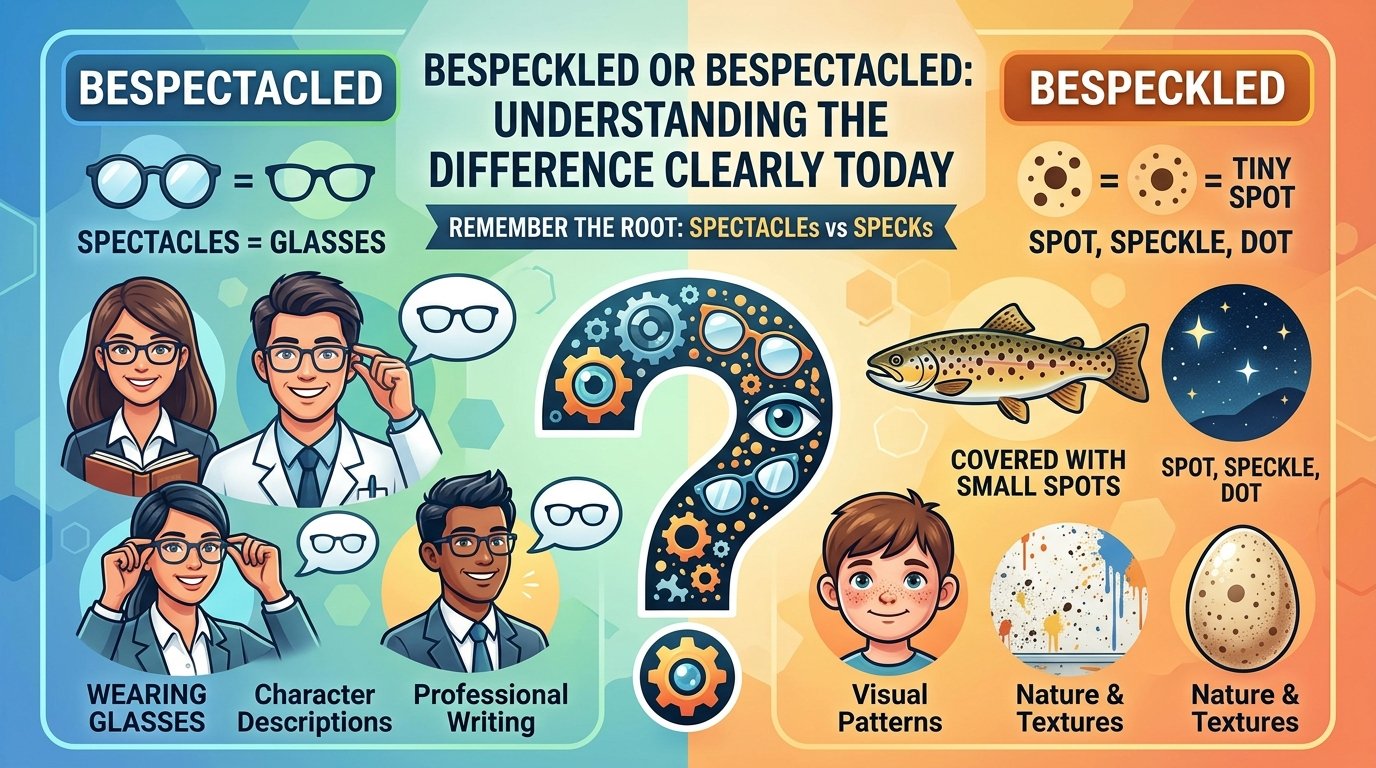
The words bespeckled or bespectacled are easy to confuse. They look almost the same, share the prefix “be-,” and contain similar letters. However, their meanings are completely different.
Bespectacled describes someone who is wearing eyeglasses, while bespeckled describes something covered with small spots, specks, or flecks.
That small difference matters. Calling a person “bespeckled” instead of “bespectacled” can change the image your sentence creates. Likewise, saying that a sky is “bespectacled” when you mean it is covered with stars is incorrect.
This guide explains the difference between bespeckled and bespectacled, including their definitions, origins, spelling, usage, common mistakes, and practical examples.
Bespeckled or Bespectacled: Why Does the Confusion Exist?
The confusion exists mainly because the two words have almost identical structures.
Both begin with “be-,” and both end with a similar-looking form. When reading quickly, it is easy to overlook the important middle sections: SPECT and SPECK.
Consider the roots:
- Bespectacled → spectacles → glasses or eyeglasses
- Bespeckled → speck → a tiny spot or mark
This distinction provides a simple memory trick.
Think of besPECTacled as being connected to SPECTacles. If the subject is a person wearing glasses, this is the correct word.
On the other hand, besPECKled contains SPECK, meaning a tiny dot or mark. If something is covered with little spots, specks, or flecks, “bespeckled” is appropriate.
See Also: Is It Correct to Say Well Wishes? A Clear Guide to Proper Usage
Why It Matters in Professional Settings
Correct word choice becomes especially important in professional and formal writing. A journalist describing a scientist, for example, may use bespectacled to provide a concise description of the person’s appearance.
Similarly, an author may describe an old painting as bespeckled with dust. The words help readers create a precise mental picture.
Using the wrong term can make professional writing confusing or unintentionally humorous. Therefore, understanding the correct usage of these commonly confused words is useful for writers, editors, students, journalists, and anyone who wants accurate English.
Bespeckled or Bespectacled: Which One Is Correct?
Both words are correct, but they are correct in different situations.
Use bespectacled when you are describing a person who wears glasses or eyeglasses.
For example:
The bespectacled professor entered the lecture hall.
Here, the professor is wearing spectacles.
Use bespeckled when something is covered with small spots, specks, dots, or flecks.
For example:
The old canvas was bespeckled with dried paint.
Here, the canvas has many small marks.
The easiest way to choose is to identify the thing being described. If it is a person wearing glasses, choose bespectacled. If it is an object, animal, surface, landscape, or scene marked with tiny spots, choose bespeckled.
What Does “Bespeckled or Bespectacled” Mean? Origins, Definition, and Usage
Although the two adjectives look similar, they come from different root words.
Their meanings become much easier to understand when you examine those roots.
Definition of Bespeckled or Bespectacled
Bespectacled is an adjective meaning wearing eyeglasses or spectacles. It usually describes a person.
For example:
The bespectacled librarian recommended several novels.
The word can be useful when “wearing glasses” sounds repetitive or when a writer wants a more literary or descriptive expression.
Bespeckled is also an adjective, but it means covered or marked with many small spots, specks, dots, or flecks.
For example:
The trout had a bespeckled back.
The word can describe animals, surfaces, objects, skies, clothing, and other things with visible markings.
Origins of the Words “Bespeckled” and “Bespectacled”
The history of each word explains the difference.
Bespectacled comes from spectacles, an older and formal term for glasses. The word “spectacle” is connected to the Latin root spectare, meaning “to look” or “watch.” This same family includes words such as spectacular, although “spectacular” has a completely different modern meaning.
The prefix “be-” can indicate being provided or furnished with something. Thus, “bespectacled” developed as a way to describe someone furnished with or wearing spectacles.
Bespeckled, meanwhile, comes from speckle. A speck is a very small spot, dot, or mark. To speckle something means to mark or cover it with such spots.
Therefore, their etymology gives you a reliable way to separate them: spectacles relate to glasses, while specks relate to spots.
Why Bespeckled Is a Common Misspelling
People sometimes use “bespeckled” when they mean “bespectacled” because the words look and sound similar.
The confusion becomes stronger when someone remembers only the first and last parts of the word. Both contain “be-” and have similar endings, so the eye can easily skip the middle.
Another reason is that “spectacles” is less common in everyday American English than “glasses.” Someone may know that a person wears glasses without immediately connecting glasses with the word “spectacles.”
The solution is simple: remember the middle.
SPECT = spectacles = glasses.
SPECK = tiny spot.
See Also: Any Problem or Any Problems: Understanding the Difference
Exploring the Significance of Bespeckled and Bespectacled in Descriptive Language
These words are especially useful in descriptive writing because they communicate visual information efficiently.
Instead of writing “the man who was wearing glasses,” an author can write “the bespectacled man.” The adjective immediately gives the reader a physical detail.
Likewise, instead of saying “the surface had many tiny spots,” a writer can say that the surface was “bespeckled.”
This makes both words valuable in fiction, journalism, biography, formal writing, and literary description.
Role of Bespectacled in Professional and Literary Writing
Bespectacled is often used in character descriptions.
A writer might introduce:
A bespectacled editor carefully reviewed the manuscript.
The adjective adds a visual detail without requiring a longer explanation.
It can also appear in journalistic profiles:
The bespectacled scientist accepted the award.
In these contexts, the word is more descriptive than simply saying “wearing glasses.”
Role of Bespeckled in Descriptive Writing
Bespeckled is useful when describing visual patterns.
Writers may describe a bespeckled sky, bespeckled trout, bespeckled hen, or bespeckled surface.
For instance:
The clear night sky was bespeckled with stars.
The word suggests numerous small points scattered across a larger area.
Related words include speckle, speck, spotted, freckled, dappled, and stippled. However, these words are not always perfect substitutes because their visual effects can differ.
Common Reasons for the Bespeckled or Bespectacled Misspelling
Several habits can lead to mistakes with these words.
First, both words have similar spelling patterns. Second, “spectacles” is not as common in casual conversation as “glasses.” Third, readers may focus on the beginning of the word instead of its root.
Another problem occurs when writers depend entirely on sound rather than meaning. Because the words are visually and phonetically similar, pronunciation alone may not always prevent confusion.
The best strategy is to connect each word with a mental image.
For bespectacled, imagine a person wearing eyeglasses.
For bespeckled, imagine an object covered in tiny dots.
This method makes the distinction easier to remember than memorizing two dictionary definitions.
Side-by-Side Comparison: Bespeckled vs Bespectacled
| Feature | Bespectacled | Bespeckled |
|---|---|---|
| Meaning | Wearing eyeglasses | Covered with small spots |
| Part of speech | Adjective | Adjective |
| Root word | Spectacles | Speckle |
| Main subject | Usually people | Objects, surfaces, animals, scenes |
| Related words | Glasses, spectacles, lenses, frames | Specks, spots, flecks, dots |
| Common context | Character descriptions, journalism | Nature, surfaces, textures |
| Example | A bespectacled teacher | A bespeckled egg |
The table reveals the main distinction: bespectacled concerns glasses, while bespeckled concerns spots.
That is the central rule to remember.
Everyday Examples of Bespeckled and Bespectacled in Language
Seeing both words in context makes their meanings clearer.
A few examples of bespectacled include:
The bespectacled teacher adjusted her frames.
A bespectacled scientist spoke to the reporters.
The novel’s hero was a quiet, bespectacled boy.
The bespectacled librarian helped me find the book.
These examples all describe people wearing glasses.
Now consider bespeckled:
The farmer noticed a bespeckled egg in the nest.
The trout’s back was bespeckled with dark brown spots.
The old jacket was bespeckled with dried mud.
The night sky was bespeckled with thousands of stars.
These examples describe things covered with small marks.
Notice that “bespeckled” can describe an animal even when the animal is not literally a surface. The important idea is the presence of scattered spots or markings.
“How to spell bespeckled or bespectacled”: Remember the Correct Spelling
If you are searching for how to spell “bespeckled or bespectacled”, focus on the middle of each word rather than trying to memorize the complete forms separately.
Bespectacled contains “spectacles.”
Bespeckled contains “speck.”
A useful memory sentence is:
SPECTacles go with glasses; SPECK goes with spots.
The spelling also tells you the meaning.
If you see “SPECT,” think of spectacles and eyeglasses.
If you see “SPECK,” think of tiny dots, flecks, or marks.
Practice Sentences
Try identifying which word belongs in each sentence.
The ______ professor walked into the classroom.
The answer is bespectacled, because the professor is wearing glasses.
The old wall was ______ with paint.
The answer is bespeckled, because the wall is covered with small marks.
The ______ librarian searched through the shelves.
The answer is bespectacled.
The bird had a ______ chest.
The answer is bespeckled, assuming the chest was covered with small spots.
Practicing with context is more effective than simply repeating the spellings. Once you connect each word with its meaning, the spelling becomes easier to remember.
Literature and Media Mentions: Correct Usage of Bespeckled and Bespectacled
Both adjectives work particularly well in literature because writers often need concise ways to describe appearance and visual details.
Bespectacled can quickly establish a character’s appearance. A reader can immediately imagine someone wearing spectacles without the author needing a longer description.
Meanwhile, bespeckled adds visual texture. A writer describing a landscape, animal, old painting, or starry sky can use the word to suggest many scattered marks.
This is why the words often appear in literary and journalistic writing rather than casual conversation.
Their value comes from precision. Instead of giving a broad description, each adjective supplies a specific visual clue.
Frequently Asked Questions about Bespeckled or Bespectacled
What’s the correct way to spell “bespeckled or bespectacled”?
Both spellings are correct. Use bespectacled for someone wearing glasses and bespeckled for something covered with small spots.
Is “bespeckled” a French word?
No. Bespeckled is an English word formed from “speckle,” meaning a small spot or mark, with the prefix “be-.”
Why is spelling “bespeckled or bespectacled” correctly important?
Correct spelling preserves meaning. Confusing these words can make readers think you mean glasses when you actually mean spots, or vice versa.
Can bespeckled describe a person?
Yes, if the person has noticeable spots or markings. However, bespectacled is the appropriate word when you mean that the person wears glasses.
Is bespectacled formal English?
Yes. Bespectacled is a standard adjective and often sounds more literary, formal, or descriptive than simply saying “wearing glasses.”
Conclusion: Why It’s Important to Spell “Bespeckled or Bespectacled” Correctly
Bespeckled and bespectacled may look nearly identical, but their meanings are entirely different. Bespectacled describes a person wearing glasses or spectacles, while bespeckled describes something covered with small spots, specks, or flecks. The easiest way to remember them is to focus on their roots: SPECT connects to spectacles, while SPECK connects to tiny spots. Once you understand that distinction, choosing the right word becomes simple. Whether you are writing an essay, article, story, or professional description, using the correct adjective makes your meaning clearer and your writing more precise.
1 thought on “Bespeckled or Bespectacled: Understanding the Difference Clearly Today”