
Choosing between Team That, Team Who, or Team Which can seem confusing, especially because the word “team” is a collective noun. A team can describe one unit, but it can also refer to several people working together.
The good news is that the choice becomes much easier when you understand the role of the relative pronoun, the type of relative clause, and the meaning you want to express.
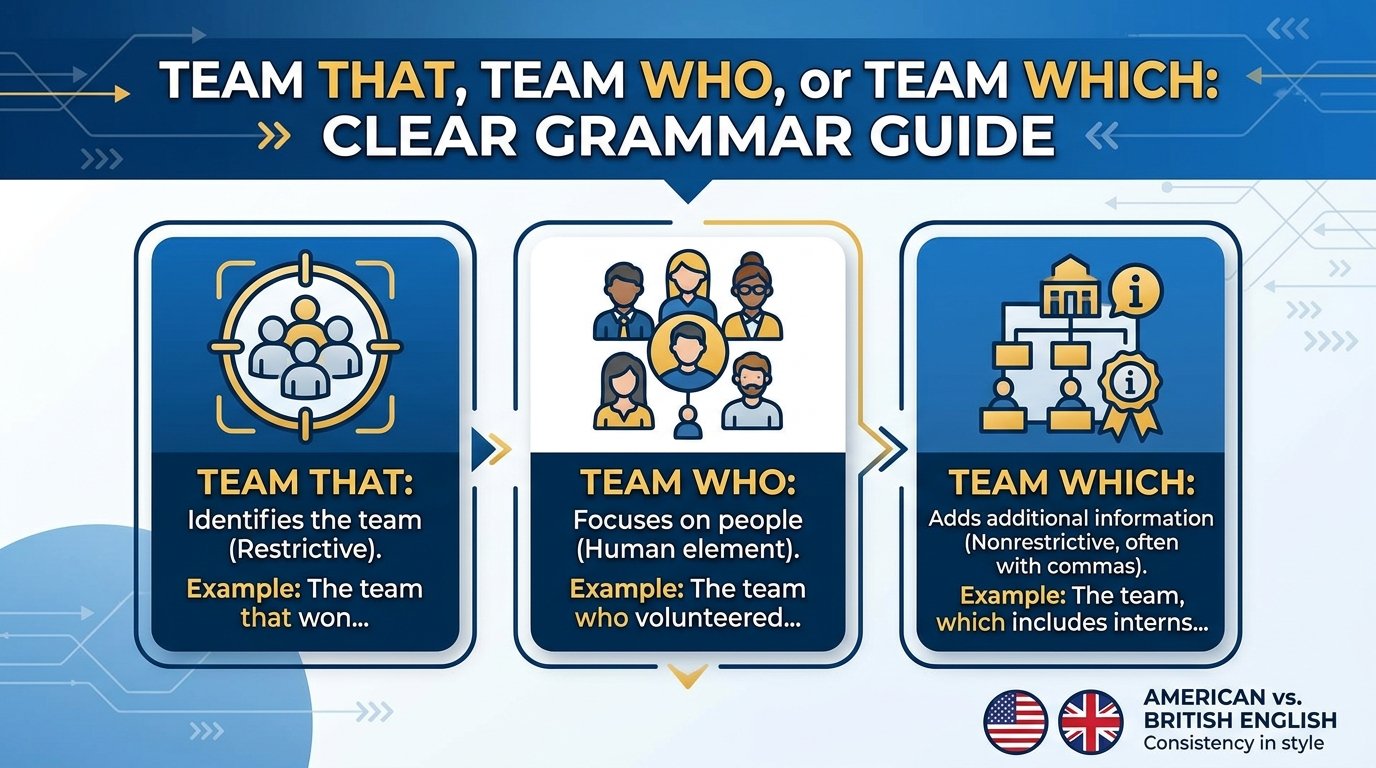
In simple terms, team that usually works well when the clause identifies a particular team. Team who can work when the focus is on the people within the team. Team which is commonly used when the clause gives additional information about the team as an entity.
This guide explains the differences, gives practical examples, and shows how American and British English handle collective nouns, verbs, and pronouns.
Team That, Team Who, or Team Which: Why Does the Confusion Exist?

The confusion exists because “team” can represent both an organization and a group of people.
Consider these three examples:
- The team that won the match celebrated.
- The team who volunteered received recognition.
- The team, which includes five designers, works remotely.
All three sentences can communicate a legitimate idea. However, the relative pronoun changes the relationship between “team” and the information that follows it.
The word that is especially common in restrictive clauses. It helps identify exactly which team the writer means.
The word who traditionally refers to people. Therefore, writers may use it when they want to emphasize individual team members rather than the team as an abstract unit.
Meanwhile, which is commonly used for things, organizations, and entities, particularly in nonrestrictive clauses.
See Also: Looking Forward to Working With You: Meaning, Grammar & Usage
Why It Matters in Professional Settings
Professional writing depends on clarity. A small difference in pronoun choice can change how readers understand a sentence.
For example:
The team that completed the project received a bonus.
Here, “that completed the project” identifies the team. The information is essential to the meaning.
Now consider:
The team, which completed the project early, received a bonus.
The main sentence already identifies the team. The information about completing the project early is additional information.
In business writing, reports, academic work, and technical documentation, this distinction helps prevent ambiguity.
Writers should also consider register and tone. “Who” may sound more human and conversational, while “that” or “which” may sound more neutral when the team is treated as an entity.
Team That, Team Who, or Team Which: Which One Is Correct?
There is no single answer that makes one option correct in every sentence. The correct choice depends on context.
Use team that when the following clause is essential to identify the team:
The team that won the competition will represent the company.
Use team who when you intentionally emphasize the people who make up the team:
The team who volunteered at the shelter deserves recognition.
For maximum clarity, you can instead write:
The team members who volunteered at the shelter deserve recognition.
Use team which when “which” introduces additional information, especially when commas separate the clause:
The team, which includes six engineers, presented the design.
This difference is closely connected to restrictive relative clause and nonrestrictive relative clause grammar.
A restrictive clause narrows the meaning. A nonrestrictive clause adds information without defining the noun.
A Quick Comparison
| Expression | Typical use | Example |
|---|---|---|
| Team that | Restrictive information | The team that won advanced. |
| Team who | Human emphasis | The team who volunteered helped. |
| Team which | Additional information | The team, which includes interns, met today. |
When you compare Team That vs Team Who vs Team Which, remember that punctuation and meaning matter more than simply memorizing one rule.
What Does “Team” Mean? Origins, Definition, and Usage
The word “team” is a noun that describes a group of people or animals working together toward a shared purpose.
Today, it is commonly used in sports, workplaces, schools, technology, business, and many other areas.
The meaning can shift slightly depending on context. In one sentence, “team” may represent an organization as a single unit. In another, it may emphasize the individual people within that group.
Definition of Team
A team is a group of individuals who cooperate to achieve a common goal.
For example:
Our team completed the assignment.
Here, “team” functions as a singular collective noun in standard American English.
However, the sentence can also be understood as referring to several people collectively.
That distinction becomes important when choosing a singular verb or plural verb.
Origins of the Word “Team”
The word “team” has a long history in English. It originally referred to a group of animals used together for pulling or carrying something.
Over time, its meaning expanded to include groups of people working together.
That development explains why “team” can naturally describe both a collection of individuals and a single organized unit.
See Also: Soo vs So: Understanding the Difference and Correct English Usage
Why Team Grammar Can Be Confusing
The main difficulty comes from the difference between grammatical form and real-world meaning.
A team contains several people, but the noun itself can function as singular.
For example:
The team is ready.
Here, the team is treated as one unit.
In another context, especially British English, a writer may say:
The team are preparing for their meeting.
The writer is emphasizing the individual members.
Therefore, subject–verb agreement depends partly on the English variety and the intended meaning.
Exploring the Significance of Team That, Team Who, or Team Which in Writing
The choice between these forms is not simply a matter of spelling. It affects sentence structure, emphasis, punctuation, and clarity.
A writer who understands these differences can create smoother and more professional sentences.
Role of a Relative Pronoun in a Sentence
A relative pronoun connects a noun to additional information.
Common relative pronouns include “that,” “who,” and “which.”
For example:
The team that won the award celebrated.
The clause “that won the award” provides information about “team.”
Similarly:
The team who trained all weekend showed dedication.
Here, “who trained all weekend” emphasizes the people associated with the team.
Finally:
The team, which consists of six engineers, presented the proposal.
The “which” clause provides extra information.
Understanding the antecedent is also important. The antecedent is the noun that the relative pronoun refers back to. In these examples, “team” is the antecedent.
Common Reasons for the Team Who, Team That, or Team Which Confusion
Several common mistakes cause writers to hesitate between these forms.
One frequent problem is using “who” automatically because a team contains people. Although that can work in contexts where the people are being emphasized, formal writing may benefit from a clearer construction.
For example:
The software team who launched the product was praised.
This can feel awkward because it is unclear whether “who” refers to the team itself or its individual members.
A clearer version is:
The software team that launched the product was praised.
Or, if the individuals are important:
The software team members who launched the product were praised.
Another common mistake involves commas.
Compare:
The team that is based in Berlin will arrive Monday.
with:
The team, which is based in Berlin, will arrive Monday.
The first sentence uses a restrictive clause. The second uses a nonrestrictive clause.
Do not add commas simply because “which” appears. Instead, decide whether the information is essential.
Side-by-Side Comparison: Team That, Team Who, or Team Which
The following comparison makes the distinction easier to remember:
| Feature | Team That | Team Who | Team Which |
|---|---|---|---|
| Main focus | Identifying the team | Highlighting people | Describing the team |
| Common clause | Restrictive | Usually human-focused | Nonrestrictive |
| Commas | Usually no | Depends on clause | Usually yes for nonrestrictive use |
| Refers to | Team as a unit | Team members | Team as an entity |
| Formality | Neutral | More personal | Formal/neutral |
| Example | The team that won | The team who volunteered | The team, which won |
The key is not to treat these as absolute rules. Grammar rules work together with context, style, and meaning.
American English vs. British English
Another reason writers become confused is the difference between American and British English.
American English generally treats collective nouns such as “team” as singular:
The team is preparing its presentation.
British English is more flexible and often uses plural agreement when the members are acting individually:
The team are preparing their presentation.
Neither approach should be mixed randomly within the same piece.
Choose a consistent house style, particularly in professional documents.
For global audiences, the American singular approach often feels straightforward:
The team is meeting today.
However, British editorial conventions may allow:
The team are meeting today.
The important principle is consistency.
Everyday Examples of Team That, Team Who, or Team Which
Seeing these forms in realistic sentences makes the rule easier to remember.
Restrictive use:
The team that completed the assignment received a certificate.
The clause identifies which team received the certificate.
Human-focused use:
The team who worked overnight deserves special recognition.
The writer is emphasizing the people.
For greater grammatical clarity, the sentence could become:
The team members who worked overnight deserve special recognition.
Nonrestrictive use:
The team, which includes several experienced developers, completed the project.
The clause adds information but does not identify the team.
Other examples include:
We hired the team that delivered the best proposal.
The team members who attended the workshop received certificates.
Our design team, which works remotely, meets every Friday.
Team Alpha, which has five members, reported progress.
These examples show how sentence structure, context, and modifier placement influence the best choice.
How to spell “Team That, Team Who, or Team Which” and Remember the Correct Usage
The phrase how to spell “Team That, Team Who, or Team Which” may appear in searches, but the real issue is usually not spelling. These expressions are spelled exactly as shown.
The challenge is choosing the correct form for the sentence.
A useful editing method is to ask one simple question:
Does the clause identify the team, describe the people, or add extra information?
If it identifies the team, “that” is usually a strong choice.
If it focuses on people, “who” may be appropriate.
If it adds extra information about the team, “which” with commas is often appropriate.
Practice Sentences
Try these examples:
The team that won the grant will lead the study.
Here, the clause identifies the team.
The team members who volunteered will lead the sessions.
Here, “who” clearly refers to people.
The team, which includes two interns, will present tomorrow.
Here, “which” introduces additional information.
A useful quick test is to remove the relative clause.
If removing it changes which team you mean, the clause is probably restrictive.
If the sentence still identifies the same team without the clause, the information is probably nonrestrictive.
Common Editing Tips for Better Grammar
Good editing can eliminate most confusion.
First, keep modifiers close to the words they modify.
Instead of:
The team that closed the deal yesterday members celebrated.
Write:
The members of the team that closed the deal yesterday celebrated.
Second, use active voice where possible:
The team that designed the prototype presented it.
This is generally clearer than:
The prototype was presented by the team that designed it.
Third, use “team members” when you want to remove collective-noun ambiguity completely.
For example:
Team members who volunteer receive credit.
This makes the antecedent of “who” unmistakably human.
Finally, check your document for consistency. In long content, search for “team who,” “team that,” and “team which.” Review each occurrence instead of replacing every instance automatically.
Literature and Media Mentions: Correct Usage of Team
Teams appear frequently in sports writing, novels, journalism, business communication, films, and television.
Sports writing often treats teams as single units:
The team that won the final celebrated throughout the city.
Narrative writing may use “who” to emphasize human characters:
The team who refused to surrender inspired everyone.
Corporate writing generally favors clarity:
The team that developed the software will maintain it.
Meanwhile, descriptive writing may use “which”:
The team, which had been assembled only months earlier, achieved remarkable results.
The intended tone should guide the choice. Personification can make writing warmer, but it should be used deliberately in formal documentation.
Frequently Asked Questions about Team That, Team Who, or Team Which
What’s the correct way to use “team that”?
Use “team that” when a restrictive clause identifies which team you mean. Usually, no commas surround the clause.
Can I use “team who” in formal writing?
Yes. Use “team who” when emphasizing people. For maximum clarity, however, “team members who” clearly identifies individual members.
When should I use “team which”?
Use “team which” mainly when “which” introduces additional information about the team. In formal nonrestrictive usage, commas normally surround the clause.
Is “team who” grammatically wrong?
No. “Team who” can be grammatical when the team is viewed through its people. Context, style, and intended emphasis determine whether it sounds appropriate.
Should I write “team is” or “team are”?
American English generally uses “team is,” while British English may use “team are” when members act individually. Follow one convention consistently.
Conclusion: Why Choosing the Right Team Form Matters
Choosing between team that, team who, and team which depends on meaning, clause type, and writing style. Use that when a clause identifies a particular team, who when you want to emphasize human members, and which when adding extra information about a team as an entity. Commas also matter because they help distinguish restrictive from nonrestrictive clauses. American English usually treats team as singular, while British English allows plural agreement more often. When uncertainty remains, rewriting with “team members who” can make your meaning immediately clear. Understanding these patterns improves grammar, readability, professional tone, and consistency across everyday and formal writing.
Related: Restrictive Modifier
2 thoughts on “Team That, Team Who, or Team Which”