
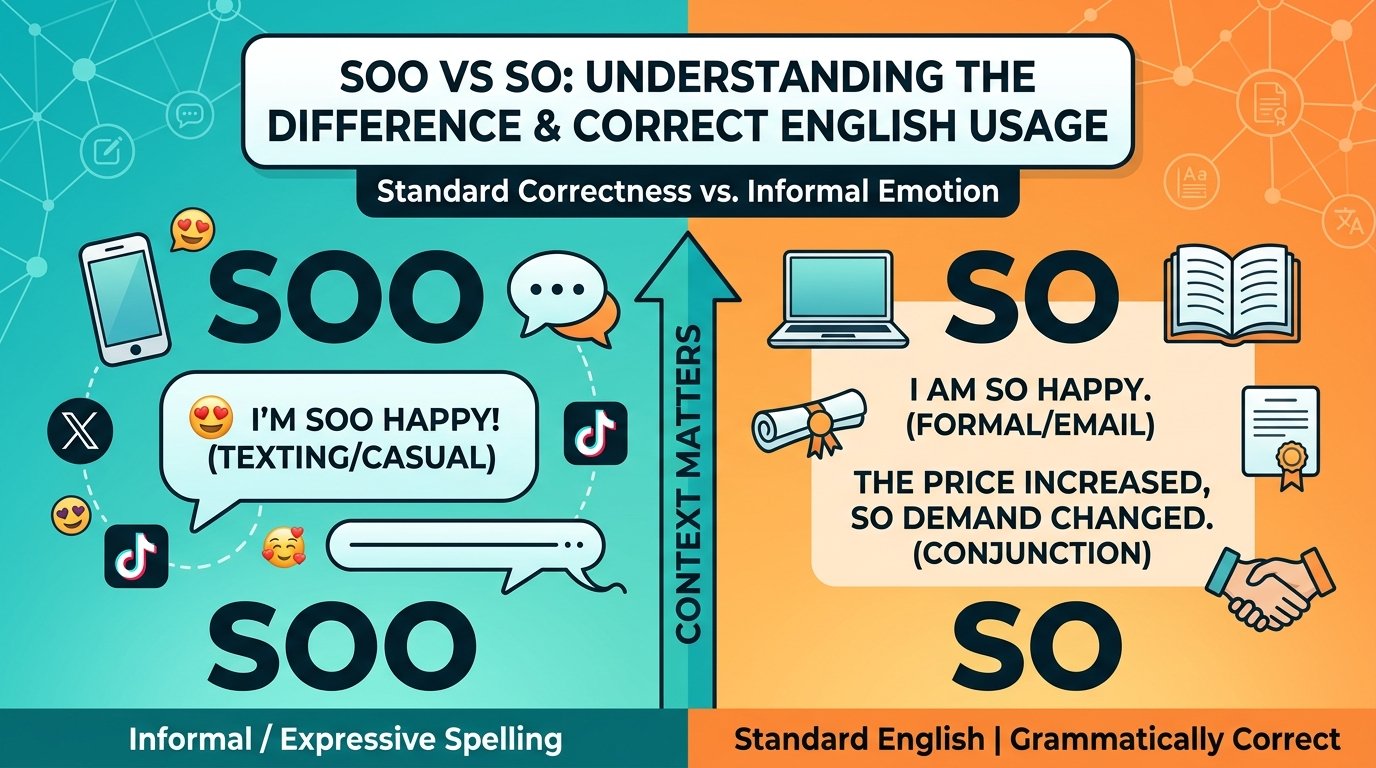
Soo vs So can look like a tiny spelling issue, but it can create real confusion in everyday English. You may see someone write, “I’m soo happy,” and wonder whether “soo” is simply another spelling of “so.”
The answer is straightforward: so is the standard English word, while soo is generally an informal spelling used to add emotion, exaggeration, or personality in casual digital communication.
That distinction becomes especially important when you move from texting to emails, essays, reports, exams, or professional writing.
This guide explains the difference between (Soo) and (So), shows how each form appears in real communication, and explains why people use extra letters even though standard grammar does not require them.
Soo vs So: Why Does the Confusion Exist?
The confusion mainly comes from digital communication, where people often write the way they speak rather than following formal grammar rules.
When someone says “so” with extra emphasis, the vowel may sound longer. In writing, people sometimes represent that stretched pronunciation by adding letters:
“So” can become “soo,” “sooo,” or even “soooo.”
This is not a new grammatical rule. Instead, it is an example of informal spelling or expressive writing.
Texting, social media, memes, and casual chats have made this style extremely common. Therefore, readers regularly encounter phrases such as “I’m soo excited” or “That was soo cute.”
Although these forms are understandable, frequency does not automatically make them standard English.
Why It Matters in Professional Settings
The distinction between standard and informal language matters most when formal writing is involved.
In an email to a manager, an academic assignment, a business report, or a job application, standard English is expected. Writing “I’m soo excited about this opportunity” may make the message appear careless, even though the meaning is obvious.
Professional readers often assocate accurate word choice, spelling, and grammar with attention to detail.
Consequently, using so instead of “soo” helps maintain professional credibility, clarity, and a polished professional image.
See Also: Invision or Envision: Understanding the Difference and Correct Usage Today
Soo vs So: Which One Is Correct?
If you are asking which form is correct in standard English, the answer is so.
The word so is a recognized English word with several grammatical functions. It can work as an adverb, a conjunction, and an intensifier.
“Soo,” on the other hand, is generally not treated as a standard alternative spelling of “so.” It is primarily an informal variation that appears in texting, social media, and other relaxed settings.
So, if you are wondering is it (Soo) or (So), choose so when correctness matters.
For example:
- I am so tired. ✓
- She is so kind. ✓
- The movie was so interesting. ✓
- I studied hard, so I passed. ✓
In contrast:
- I am soo tired. ✗ in standard formal English
- She is soo kind. ✗ in standard formal English
- The movie was soo interesting. ✗ in standard formal English
The informal versions may be perfectly understandable in a message between friends, but they do not replace the standard form.
What Does “So” Mean? Origins, Definition, and Usage
Understanding what so actually does makes the difference much easier to remember.
The word has been part of English for a very long time and has developed several related functions. Today, it is one of the most flexible and frequently used words in the language.
Definition of “So”
As an adverb, so can indicate degree or intensity.
Consider these examples:
- She is so talented.
- The coffee is so hot.
- I am so grateful.
- That book was so interesting.
Here, so tells us how strongly a quality applies.
It can also function as an intensifier, adding emphasis to an adjective or adverb.
For example, “I’m so happy” communicates stronger emotion than simply “I’m happy.”
Another important function appears when so acts as a conjunction.
For instance:
- It was raining, so we stayed home.
- He worked hard, so he succeeded.
- The price increased, so demand changed.
In these examples, so connects ideas and expresses a result or consequence.
Origins of the Word “So”
The history of so goes back to Old English and related Germanic languages. Its early meanings included ideas such as “in this way,” “to such an extent,” and “therefore.”
Over centuries, its uses expanded.
That long history helps explain why so has such a broad role in modern English grammar. It can describe degree, connect thoughts, refer to a manner, or introduce a result.
Why “Soo” Is a Common Misspelling
People usually do not write “soo” because they believe they have discovered a new standard word.
Instead, they often use it to reproduce spoken emphasis.
For example, imagine someone saying:
“I am SO happy!”
In speech, the word “so” may be drawn out for emotional effect. A person texting may reproduce that sound as:
“I’m soo happy!”
The spelling therefore communicates tone, not a new grammatical meaning.
This is why “soo” is common in casual communication, but unsuitable when standard English is required.
Why Do People Use “Soo” Online?
There are several reasons.
First, people use emotional emphasis. Extra letters can make excitement, surprise, frustration, or affection feel stronger.
Second, online communication often lacks facial expressions and vocal tone. Writers therefore use spelling, punctuation, emojis, and repeated letters to communicate feelings.
Third, social media encourages personality. A caption such as “That dress is soo pretty 😍” feels more expressive than “That dress is so pretty.”
Finally, people type quickly. In text messages, grammar is often less important than speed and natural conversation.
These habits explain why “soo” appears so frequently without making it standard English.
Common Reasons for the “Soo” Misspelling
The most common reason is emotional exaggeration.
Someone might write:
“I’m soo excited!”
The extra “o” visually stretches the word and suggests that the writer is extremely excited.
Another reason is imitation of speech. People naturally lengthen sounds when speaking with emotion.
A third reason is online culture. Expressions such as “nooo,” “yesss,” and “sooo” have become familiar forms of informal writing.
There is also simple habit. After seeing these spellings repeatedly in online conversations, people may begin using them automatically.
None of these reasons changes the formal rule: so remains the standard spelling.
Side-by-Side Comparison: “Soo” vs “So”
| Feature | So | Soo |
|---|---|---|
| Standard English | Yes | No |
| Formal writing | Correct | Avoid |
| Academic writing | Correct | Avoid |
| Professional emails | Correct | Avoid |
| Texting | Correct | Common as a stylistic choice |
| Social media | Correct | Common informally |
| Expressive emphasis | Yes | Often used for stronger tone |
| Grammar role | Adverb, conjunction, intensifier | Informal expressive spelling |
| Meaning | Degree, result, emphasis, manner | Usually the same meaning as “so” |
| Credibility | Maintains formal tone | Can appear careless in formal contexts |
The table shows why context matters.
If you are chatting with a close friend, “That was soo funny!” is unlikely to cause confusion.
However, an academic essay should say, “That was so significant,” rather than using an expressive spelling.
Everyday Examples of “So” in Language
The easiest way to understand so is to see it in different contexts.
Spoken English
People use so constantly in conversation:
“That’s so nice.”
“I’m so glad you came.”
“You’re so funny.”
Here, so usually adds emphasis or expresses degree.
Written English
In ordinary writing, so can show either emphasis or a result:
“She was so tired that she went straight to bed.”
“The weather was bad, so we canceled the trip.”
Both uses are grammatically standard.
Professional English
Professional communication also uses so naturally:
“The results were delayed, so the report was submitted later.”
“Costs increased, so the company adjusted its budget.”
There is no need to replace so with an unusual spelling to make the sentence stronger.
See Also: Its Self or Itself: Understanding the Difference Clearly Today
Soo vs So in Formal and Informal English
Context is the key difference.
In formal English, use so.
That includes academic papers, essays, exams, reports, applications, business correspondence, professional blogs, and news writing.
In informal English, “soo” may appear as a stylistic choice.
For example:
“I’m soo happy you came!”
“That puppy is soo cute!”
“That was soo unexpected!”
These examples communicate emotion effectively in casual settings.
Still, informal acceptability should not be confused with grammatical correctness. “Soo” signals an informal tone rather than serving as a recognized standard spelling.
When Should You Always Use “So”?
Use so whenever accuracy, professionalism, or standard grammar matters.
That includes:
- Academic assignments
- Business emails
- Job applications
- Reports
- Exams
- Professional websites
- Formal letters
- News articles
- Official documents
If your reader expects standard English, there is no advantage to writing “soo.”
Using the standard form keeps your writing clear and professional.
When Might “Soo” Be Acceptable?
There are limited situations where “soo” can work naturally.
Casual texting is one example.
Social media captions are another. Friends may intentionally stretch words to express excitement or humor.
Creative dialogue can also use it when a writer wants to reproduce a character’s informal voice.
For example:
“I’m soo ready for the weekend!”
In this context, “soo” communicates personality.
However, moderation is useful. If every sentence contains stretched spellings, the writing can become difficult to read or appear immature.
How to Spell “Soo vs So” Correctly
If you are searching for how to spell “Soo vs So”, remember one simple rule: the standard English word is so.
You do not need an additional “o” to show intensity.
Write:
“I am so happy.”
Not:
“I am soo happy.”
The important point is that “soo” is not normally an alternative spelling that should be substituted whenever you want to emphasize a word.
Instead, standard English already allows so to function as an intensifier.
If you need stronger emphasis in formal writing, change the sentence rather than changing the spelling.
For example:
“I am extremely happy.”
“I am very excited.”
“I am genuinely delighted.”
These alternatives express stronger meaning while preserving formal correctness.
Practice Sentences
Here are several examples to reinforce the difference:
Correct: She is so confident.
Informal: She is soo confident!
Correct: That movie was so funny.
Informal: That movie was soo funny!
Correct: He was tired, so he went home.
Incorrect in standard English: He was tired, soo he went home.
Notice that the conjunction example is especially important. When so connects two clauses to show a result, “soo” cannot replace it.
Common Mistakes and Misunderstandings
One frequent mistake is believing that “soo” is simply an accepted alternative spelling.
It is not generally considered standard English.
Another mistake is using expressive spelling in professional contexts.
Although the reader will probably understand you, the spelling can distract from your message.
A third mistake is assuming that something common online must be grammatically correct.
Internet language changes quickly. Digital culture creates many informal forms that are useful in conversation but inappropriate in formal writing.
Finally, some writers confuse pronunciation with spelling. A speaker may stretch the sound of “so,” but that does not mean the written word requires additional letters.
Why Correct Word Choice Improves Your Writing
Good writing is not only about avoiding mistakes. It is also about communicating clearly.
Choosing so instead of “soo” in formal contexts shows that you understand the difference between standard grammar and casual expression.
That improves clarity, trust, and credibility.
Readers often make quick judgments about writing. Small spelling choices can influence how professional a message feels.
Therefore, using the standard form is a simple way to maintain strong language control.
Literature and Media Mentions: Correct Usage of “So”
In edited books, newspapers, educational material, and other formal publications, so is the normal spelling.
Informal forms such as “soo” are more likely to appear in dialogue, social media, online comments, or writing designed to imitate casual speech.
This distinction is useful when reading modern media.
You may encounter “sooo” or “soo” online, but the surrounding context tells you that the writer is intentionally using stylistic language.
Therefore, seeing an informal spelling in published or online content does not automatically mean it has become a standard dictionary form.
Frequently Asked Questions About Soo vs So
What’s the correct way to spell “Soo vs So”?
The standard word is so. “Soo” is an informal expressive spelling commonly used online to show emotion, emphasis, or exaggerated pronunciation.
Is “Soo” a French word?
“Soo” is not the standard English equivalent of so. Its appearance in English usually reflects informal spelling, while language origins depend on context.
Why is spelling “So” correctly important?
Correct spelling improves clarity, credibility, and professionalism. Using so is especially important in academic, business, formal, and professional communication.
Is “Soo” ever acceptable in English?
“Soo” can appear in informal texting, social media, captions, dialogue, or playful writing. However, it should not replace so in formal standard English.
Is “Soo” an alternative spelling of “So”?
Generally, no. “Soo” is an informal expressive variation rather than a standard alternative spelling. Use so whenever standard English or formal accuracy is expected.
Conclusion: Why It’s Important to Spell “So” Correctly
Soo vs So becomes simple once you separate standard grammar from informal digital expression. So is the correct standard English word and can function as an adverb, conjunction, or intensifier. Soo is mainly an expressive spelling used in casual communication to show emotion or exaggeration. Although it can sound natural in texts and social media, it should not appear in formal writing. Remember this simple rule: use so when correctness matters, and reserve “soo” for deliberately informal situations. This distinction will make your writing clearer, more polished, and more professional.
You may also like: Eaten vs Ate: What’s the Difference?
4 thoughts on “Soo vs So: Understanding the Difference and Correct English Usage”