
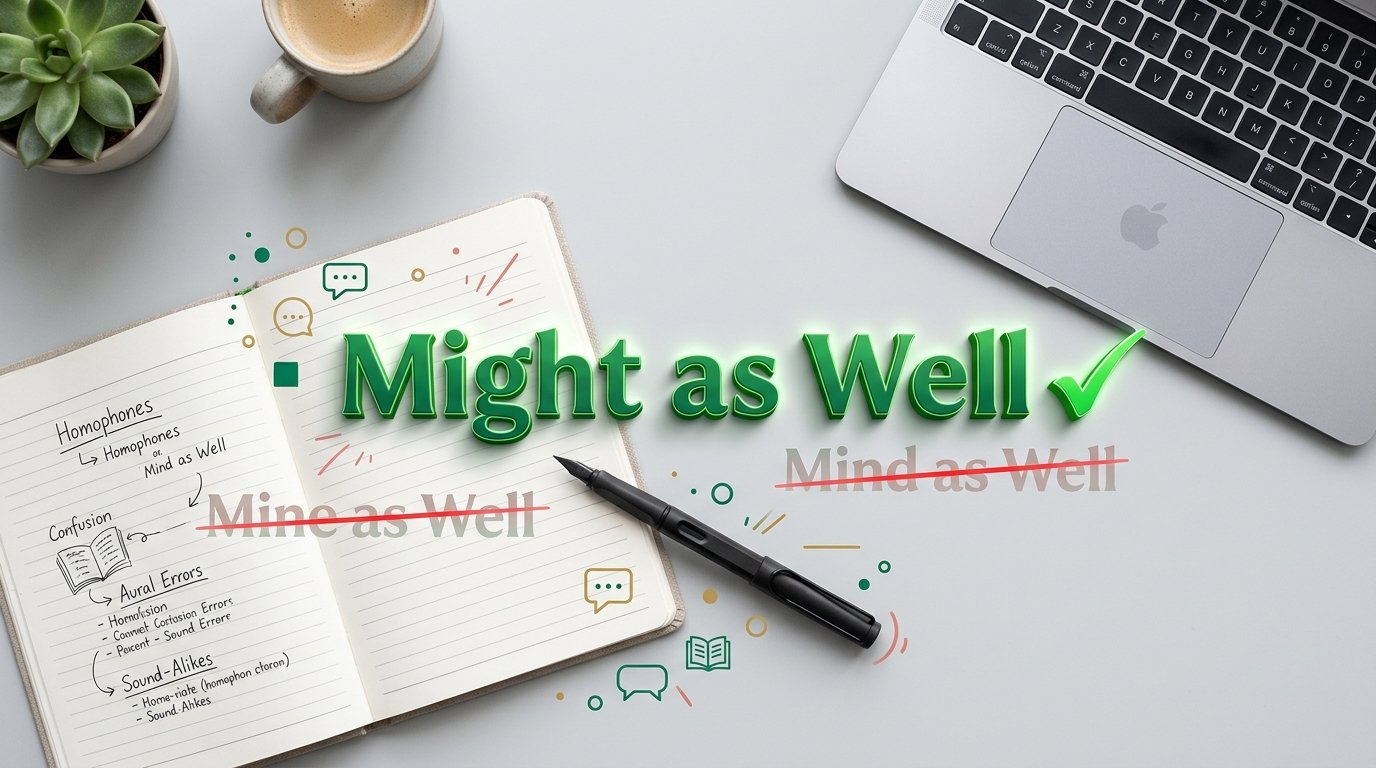
If you have ever wondered whether to write mine as well, might as well, or mind as well, you are not alone. These phrases can sound surprisingly similar in everyday speech, especially when someone says them quickly.
However, they don’t have the same meaning or grammatical role. In standard English, might as well is the phrase you usually want when you mean that an action is sensible, reasonable, or has little downside.
Mine as well can be correct, but only when mine works as a possessive pronoun. Meanwhile, mind as well is generally a nonstandard version of might as well and should usually be avoided in formal writing.
Understanding the difference will help you write more clearly and avoid a small mistake that can make an otherwise good sentence look incorrect.
Mine as Well vs Might as Well vs Mind as Well: Why Does the Confusion Exist?
The confusion mainly comes from pronunciation.
When people say might as well quickly, the words can blend together. The final sound of might may become less noticeable, making the expression sound closer to mind as well.
Likewise, someone who hears the phrase without seeing it written may guess mine as well. This is especially common among English learners and people who have learned the expression through conversation rather than reading.
The three expressions also contain familiar English words:
- might is a modal verb.
- mind is normally a verb.
- mine is a possessive pronoun.
Because each word already has a legitimate place in English, it can be difficult to recognize which one belongs in a particular sentence.
Why It Matters in Professional Settings
Small spelling and grammar choices matter more in professional communication.
A phrase such as We mind as well continue may be understood by a reader, but it can look like a typo or grammatical error. In emails, reports, applications, academic work, and business documents, standard English is the safer choice.
Therefore, use might as well when expressing a sensible suggestion. If you mean possession, use mine only when the surrounding sentence clearly supports that meaning.
Mine as Well vs Might as Well vs Mind as Well: Which One Is Correct?
In most situations, might as well is the correct standard phrase.
It expresses the idea that something is reasonable to do because there is little reason not to do it.
For example:
We might as well leave now because the store closes soon.
Here, the speaker isn’t saying that leaving is compulsory. Instead, leaving seems like the sensible option.
By contrast, mind as well is generally considered a nonstandard variant when it is used with the same meaning as might as well. You may hear it in casual speech or particular dialects, but it isn’t recommended in standard formal writing.
Mine as well has a different function. It can be grammatical when mine means “belonging to me.”
For example:
If nobody wants the extra ticket, it can be mine as well.
Here, mine replaces a noun phrase such as my ticket. It isn’t another spelling of might.
So, when choosing among the three, ask yourself what you mean:
Sensible action? → might as well
Something belongs to me? → mine
Using “mind” to mean “might”? → usually incorrect in standard English
See Also: Emasculate or Demasculate: Understanding the Difference Clearly
What Does “Might as Well” Mean? Origins, Definition, and Usage
Might as well is an established idiomatic expression in English.
It commonly means that an action is reasonable under the circumstances, particularly when alternatives are no better.
Consider this example:
It’s already late, so we might as well finish the project tonight.
The speaker is suggesting that finishing the project is sensible because the situation already makes continuing reasonable.
The expression can also communicate resignation or acceptance:
Since we’re already here, we might as well stay for dinner.
The speaker may not have planned to stay, but remaining there seems worthwhile.
Definition of Might as Well
The basic meaning of might as well is:
“It would be reasonable to” or “there is little reason not to.”
The expression normally follows this structure:
might + as well + base verb
Examples include:
- We might as well go.
- You might as well try.
- They might as well wait.
- I might as well call her.
- We might as well start now.
Notice that the verb after might stays in its base form.
You say:
We might as well go.
Not:
We might as well to go.
This is a basic modal verb rule. After might, the following verb does not take to.
See Also: Conform With or Conform To: Understanding the Difference Clearly
Origins of the Phrase “Might as Well”
The expression developed from the older use of might as a modal expressing possibility or suitability. Over time, might as well became an established idiom used to suggest an action when circumstances make it reasonable.
Today, English speakers use it naturally in both American and British English.
Its meaning can depend slightly on context, but the central idea remains the same: given the circumstances, doing something seems sensible.
Why “Mind as Well” Is a Common Misspelling
The spelling mind as well often develops because might as well can be difficult to hear clearly in fast conversation.
The words may blend together when spoken:
might as well
A listener who doesn’t know the written form may interpret the sound as mind as well.
There is another reason for the mistake: mind is itself a normal English word. It can mean to care about something or pay attention to something.
For example:
Do you mind waiting here?
Because mind already exists as a common verb, learners may assume mind as well is another grammatical expression.
In standard English, however, it normally isn’t used as a substitute for might as well.
Exploring the Significance of “Might as Well” in Everyday English
Unlike a technical term, might as well is a flexible everyday expression. It appears in conversations, messages, stories, workplace discussions, and informal recommendations.
It can make a suggestion sound less forceful.
Compare:
We should leave now.
with:
We might as well leave now.
The first sentence sounds more direct. The second suggests that leaving is simply the sensible option.
This subtle difference explains why the phrase is so common in natural conversation.
Role of “Might as Well” in Everyday Communication
The expression often appears when someone is choosing between similar options.
For example:
The next bus arrives in an hour, so we might as well walk.
The speaker isn’t necessarily excited about walking. Instead, walking seems reasonable because waiting would take too long.
You can also use it when circumstances have already changed:
Since you’ve finished your work, you might as well come with us.
Here, the completed work provides the reason for the suggestion.
The expression can therefore communicate suggestion, practical reasoning, acceptance, or mild resignation.
Common Reasons for the “Mine as Well” and “Mind as Well” Misspellings
Several factors explain why people confuse these expressions.
First, pronunciation plays a major role. Fast speech can hide the difference between might, mind, and mine.
Second, people often learn conversational phrases by listening. If they have never seen the expression in writing, they may create their own spelling.
Third, English contains many words that sound similar but have completely different meanings.
For example, mine is a possessive pronoun, while mind is generally a verb or noun. Neither automatically creates the meaning expressed by might as well.
Finally, autocorrect and repeated informal usage can reinforce an incorrect form.
A useful editing habit is to pause whenever you see mind as well. Ask whether the sentence actually means it makes sense to. If it does, might as well is almost certainly the intended expression.
Side-by-Side Comparison: Mine as Well, Might as Well, and Mind as Well
| Phrase | Standard English? | Meaning | Typical Use |
|---|---|---|---|
| Might as well | Yes | It makes sense to; there is little reason not to | Suggestions and practical decisions |
| Mine as well | Sometimes | Also belonging to me | Possessive contexts |
| Mind as well | Usually no | Generally intended as “might as well” | Nonstandard or dialectal speech |
The key difference is grammatical as well as semantic.
Might is a modal verb, so it can introduce a suggestion.
Mine is a possessive pronoun, so it identifies something belonging to the speaker.
Mind is ordinarily a verb or noun and does not perform the same modal function as might.
That distinction makes the correct choice much easier.
Everyday Examples of “Might as Well” in Language
Here are several natural examples:
We’re already at the mall, so we might as well have lunch.
The speaker sees lunch as a reasonable choice because they are already there.
If you’re going to the store, I might as well come with you.
The speaker sees an opportunity to join.
The weather is getting worse. We might as well head home.
Going home becomes the sensible option.
We missed the earlier train, so we might as well take the next one.
The phrase presents the next action as practical.
For mine as well, the meaning changes:
If you don’t want the last cookie, it can be mine as well.
Here, mine means “belonging to me.”
You could also say:
That seat is mine as well.
However, many speakers would choose too instead:
That seat is mine, too.
This often sounds more natural and clearer.
For mind as well, consider:
We mind as well leave now.
If the intended meaning is “It makes sense to leave now,” the standard correction is:
We might as well leave now.
“How to Spell Mine as Well, Might as Well, or Mind as Well” and Remember the Correct Spelling
If you’re searching for how to spell mine as well, might as well, or mind as well, the easiest method is to remember the meaning rather than the sound.
When you’re suggesting an action, choose:
might as well
When you’re describing ownership, choose:
mine
When mind appears where you mean “it makes sense to,” check whether you actually need:
might as well
A simple substitution test can help.
Take this sentence:
We mind as well stay.
Replace mind as well with might as well:
We might as well stay.
The meaning works perfectly, so might is the correct choice.
Practice Sentences
Try completing these sentences mentally:
The movie starts in ten minutes, so we ___ wait here.
Answer: might as well
Nobody wants the extra notebook, so it can be ___.
Answer: mine
We ___ finish the work before going home.
Answer: might as well
This kind of minimal pair practice helps learners connect grammar with meaning instead of memorizing spelling alone.
Literature and Media Mentions: Correct Usage of “Might as Well”
Might as well is deeply established in everyday English and appears naturally in dialogue, fiction, journalism, entertainment, and informal communication.
Writers use it because it captures a particular attitude: an action may not be ideal, but given the circumstances, it seems sensible.
Characters may say:
“We might as well go.”
The line can suggest acceptance, practicality, or mild resignation depending on the surrounding scene.
Meanwhile, a writer may intentionally use mind as well in dialogue to represent a particular dialect or speech pattern.
That doesn’t make it the preferred spelling in standard prose.
When writing an article, essay, report, or professional message, standard usage is usually the better choice. When writing realistic dialogue, however, nonstandard forms can sometimes be purposeful.
Frequently Asked Questions About Mine as Well, Might as Well, and Mind as Well
What’s the correct way to spell “might as well”?
Might as well is the standard spelling when you mean that an action is reasonable, sensible, or has little downside given the circumstances.
Is “mine as well” a phrase?
Yes, but only in specific possessive contexts. Mine must refer to something belonging to the speaker, such as “The extra ticket can be mine as well.”
Is “mind as well” grammatically correct?
Usually not when you mean “might as well.” It may occur in dialectal or informal speech, but standard writing should normally use might as well instead.
What is the difference between “might as well” and “mine as well”?
Might as well suggests a sensible action, while mine as well expresses possession or means that something belongs to the speaker too.
How can I remember “might as well”?
Connect might as well with the idea “it makes sense to.” If you’re recommending a practical action, might as well is usually the correct expression.
Conclusion: Why Choosing the Correct Phrase Matters
When choosing between mine as well, might as well, and mind as well, focus on meaning first. Might as well is the standard idiom for a sensible or practical action, while mine expresses possession. Mind as well is generally a nonstandard substitute caused by pronunciation or mishearing. Remember the simple test: if you mean “it makes sense to,” choose might as well. If something belongs to you, choose mine. Learning this small distinction improves grammar, clarity, and confidence in everyday and professional English.
Related reading: Mine As Well, Might As Well, or Mind As Well, Piece of Mind or Peace of Mind, Unselect vs Deselect.
1 thought on “Mine as Well vs Might as Well vs Mind as Well: Understanding the Difference”