
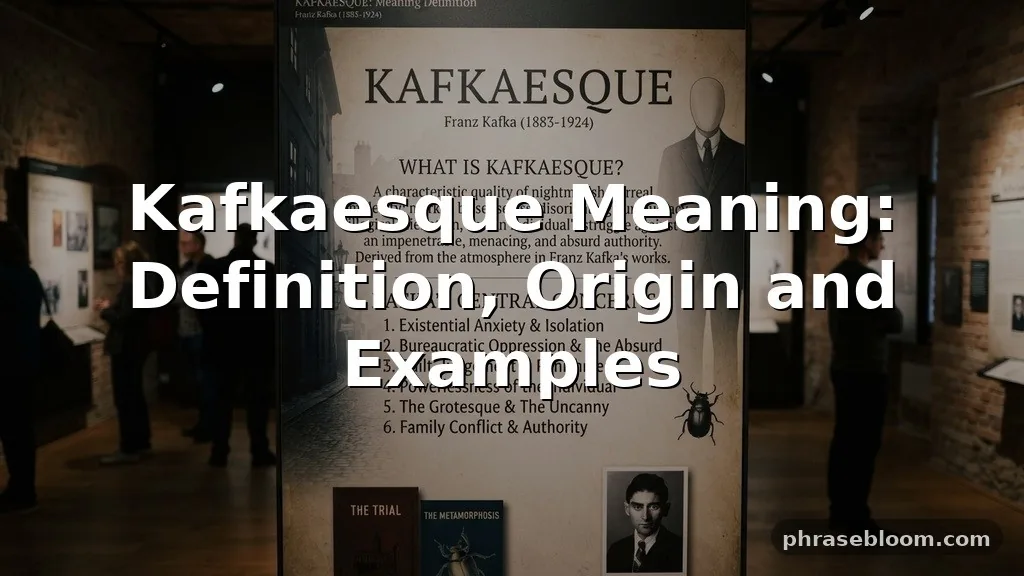
Kafkaesque Meaning: Definition, Origin and Examples
The Kafkaesque meaning describes a situation that feels trapped in a maze of confusing rules, arbitrary authority, and powerless resistance. The word comes from the fiction of Franz Kafka, especially stories such as The Trial, where an ordinary person faces a threatening system without understanding what he has done or how to escape.
Today, people use “Kafkaesque” for more than strange or frightening events. It usually points to a specific kind of absurdity: faceless institutions create surreal problems, explanations remain out of reach, and the individual becomes increasingly isolated. Understanding that distinction helps you use the word accurately in essays, journalism, workplace writing, and everyday conversation.
What Does Kafkaesque Mean?
The Kafkaesque definition refers to a disturbing situation shaped by oppressive bureaucracy, unclear procedures, arbitrary authority, and a deep sense of powerlessness. A person may be required to follow rules that are never explained, appeal to officials who cannot help, or defend himself against an accusation without learning its details.
In plain English, something is Kafkaesque when it resembles a nightmare scenario created by a faceless institution. The circumstances may look ordinary at first, but they become increasingly irrational, threatening, and impossible to control.
For example, a government office might reject an application because of a missing document, while refusing to say which document is missing. If every department sends the applicant to another department and no one accepts responsibility, the experience could reasonably be called Kafkaesque.
The term does not simply mean “weird.” A strange costume, an unusual dream, or an eccentric personality is not necessarily Kafkaesque. The word usually involves a combination of bureaucratic absurdity, alienation, fear, and powerlessness.
| Feature | What it involves | Typical effect |
|---|---|---|
| Unclear rules | Requirements are hidden, changing, or impossible to interpret | Confusion and anxiety |
| Faceless authority | Decisions come from offices, systems, or officials without accountability | Powerlessness |
| Absurd procedure | Logical steps produce irrational or unfair results | Frustration and disbelief |
| Isolation | The individual cannot obtain meaningful help or understanding | Alienation |
Where the Word Kafkaesque Comes From
“Kafkaesque” comes from the name of Franz Kafka, the German-speaking Jewish writer born in Prague in 1883. Kafka’s fiction often places ordinary people inside systems that are frightening precisely because they are difficult to understand.
Kafka did not create the English adjective “Kafkaesque” as a formal label for his own work. The term developed after his writing became widely read and was used to describe situations that reflected his recurring themes. It now functions as a normal adjective in English.
Kafka’s work is associated with modern society because it captures the anxiety of living among institutions that are larger than any one individual. Courts, employers, governments, schools, and other organizations can appear rational from the outside while producing bewildering experiences for the people inside them.
That tension gives the word its lasting force. Kafka’s stories are not merely about castles, courtrooms, or mysterious transformations. They show people struggling to find meaning and agency in systems that offer procedures without genuine understanding.
Readers who want historical context can consult the Encyclopaedia Britannica biography of Franz Kafka. His life, professional background, and literary concerns help explain why the adjective is connected so strongly with alienation and institutional power.
Kafka’s central concerns
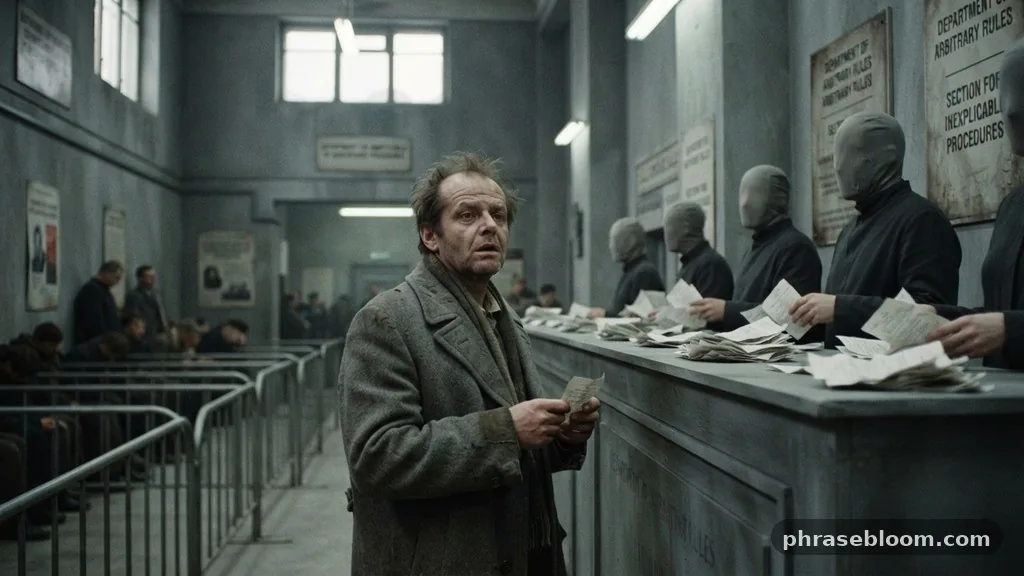
- Individuals confronting institutions they cannot influence.
- Rules that seem authoritative but remain unexplained.
- Guilt or punishment without a clear accusation.
- Communication that produces more confusion rather than clarity.
- Existential anxiety caused by uncertainty and isolation.
These themes explain why “Kafkaesque” can describe both literature and real events. The word has moved beyond literary criticism, but its foundation remains Kafka’s portrayal of people who cannot obtain a fair explanation from the systems governing their lives.
Kafkaesque in The Trial
The Trial offers one of the clearest examples of the Kafkaesque meaning. The novel follows Josef K., a bank employee who is arrested one morning without being told what crime he has committed.
Josef K. is not treated as a prisoner in the usual sense. He continues working and moving through the city, yet an invisible legal process hangs over him. He tries to understand the accusation and defend himself, but every attempt leads him deeper into an opaque and threatening court system.
The novel’s horror comes from the gap between procedure and justice. The court appears to possess authority, but its officials do not provide the ordinary information that would allow Josef K. to respond fairly.
This is why “Kafkaesque” is often connected with arbitrary authority. The institution does not need to explain itself because its power seems to exist independently of reason, transparency, or accountability.
The setting also creates alienation. Josef K. encounters lawyers, clerks, attendants, and court representatives, yet none of them gives him a clear path forward. He is surrounded by people and still fundamentally alone.
Why The Trial is not simply a story about a bad court
The novel does not present bureaucracy as a single villain that can be defeated by exposing one corrupt official. Its deeper concern is the system itself, including the way people become dependent on procedures they cannot understand.
That distinction matters in modern usage. A delayed court case may be frustrating, but a situation becomes more Kafkaesque when the person cannot discover the charge, the responsible authority, the applicable rule, or the method of appeal.
Kafkaesque in The Castle and The Metamorphosis
The Castle develops another important part of the Kafkaesque meaning. The main character, known as K., arrives in a village and tries to gain access to the castle authorities, but he encounters layers of officials, messages, delays, and misunderstandings.
The castle represents authority that is physically present yet practically unreachable. K. believes that the institution controls his status in the village, but he cannot establish a direct relationship with anyone who can explain the rules.
This pattern appears in everyday descriptions of labyrinthine systems. A person may be able to contact a company, agency, or university, but every contact leads to another form, another queue, or another representative with limited information.
The Metamorphosis presents a different kind of alienation. Gregor Samsa wakes up transformed into a monstrous insect, and the transformation changes how his family, employer, and society respond to him.
The story is surreal, but its emotional structure is recognizable. Gregor’s value has been tied to his ability to work, and once he can no longer perform that role, communication breaks down and his family increasingly treats him as a burden.
Calling a situation Kafkaesque can therefore emphasize more than bureaucracy. It can also describe dehumanization, social isolation, identity loss, and the feeling that ordinary life has become absurd.
Different Kafkaesque patterns
Kafka’s major works should not be reduced to one formula. The Trial centers on unexplained accusation, The Castle focuses on inaccessible authority, and The Metamorphosis explores alienation within family and work.
All three works share a pressure placed on the individual by forces that are difficult to interpret or resist. That shared pressure is more important than any single visual detail, such as a courtroom, a castle, or an insect transformation.
Kafkaesque Meaning in Modern Society
People use “Kafkaesque” today to describe experiences involving government agencies, legal processes, technology platforms, corporations, hospitals, schools, and large employers. The setting can change, but the emotional pattern remains recognizable.
Consider an automated fraud investigation that freezes a person’s bank account. The customer receives a generic notice, cannot reach the department responsible, and is told by each support channel that only another department can help.
That situation may be called Kafkaesque because a supposedly efficient system has become impossible to question. The institution has information and power, while the individual has no clear explanation or effective remedy.
Technology can intensify this pattern. An online platform may remove a user’s account for violating an unspecified rule, provide an automated appeal form, and reject the appeal without identifying the evidence or policy involved.
The problem is not simply inconvenience. The person is placed inside an administrative process that claims authority but offers little transparency. That combination produces the existential anxiety associated with Kafka’s fiction.
The word can also describe workplace experiences. An employee might be blamed for missing a target that was never communicated, instructed to obtain approval from a manager who has left the organization, or required to follow a policy that different departments interpret differently.
Use the term carefully, though. Not every inefficient service is Kafkaesque. A long wait, an unhelpful email, or a mistaken invoice may be ordinary incompetence rather than a full example of Kafkaesque absurdism.
How to Use Kafkaesque in a Sentence
“Kafkaesque” is usually an adjective. It modifies a noun directly or appears after a linking verb such as “be,” “seem,” or “become.” In both positions, it describes an experience, system, process, or atmosphere marked by confusion and powerlessness.
Before a noun
- “The company’s approval process became a Kafkaesque maze of forms and contradictory instructions.”
- “She described the immigration interview as a Kafkaesque encounter with an authority that would not explain its decision.”
- “The novel presents a Kafkaesque bureaucracy that turns ordinary mistakes into serious accusations.”
- “Employees faced a Kafkaesque series of software permissions after the organizational change.”
In each sentence, “Kafkaesque” appears before a noun and identifies the quality of the situation. The word does not mean merely complicated; it suggests that the complexity is irrational, threatening, or impossible to challenge.
After a linking verb
- “The entire process was Kafkaesque.”
- “The meeting became Kafkaesque when nobody could identify who had made the decision.”
- “What began as a routine complaint soon seemed Kafkaesque.”
Here, the adjective follows the verb and describes the subject. This placement is useful when the sentence needs to introduce the situation first and characterize it afterward.
In public and professional writing
“Kafkaesque” can work in journalism, commentary, literary criticism, and business writing, but the surrounding sentence should explain the concrete facts. A report that simply labels a process Kafkaesque without describing the missing information or conflicting rules may sound dramatic rather than precise.
For example, “The licensing procedure was Kafkaesque” is less informative than “The licensing procedure required three approvals, but each office denied responsibility for issuing the final certificate.” The second sentence gives readers a reason for the description.
What Kafkaesque Does Not Mean
A common mistake is using “Kafkaesque” as a synonym for anything surreal. Surreal situations can be Kafkaesque, but surrealism alone is not enough.
A colorful dream, an unexpected coincidence, or a bizarre work of art may be surreal without involving institutions, powerlessness, or existential anxiety. Kafkaesque usually implies that a person is caught in a system or condition that feels both irrational and authoritative.
| Word | Main idea | Example |
|---|---|---|
| Surreal | Strangely dreamlike or unreal | A surreal painting shows a city floating above the sea. |
| Absurd | Illogical, unreasonable, or ridiculous | The rule requiring two identical signatures is absurd. |
| Dystopian | Connected with an oppressive imagined society | The novel portrays a dystopian state that monitors every citizen. |
| Kafkaesque | Marked by opaque authority, bureaucratic absurdity, and powerlessness | The appeal process sends each applicant to an office that denies responsibility. |
The distinctions can overlap. A dystopian story may contain Kafkaesque scenes, and a Kafkaesque experience may seem absurd or surreal. Still, the terms emphasize different features.
Another mistake is treating “Kafkaesque” as a synonym for cruelty alone. A violent event may be horrifying without being Kafkaesque. The adjective becomes more accurate when the horror is connected to incomprehensible procedures, hidden authority, or an inability to obtain a meaningful explanation.
Kafkaesque, Absurdism, and Existential Anxiety
Kafkaesque writing often intersects with absurdism, a literary and philosophical approach concerned with the conflict between the human desire for meaning and a world that does not provide clear answers.
Kafka’s characters usually want practical things. Josef K. wants to understand the accusation against him.
K. wants access to the castle. Gregor Samsa wants to continue supporting his family and preserve his dignity.
Their goals are not bizarre. What becomes bizarre is the world’s response to them. Institutions and relationships that should offer order instead produce silence, delay, contradiction, and rejection.
This creates existential anxiety. The character cannot rely on familiar assumptions about justice, identity, work, family, or social status.
“Kafkaesque” is therefore stronger than “confusing.” It suggests that confusion has become a condition of existence, not a temporary problem that a helpful explanation can solve.
Modern readers often recognize this feeling in large systems. A person may understand that a decision was made by software, policy, or an internal process, but that knowledge does not reveal who is responsible or how the decision can be challenged.
The result is a distinctive kind of alienation. The person is technically included in the system as a customer, citizen, employee, student, or patient, yet has little practical ability to influence it.
Common Mistakes When Using Kafkaesque
Good usage depends on matching the word to the situation. The following mistakes are common because Kafkaesque has become popular in general commentary.
Using it for any strange event
Incorrect: “The birthday party had a Kafkaesque cake shaped like a train.”
Better: “The event became Kafkaesque when the venue’s management cancelled the reservation but demanded proof that the reservation had never existed.”
The corrected sentence adds institutional confusion and contradictory authority. Those details make the adjective meaningful rather than decorative.
Using it without evidence
Weak: “The new benefits system is Kafkaesque.”
Stronger: “The new benefits system is Kafkaesque because employees must request access from a manager who cannot view the approval form.”
The stronger version identifies the mechanism that creates powerlessness. Specific details protect the word from becoming vague exaggeration.
Confusing Kafkaesque with merely unfair
Incorrect: “The manager’s decision was Kafkaesque because I disliked the outcome.”
Better: “The manager’s decision felt Kafkaesque because the employee was penalized under a policy that had never been published or communicated.”
An unfair decision may be wrong without being Kafkaesque. The latter example includes hidden rules and an inability to respond fairly.
Turning the word into a noun
“Kafkaesque” is not normally a noun. Avoid constructions such as “the Kafkaesque of the system.” Write “the Kafkaesque quality of the system,” “the system’s Kafkaesque character,” or simply describe the process directly.
Practical Guidance for Writers
Before using “Kafkaesque,” identify the concrete source of the unease. Ask whether the person faces an opaque authority, contradictory instructions, unexplained punishment, or a system that prevents meaningful appeal.
- Name the institution or system involved.
- Explain what rule, decision, or accusation remains unclear.
- Show how the individual lacks power or access to a remedy.
- Use “Kafkaesque” as a summary, not as a substitute for evidence.
- Choose a simpler word if “confusing,” “unfair,” or “bureaucratic” is more exact.
In academic writing, define the term before applying it to a text or social situation. A paper might state that “Kafkaesque” refers here to institutional power combined with unexplained accusation and individual powerlessness.
In workplace communication, use the word selectively. It may be effective in an opinion piece or a thoughtful internal discussion, but it can sound theatrical in a formal incident report where a direct description would be more useful.
In journalism, the adjective should follow verifiable facts. Explain the sequence of events, identify the responsible organizations, and show why the process was opaque before calling it Kafkaesque.
In everyday conversation, the word can be shorter. “The cancellation process was completely Kafkaesque” may be enough if everyone already knows that the company sent contradictory notices and offered no human support.
Frequently Asked Questions
What is the Kafkaesque meaning?
Kafkaesque describes a situation involving confusing authority, oppressive bureaucracy, unexplained rules, alienation, and powerlessness. It often feels like a nightmare created by a faceless institution.
Does Kafkaesque always mean bureaucratic?
Not always, but bureaucracy is a common feature. The term can also describe alienation, identity loss, and existential anxiety, especially when a person cannot understand or control the forces shaping their life.
Is Kafkaesque only used for Franz Kafka’s books?
No. The word comes from Kafka’s fiction, but modern English uses it for real events, institutions, workplace problems, legal procedures, and technology systems that resemble patterns in his writing.
What is an example of a Kafkaesque situation?
An agency might deny a person’s application for an undisclosed reason, refuse to identify the missing information, and send the person through several offices that cannot accept an appeal. That combination of authority, confusion, and powerlessness is Kafkaesque.
Is Kafkaesque the same as surreal?
No. “Surreal” means dreamlike or unreal, while “Kafkaesque” usually adds institutional pressure, arbitrary authority, alienation, or bureaucratic absurdity. A situation can be both, but the words are not exact synonyms.
Conclusion
The Kafkaesque meaning centers on a person trapped inside an opaque and threatening system. Franz Kafka’s The Trial, The Castle, and The Metamorphosis provide different versions of that experience, from unexplained legal accusation to inaccessible authority and social alienation.
Use “Kafkaesque” when the facts show more than strangeness or inconvenience. Look for arbitrary rules, faceless institutions, contradictory procedures, and a genuine loss of control. If you explain those details clearly, the word becomes a precise description rather than a dramatic label.
Related: Any Problem or Any Problems · Their Life vs Their Lives · Full Proof vs Foolproof
1 thought on “Kafkaesque Meaning: Definition, Origin and Examples”