
Company-Wide or Companywide? Correct Usage
Choosing between company-wide or companywide usually comes down to spelling and house style, not meaning. Both forms describe something that affects, involves, or covers the entire company, and both appear in modern English.
For most professional writing, company-wide is the safest choice when the expression comes directly before a noun, as in “company-wide policy.” Companywide is also correct as a closed compound, especially when it matches an established dictionary or organizational style. The key is to understand the grammatical position, choose deliberately, and stay consistent throughout the document.
Company-Wide or Companywide: The Direct Answer
Company-wide and companywide generally have the same meaning: something applies to the entire company. For example, “a company-wide training program” and “a companywide training program” both describe training intended for employees across the organization.
When the expression functions as a compound modifier before a noun, company-wide is usually the safest professional spelling. The hyphen makes it immediately clear that “company” and “wide” work together to describe the following noun.
Companywide is also a legitimate one-word spelling. It is a closed compound, meaning that two words have joined to form one word, as in “worldwide” or “nationwide.” Some dictionaries, publications, and organizations prefer this form because similar compounds have developed into single words.
| Form | Spelling | Meaning | Typical grammatical function | Common context | Practical recommendation |
|---|---|---|---|---|---|
| company-wide | Hyphenated | Covering the entire company | Adjective or adverbial complement | “Company-wide policy” or “applies company-wide” | Safest general choice, especially before a noun |
| companywide | One word | Covering the entire company | Adjective or adverb | “Companywide changes” or “introduced companywide” | Use when your dictionary or house style prefers it |
| company wide | Two separate words | Usually intended to mean the entire company | Less established compound form | Occasional informal or inconsistent usage | Usually revise to company-wide, companywide, or a clearer phrase |
The answer to “is company-wide hyphenated?” is therefore yes when you choose the hyphenated form. The answer to “is companywide one word?” is also yes. These are spelling variants, not normally different concepts.
What Company-Wide Means
The company-wide meaning is simple: something extends across the whole company rather than applying only to one department, office, team, or location. A company-wide policy applies to all relevant employees, while a company-wide announcement is sent to the organization as a whole.
The word can describe scope, reach, or participation. A company-wide initiative may include every department, a company-wide change may affect all employees, and company-wide training may be required throughout the business.
- Company-wide policy: a rule that applies across the organization.
- Company-wide announcement: a message intended for the whole workforce.
- Company-wide initiative: a project involving multiple departments or the entire company.
- Company-wide training: instruction assigned across the employee population.
- Company-wide change: an organizational change with broad internal effects.
The word does not always mean that every individual experiences exactly the same result. For example, a company-wide software rollout may reach every department while giving finance, sales, and engineering different tools or permissions.
Scope matters. “Company-wide” normally refers to one company, while “organization-wide” may include separate entities, institutions, or divisions under a broader organizational structure.
Why the Hyphen Matters Before a Noun
A compound modifier is a group of words that works together to describe a noun. In “company-wide policy,” the expression modifies “policy,” and the hyphen signals that “company” and “wide” belong together as one descriptive unit.
Without that signal, readers may still understand the sentence, but the structure is less clear. Professional writing benefits from showing the relationship between words rather than making the reader reconstruct it.
These examples use the standard hyphenated form:
- The board approved a company-wide policy on data retention.
- Human Resources issued a company-wide announcement about the holiday schedule.
- The chief executive introduced a company-wide initiative to improve accessibility.
- Managers must complete the company-wide training before the system launch.
- The merger created a company-wide change in reporting procedures.
In each sentence, “company-wide” appears immediately before a noun and acts as an adjective. The hyphen prevents “company” from appearing to modify “wide” separately.
That does not mean every style authority treats the hyphen as mandatory in every document. Some editors prefer the closed form “companywide policy,” particularly when their style recognizes “companywide” as an established compound. The practical point is to use the form your chosen style supports consistently.
Companywide as a Closed Compound
Companywide is one word. It is called a closed compound because the original parts have been combined without a space or hyphen. English contains many compounds that have developed in this way, including “nationwide,” “worldwide,” “lengthwise,” and “otherwise.”
The closed form has the same basic companywide meaning as “company-wide.” “The companywide policy applies to all offices” and “The company-wide policy applies to all offices” communicate the same idea.
Companywide may look more compact in headlines, software interfaces, reports, and repeated workplace phrases. It can also fit naturally with other established compounds:
- The companywide benefits review begins next month.
- Companywide changes will affect access to the expense system.
- The new security standard is now companywide.
- Managers received companywide guidance from the compliance team.
Some readers consider the hyphenated version easier to scan, especially when the expression appears before a long noun phrase. Others regard “companywide” as the more developed modern compound. Neither preference automatically changes the meaning.
If you choose “companywide,” do not switch to “company-wide” in the next paragraph without a reason. Mixed spelling can make an edited document look unfinished, especially in a company policy, annual report, or employee handbook.
Predicate and Adverbial Uses
The expression does not appear only before nouns. It can also follow a linking verb or describe how an action occurs across the company. These positions can affect the most natural spelling and may reduce the need for a hyphen.
In the sentence “The policy is company-wide,” the expression follows the linking verb “is” and describes the policy. This is a predicate adjective, meaning that the adjective comes after a verb and refers back to the subject.
- The policy is company-wide.
- The new benefits plan is companywide.
- The changes apply company-wide.
- The new system was introduced companywide.
- Managers implemented the process across the company.
“The changes apply company-wide” uses the expression in an adverbial role. It tells readers where or across what scope the changes apply. “The new system was introduced companywide” performs the same function with the closed form.
There is no universal rule saying that the hyphen must disappear after a verb. “The policy is company-wide” is fully natural, and many professional editors would retain that spelling. The important distinction is that the expression is not functioning as a pre-noun compound modifier in that sentence.
Context, readability, and house style still matter. If an organization has selected “company-wide” throughout its documents, changing to “companywide” only because the word follows a verb may create unnecessary inconsistency.
Is Company Wide Without a Hyphen Acceptable?
Company wide as two separate words is generally not the preferred spelling when the words function together as a compound modifier. In “a company wide policy,” the writer intends the two words to act as one description, so “company-wide policy” or “companywide policy” is clearer.
The unhyphenated form may appear in informal writing, quickly typed emails, older documents, or text produced by inconsistent editing. Readers will often understand it, but that does not make it the strongest choice for formal business English.
Compare these versions:
- Preferred: The company-wide policy takes effect on July 1.
- Also acceptable: The companywide policy takes effect on July 1.
- Usually revise: The company wide policy takes effect on July 1.
The issue is not that “company wide” creates a completely different meaning. The problem is that the space fails to show that the two words form a single modifier before “policy.” A hyphenated or closed compound removes that small moment of uncertainty.
There are sentences where “company” and “wide” could be interpreted independently, although these are uncommon. If “wide” clearly describes a physical or figurative width belonging to “company,” separate wording may be possible, but most workplace uses intend the compound meaning.
American English, British English, and House Style
American English and British English do not divide this issue into a simple rule where one region uses “company-wide” and the other always uses “companywide.” Both forms can be found in different publications, dictionaries, industries, and editorial systems.
Canadian English and Australian English also show variation. A publication may prefer a hyphen because it treats the expression as a compound modifier, while another may use the closed form because it recognizes the word as an established compound.
Dictionary definitions can help, but dictionaries do not always agree on every compound or prescribe one spelling for every context. Writers may consult resources such as Merriam-Webster’s dictionary, the Oxford English Dictionary, or Cambridge Dictionary, then check the style guide used by their employer or publication.
Professional teams may follow the Associated Press Stylebook, the Chicago Manual of Style, an academic style manual, or an internal editorial policy. The same organization may also have a house style that settles questions not addressed in a general reference work.
That is why claims such as “companywide is exclusively American” or “company-wide is exclusively British” are too strong. Usage develops gradually, and compound-word preferences often vary by industry and publication rather than by national English alone.
For an international audience, the safest choice is the one that is easiest to read and used consistently. The hyphenated spelling often provides the clearest visual signal, while the closed spelling is efficient when the audience already accepts it.
Company-Wide Usage in Workplace Writing
The expression appears in many kinds of organizational communication. Its best form depends less on the subject than on the organization’s chosen spelling and the sentence’s grammatical structure.
Policies and employee handbooks
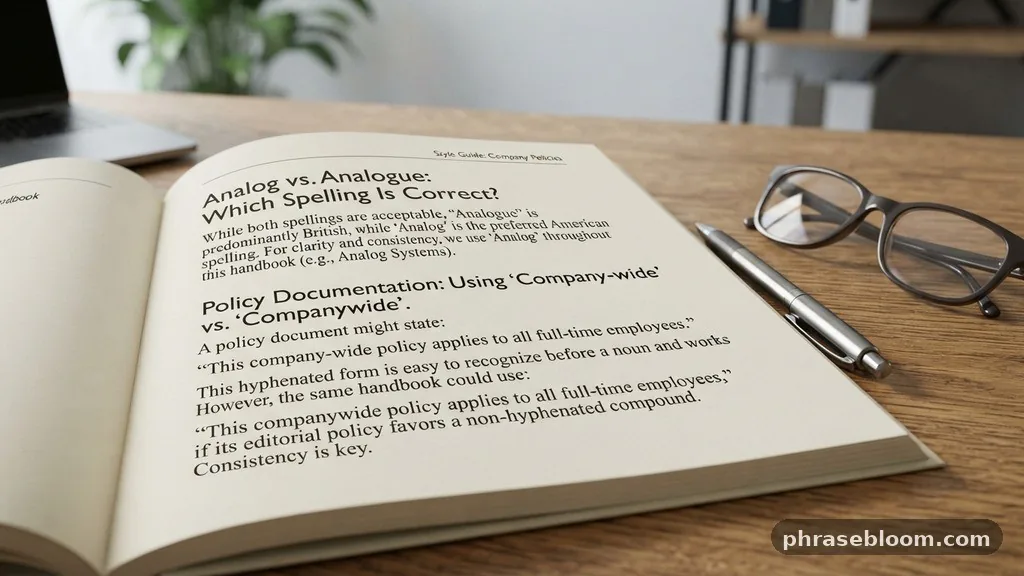
A policy document might state, “This company-wide policy applies to all full-time and part-time employees.” The hyphenated form is easy to recognize before the noun and works well in formal rules.
The same handbook could use “This companywide policy applies to all full-time and part-time employees” if its editorial policy prefers closed compounds. Both versions are suitable if the document applies its choice throughout.
Announcements and internal emails
An employee announcement could say, “We are issuing a company-wide announcement about the office relocation.” A shorter email might read, “The relocation update will be shared companywide on Friday.”
The first example uses an adjective before “announcement.” The second uses an adverbial form to describe how broadly the update will be shared. “Across the company” is also natural when a warmer, more conversational tone is useful.
Training and technology rollouts
For a software launch, write, “The company-wide training sessions begin two weeks before the rollout.” This tells employees that the sessions are intended for the full company, even if different roles attend different modules.
A project report could say, “The new authentication system was introduced companywide.” Here the closed form follows the verb and functions adverbially. “The system was introduced throughout the company” is a clear alternative if the writer wants to avoid the spelling decision.
Reports and organizational changes
A business report might state, “The companywide changes reduced duplication between regional teams.” A more formal version could use “company-wide changes” without changing the meaning.
For organizational communication, accuracy about scope is important. If only the North American division changed, “company-wide” would overstate the reach, and “division-wide” or “organization-wide” might be more precise.
Marketing and public communication
A public announcement might say, “The company-wide sustainability program includes redesigned pacaging and lower-emission shipping options.” This signals that the program extends across the business rather than belonging to one product line.
Marketing copy often benefits from simpler language. “Our sustainability program covers the entire company” may be clearer than either compound, particularly for customers who are not familiar with internal business terminology.
Meetings and benefits announcements
“The chief executive will discuss the plan at the next company-wide meeting” is a standard workplace sentence. In a benefits email, “The companywide health benefits review begins in October” is equally understandable if the organization uses the closed form.
These examples work because the scope is concrete. They tell readers that the meeting, review, training, announcement, or change reaches the organization as a whole.
Alternatives to Company-Wide and Companywide
Sometimes a different phrase is clearer than either spelling. Rewriting can also make a sentence sound less formal or avoid repeated use of a word that has already appeared several times.
| Alternative | Best use | Example |
|---|---|---|
| across the company | Conversational workplace writing | The update was shared across the company. |
| throughout the company | Emphasizing broad distribution or location | The new process is used throughout the company. |
| across the organization | Organizations with multiple departments or units | The initiative supports teams across the organization. |
| organization-wide | A broader organization than one company | The organization-wide standard applies to every division. |
| enterprise-wide | Large business systems, platforms, or corporate operations | The enterprise-wide software platform connects regional offices. |
“Company-wide,” “organization-wide,” and “enterprise-wide” are related but not always interchangeable. An enterprise may include several companies, subsidiaries, or business units, while a company may refer to one legal or operating entity.
“Across the company” often sounds more natural in an email: “The survey was sent across the company.” “Throughout the company” can emphasize distribution: “The standard is followed throughout the company.” Choose the phrase that communicates the actual scope.
Rewriting can also solve a crowded sentence. Instead of “The company-wide cross-functional operational efficiency initiative,” write “The initiative to improve operations across the company.” The second version is longer in word count but easier to understand.
Common Mistakes and Their Corrections
Most errors with this expression involve inconsistent spelling, incorrect word formation, or imprecise scope. They are easy to fix once the writer identifies the intended function.
- Inconsistent spelling: A report uses “company-wide” in the introduction and “companywide” in the recommendations. Choose one form and apply it consistently.
- Unhyphenated compound modifier: “The company wide policy changed.” Revise it to “The company-wide policy changed” or “The companywide policy changed.”
- Invented adverb: “The change was implemented companywidely.” Use “implemented companywide,” “implemented company-wide,” or “implemented across the company.”
- Using it as a noun: “The companywide approved the plan.” Use “The companywide policy approved the plan” or “The company approved the plan companywide,” depending on the intended meaning.
- Overstating scope: “The company-wide rule applies to our regional office” may be inaccurate if the rule covers only that office. Use “office-wide” or name the actual scope.
- Confusing spelling with meaning: “Companywide changes” and “company-wide changes” generally describe the same kind of changes. The difference is style, not a separate business concept.
Another common mistake is treating “wide” as a general intensifier and attaching it to any noun without checking established usage. “Company-wide” is established, but that does not mean every new “noun-wide” construction will sound natural or clear.
Writers should also avoid changing the form because they assume a different spelling signals a different level of importance. Neither “company-wide” nor “companywide” automatically means mandatory, strategic, permanent, or legally binding.
How to Choose the Right Form
A practical decision process can resolve most cases quickly. First, ask what the expression is doing in the sentence. If it directly modifies a noun, the hyphenated form is a reliable default.
- Check the noun position. For “company-wide policy,” “company-wide announcement,” and “company-wide initiative,” use the hyphenated form unless your style guide specifically prefers “companywide.”
- Check the house style. Search recent approved documents, templates, or the organization’s editorial guide. Existing internal usage is often more important than personal preference.
- Consider the audience. American, British, Canadian, Australian, and international readers can understand both forms, but a publication may have a regional or institutional preference.
- Check consistency. Apply the chosen spelling across headings, body copy, captions, emails, and related documents.
- Rewrite if needed. Use “across the company” or “throughout the company” if the compound makes the sentence harder to read.
For a business email, either “company-wide” or “companywide” is usually acceptable. A short email may sound more natural with “across the company,” especially in a sentence such as “The message will go to employees across the company this afternoon.”
For an employee handbook, legal policy, or compliance document, follow the organization’s established terminology. Consistency matters because readers may interpret changes in wording as changes in scope, even when the writer intended only a spelling variation.
For academic writing, consult the required style guide and use its preferred treatment. For websites and marketing materials, prioritize readability, brand consistency, and the terminology customers are most likely to understand.
For software interfaces, space may be limited, but clarity still comes first. “Companywide settings” may fit a label, while “Settings for the entire company” may be clearer in help text or onboarding instructions.
Company-Wide or Companywide in a Sentence
The following examples are ready to adapt. They show how the expression works in different professional situations without suggesting that one spelling is always mandatory.
- “The company-wide policy requires managers to document access changes.”
- “The companywide policy takes effect after the annual review.”
- “Please share the announcement company-wide with all office locations.”
- “The new payroll system will be available companywide by Monday.”
- “A company-wide initiative will support mentorship across departments.”
- “The companywide training includes separate modules for managers and contractors.”
- “The policy is company-wide, but local procedures may differ.”
- “The changes apply companywide after the final approval.”
- “The new meeting schedule was communicated across the company.”
- “The benefits update was distributed throughout the company.”
The first two examples place the expression before a noun, so both the hyphenated and closed forms act as adjectives. The third and fourth use the word after a verb, where “company-wide” and “companywide” can function adverbially.
The examples using “across the company” and “throughout the company” avoid the compound question entirely. They are especially useful when the surrounding sentence already contains several modifiers or when the audience includes readers who prefer plain business language.
FAQ: Company-Wide or Companywide
Is company-wide or companywide correct?
Both are correct in modern usage. They generally have the same meaning, so the choice is usually a matter of spelling preference, style guide rules, and organizational consistency.
Is company-wide more formal?
Not automatically. The hyphenated form often looks safer and clearer in formal writing, especially before a noun, but “companywide” can also be appropriate in professional documents when it matches the selected house style.
Should company-wide be hyphenated before a noun?
Usually, yes. “Company-wide policy” clearly marks the expression as a compound modifier. “Companywide policy” is also acceptable when the organization or publication prefers the closed compound.
Is company wide wrong?
It is generally not the preferred form when the words function together as one modifier. Revise “company wide announcement” to “company-wide announcement” or “companywide announcement” for clearer, more polished writing.
Can I write “The policy is company-wide”?
Yes. “The policy is company-wide” is a natural and correct sentence. The expression follows the linking verb “is” and describes the policy, rather than appearing directly before a noun.
Conclusion
Analog vs Analogue is a different spelling question, but company-wide versus companywide follows the same broader lesson: context and style matter. Both “company-wide” and “companywide” mean that something applies across the entire company, while “company wide” is usually less polished when the words form a compound modifier.
Use company-wide as the dependable default before a noun, choose companywide when your dictionary or house style supports the closed compound, and consider “across the company” when plain wording is clearer. Once your organization has chosen a form, apply it consistently across policies, reports, emails, websites, and internal communication.
You may also like: Aging vs Ageing: Which Spelling Is Correct?