
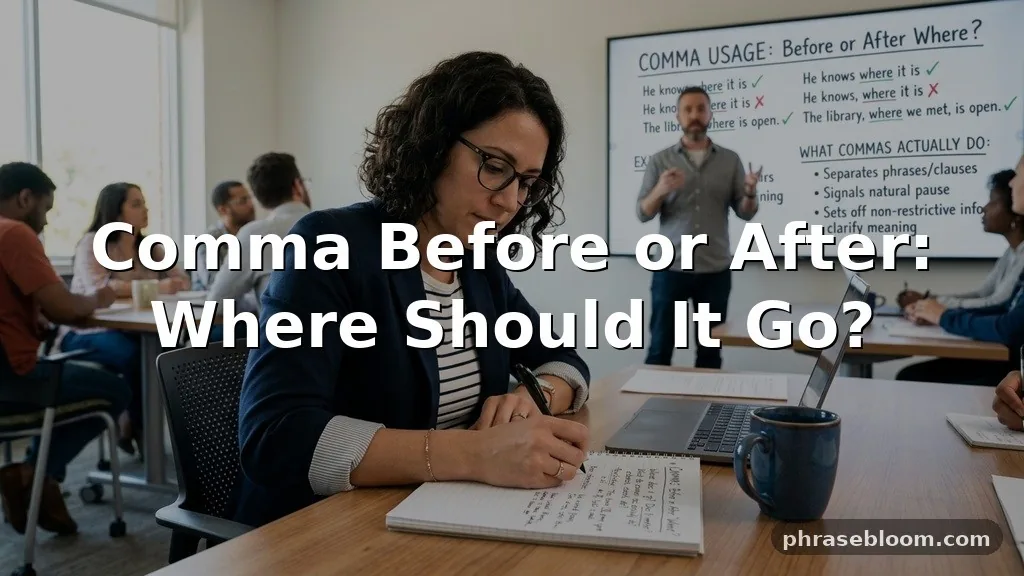
Comma placement depends on the words around the punctuation, not on a single universal rule. The comma may go before a conjunction, after an introductory phrase, around a nonrestrictive clause, or nowhere at all. That is why “comma before or after” questions often need a sentence-level answer.
The safest method is to identify the grammatical job of the surrounding words. The examples below show where commas belong in emails, reports, academic writing, dialogue, and everyday sentences, including the cases that cause the most confusion.
A comma usually goes before a coordinating conjunction such as and, but, or so when that conjunction joins two independent clauses. It usually goes after an introductory word, phrase, or clause that comes before the main statement.
Compare these two patterns:
- Before a conjunction: The report was complete, but the figures needed review.
- After an introductory phrase: After reviewing the figures, the analyst revised the report.
- Before and after a nonrestrictive clause: The report, which was published Friday, includes revised figures.
- No comma: The analyst revised the report because the figures had changed.
The placement changes because the grammatical structures change. A comma is not simply attached to a particular word such as and, because, or which.
For formal writing, read the entire sentence and ask what relationship the comma is marking. It may separate complete thoughts, signal an introductory element, set off extra information, clarify a list, or indicate a pause in dialogue.
What Commas Actually Do
A comma is a punctuation mark that helps readers interpret the structure of a sentence. It can separate items, distinguish a dependent clause from an independent clause, mark a parenthetical expression, or prevent two ideas from running together.
Consider the difference between an independent clause and a dependent clause. An independent clause can stand alone as a complete sentence, while a dependent clause begins with a word such as although, because, or when and depends on another clause for its full meaning.
When two independent clauses are joined with a coordinating conjunction, a comma normally appears before the conjunction:
The director approved the budget, and the finance team released the funds.
Both parts could stand alone. “The director approved the budget” is complete, and “the finance team released the funds” is also complete.
That rule does not apply in the same way when the second element is not an independent clause:
The director approved the budget and released the funds.
Here, and joins two verb phrases with the same subject. A comma is usually unnecessary because the sentence contains one subject and a compound predicate rather than two independent clauses.
Commas also improve clarity. In a sentence such as After the meeting ended, employees returned to their desks, the comma shows where the introductory clause ends and the main clause begins.
Comma Before a Conjunction
The most familiar “comma before or after” question involves and, but, or, nor, for, so, and yet. These are coordinating conjunctions, often remembered through the acronym FANBOYS.
Use a comma before one of these conjunctions when it joins two independent clauses:
The software update was installed, but several users still reported errors.
The comma belongs before but, not after it. The conjunction connects the two complete clauses, and the comma signals that boundary.
More examples include:
- The proposal was ambitious, yet the board approved it.
- The supplier missed the deadline, so the launch moved to Friday.
- The team can revise the design, or it can proceed with the current version.
- The office was closed, and employees worked remotely.
Do not add a comma before the conjunction merely because you hear a pause. In short sentences with a shared subject, the comma is often unnecessary: Maria opened the file and checked the figures.
A comma splice occurs when a writer joins two independent clauses with only a comma:
Incorrect: The meeting ended, everyone returned to work.
You can correct the comma splice by adding a coordinating conjunction, using a semicolon, or separating the clauses into two sentences:
Correct: The meeting ended, and everyone returned to work.
Correct: The meeting ended; everyone returned to work.
Comma After an Introductory Word, Phrase, or Clause
A comma commonly follows an introductory element at the beginning of a sentence. This element may be an introductory word, an introductory phrase, or an introductory clause.
An introductory word often signals attitude, transition, or connection:
- However, the contract still requires legal review.
- Fortunately, the files were backed up.
- Yes, the revised schedule is available.
- Meanwhile, the technical team investigated the outage.
An introductory phrase also takes a comma when it comes before the main clause:
After reviewing the contract, the attorney requested one change.
Before the presentation, the team tested the equipment.
With the final approval in hand, the project manager notified the client.
An introductory dependent clause is usually followed by a comma:
Although the deadline was close, the writers completed the draft.
When the shipment arrives, the warehouse will update its records.
When the dependent clause comes after the independent clause, the comma is often omitted:
The writers completed the draft although the deadline was close.
The warehouse will update its records when the shipment arrives.
This placement can change if the introductory material is short and closely connected to the main clause. In polished writing, clarity matters more than forcing a pause into every short sentence. If the opening phrase could be misread as part of the main clause, add the comma.
Commas Around Extra Information
Some sentence elements provide information that is helpful but not essential to identify the noun. These elements are called nonrestrictive clauses, and commas go before and after them when they appear in the middle of a sentence.
The conference room, which was renovated last year, can hold forty people.
The clause which was renovated last year adds information about the conference room. Removing it leaves a complete sentence: The conference room can hold forty people.
A similar rule applies to parenthetical expressions, which interrupt the sentence with an aside:
The proposed schedule, in my view, gives the team enough preparation time.
If the parenthetical expression appears at the beginning or end, only one comma may be needed:
In my view, the proposed schedule gives the team enough preparation time.
The proposed schedule gives the team enough preparation time, in my view.
Appositives can also require commas. An appositive is a noun or noun phrase that renames another noun:
Jordan Lee, the company’s compliance officer, reviewed the policy.
The title is extra information because the sentence identifies Jordan Lee by name. If the identifying phrase is essential, commas may not be appropriate:
Compliance officer Jordan Lee reviewed the policy.
Do not place commas around a restrictive clause, which is necessary to identify the noun:
Employees who work remotely must complete the security training.
The clause who work remotely identifies which employees the sentence concerns. Adding commas would suggest that all employees work remotely, changing the meaning.
Comma Before or After in Lists
Commas separate three or more items in a series. The final comma before the conjunction is called the Oxford comma, or serial comma.
The training covers passwords, device security, and data retention.
Many style guides permit or recommend the Oxford comma because it can make the relationships among list items clearer. Other publications omit it when the meaning remains obvious.
Problems arise when the list contains paired items or internal conjunctions:
The workshop covers hiring and onboarding, compliance and reporting, and workplace safety.
Here, the Oxford comma helps readers see that the list contains three pairs. Without it, the final items may be harder to group correctly.
Do not use a comma between two adjectives that work together as a unit:
The company introduced a new employee benefits portal.
Use a comma when the adjectives independently describe the noun:
The company introduced a secure, flexible portal.
One useful test is to place and between the adjectives. If “secure and flexible portal” sounds natural, a comma may be appropriate. If “new and employee benefits portal” does not make sense, the words are functioning differently and should not be separated.
Commas also appear in dates, addresses, and names of places, although modern style varies. A sentence such as The meeting is scheduled for June 12, 2026, in Chicago uses commas to separate the year and the location from the surrounding sentence.
Comma Before or After Quotation Marks
Quotation marks create another common placement question. In American English, commas and periods generally appear inside closing quotation marks, even when the punctuation is not part of the quoted material.
The manager called the proposal “practical,” and the board approved it.
“Please submit the form today,” the supervisor said.
The comma belongs inside the closing quotation mark in these examples. This convention is especially important in dialogue punctuation and reported speech.
Question marks and exclamation points follow a different logic. Place them inside the quotation marks when they belong to the quoted material:
The client asked, “When will the installation begin?”
Place them outside when the surrounding sentence is the question:
Did the client really say “approve the installation”?
British English often follows a more logical punctuation system in which quotation marks contain only punctuation that belongs to the quoted words. American English typically follows the established convention of placing commas and periods inside quotation marks.
If you are writing for an international audience, follow the publication’s style guide. The key is not to move commas randomly. Apply one quotation and dialogue system consistently throughout the document.
For a detailed reference, consult the Purdue OWL guidance on comma usage.
Company-Wide, Companywide, or Company Wide?
The expression company-wide is commonly used as a compound modifier before a noun: company-wide policy, company-wide announcement, and company-wide training.
Companywide is also used as a closed compound word. It has the same basic meaning and can appear in the same kinds of sentences: companywide changes affected every department.
The difference is generally one of spelling preference, editorial style, and house style rather than meaning. A company’s internal documentation may prefer companywide, while another organization may use company-wide for readability.
Company wide as two separate words is usually not the preferred form when the expression works as one modifier. A sentence such as The company wide policy applies to everyone may look unfinished or less polished because the compound relationship is not clearly marked.
Writers should also avoid inventing an adverb such as companywidely. Use company-wide, companywide, across the company, or throughout the company instead.
| Form | Spelling | Meaning | Typical function | Practical recommendation |
|---|---|---|---|---|
| company-wide | Hyphenated compound | Involving the entire company | Modifier before a noun; adjective or adverbial use in some styles | Safest clear choice before a noun unless house style says otherwise |
| companywide | Closed compound | Involving the entire company | Modifier, adjective, or adverbial use | Use if your dictionary, style guide, or organization prefers it |
| company wide | Two separate words | Usually intended to mean company-wide | Occasionally used as ordinary adjective plus adverb, but often unclear | Generally revise to a compound form or rewrite the sentence |
| across the company | Open phrase | Throughout the company | Prepositional phrase | Clear alternative when you want to avoid spelling variation |
Company-Wide in Real Workplace Sentences
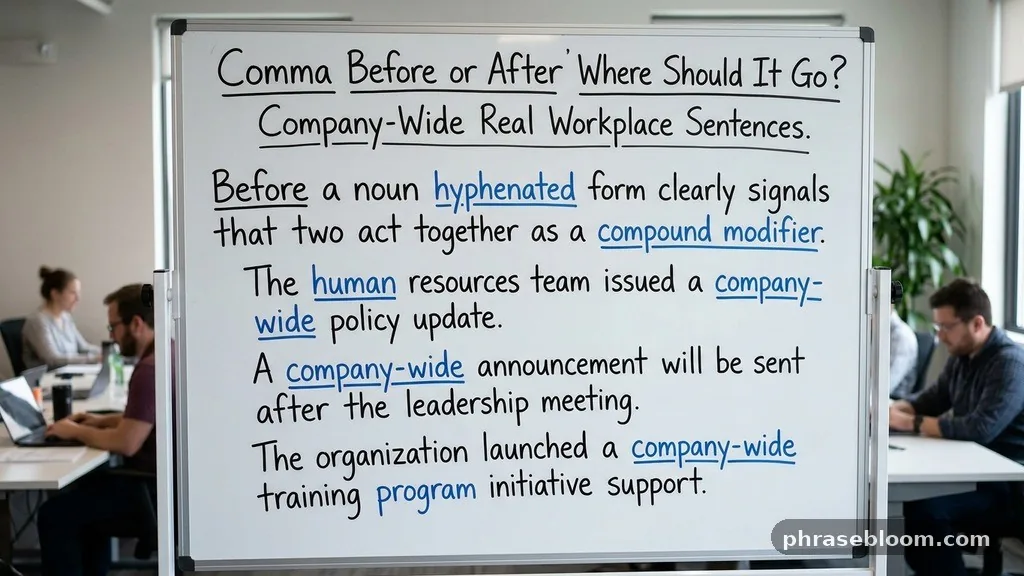
Before a noun, the hyphenated form clearly signals that the two words act together as a compound modifier:
- The human resources team issued a company-wide policy update.
- A company-wide announcement will be sent after the leadership meeting.
- The organization launched a company-wide training program.
- The initiative supports a company-wide change in reporting procedures.
- The technology group scheduled a company-wide software rollout.
Each example uses the expression directly before a noun. The hyphen helps readers process company-wide as one descriptive unit rather than as two unrelated words.
The closed form also works if it matches the organization’s style:
The companywide policy update takes effect on July 1.
Companywide training begins next month.
The report measures the results of several companywide initiatives.
In an email, either form can be natural:
Please complete the company-wide survey by Friday.
Please complete the companywide survey by Friday.
Choose one form and use it consistently in the subject line, message body, attachment, and related documentation. Switching between forms without a reason can make a document appear lightly edited, even though both spellings are understood.
For public communication, alternatives may sound more direct:
The new benefits apply across the company.
All employees throughout the company will receive access.
These rewrites remove the hyphenation decision and may be especially helpful for short announcements, software labels, or headlines where compact wording matters.
Can Company-Wide Appear After a Verb?
Yes. The expression can appear after a linking verb as a predicate adjective:
The new policy is company-wide.
In this sentence, company-wide describes the policy. It is not placed before a noun, but the hyphenated form remains a clear and widely used choice.
It can also appear in an adverbial role to describe the scope of an action:
The new system was introduced company-wide.
The changes apply company-wide.
Some style systems prefer companywide in these positions because the term has developed into a closed compound. Others retain the hyphen for readability. The grammatical position does not create a universal answer by itself.
Compare the forms:
- The policy is company-wide. Predicate adjective describing the policy.
- The policy applies company-wide. Adverbial expression describing where or to whom it applies.
- The companywide policy applies to every department. Closed compound modifier before a noun.
- The policy applies across the company. Open phrase that avoids the spelling issue.
Some writers prefer throughout the company after a verb because its meaning is immediately transparent:
The new system was introduced throughout the company.
That version is not more correct in every context, but it can be more natural when the sentence emphasizes distribution rather than the adjective itself.
American English, British English, and House Style
Neither company-wide nor companywide should be treated as exclusively American or exclusively British. Both forms can be encountered across varieties of English, and usage may differ among publishers, dictionaries, industries, and organizations.
English compound words often develop over time. A phrase may begin as two words, become hyphenated as readers start treating it as a unit, and eventually appear as a closed compound. Not every word follows that path at the same speed, and different editorial authorities may make different choices.
That history explains why a style guide matters. A business may use companywide in its employee handbook, website, and software interface because its house style favors closed compounds. Another may retain company-wide in all formal documents.
Audience also matters. American English business writing often favors familiar workplace compounds, while British English publications may make different choices about hyphenation and quotation punctuation. Those tendencies do not create a simple rule that determines the spelling in every case.
For formal writing, use this order of priority:
- Follow a mandatory style guide or legal drafting standard.
- Follow the organization’s established house style.
- Check the preferred form in a current dictionary or editorial reference.
- Choose the clearest form for the audience.
- Use the same form throughout the document.
Consistency is more valuable than personal preference. If a report begins with company-wide training, do not switch to companywide training on the next page unless the change reflects a deliberate editorial decision.
Alternatives That Avoid the Hyphenation Question
Sometimes the best solution is a rewrite. Alternatives can make a sentence clearer, shorten a headline, or avoid a form that conflicts with an established style.
- Across the company: The survey was distributed across the company.
- Throughout the company: The security update is required throughout the company.
- Across the organization: The policy applies across the organization.
- Organization-wide: The organization-wide initiative begins in September.
- Enterprise-wide: The enterprise-wide platform will replace several older systems.
- For all employees: The training is required for all employees.
Across the company is often conversational and direct. Throughout the company emphasizes broad distribution or coverage, while across the organization works well when the entity includes subsidiaries, departments, or nonprofit units that may not be described as one company.
Organization-wide and enterprise-wide are useful when “company” is too narrow. An enterprise-wide security standard may apply to several business units, while an organization-wide policy may include employees, volunteers, and affiliated offices.
Rewriting can also improve a sentence that uses an awkward post-verb construction:
Less direct: The change was implemented company-wide.
Clear alternative: The change was implemented across all departments.
Neither version is automatically superior. Select the wording that best communicates scope and matches the document’s tone.
Common Comma Placement Mistakes
Comma errors often result from applying a rule mechanically. Writers may add a comma wherever they hear a pause, omit a comma because a sentence sounds short, or place punctuation beside a familiar word without checking the sentence structure.
Here are frequent problems and practical corrections:
- Comma splice: The policy changed, employees received a new form. Correct it with a conjunction, semicolon, or period.
- Missing introductory comma: After the meeting ended employees returned to work. Add a comma after ended.
- Unnecessary comma between subject and verb: The revised policy, applies to contractors. Remove the comma.
- Missing comma around extra information: The manager who joined last year approved the request. Add commas only if the clause is nonrestrictive and not needed to identify the manager.
- Incorrect conjunction comma: The team reviewed the file, and approved the final copy. Remove the comma if and joins two verbs with one subject.
- Misplaced quotation comma: The director said, “The project is complete”, before leaving. In American English, place the comma inside the quotation marks.
- Unclear list punctuation: The plan covers hiring, training and compliance reporting. Decide whether your style uses the Oxford comma and apply it consistently.
A comma can also change meaning. Compare Let’s thank the managers, who supported the project with Let’s thank the managers who supported the project. The first sentence refers to all the managers and adds a comment; the second identifies only the managers who provided support.
Proofreading should therefore focus on relationships, not just pauses. Ask whether the words after the comma are essential, introductory, parenthetical, or part of a separate independent clause.
A Practical Method for Choosing Comma Placement
When you are unsure whether the comma goes before or after a word, use a short diagnostic process. It works in professional writing as well as in academic and everyday sentences.
- Find the main clause. Identify the subject and verb that carry the central message.
- Check for an introductory element. If a phrase or dependent clause comes first, a comma will often follow it.
- Check for two independent clauses. If a coordinating conjunction joins them, a comma will usually come before the conjunction.
- Test optional information. If a clause can be removed without changing which noun you mean, it may be nonrestrictive and require commas.
- Look for a list. Separate three or more parallel items and follow your chosen Oxford comma style.
- Check the house style. Apply the rules used by your employer, school, publisher, or client.
- Read for meaning. If the punctuation creates an unintended interpretation, revise the sentence.
Suppose you write: Because the supplier changed the schedule the installation moved to Monday. The opening is a dependent clause, so add a comma after schedule.
Now consider: The supplier changed the schedule because the installation moved to Monday. The dependent clause comes second and is closely connected to the main clause, so no comma is normally needed.
For a difficult sentence, rewrite it rather than forcing punctuation into a crowded structure. Two clear sentences often communicate better than one sentence packed with clauses, parenthetical expressions, and multiple commas.
Professional and Academic Writing Guidance
In business emails, use the punctuation that makes the action and responsibility clear. After reviewing the proposal, please send your comments is easier to process than a sentence with an unmarked introductory phrase.
In employee handbooks and policy documents, consistency is especially important. A misplaced comma can blur whether a requirement applies to every employee or only to a defined group, particularly when a restrictive clause is involved.
Legal and compliance writing requires extra care because punctuation may affect scope. Do not rely on a general comma rule when a sentence contains exceptions, conditions, or multiple modifiers. If the meaning is important, restructure the sentence and obtain the appropriate review.
Business reports benefit from restrained punctuation. Use commas to show structure, not to create dramatic pauses. A sentence such as The results were positive, but additional testing is required clearly contrasts two independent clauses without overloading the reader.
Websites and marketing materials may use shorter sentences and occasional fragments, but the same clarity principles still apply. Headings often omit commas for compactness, while body copy should maintain standard punctuation.
Software interfaces need special attention because labels have limited space. Instead of squeezing a long introductory phrase into a button or notification, rewrite the text: Submit after reviewing all fields may work better than a sentence with complex comma placement.
Academic writing should follow the required style guide. APA, MLA, Chicago, and institutional guidelines may differ in details such as the Oxford comma, quotation punctuation, and treatment of parenthetical material. The important practice is to identify the applicable standard before editing the final draft.
Examples You Can Copy and Adapt
The following sentences show common patterns in realistic workplace and academic contexts:
- Before a coordinating conjunction: The audit is complete, but the recommendations need management approval.
- After an introductory phrase: After receiving the final data, the research team updated the table.
- After an introductory clause: Because the vendor changed its terms, the procurement team reopened negotiations.
- Without a comma before a shared verb: The coordinator reviewed the forms and submitted the report.
- With a nonrestrictive clause: The quarterly report, which includes international sales, is available online.
- With a restrictive clause: Reports that contain confidential data require additional approval.
- With direct address: Priya, please send the revised schedule before noon.
- With an appositive: Marcus Chen, the project sponsor, approved the revised budget.
- With an Oxford comma: The meeting covered staffing, costs, timelines, and risk controls.
- With quotation marks: “Please review the attachment,” the coordinator wrote.
- With a comma splice corrected: The deadline changed, so the team adjusted the testing plan.
- With a parenthetical expression: The proposal, in its current form, does not address accessibility.
Notice that each comma has a job. It does not appear merely because the sentence sounds as if it contains a pause.
Frequently Asked Questions
Should the comma go before or after a conjunction?
Put the comma before a coordinating conjunction when it joins two independent clauses: The team finished the draft, and the editor reviewed it. Do not usually add the comma when the conjunction joins only words or verb phrases.
Should there be a comma after an introductory phrase?
Usually, yes. Write After the meeting, the director called the client. The comma marks the end of the introductory phrase and helps readers find the main clause.
What is a comma splice?
A comma splice joins two independent clauses with only a comma. Correct it by adding a coordinating conjunction, using a semicolon, or separating the clauses into two sentences.
Do nonrestrictive clauses need commas?
Yes. A nonrestrictive clause provides extra information and should generally be enclosed by commas: The policy, which was revised in May, applies to contractors. Do not use commas when the clause identifies which noun you mean.
Does the Oxford comma matter?
The Oxford comma is the comma before the final conjunction in a list. Some styles require it, while others omit it when the meaning is clear. Follow the relevant style guide and use the same approach throughout your document.
Final Guidance on Comma Before or After
The answer to a Comma Before or After question comes from grammar and meaning. Place a comma before a coordinating conjunction when it joins two independent clauses, after an introductory element, and around information that is extra rather than essential.
When a sentence still feels uncertain, identify the clauses and rewrite for clarity. A consistent style guide, careful proofreading, and attention to the reader will solve most punctuation problems before they reach an email, report, or published document.
1 thought on “Comma Before or After: Where Should It Go?”