
The difference between unalienable vs inalienable is mainly one of spelling, history, and context rather than meaning. Both words describe rights that cannot properly be given away, transferred, or taken from a person, although unalienable is the form used in the Declaration of Independence and inalienable is common in modern legal, academic, and general writing.
Neither spelling is automatically wrong. In formal writing, choose the form that fits your audience, quotation, or style guide, then use it consistently. The explanation below covers the definition, etymology, legal terminology, historical usage, and practical sentence patterns that help distinguish the two forms.
The Direct Answer: Unalienable or Inalienable?
Unalienable and inalienable generally have the same basic meaning: incapable of being surrendered, transferred, sold, or taken away. Both can describe fundamental rights that belong to people by virtue of their humanity rather than because a government or institution has granted them.
The safest choice depends on what you are writing. Use unalienable when quoting or discussing the wording of the United States Declaration of Independence, which refers to “unalienable Rights.” Use inalienable for most contemporary legal, academic, policy, and general contexts unless a house style says otherwise.
| Form | Basic meaning | Typical use | Practical advice |
|---|---|---|---|
| Unalienable | Unable to be surrendered or transferred | Historical and constitutional discussion | Use for the Declaration’s wording or where an established style prefers it |
| Inalienable | Unable to be surrendered or transferred | Modern legal, academic, and formal writing | A dependable general-purpose choice |
| Alienable | Capable of being transferred or surrendered | Property, contractual, or legal contexts | Use as the contrasting term |
The two words should not be treated as completely different legal concepts. In most sentences, the distinction is a spelling variant shaped by etymology, historical preference, and editorial convention.
What Unalienable Means
Unalienable means not capable of being alienated. In older legal language, “alienate” could mean to transfer ownership, convey property, or give up a right. An unalienable right, therefore, is one that cannot legitimately be removed from its holder through an ordinary transaction or voluntary surrender.
The word is especially associated with the Declaration of Independence. Its second paragraph states that “all men are created equal” and are “endowed by their Creator with certain unalienable Rights,” including “Life, Liberty and the pursuit of Happiness.” The document’s spelling is part of its historical identity.
That historical association gives unalienable a distinctive rhetorical force. A writer discussing the Declaration, Thomas Jefferson’s drafting, or the political language of the eighteenth century may deliberately retain the original form instead of replacing it with the more familiar modern spelling.
The prefix “un-” has a straightforward negative sense. It suggests that something cannot be alienated, just as “unbreakable” describes something that cannot be broken. That transparent construction may have helped the form remain recognizable in historical and political writing.
Unalienable rights in historical writing
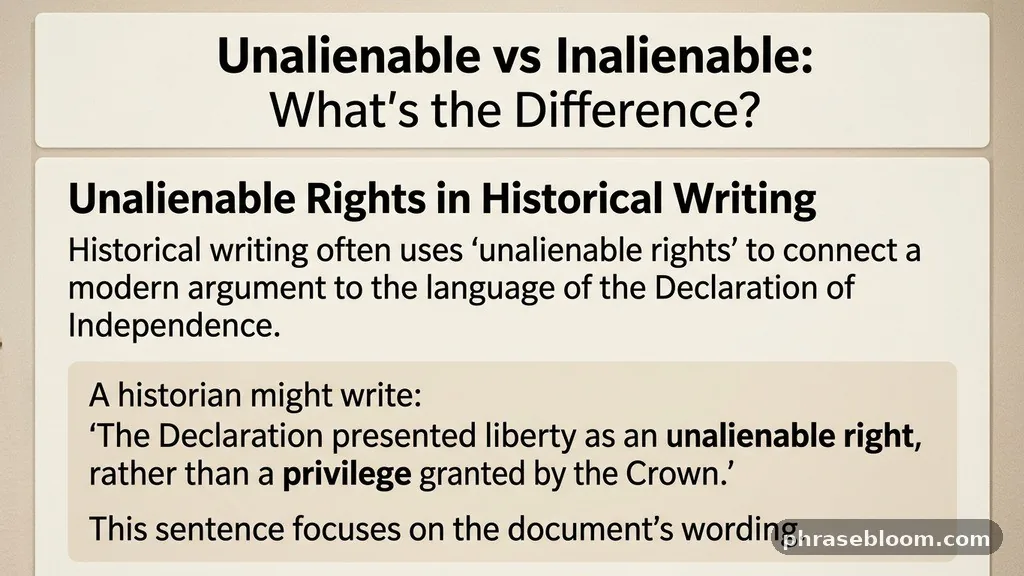
Historical writing often uses unalienable rights to connect a modern argument with the language of the Declaration of Independence. For example, a historian might write, “The Declaration presented liberty as an unalienable right rather than a privilege granted by the Crown.” The sentence focuses on the document’s wording and political theory.
A museum label, classroom lesson, or scholarly essay may also preserve the spelling because changing it would blur an important textual detail. When the exact language of a primary source matters, the original spelling should normally remain intact.
- Historical quotation: “The Declaration refers to unalienable Rights.”
- Historical analysis: “The phrase expressed a theory of rights that preceded government.”
- Modern adaptation: “The author describes privacy as an inalienable right.”
These examples show why context matters. The historical form is not merely an archaic error, while the modern form is not a rejection of the Declaration. Each can be appropriate for a different communicative purpose.
What Inalienable Means
Inalienable has the same central meaning as unalienable: it describes something that cannot be alienated, transferred, or surrendered. The word is widely used in discussions of human rights, natural rights, personal dignity, civil liberties, and fundamental freedoms.
The prefix “in-” also means “not” in this context. Inalienable therefore means not alienable. The difference is morphological and historical, not usually conceptual.
Modern writers frequently use phrases such as inalienable rights, inalienable dignity, and inalienable freedoms. These expressions appear in legal commentary, philosophy, international human-rights discussions, constitutions, public policy, and formal speeches.
“Inalienable” can sound slightly more conventional in contemporary professional writing because many readers encounter it in current legal and academic texts. That does not make it universally superior. A writer referring specifically to the Declaration may still need unalienable.
Inalienable in legal and political language
Legal terminology often uses “inalienable” to express the idea that certain rights are inherent rather than granted by contract. For example, a policy might state that every person possesses inalienable rights to bodily autonomy and equal treatment, subject to the precise legal framework governing those rights.
Care is important here. Calling a right inalienable does not automatically settle every legal dispute about how that right operates. Courts, statutes, constitutions, and international instruments may define its scope, limits, enforcement mechanisms, and relationship to other rights.
The word expresses a principle. It does not replace legal analysis.
In general writing, “inalienable” can also describe something other than a legally enforceable right. A philosopher may call dignity inalienable, while a political theorist may describe freedom as inalienable. The surrounding argument determines whether the word is being used philosophically, morally, historically, or legally.
Unalienable vs Inalienable in the Declaration of Independence
The Declaration of Independence is the most familiar reason people ask about unalienable vs inalienable. The document uses the spelling “unalienable,” and that form appears in the well-known passage about life, liberty, and the pursuit of happiness.
Readers should preserve that spelling when quoting the document directly. A sentence such as “The Declaration identifies life, liberty, and the pursuit of happiness as unalienable Rights” accurately reflects the historical text, while “The Declaration identifies them as inalienable rights” is a modernized paraphrase.
Both sentences can be acceptable, but they do different jobs. The first foregrounds the original wording. The second communicates the idea in the spelling more common in much contemporary prose.
The National Archives provides a reliable transcription and image of the Declaration of Independence transcript, which is useful when exact wording matters.
What Thomas Jefferson’s wording does and does not prove
The Declaration’s use of unalienable does not prove that inalienable is incorrect. It proves that the document’s chosen spelling was unalienable. Historical documents often preserve forms that coexist with later or parallel variants.
Nor does the Declaration establish that every modern writer must use unalienable. A legal textbook discussing natural rights may reasonably use inalienable throughout, particularly if that is the form used by its publisher or relevant sources.
The same principle applies to capitalization. In a direct quotation, a writer may reproduce the document’s capitalization. In ordinary modern prose, “unalienable rights” and “inalienable rights” are usually written with lowercase initial letters unless they begin a sentence or form part of a title.
Historical spelling and modern paraphrase
Use the historical spelling when precision about the primary source is central. Use the modern spelling when the source is being explained rather than quoted and the audience benefits from current general usage.
- Direct quotation: The Declaration calls these “unalienable Rights.”
- Historical paraphrase: The Declaration presents certain rights as unalienable.
- Modern discussion: Many political philosophers describe human rights as inalienable.
- Editorial explanation: Unalienable and inalienable are spelling variants with substantially the same meaning.
This approach avoids a common mistake: treating the historical spelling as the only valid form or assuming the modern spelling changes the underlying idea.
Unalienable and Inalienable: Etymology and Meaning
Both words are built around alienable, which comes from the idea of making something alien or transferring it to another person. The related legal verb “alienate” has long been used for the transfer of property, title, interests, or rights.
In this context, “alienation” does not mean hostility toward foreigners. It refers to a change in ownership or control. A piece of property may be alienable if it can be sold or conveyed, while a right may be described as inalienable if its holder cannot validly transfer it away.
The prefixes create the negative meaning. “Unalienable” uses un- plus alienable, while “inalienable” uses in- plus alienable. English contains many pairs in which different negative prefixes produce forms with overlapping meanings.
The spelling difference may also reflect a broader history of English word formation. Words change through translation, borrowing, pronunciation, editorial preference, and repeated use. Once a form becomes established in a major historical document, it may remain prominent even when another form becomes more common in later prose.
Alienable as the contrasting term
Alienable is useful for understanding both variants. If an interest is alienable, it can generally be transferred, assigned, sold, or otherwise conveyed, subject to the applicable law and contract terms.
For example, a leasehold interest might be alienable under certain conditions, while a personal human right is often described as inalienable. The comparison is not always simple, because laws can restrict transfers even when an interest is not inherently inalienable.
That distinction explains why “inalienable” should not be used casually as a synonym for “important.” An inalienable right is not merely valuable. The word makes a specific claim about whether the right can be surrendered or transferred.
Likewise, “unalienable” is not a general synonym for “permanent” in every sentence. A permanent benefit, contractual promise, or policy may still be legally modified if the relevant agreement or law allows it.
How to Use the Words in Real Sentences
The best way to understand the usage is to examine realistic contexts. Both forms can function as adjectives before a noun, and both can describe a principle, right, freedom, or status. The choice usually reflects style or context rather than a change in meaning.
Before a noun
In the phrase inalienable rights, “inalienable” modifies the noun “rights.” The same structure appears in “unalienable freedoms” and “inalienable human dignity.”
- The charter recognizes inalienable rights belonging to every resident.
- The lesson examined the Declaration’s reference to unalienable Rights.
- The organization describes personal dignity as an inalienable value.
- The court considered whether the claimed freedom was truly inalienable.
- The essay connects natural rights with the idea of unalienable liberty.
All of these examples use the word adjectivally. The noun that follows tells readers what is being described as incapable of transfer or surrender.
In formal and academic prose
An academic writer might choose inalienable in a discussion of political philosophy: “The theory holds that people possess inalienable rights before the formation of government.” A historian might instead write, “The Declaration’s authors described these as unalienable rights.”
The first sentence uses current analytical language. The second highlights a historical source. Neither choice creates a different theory by itself.
In public communication
A nonprofit could state, “Every person deserves respect for their inalienable dignity.” A civic education program might say, “Students will examine how the Declaration described rights as unalienable.” The audience and purpose guide the spelling.
Business writing uses these words less often than legal or political writing, but they may appear in ethics statements, human-rights commitments, accessibility policies, and corporate governance documents. In those settings, clarity matters more than displaying historical vocabulary.
Grammar, Predicate Use, and Adverbial Use
Many questions about this topic focus on whether the word can appear after a noun or verb. It can. The grammatical position may affect punctuation and hyphenation, although the underlying meaning remains stable.
Predicate adjective use
In the sentence “The right is inalienable,” the adjective follows a linking verb and describes the subject. This is called a predicate adjective. The same pattern works with the historical spelling: “The right is unalienable.”
When the adjective appears after the noun, it is not normally hyphenated because it is not forming a compound modifier directly before another noun. The natural sentence is:
The policy recognizes that privacy is inalienable.
A historical discussion could use:
The Declaration presents liberty as unalienable.
Adverbial use
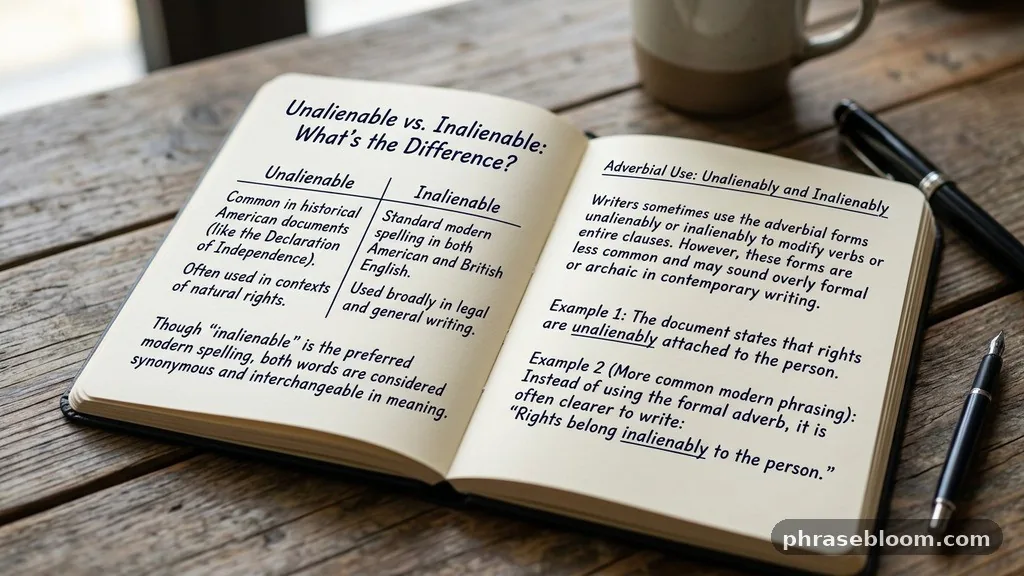
Writers also use “inalienably” or “unalienably” as adverbs, though these forms are less common and may sound formal. An adverb modifies a verb or an entire clause, as in “The rights are unalienably attached to the person.”
In many cases, rewriting produces clearer English. Instead of “The rights belong unalienably to every person,” write “The rights belong inherently to every person” or “The rights cannot be transferred from the person.” The best alternative depends on the intended meaning.
Some writers use the adjective in a broader adverbial phrase, such as “The principle applies inalienably.” That construction may be grammatically understandable but is less natural than a clearer sentence explaining what cannot be transferred.
Before a noun and hyphenation
Because inalienable and unalienable are single adjectives, they do not need an internal hyphen. Write “inalienable rights,” not “in-alienable rights.” The spelling itself already shows that the prefix and base word form one adjective.
The question of a hyphen usually arises because readers confuse this issue with compounds such as “rights-based” or “state-created.” Inalienable is not normally written with a hyphen in ordinary use.
American English, British English, and Style Preferences
It would be misleading to claim that unalienable belongs exclusively to American English or that inalienable belongs exclusively to British English. Both forms have appeared across varieties of English, and neither spelling can be assigned neatly to one national standard.
American usage is strongly influenced by the Declaration of Independence, which makes unalienable especially recognizable in United States history and civic education. That historical prominence does not prevent American writers from using inalienable in legal, philosophical, and contemporary political contexts.
British and international writers may encounter both variants as well. Their choice may depend on a dictionary, publisher, academic department, legal tradition, or institutional style guide. A British writer discussing the American Declaration may preserve unalienable, while a writer on international human rights may prefer inalienable.
Why house style matters
A house style is the set of editorial decisions an organization applies across its publications. It may specify preferred spellings, capitalization, quotation practices, and treatment of historical terms.
If a university department consistently uses inalienable, follow that choice in its reports and course materials. If a museum label preserves the Declaration’s exact language, use unalienable for that historical reference. Consistency helps readers understand that the variation is deliberate rather than accidental.
A style guide may also tell writers when to modernize quotations, how to identify omissions, and whether to retain original spelling. Those instructions should take priority over personal preference.
Formal writing recommendations
For formal writing without a relevant historical quotation, inalienable is a practical default. It is familiar, current, and suitable for legal commentary, academic prose, policy writing, and professional communication.
For a direct quotation from the Declaration, use unalienable. If you are paraphrasing the document, either form may work, but unalienable keeps the historical connection visible.
Do not alternate between the two spellings simply to make prose look varied. In this case, variation can appear to signal a distinction that the writer does not intend.
Alternatives That Avoid the Spelling Question
Sometimes the clearest solution is to rewrite the sentence. Alternatives can also help when the audience may not know the word or when the legal claim needs more explanation than one adjective can provide.
| Expression | Best use | Example |
|---|---|---|
| Inalienable right | Formal legal or philosophical writing | The author describes privacy as an inalienable right. |
| Unalienable right | Historical or Declaration-related writing | The text echoes the Declaration’s language about unalienable rights. |
| Inherent right | Plain formal prose | The policy recognizes an inherent right to personal dignity. |
| Right that cannot be surrendered | Maximum clarity for general readers | The agreement protects a right that cannot be surrendered. |
| Right belonging to every person | Accessible public communication | The statement affirms a right belonging to every person. |
Inherent is often a useful synonym, but it is not perfectly identical. Inherent means naturally belonging to something, while inalienable emphasizes that the right cannot be transferred or surrendered. Use “inherent” when origin or essential character matters more than transferability.
“Fundamental rights,” “natural rights,” and “human rights” are related expressions, but each carries its own legal or philosophical associations. A writer should choose the term that matches the argument rather than treating all four as interchangeable.
Plain-language alternatives can be especially valuable in employee communications, public notices, and introductory educational materials. “Rights that cannot be taken away” is immediately understandable, though it may simplify a complicated legal position.
Common Mistakes and How to Avoid Them
The most common mistake is treating one spelling as correct in every context and the other as an error. That approach ignores the historical evidence and the role of editorial style.
Changing spelling without a reason
A report may use “inalienable rights” in one section and “unalienable rights” in another. The change may not be grammatically wrong, but it can suggest an intended difference in meaning. Choose a form and apply it consistently unless a quotation requires the other spelling.
Modernizing a quotation silently
Changing “unalienable” to “inalienable” inside a direct quotation alters the source’s wording. If the exact quotation matters, retain the original spelling. If you modernize or paraphrase, make clear that the sentence is not a verbatim quotation.
Confusing importance with inalienability
Not every important right is inalienable. The term concerns whether a right can be alienated, not simply whether the writer values it. If the legal or philosophical point is only that a right is essential, “fundamental” may be more accurate.
Using alienation too broadly
In legal terminology, alienation often concerns transfer or surrender. It does not automatically mean destruction, restriction, or violation. A government may violate a right without legally transferring it to someone else, so the word should be used with precision.
Overusing formal vocabulary
“Inalienable” can be appropriate, but it may sound abstract in a short workplace message. If employees need a direct instruction, “This protection cannot be waived under the policy” may communicate more clearly than “This protection is inalienable.”
A Practical Decision Method for Writers
You can usually choose the right form by following a short process. Start with the sentence’s purpose, then check the relevant style expectations.
- Ask whether history is central. If you are quoting or closely discussing the Declaration of Independence, use unalienable for the source’s wording.
- Check the organization’s style. A publisher, law firm, university, or government office may have a preferred spelling.
- Choose a modern default if no style applies. Inalienable is a practical choice for many contemporary formal contexts.
- Confirm the intended meaning. Use the word only when you mean that a right cannot be transferred or surrendered.
- Consider a clearer alternative. “Cannot be surrendered” may serve general readers better.
- Review the whole document. Search for both spellings and decide whether the variation is intentional.
This method separates three issues that are often confused: meaning, historical spelling, and editorial preference. The word’s definition comes first, but style and audience determine the most effective presentation.
For international audiences, a brief explanation may help. For example, “The term inalienable means that the right cannot be transferred or surrendered; the historical Declaration of Independence uses the spelling unalienable.” One sentence can prevent unnecessary confusion.
Professional, Academic, and Workplace Usage
In a business email, use the form your organization already uses. If no house style exists, “inalienable” is suitable for a formal statement, while a plain-language alternative may be better for routine communication.
An employee handbook might say, “Employees retain inalienable rights to equal treatment under applicable law.” It could also say, “Employees have rights that cannot be surrendered through this policy.” The second version is easier for readers who are unfamiliar with legal vocabulary.
A legal or policy document requires special care. “Inalienable” should not be inserted merely to make a provision sound authoritative. The document should identify the source and legal scope of the right, especially if the provision could affect contracts, consent, privacy, employment, or access to services.
Academic writers should follow the terminology used by their field and sources. A paper on the Declaration may distinguish the original word unalienable from later usage, while a paper on human-rights theory may use inalienable consistently as its central term.
Websites and marketing materials should prioritize clarity. If the word appears in a public-facing mission statement, decide whether the audience will understand it without explanation. “Every person has an inalienable right to dignity” is formal and concise, while “Everyone deserves dignity that cannot be taken away” is more direct.
Internal software interfaces rarely need either term. A button, alert, or workflow instruction should state the action plainly. The abstract adjective belongs in explanatory policy text, not necessarily in a short user-interface label.
Examples You Can Copy and Adapt
The following examples show how writers can use both variants without implying that they have different basic meanings.
- The organization recognizes that every person has inalienable rights.
- The lesson explains why the Declaration uses the word unalienable.
- Our policy protects a right that employees cannot voluntarily surrender.
- The speaker connected human dignity with inalienable freedom.
- The exhibit reproduces the Declaration’s reference to unalienable Rights.
- The article distinguishes legal rights from broader claims about natural rights.
- The committee described access to basic care as an inalienable human right.
- The author uses unalienable throughout when discussing eighteenth-century political language.
- The revised handbook uses inalienable in accordance with the organization’s house style.
- For general readers, the report explains that the right cannot be transferred or surrendered.
Notice that the spelling follows the purpose of each sentence. Historical references preserve the source’s identity, while contemporary statements use the form selected by the writer or institution.
When editing, read the complete paragraph rather than judging the word in isolation. A sentence about a historical document may need unalienable, while the next paragraph may discuss modern legal theory with inalienable. That change is acceptable if the reason is clear and the document does not create a false distinction.
Frequently Asked Questions
Is unalienable or inalienable correct?
Both are established forms with substantially the same meaning. Unalienable is especially associated with the Declaration of Independence, while inalienable is a common choice in modern formal, academic, legal, and general writing.
Is unalienable more correct than inalienable?
No. Unalienable is the correct form for the historical wording of the Declaration, but inalienable is not an incorrect replacement in ordinary modern prose. Follow the relevant quotation, style guide, or house style.
Is inalienable one word?
Yes. Inalienable is written as one word, and it does not normally contain a hyphen. Unalienable is also one word.
Can I write “the right is inalienable”?
Yes. In that sentence, inalienable is a predicate adjective following the linking verb “is.” The equivalent sentence with unalienable is also grammatically possible: “The right is unalienable.”
What should I use in professional writing?
Use the spelling required by your organization or applicable style guide. If there is no established preference, inalienable is a practical modern choice, but rewrite the sentence as “cannot be surrendered” when plain language would serve the audience better.
Conclusion
The practical answer to unalienable vs inalienable is that both forms are valid in established usage and normally express the same idea. Choose unalienable for the Declaration of Independence or another historical context that preserves the source’s wording; choose inalienable for many modern legal, academic, and professional contexts unless a style guide says otherwise.
Check the intended meaning, respect quotations, and apply one spelling consistently throughout your document. If the word feels too abstract, explain the principle directly by saying that the right cannot be transferred or surrendered.