
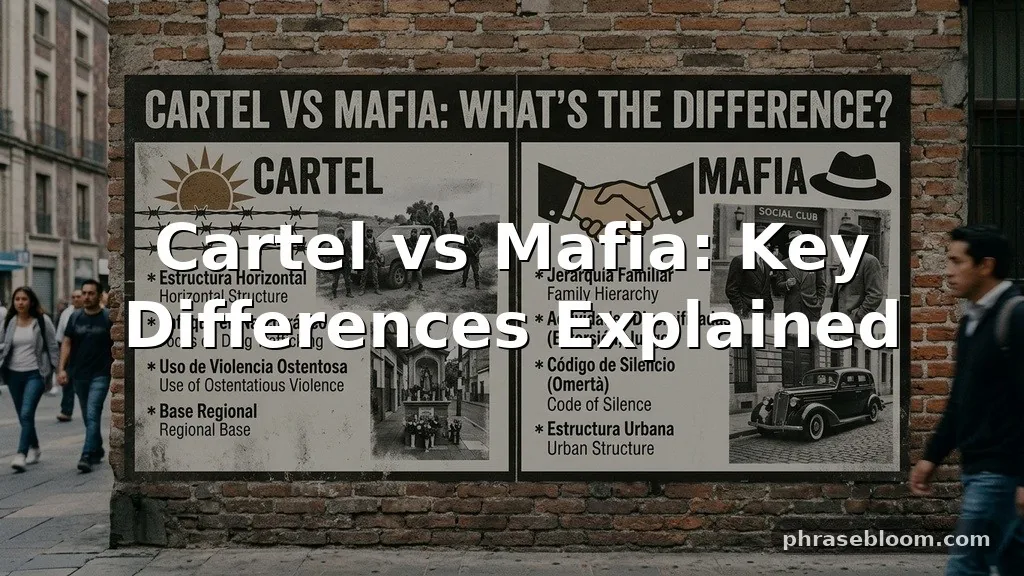
Cartel vs mafia is not simply a choice between two names for the same criminal group. Both can be forms of organized crime, but they usually differ in structure, history, operating methods, and relationships with territory and markets. A cartel commonly describes an alliance or network controlling an illegal market, especially drug trafficking, while mafia often refers to a hierarchical criminal organization built around families, loyalty, protection, and long-term local influence.
The categories overlap, and real groups do not always fit neatly into one box. The comparison becomes clearer when you examine leadership, recruitment, violence, corruption, money laundering, and the way each organization controls business and territory.
The Short Answer: Cartel vs Mafia
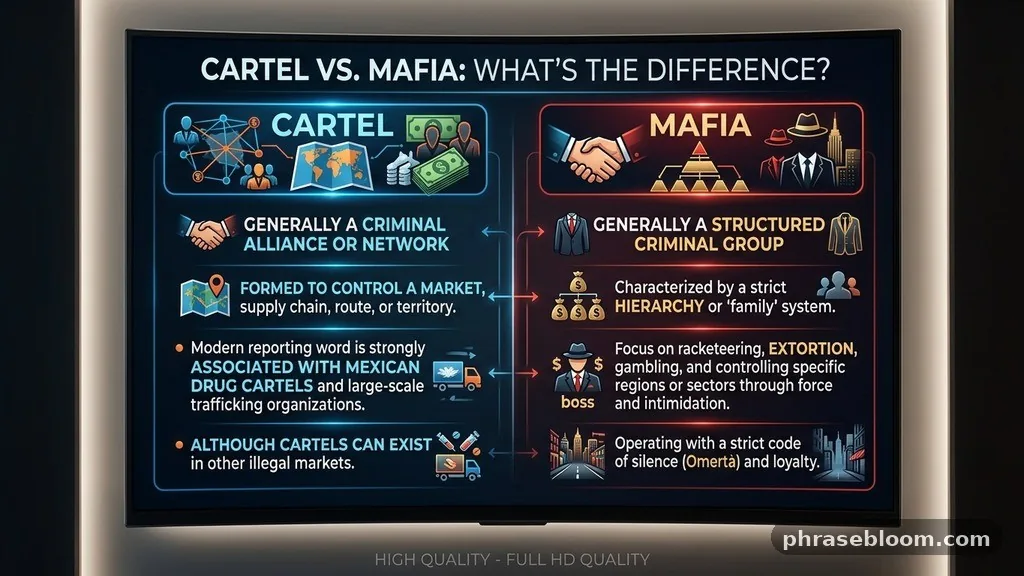
A cartel is generally a criminal alliance or network formed to control a market, supply chain, route, or territory. In modern reporting, the word is strongly associated with Mexican drug cartels and large-scale trafficking organizations, although cartels can exist in other illegal markets.
A mafia is generally a structured criminal society or syndicate that relies on hierarchy, secrecy, personal loyalty, intimidation, and influence over a particular community or region. The word can describe the Sicilian and Italian-American traditions specifically, but it is also used more broadly for crime families and similar organizations.
Neither term has one universal legal definition. A group called a cartel may contain several semi-independent factions, while a mafia group may participate in drug trafficking, smuggling, extortion, and financial crime. The most useful distinction is this: cartels are often described by the markets or networks they control, while mafias are often described by their social structure and system of power.
| Feature | Cartel | Mafia |
|---|---|---|
| Basic idea | An alliance or network controlling an illegal market, route, or territory | A durable criminal society organized around hierarchy, loyalty, and influence |
| Common association | Drug trafficking, smuggling, and territorial competition | Extortion, racketeering, corruption, protection schemes, and infiltration of legitimate business |
| Structure | May be centralized, federated, or divided into factions | Often organized through families, crews, ranks, and personal relationships |
| Geographic focus | Routes, production zones, ports, border crossings, and distribution markets | Neighborhoods, cities, regions, and business or political networks |
| Violence | Often linked to market competition, route control, and internal conflict | Often used for discipline, intimidation, enforcement, and protection |
| Practical takeaway | Think market-control network | Think organized criminal society or crime family |
What a Cartel Is
The word cartel originally described an agreement among independent parties to control competition or divide a market. In criminal contexts, it refers to organizations or alliances that coordinate illegal production, transportation, distribution, and profits. A drug cartel may control laboratories, supply routes, border crossings, wholesale distribution, or local retail networks.
Some cartels are relatively centralized, with senior leaders directing major operations. Others operate as loose federations in which regional cells, armed wings, transporters, financiers, and local distributors cooperate while retaining considerable independence.
This flexibility matters. If one leader is arrested or killed, a cartel may fragment into rival factions rather than disappear. The resulting conflict can involve disputes over territory, trafficking routes, money, and access to suppliers.
Cartels are often associated with the illegal drug trade because drug trafficking requires a wide supply chain. A major organization may depend on producers, chemists, pilots, drivers, maritime operators, corrupt officials, money brokers, and distributors in several countries.
That does not mean every cartel is identical or that the word applies only to narcotics. Criminal groups have used cartel-like arrangements for smuggling, counterfeit goods, migrant exploitation, weapons, and other illegal markets. The term emphasizes coordination and market control more than a single cultural identity.
What a Mafia Is
Mafia usually describes a criminal organization with a durable internal society. Its power may come from formal ranks, family relationships, initiation rituals, personal loyalty, shared codes, and a reputation for retaliation. A mafia group often seeks influence that lasts beyond one shipment or one criminal transaction.
The classic historical example is the Sicilian Mafia, often associated with Cosa Nostra. Related traditions developed in other settings, including the Italian-American Mafia, sometimes called La Cosa Nostra in the United States. These groups have been linked to extortion, illegal gambling, labor racketeering, loan sharking, corruption, murder, and infiltration of legitimate industries.
A mafia organization may collect payments from businesses in exchange for supposed protection. That practice is often called a protection racket, although the “protection” may be protection from the same group demanding the money.
Unlike a purely transactional criminal network, a mafia group often presents itself as a social order. Members may use kinship, initiation, silence, and obligations to create trust inside the organization. The code known as omertà is commonly associated with a refusal to cooperate with authorities, although actual behavior varies across groups and periods.
Mafia groups can also be commercially diverse. They may earn money from construction, waste management, gambling, trafficking, fraud, and control of contracts. Money laundering can then make criminal proceeds appear connected to restaurants, property, businesses, or financial transactions.
Structure and Leadership
The clearest difference in the cartel vs mafia comparison often appears in organizational design. A mafia is commonly portrayed as a hierarchy containing a boss, senior advisers, captains, crews, and lower-ranking members. The exact titles differ, but the underlying idea is a ranked chain of authority.
A cartel may use a hierarchy too, but its structure is often more networked. It can include production specialists, transport cells, armed units, local partners, corrupt intermediaries, and financial operators who do not all report to one central authority.
These are tendencies, not fixed rules. Some cartels have powerful central leaders, and some mafia organizations have decentralized factions that operate with considerable autonomy.
- Leadership: Mafia groups often emphasize rank, family authority, and personal allegiance; cartels may emphasize operational control and market access.
- Membership: Mafia groups may use initiation and long-term loyalty, while cartel networks may rely on contractors, local cells, and temporary alliances.
- Decision-making: Mafia organizations can use formal internal councils or chains of command; cartels may negotiate between factions or regional commanders.
- Continuity: A mafia identity may survive the loss of an individual leader, while a cartel may split when control of a route or market becomes contested.
- Relationships: Both can use family ties, corruption, coercion, and business contacts, but the balance differs from group to group.
Modern criminal organizations also adapt quickly. Encrypted communication, international finance, online fraud, and subcontracted violence can make old labels less precise. A group may have a mafia-style hierarchy at the center and a cartel-like network around it.
Territory, Markets, and Business
Cartels frequently compete over production zones, trafficking corridors, ports, border crossings, and distribution areas. Territory matters because control of a route can determine who receives drugs, weapons, money, and information. Competition may involve alliances, bribery, kidnapping, intimidation, and violence.
A mafia group may control territory in a different way. Instead of concentrating mainly on a trafficking corridor, it may seek influence over neighborhoods, unions, public contracts, businesses, officials, and local institutions. Its power can become embedded in ordinary economic activity.
The distinction is not absolute. Mafia organizations have controlled drug markets, and cartels have exercised political and social influence in communities. Still, the typical emphasis differs: cartel activity is often described through supply chains and market competition, whereas mafia activity is often described through protection, infiltration, and governance-like control.
For example, a cartel might demand payment from an independent distributor who wants to move illegal drugs through a region. A mafia group might demand recurring payments from restaurants, contractors, or shop owners and use threats to enforce compliance.
Both practices can involve extortion, corruption, and money laundering. The difference lies less in whether a particular crime occurs and more in the broader system surrounding it.
Violence and Enforcement
Violence appears in both cartel and mafia activity, but its strategic role can differ. Cartel violence is often connected to open competition for routes, production areas, distribution markets, and local dominance. Rival groups may fight over a port, border region, city, or supply chain.
That conflict can produce public displays of force, attacks on rivals, threats against officials, and attempts to intimidate communities. The level of violence varies greatly across organizations and periods, so it is inaccurate to treat every cartel as equally violent.
Mafia violence has historically been used to enforce silence, collect debts, punish disobedience, remove competitors, and protect a group’s reputation. A mafia organization may prefer intimidation and corruption when they are cheaper and less disruptive than open conflict.
Reputation matters to both models. If members cannot enforce agreements, suppliers, partners, and victims may stop cooperating. Violence, or the credible threat of it, can substitute for formal contracts in illegal markets.
At the same time, organized crime is not defined only by violence. Fraud, bribery, financial manipulation, smuggling, cybercrime, and legal-business infiltration can be central sources of income. The Federal Bureau of Investigation’s overview of organized crime describes a broad field that includes both traditional criminal groups and newer transnational networks.
History and Cultural Meaning
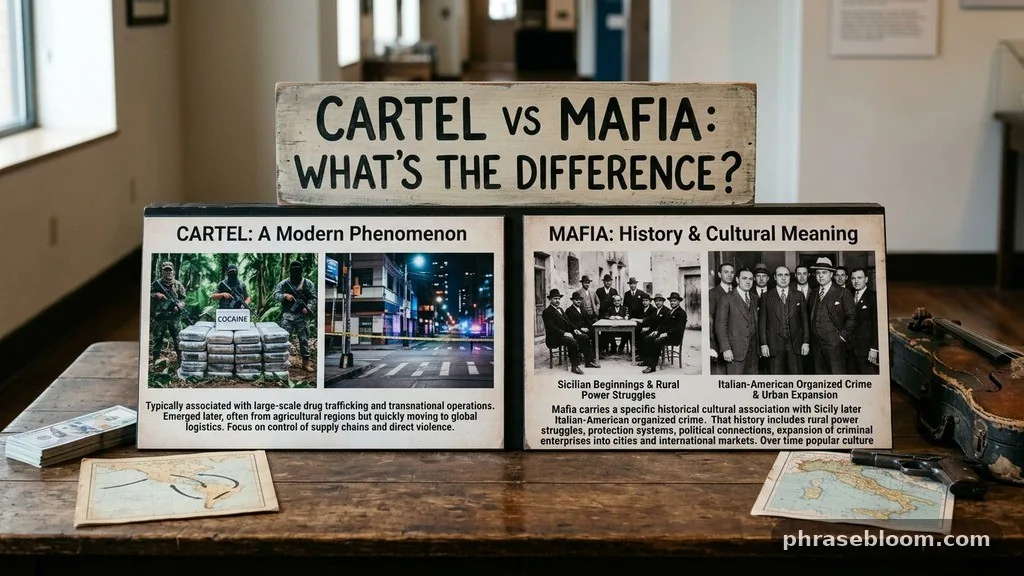
“Mafia” carries a specific historical and cultural association with Sicily and later with Italian-American organized crime. That history includes rural power struggles, protection systems, political connections, and the expansion of criminal enterprises into cities and international markets.
Over time, popular culture broadened the word. Films, television shows, novels, and news reports often use mafia to mean any secretive, hierarchical criminal society. That broader use can be convenient, but it may blur important differences between historical groups.
“Cartel” has a different history. In ordinary economics, a cartel is an agreement among businesses to limit competition, coordinate prices, or divide markets. In criminal reporting, the term became strongly associated with drug-trafficking organizations that manage cross-border supply chains.
This difference in origin explains why the words suggest different things. Mafia evokes family, ritual, secrecy, and local influence. Cartel evokes commodities, routes, suppliers, armed competition, and international distribution.
Neither popular image tells the whole story. A real criminal organization may use family connections and formal ranks while also controlling an international drug market. Labels help describe patterns, but they cannot replace evidence about the group’s actual activities.
Examples of Overlap
The question “cartel vs mafia” can become misleading if it assumes that the categories never overlap. Criminal organizations borrow methods from one another, cooperate when profitable, and change structure under pressure from law enforcement or rival groups.
A mafia group may enter the illegal drug trade because it already has distribution contacts, corrupt relationships, money-laundering channels, and local control. A cartel may build political influence, collect protection payments, and use community intimidation in ways associated with mafia-style power.
Some groups function as syndicates made up of semi-independent crews. Others create alliances that last only while the participants benefit. An organization can also shift from one model to another after leadership changes, arrests, market disruptions, or internal conflict.
Several factors make classifications difficult:
- Multiple revenue streams: A group may combine drug trafficking with fraud, extortion, smuggling, gambling, and illegal mining.
- Layered organization: Senior leaders may rely on both family-based members and independent contractors.
- Changing alliances: Rival groups can cooperate over logistics while competing over territory.
- Different definitions: Journalists, police agencies, courts, and researchers may use labels for different purposes.
- Public shorthand: A dramatic label may be used even when the group’s internal structure is more complicated.
For careful writing, describe the observed conduct first. Say that a group controls a trafficking corridor, collects protection payments, launders money, or coordinates multiple cells. The label should clarify those facts, not replace them.
Cartel vs Mafia in Law and Reporting
Legal systems do not always use cartel and mafia as precise, interchangeable legal categories. Prosecutors may charge individuals with conspiracy, racketeering, drug trafficking, extortion, money laundering, corruption, murder, or organized criminal activity. The formal charge often matters more than the popular label.
In the United States, racketeering laws can address patterns of criminal activity conducted through an enterprise. Other countries use different statutes and terminology. A group’s classification in a news report does not necessarily establish the legal elements required for a conviction.
Reporting choices also shape public understanding. A newspaper might call a group a cartel because of its control over cocaine shipments, while an investigator might describe it as a transnational criminal organization. Another source could emphasize its armed wing, financial network, or local political influence.
Careful reporting should distinguish allegations from established facts. It should also avoid suggesting that nationality, ethnicity, or family background automatically determines whether a group is a mafia or cartel. The relevant evidence concerns organization, conduct, leadership, markets, and relationships with institutions.
For students and professional writers, a useful approach is to define the term on first use. For example: “The report uses cartel to describe a network that coordinates drug trafficking routes.” That brief explanation prevents readers from assuming that all cartels have the same structure.
Which Term Should a Writer Use?
Choose the term that matches the evidence and the purpose of the writing. If the central issue is control of an illegal market or trafficking route, cartel may be appropriate. If the focus is a durable hierarchy involving families, protection rackets, corruption, and long-term territorial influence, mafia may be more accurate.
Do not use mafia as a dramatic synonym for any criminal group. A small smuggling crew, an online fraud ring, and a military insurgency may all commit serious crimes, but calling each one a mafia can obscure how it operates.
Likewise, cartel should not automatically mean a large drug organization. In economics, the word can describe cooperation among legitimate businesses, while in criminal reporting it usually carries a different meaning. Context determines the interpretation.
When precision matters, combine the label with a concrete description:
- “A transnational drug-trafficking cartel operating across several borders.”
- “A mafia-linked crime family accused of extortion and racketeering.”
- “A criminal syndicate coordinating smuggling and money laundering.”
- “A decentralized organized-crime network with several regional factions.”
This approach is stronger than relying on a label alone. It tells the reader what the organization does and how it is structured.
Common Misunderstandings
One common mistake is treating cartel and mafia as exact synonyms. They can overlap, but their usual emphases are different. A cartel is commonly understood through market control and network coordination, while mafia more often suggests a hierarchical criminal society.
Another mistake is assuming that mafia groups are always Italian or that cartels are always based in Latin America. Italian mafia traditions are historically important, and Mexican drug cartels are widely reported, but organized crime exists in many countries and forms.
It is also misleading to assume that a mafia is always more organized than a cartel. Some cartels have sophisticated command systems, financial operations, and international logistics. Some mafia groups are fragmented, decentralized, or internally unstable.
Finally, popular culture often exaggerates rituals, loyalty, and leadership titles. Real organizations may be less formal, more opportunistic, and more dependent on temporary relationships than fictional stories suggest.
How the Terms Apply to Modern Organized Crime
Modern organized crime increasingly operates across borders and sectors. A criminal organization may use social media for recruitment, shell companies for money laundering, corrupt officials for protection, and legitimate logistics businesses to move illegal goods.
Technology can weaken the old distinction between a mafia and a cartel. A group with a traditional hierarchy may outsource cybercrime, while a trafficking network may contract independent specialists for transportation, weapons, accounting, or violence.
Financial crime is particularly important because illegal profits must be stored, transferred, and converted into usable assets. Criminal networks may invest in property, businesses, luxury goods, or international accounts, although the specific methods differ by jurisdiction and group.
Corruption can also expand an organization’s reach. Bribed officials, compromised employees, and intimidated witnesses can reduce the need for constant violence. The most resilient groups may combine coercion with legitimate-looking business activity and political influence.
For that reason, researchers and investigators increasingly use broader terms such as transnational criminal organization or organized-crime network. These descriptions can be more accurate than forcing every group into a cartel-versus-mafia binary.
Frequently Asked Questions
Is a cartel the same as a mafia?
No. Both can be organized criminal groups, and they may engage in similar crimes, but cartel usually emphasizes market or route control while mafia usually emphasizes hierarchy, loyalty, protection, and long-term influence.
Are Mexican drug cartels mafias?
They may display some mafia-like features, such as territorial control, corruption, extortion, and hierarchical leadership. However, cartel is generally the more precise term when discussing organizations centered on drug trafficking networks and illegal-market control.
What is the Italian Mafia?
The phrase can refer broadly to Italian organized-crime traditions, including the Sicilian Mafia, ‘Ndrangheta, Camorra, and other groups. These organizations are not identical, so a specific name is preferable when the identity of the group is known.
Do cartels and mafias use violence?
Both may use violence, threats, and intimidation to enforce agreements, punish rivals, and control territory. Cartel violence is often associated with market and route competition, while mafia violence may be used for discipline, extortion, and protection, but real cases vary.
What is the safest term in formal writing?
Use the most specific term supported by evidence, then explain the group’s activities. If the classification is uncertain, “organized-crime network” or “criminal syndicate” may be more accurate than choosing cartel or mafia for dramatic effect.
Final Takeaway on Cartel vs Mafia
The practical difference in cartel vs mafia is one of emphasis, not an absolute dividing line. Cartel generally points to a network or alliance controlling an illegal market, supply chain, or territory, while mafia usually points to a durable criminal society built on hierarchy, loyalty, extortion, corruption, and influence.
Use the labels carefully, define them in context, and describe the conduct behind them. That approach produces a more accurate account of organized crime than treating cartel and mafia as interchangeable words.
Related reading: Unselect vs Deselect, Hassle vs Hastle, Continuous vs Continous.