

The difference between full proof and foolproof matters because the two expressions do not normally mean the same thing. If you mean “simple, reliable, and unlikely to fail,” the correct word is usually foolproof, written as one word.
Full proof is a separate phrase that means complete or sufficient evidence in a literal context. The hyphenated form full-proof is uncommon and usually should not replace foolproof. Understanding the distinction will help you avoid a common spelling mistake in business writing, academic work, instructions, emails, and everyday English.
Foolproof Is Usually the Correct Word
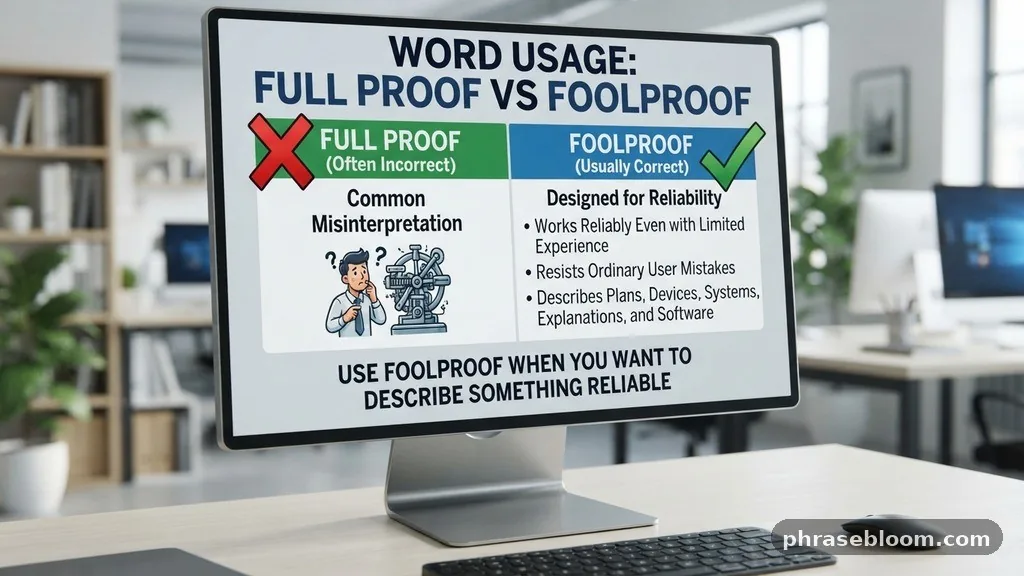
Use foolproof when you want to describe something designed to work reliably, even if the person using it has little experience or makes ordinary mistakes. The word can describe a method, plan, device, system, explanation, or set of instructions.
For example, “The software includes a foolproof backup process” means the backup process is easy to follow and unlikely to fail because of user error. In “She created a foolproof way to organize the files,” foolproof describes the method, not evidence or certainty in a legal sense.
The most useful rule is simple: if you mean reliable, fail-safe, or very easy to use, choose foolproof. It is a closed compound, meaning two words have joined to form one established word.
- Foolproof plan: a plan designed to prevent mistakes or failure.
- Foolproof instructions: instructions that are especially clear and easy to follow.
- Foolproof system: a system that limits the possibility of user error.
- Foolproof method: a method expected to work reliably in ordinary conditions.
The word does not literally accuse anyone of being a fool. In modern usage, it usually emphasizes the design of the thing being described. A foolproof form, checklist, or procedure is intended to be forgiving when people misunderstand a step or overlook a detail.
For a dictionary-based reference, the Merriam-Webster definition of foolproof confirms the word’s established meaning and standard spelling. Dictionaries are especially useful when a phrase sounds logical but may not be a recognized English word.
What Full Proof Means
Full proof can be correct when the words retain their ordinary meanings. Here, full is an adjective meaning complete, and proof is a noun meaning evidence or demonstration of truth. The phrase therefore refers to complete proof or a complete body of evidence.
For example, “The prosecution presented full proof of the transaction” uses full proof as a noun phrase. The sentence is grammatical, although a modern writer might choose the more natural “complete proof” or “conclusive evidence.”
In some specialized settings, especially older legal, religious, or philosophical writing, full proof may appear as a formal expression. Its meaning depends on the surrounding sentence. It does not automatically mean that a procedure is easy, safe, or impossible to perform incorrectly.
Compare these examples:
| Expression | Meaning | Example | Recommendation |
|---|---|---|---|
| foolproof | Reliable and easy to use | We need a foolproof method. | Use this for “unlikely to fail.” |
| full proof | Complete evidence or proof | The report provides full proof of the claim. | Use only when the literal meaning fits. |
| full-proof | Rare or improvised compound form | A full-proof system | Usually replace it with foolproof or fully proven. |
The distinction is therefore semantic as well as visual. Foolproof describes dependability or ease of use, while full proof refers to evidence that is complete. Confusing them can change the meaning of a sentence.
Foolproof vs Full Proof: The Meaning Difference
The easiest way to understand foolproof vs full proof is to identify what the expression modifies. If it modifies a tool, process, plan, or instruction, foolproof is probably the intended adjective. If it refers to evidence, documentation, or demonstration, full proof may be appropriate.
Consider the sentence “This is a full proof way to reset the device.” The writer probably means that the method is highly reliable. In standard modern English, “This is a foolproof way to reset the device” is the better choice.
Now consider “The investigator demanded full proof before approving the claim.” Here, the subject is evidence, so the separate phrase can make sense. The writer could also say “complete proof,” “sufficient evidence,” or “conclusive evidence,” depending on the intended level of certainty.
Meaning changes with the noun
Words surrounding the expression often reveal the intended meaning. A “foolproof recipe” is designed to produce reliable results, while “full proof of ownership” means complete evidence that someone owns something.
Here are several contrasts:
- “The engineer designed a foolproof safety system.” The system is intended to prevent mistakes.
- “The engineer supplied full proof of compliance.” The engineer supplied complete evidence.
- “The trainer gave us foolproof instructions.” The instructions are easy to follow.
- “The audit found full proof of the payment.” The audit found complete documentation.
The phrase full proof meaning is therefore not identical to the foolproof meaning. One concerns completeness of evidence; the other concerns resistance to error. The spelling difference reflects a difference in the compound’s history and established usage.
Is Foolproof One Word?
Yes. Foolproof is normally written as one word. It is a closed compound adjective, which means the original words have combined without a space or hyphen.
The same pattern appears in many familiar compounds, including “waterproof,” “childproof,” “tamperproof,” and “bulletproof.” These words describe something protected against a particular problem. Foolproof follows a similar pattern, although it refers to mistakes or poor handling rather than water or physical force.
In a sentence such as “The company needs a foolproof approval process,” the word comes directly before the noun “process.” It acts as a compound modifier. A compound modifier is a group of words that works together to describe a noun, but in this case the group has developed into one standard word.
The standard foolproof spelling does not require a hyphen. Writing “fool-proof” is not normally necessary in contemporary professional English, and writing “fool proof” as two words may look like a mistake when the intended meaning is “reliable.”
That does not mean every compound follows the same pattern. English compounds develop over time, and some remain open phrases, some use hyphens, and others become closed words. The correct form depends on established usage rather than on a single universal formula.
Is Full-Proof a Correct Spelling?
Full-proof is not the usual spelling for the meaning most people intend. A writer may create it by applying the logic of “waterproof” or “foolproof,” but that does not make it an established standard word.
If you write “a full-proof method,” most readers will understand that you mean “a method that cannot fail.” Still, the expression may look improvised, especially in a report, policy, academic paper, or client-facing document. Foolproof method is the established choice.
The hyphenated form can occasionally appear in creative or highly specialized writing as a temporary compound adjective. English allows writers to form new compounds when the meaning is clear. However, a possible formation is not automatically the best professional choice.
Use a clearer alternative if you want to emphasize complete validation rather than ease of use. Depending on the context, you might write:
- Fully tested procedure
- Thoroughly verified process
- Fail-safe design
- Reliable operating method
- Complete proof of compliance
- Conclusive evidence
These alternatives prevent the reader from guessing what full-proof is supposed to mean. Precision matters more than preserving a phrase that sounds familiar but is not firmly established.
Grammar and Compound-Adjective Usage
Foolproof is primarily an adjective. It usually appears before a noun, as in “a foolproof process,” but it can also appear after a linking verb, as in “The process is foolproof.” The spelling stays the same in both positions.
A linking verb connects the subject to a description. In “The procedure is foolproof,” the verb “is” links “procedure” with the adjective “foolproof.” Because foolproof is already a closed compound, its position does not require a new hyphenation pattern.
Examples include:
- “The installation guide provides a foolproof sequence of steps.”
- “The new sequence is foolproof for first-time users.”
- “We need a foolproof way to verify each account.”
- “The verification process appears foolproof under normal conditions.”
In each example, the word means reliable and resistant to ordinary mistakes. It does not mean that failure is metaphysically impossible. A “foolproof” system can still fail because of unusual conditions, defective equipment, missing information, or circumstances outside its design.
Foolproof as an adverbial idea
English speakers sometimes need an adverbial expression, meaning a phrase that describes how an action applies. “The new procedure was introduced foolproof” is not standard because foolproof is an adjective, not the usual adverb in that structure.
Better versions include “The new procedure was introduced in a foolproof way,” “The team introduced the procedure with foolproof safeguards,” or “The team introduced a foolproof procedure.” These rewrites make the grammatical relationship clear.
Likewise, “The system works foolproof” is not standard professional English. Use “The system works reliably,” “The system is foolproof,” or “The system has a foolproof design.”
Good editing looks at both spelling and sentence function. A word can be correctly spelled but still placed in an unnatural grammatical role.
Foolproof in Professional and Academic Writing
In business English, foolproof is common and understandable, but its tone can vary. It often sounds practical and conversational, which makes it suitable for training materials, internal emails, operating instructions, and product documentation.
Some formal documents may benefit from a more precise term. A legal policy might say “designed to minimize user error” instead of “foolproof,” especially if the organization needs to avoid an absolute-sounding promise. A technical report might say “validated under specified operating conditions.”
Consider the audience and the claim:
| Context | Natural wording | Why it works |
|---|---|---|
| Workplace email | Here is a foolproof way to submit the form. | Friendly and easy to understand. |
| Training guide | Follow this foolproof three-step process. | Signals simplicity and practical reliability. |
| Technical report | The procedure minimizes the risk of operator error. | More precise and less absolute. |
| Policy document | The control is designed to prevent unauthorized changes. | States the specific function instead of using a broad label. |
| Marketing copy | Our foolproof setup takes minutes. | Persuasive, but should be supported by the product’s real performance. |
Academic writing deserves particular care. “Foolproof” can be acceptable in an essay about language, design, or public instructions, but a research paper may need a narrower description. “A foolproof survey method” could overstate the method’s reliability unless the writer explains what risks have been controlled.
Do not confuse an accessible word with an informal error. Foolproof is a standard dictionary word. The question is whether its tone and strength suit the claim you are making.
Common Mistakes and Better Corrections
The most frequent error is writing full proof when the intended meaning is “easy to use and unlikely to fail.” The correction is usually foolproof, not full-proof.
Here are practical corrections:
- Incorrect for the intended meaning: “We created a full proof checklist.”
Better: “We created a foolproof checklist.” The checklist is meant to prevent omissions. - Unusual: “This is a full-proof process.”
Better: “This is a foolproof process.” The established adjective is one word. - Potentially unclear: “The report offers full proof.”
Better: “The report offers complete proof” or “The report provides conclusive evidence.” These alternatives make the evidence meaning explicit. - Incorrect adverbial form: “The software runs foolproof.”
Better: “The software runs reliably” or “The software is foolproof.” - Overstatement: “This foolproof system can never fail.”
Better: “This system is designed to reduce user error.” The revision avoids promising more than the evidence supports.
Another mistake is treating foolproof as a noun. You can describe “a foolproof solution,” but you normally cannot say “the foolproof was effective.” Use “the foolproof solution,” “the reliable method,” or “the fail-safe design.”
Writers also sometimes use full proof because they associate “full” with completeness and “proof” with reliability. That connection is understandable, but English vocabulary depends on established combinations. The fact that two words make logical sense together does not mean they form the standard adjective.
Examples You Can Copy and Adapt
Natural examples are often the fastest way to remember the distinction. Each sentence below uses foolproof to describe a process, object, or method that should be easy to use or resistant to error.
- “The onboarding team prepared a foolproof checklist for new hires.”
- “Please include a foolproof method for recovering a locked account.”
- “The recipe is foolproof if you measure the ingredients carefully.”
- “We need a foolproof way to identify duplicate customer records.”
- “The updated form provides a foolproof path through the approval process.”
- “This backup routine is simple enough to be nearly foolproof.”
- “The trainer demonstrated a foolproof technique for labeling samples.”
These examples work because the word directly modifies a noun or follows a linking verb. It describes practical reliability, not evidence.
Here are examples in which full proof can make sense as a separate noun phrase:
- “The auditor requested full proof of payment.”
- “The researcher did not claim to have full proof of the theory.”
- “The committee wanted full proof before accepting the historical attribution.”
- “The contract requires full proof that the work was completed.”
Even in these sentences, “complete proof,” “documented proof,” or “conclusive evidence” may sound more natural. The choice depends on the desired tone and the exact type of evidence involved.
How to Choose the Right Form
When you are unsure about foolproof vs full proof, ask what the phrase is doing in the sentence. This quick test usually resolves the issue without requiring complex English grammar terminology.
- Identify the intended meaning. If you mean reliable or easy to use, choose foolproof. If you mean complete evidence, consider full proof.
- Check the noun nearby. “Foolproof instructions” and “foolproof equipment” are natural. “Full proof of ownership” and “full proof of payment” may be appropriate.
- Look at the grammatical role. Use foolproof as an adjective, such as “The design is foolproof.” Avoid forcing it into an adverbial position.
- Consider the formality of the document. In a technical, legal, or academic document, a more specific phrase may communicate the point better.
- Check the claim’s strength. “Foolproof” suggests strong resistance to error, so do not use it casually if the method has not been tested.
Sentence rewriting can also solve the problem. Instead of choosing between “full proof” and “full-proof,” write “a thoroughly tested process,” “a reliable procedure,” or “complete evidence,” depending on what you mean.
For professional writing, the safest default is clear and established wording. Use foolproof for reliability, and use complete proof or conclusive evidence when discussing evidence. That rule prevents most confusion.
Related Words and Clear Alternatives
Foolproof is not always the best word, even when it is spelled correctly. Different alternatives emphasize different qualities. “Fail-safe” focuses on what happens when a system fails, while “user-friendly” focuses on ease of use.
| Word or phrase | Main emphasis | Example |
|---|---|---|
| Foolproof | Resistant to ordinary mistakes | A foolproof installation guide |
| Fail-safe | Moves to a safe condition after failure | A fail-safe shutdown mechanism |
| User-friendly | Easy and pleasant for users | A user-friendly dashboard |
| Reliable | Consistently performs as expected | A reliable reporting tool |
| Well-tested | Checked through testing | A well-tested procedure |
| Conclusive | Settles a question through evidence | Conclusive evidence of fraud |
These words are not interchangeable in every sentence. A fail-safe machine may protect people after a malfunction but still be difficult to operate.
A user-friendly application may be easy to learn without being foolproof. A reliable process may require expert training.
Likewise, full proof is not always the strongest way to describe evidence. “Substantial evidence,” “documented evidence,” “proof beyond doubt,” and “conclusive evidence” each carry different meanings. Choose the phrase that accurately describes the evidence rather than selecting a word because it sounds forceful.
FAQ: Full Proof vs Foolproof
Is foolproof or full proof correct?
Both can be correct in different contexts. Use foolproof as one word when you mean reliable or easy to use. Use full proof as two words when you literally mean complete evidence or proof.
Is foolproof one word?
Yes. Foolproof is normally written as one word. It is an established closed compound adjective, as in “a foolproof plan” or “the system is foolproof.”
Is full-proof a standard spelling?
It is not the usual standard spelling for the meaning “unlikely to fail.” In most professional writing, replace full-proof with foolproof, “fully tested,” or another precise alternative.
Can full proof mean reliable?
Not normally. Full proof generally refers to complete evidence. If you mean that a process is reliable and resistant to mistakes, foolproof is the correct usage.
What is the best choice in formal writing?
Use foolproof when that exact meaning is intended, but consider a more specific term such as “reliable,” “fail-safe,” or “designed to minimize error.” For evidence, “complete proof” or “conclusive evidence” may be clearer than “full proof.”
Conclusion: Choose Foolproof for Reliability
The answer to Full Proof vs Foolproof depends on meaning, not just spelling. Foolproof is the standard one-word adjective for something reliable, simple, or resistant to ordinary mistakes. Full proof remains a separate phrase for complete evidence, while full-proof is usually an unnecessary and unfamiliar construction.
Before publishing, replace “full proof” with “foolproof” if you are describing a method or system. If you are discussing evidence, consider “complete proof” or “conclusive evidence” for greater clarity. A quick meaning check will keep your writing accurate and natural.
Explore more on PhraseBloom.