
Adamance Meaning: Definition, Synonyms and Usage
Adamance means firm, often unyielding determination. The word describes a person’s refusal to change a position, accept a request, or compromise, especially when that firmness seems unusually strong. The adamance meaning can therefore be positive, neutral, or critical depending on the situation.
You may see adamance in formal writing, news reports, literary criticism, and serious discussion, although “firmness” or “determination” is more common in everyday speech. This article explains the definition of adamance, its relationship to “adamant,” its synonyms and antonyms, its history, and practical ways to use adamance naturally.
Adamance Meaning in Plain English
Adamance is the quality of being adamant. In plain English, it means holding firmly to a view, decision, demand, or refusal and showing little or no willingness to change.
For example, if a manager refuses to alter a deadline despite repeated requests, someone might describe the manager’s adamance about the schedule. The word focuses on the strength of the person’s position, not necessarily on whether that position is right or wrong.
Adamance can describe determination in a favorable way. A person may show adamance in defending a vulnerable colleague, protecting a safety standard, or opposing an unfair decision.
It can also suggest stubbornness or inflexibility. If someone rejects every reasonable compromise, a writer may use adamance to imply that the person’s firmness has gone too far.
| Term | Basic meaning | Typical tone | Example |
|---|---|---|---|
| Adamance | Strong, persistent firmness | Formal and sometimes critical | Her adamance prevented a quick agreement. |
| Firmness | Steady resolve | Usually neutral or positive | His firmness helped the team follow the safety rule. |
| Determination | Strong intention to achieve something | Usually positive | Her determination carried the project forward. |
| Stubbornness | Refusal to change despite reasons | Usually negative | His stubbornness made discussion difficult. |
| Inflexibility | Inability or unwillingness to adapt | Usually negative | The policy’s inflexibility caused delays. |
The word is a noun. It names a quality or state rather than a person. You can say “the director’s adamance” or “their adamance about the rule,” but you normally would not call someone “an adamance.”
What Does Adamance Describe?
Adamance usually describes a person’s attitude toward a position, decision, demand, or principle. It can also describe the force with which someone communicates that position.
Consider the sentence, “The board was surprised by the chair’s adamance.” This does not tell us exactly what the chair believed, but it tells us that the chair would not easily be persuaded or moved.
The word often appears with a prepositional phrase that identifies the subject of the firmness. Common patterns include adamance about, adamance regarding, and adamance in.
- Her adamance about protecting client data was clear.
- The minister’s adamance regarding the proposal delayed negotiations.
- His adamance in defending the original design divided the committee.
- The company showed adamance in maintaining the safety requirement.
These patterns make the sentence more precise. Instead of merely saying that someone was firm, they show what the person refused to abandon.
Adamance can also refer to an unyielding attitude during a disagreement. A negotiator’s adamance may strengthen a bargaining position, but it may also prevent a practical solution.
Adamance and Adamant: The Grammatical Difference
Adamant is an adjective, while adamance is a noun. An adjective describes a person or thing, and a noun names the quality itself.
| Word | Part of speech | Example |
|---|---|---|
| Adamant | Adjective | The supervisor was adamant about the deadline. |
| Adamance | Noun | The supervisor’s adamance surprised the team. |
| Adamantly | Adverb | The supervisor adamantly rejected the request. |
These forms are connected, but they do not fit into a sentence in the same way. “She was adamant” is correct because an adjective follows the linking verb “was.” “Her adamance was obvious” is correct because the noun names the quality being observed.
How “adamant” works
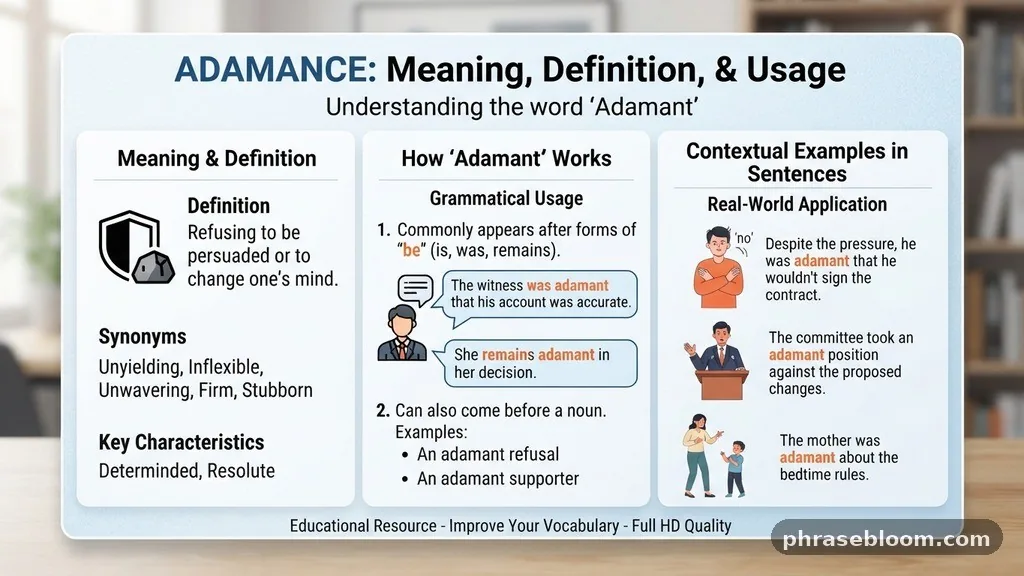
Adamant commonly appears after forms of “be,” such as “is,” “was,” or “remains.” It can also come before a noun in expressions such as “an adamant refusal” or “an adamant supporter.”
Examples include “The witness was adamant that the account was accurate” and “The committee took an adamant position against the change.” In both examples, adamant describes a person or position that will not easily shift.
How “adamance” works
Adamance usually acts as the subject or object of a sentence. For example, “Her adamance impressed the volunteers” treats adamance as the subject of “impressed.”
It can also follow a possessive noun or pronoun: “the athlete’s adamance,” “their adamance,” or “the organization’s adamance.” This structure is useful in formal writing because it lets you discuss a person’s firmness as an idea or characteristic.
Adamance Synonyms and Antonyms
The best synonym depends on the writer’s intended tone. Some alternatives emphasize strength and courage, while others suggest unreasonable refusal.
Useful synonyms
- Firmness: steady strength in a decision or position.
- Determination: strong intention to achieve a goal.
- Resoluteness: serious, unwavering commitment to a decision.
- Persistence: continuing despite difficulty or opposition.
- Insistence: repeated or forceful demand that something happen.
- Steadfastness: loyal and consistent commitment to a principle.
- Intransigence: refusal to compromise, usually with a negative tone.
- Stubbornness: unwillingness to change, often despite good reasons.
“Firmness” is often the safest replacement in professional writing. “Determination” sounds more positive, while “stubbornness,” “intransigence,” and “inflexibility” make the criticism clearer.
“Resoluteness” is close to adamance but tends to sound more dignified. It often suggests courage or discipline rather than resistance for its own sake.
Useful antonyms
Adamance antonyms include flexibility, openness, cooperation, compliance, compromise, hesitation, uncertainty, and indecision. Each one points in a different direction.
- Flexibility suggests a willingness to adapt.
- Openness suggests receptiveness to new information.
- Compromise suggests movement toward a shared solution.
- Hesitation suggests uncertainty before making a decision.
- Indecision suggests difficulty choosing or committing.
For instance, “The team valued her flexibility during negotiations” presents a quality opposite to adamance. “The team criticized her indecision” presents a different opposite, because indecision concerns a lack of firmness rather than a willingness to cooperate.
Adamance Etymology and Word History
The history of adamance is connected to the older word adamant. Adamant ultimately comes from a Greek word associated with something unconquerable or unbreakable, and it passed through Latin and French before developing into English usage.
The original imagery was physical hardness. Over time, English speakers used adamant metaphorically for a person, belief, or position that could not be moved.
Adamance developed as the noun form describing that quality. Its meaning is therefore closely tied to firmness, resistance, and an unwavering position.
The word’s history helps explain its tone. It carries a stronger sense of resistance than ordinary words such as “preference” or “confidence.” A preference can change easily; adamance implies that change is unlikely without substantial pressure or persuasion.
People sometimes connect adamant with “diamond” because both words have associations with hardness, but the words are not interchangeable. Adamant can be used figuratively for a rigid position, while diamond normally names a gemstone or a carbon crystal.
For a concise reference definition and pronunciation information, consult the Merriam-Webster entry for adamance. A dictionary can confirm the word’s part of speech, core sense, and standard spelling.
Adamance Usage in Formal and Everyday English
Adamance is a legitimate English word, but it is not among the most common nouns in ordinary conversation. In casual speech, people are more likely to say “firmness,” “stubbornness,” or “refusal to compromise.”
Formal writing uses adamance more often because the noun allows the writer to analyze a person’s conduct or position. It can fit naturally in journalism, history, political commentary, workplace reports, and academic prose.
For example, “The negotiator’s adamance prolonged the discussion” sounds formal and analytical. “The negotiator was being stubborn” is more direct and conversational.
The choice should match the audience. A workplace email to a colleague may be clearer with “firm position,” while a report analyzing a negotiation may reasonably use “adamance.”
Examples from professional contexts
“The director’s adamance about protecting customer records led to stronger access controls.” Here, adamance describes a firm commitment to data protection, and the result makes the sentence concrete.
“The employee’s adamance regarding the safety procedure was initially unpopular, but the concern proved valid.” This example presents resistance in a positive light because the safety concern was justified.
“The supplier’s adamance over the payment terms prevented the parties from signing the agreement.” In this sentence, adamance has a negative or limiting effect because it blocks an outcome.
These examples show why context matters. The word itself indicates strong firmness, but surrounding details determine whether the firmness appears principled, practical, unreasonable, or damaging.
Adamance in a Sentence
Natural examples make the word easier to understand than a definition alone. The following sentences show several common grammatical patterns.
- Her adamance about the revised safety standard persuaded the committee to reconsider.
- The coach’s adamance was frustrating, but the players understood the reason for the rule.
- After reviewing the evidence, the lawyer questioned the witness’s adamance.
- The employee spoke with adamance when explaining why the records had to remain confidential.
- His adamance regarding the budget left little room for negotiation.
- The organization’s adamance in opposing discrimination shaped its hiring policy.
- The negotiators mistook courtesy for flexibility and underestimated her adamance.
- Public criticism did not weaken the mayor’s adamance about the proposed reform.
The first example uses “adamance about” to identify the subject of the firm position. The second places adamance after a possessive noun, a common structure in professional and analytical writing.
The fourth example uses “with adamance” to describe manner. This construction is grammatical, but “adamantly” may sound more natural in some contexts: “The employee spoke adamantly about the confidentiality requirement.”
The final examples show that adamance can describe political, organizational, legal, and interpersonal behavior. It is not limited to one profession or subject area.
Choosing between adamance and adamantly
Use adamance when you want to name the quality. Use adamantly when you want to describe how someone acts, speaks, or refuses.
Compare “The witness’s adamance concerned the investigators” with “The witness adamantly denied the allegation.” The first sentence discusses a quality; the second describes the manner of the denial.
Positive, Neutral, and Negative Connotations
Adamance does not always praise or criticize the person involved. Its meaning is stable, but its connotation changes according to the reason for the firmness and the consequences that follow.
Positive adamance may involve defending a principle. A doctor’s adamance about informed consent may reflect professional responsibility, while an employee’s adamance about accurate reporting may protect an organization from serious errors.
Neutral adamance can simply describe a strong position. A historical account might say that a leader showed adamance during negotiations without making a clear judgment about whether the leader acted wisely.
Negative adamance suggests stubbornness, rigidity, or an unyielding attitude that prevents cooperation. If a manager refuses a workable adjustment for no clear reason, “adamance” may imply that the manager’s firmness has become counterproductive.
| Intended meaning | Better word choice | Example |
|---|---|---|
| Principled strength | Adamance or steadfastness | Her adamance protected the workers’ rights. |
| Goal-focused effort | Determination | His determination helped him complete the project. |
| Refusal to negotiate | Adamance or intransigence | Their adamance stalled the talks. |
| Unreasonable resistance | Stubbornness or inflexibility | The policy’s inflexibility created unnecessary problems. |
If you want to sound fair, provide the surrounding reason or result. A sentence such as “Her adamance protected the standard” gives readers a basis for interpreting the word positively.
Common Mistakes with Adamance
One common mistake is treating adamance as if it meant confidence. Confidence means belief in one’s ability or judgment, while adamance means unwillingness to change a position. Someone can be confident but open to correction.
Another mistake is using adamance for persistence toward a goal. “He showed adamance in completing the marathon” is possible, but “He showed determination” is usually more natural because the sentence concerns effort rather than refusal.
Writers also sometimes use adamance where “adamant” is required. “She was adamance about the rule” is incorrect because the adjective must follow “was.” The correction is “She was adamant about the rule.”
Conversely, “Her adamant about the rule caused concern” is incorrect. The noun is needed after the possessive pronoun, so the corrected sentence is “Her adamance about the rule caused concern.”
- Incorrect: The supervisor was adamance about the deadline.
Correct: The supervisor was adamant about the deadline. - Incorrect: Their adamant surprised the panel.
Correct: Their adamance surprised the panel. - Less precise: She showed adamance in finishing the task.
Clearer: She showed determination in finishing the task. - Potentially unclear: His adamance was impressive.
Clearer: His adamance about protecting the records was impressive.
Do not invent forms such as “adamantlyness” or use adamance as a verb. English already has the related forms adamant, adamantly, and adamance.
How to Choose the Right Word
Start by asking what you want to emphasize. If the emphasis is on a person’s refusal to move from a position, adamance may be suitable. If the emphasis is on effort toward a goal, determination is probably better.
Next, consider the tone. “Firmness” is broad and usually neutral, “resoluteness” can sound admiring, and “stubbornness” clearly suggests criticism.
Finally, check whether your audience will understand a relatively formal word. In a legal analysis or research paper, adamance may fit naturally. In a short customer email, “firm position” will often be more direct.
- Use adamance for strong, persistent refusal or commitment.
- Use adamant to describe a person or position.
- Use adamantly to describe an action or manner.
- Use determination for focused effort toward a goal.
- Use firmness when you want a neutral, widely understood term.
- Use stubbornness when unreasonable resistance is the main idea.
Good word choice is not only about dictionary definition. It is also about the strength, judgment, and emotional tone that readers will infer from the word.
Frequently Asked Questions About Adamance
What is the definition of adamance?
Adamance is the quality of being adamant. It means strong firmness, determination, or insistence, often with little willingness to change a position.
Is adamance a positive or negative word?
It can be either. Adamance may suggest principled strength, but it may also imply stubbornness or inflexibility when a person refuses reasonable compromise.
Is adamance the same as determination?
They overlap, but they are not identical. Determination usually concerns pursuing a goal, while adamance more often concerns holding firmly to a position, demand, or refusal.
What is the difference between adamance and adamant?
Adamance is a noun, as in “Her adamance was clear.” Adamant is an adjective, as in “She was adamant about the policy.”
What are common adamance synonyms?
Common synonyms include firmness, resoluteness, determination, insistence, steadfastness, stubbornness, and intransigence. The best choice depends on whether you want a positive, neutral, or critical tone.
Conclusion
The Adamance Meaning is straightforward: it describes strong, often unyielding firmness about a belief, decision, demand, or refusal. The noun is related to adamant and adamantly, but each form has a different grammatical role.
Choose adamance when you need a formal word for an unwavering position, then use the surrounding sentence to show whether that firmness is principled or unhelpfully stubborn. If a simpler term would serve your audience better, “firmness,” “determination,” or “stubbornness” may be the clearer choice.
Related: Sounds Great Meaning · Alright vs All Right · Deem Fit
Explore more on PhraseBloom.