

The standard English choice is “I didn’t do anything,” while “I didn’t do nothing” is a double negative in formal grammar. The two sentences can communicate the same idea in some varieties of English, but they do not have the same status in professional or academic writing.
The difference involves the auxiliary verb “did,” the negative auxiliary “didn’t,” and the indefinite pronouns “anything” and “nothing.” Once you understand how negative sentences work, you can choose the right form for standard English, informal speech, dialogue, or a specific regional style.
The Direct Answer: “I Didn’t Do Anything”
Use “I didn’t do anything” in standard English when you mean that you did no activity or took no action. This is the safest form for formal writing, workplace communication, school assignments, reports, and most edited publications.
The sentence contains one grammatical negative element: “didn’t.” The word “anything” is used in negative sentences to refer to an unspecified thing or action.
| Sentence | Typical status | Meaning in standard English |
|---|---|---|
| I didn’t do anything. | Standard and widely accepted | I did no activity or action. |
| I didn’t do nothing. | Nonstandard in formal English, but used in some dialects | Often intended to mean I did no activity or action. |
| I did nothing. | Standard and widely accepted | I did no activity or action. |
| I did something. | Standard and widely accepted | I performed an activity or took an action. |
“I did nothing” is another fully standard option. It uses the past-tense auxiliary “did” with the negative pronoun “nothing,” so the sentence does not need another negative word.
For a professional email, write, “I didn’t do anything with the file,” or “I did nothing with the file.” Do not use “I didn’t do nothing” unless you are intentionally reproducing a speaker’s informal or dialectal wording.
Why “Anything” Works After “Didn’t”
English commonly uses “anything” in negative sentences. In “I didn’t do anything,” the negative meaning comes from “didn’t,” which is the contracted form of “did not.” The word “anything” does not create a second negative.
Compare these examples:
- I didn’t see anything in the office.
- She didn’t receive anything by email.
- We didn’t change anything in the contract.
- They didn’t tell anyone about the meeting.
- He didn’t find anything unusual in the report.
Each sentence has one negative auxiliary and an indefinite pronoun such as “anything” or “anyone.” This is the normal pattern in standard English.
The auxiliary verb “did” carries the past tense in these sentences. Because “did” already shows the past tense, the main verb remains in its base form: “do,” not “did.” That is why the correct sentence is “I didn’t do anything,” not “I didn’t did anything.”
The same pattern appears with other verbs. Write “She didn’t see anything,” not “She didn’t saw anything,” because the past tense is already expressed by “didn’t.” This point is separate from the choice between “nothing” and “anything,” but it often appears in the same sentence.
“Anything” Versus “Nothing”
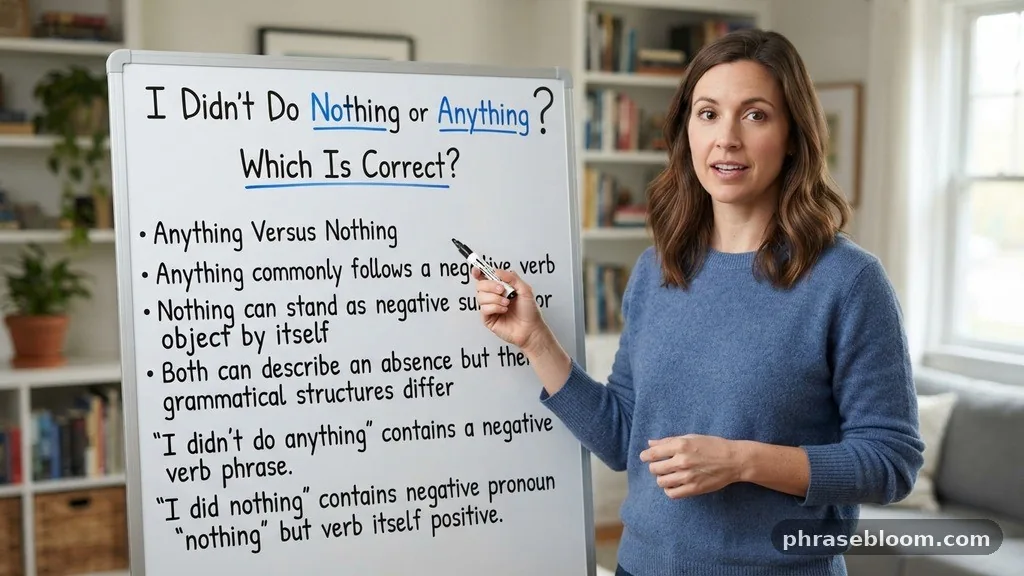
“Anything” commonly follows a negative verb, while “nothing” can stand as the negative subject or object by itself. Both can describe an absence, but their grammatical structures differ.
“I didn’t do anything” contains a negative verb phrase. “I did nothing” contains the negative pronoun “nothing,” but the verb itself is not negative. These forms express the same basic sentence meaning without creating two negative elements.
That distinction helps explain why “I didn’t do nothing” sounds different to many readers. It places “didn’t” and “nothing” in the same clause, which standard prescriptive grammar generally treats as a double negative.
Is “I Didn’t Do Nothing” Always Wrong?
In formal standard English, “I didn’t do nothing” is generally marked as incorrect because it contains a double negative. A double negative occurs when two negative forms appear in a clause where standard grammar expects only one negative expression.
Under a traditional logical interpretation, two negatives might appear to cancel each other. “I didn’t do nothing” could therefore be interpreted as “I did something.” However, ordinary speakers who use this construction usually do not intend that meaning.
In several English dialects, including varieties associated with different regions and communities, two negative words can reinforce one another. This pattern is called negative concord. Under negative concord, “I didn’t do nothing” means “I didn’t do anything,” not “I did something.”
The distinction between prescriptive grammar and descriptive grammar matters here. Prescriptive grammar describes the rules expected in a formal variety, while descriptive grammar examines how people actually speak and write in different communities.
From a descriptive perspective, “I didn’t do nothing” is a real construction used by real speakers. From a formal-writing perspective, it may be judged nonstandard and can distract readers from the intended message.
That does not make the speaker unintelligent. It means the expression belongs to a different variety or register of English. A novelist might use it in dialogue to represent a character’s voice, while an employee should normally avoid it in a company report.
Meaning Depends on Context
Consider the exchange, “Who broke the window?” “I didn’t do nothing.” Many listeners will understand the reply as a denial: the speaker claims not to have caused any damage.
In a carefully edited legal statement, however, the same wording may invite questions about its intended meaning. The safest revision is “I didn’t do anything” or “I did nothing.” Clear writing removes the ambiguity created by the double negative.
If you are analyzing a song lyric, novel, interview, film script, or recorded conversation, preserve the original wording when the speaker’s voice matters. If you are correcting an essay, email, or report, use the standard form unless the assignment specifically concerns dialect or spoken language.
Double Negatives and Negative Concord
A double negative is not always used in the same way across all varieties of English. In formal standard English, two negative words in one clause often create an unintended or nonstandard structure. In negative-concord varieties, those negative words work together to express one strong negative meaning.
Examples of negative-concord speech include forms such as “I didn’t see nothing” and “She never told nobody.” Speakers who use these patterns typically understand them as “I didn’t see anything” and “She never told anybody.”
Standard edited English usually changes those sentences to:
- I didn’t see anything.
- She never told anybody.
- We don’t have any evidence.
- He couldn’t find anything useful.
The choice is connected to register, which means the level or style of language appropriate for a situation. Informal speech may allow regional grammar patterns that would be revised in formal writing, just as conversation often includes contractions, interruptions, and incomplete sentences.
American English and British English both contain dialects that use negative concord. It is inaccurate to say that every American speaker rejects double negatives or that every British speaker accepts them. The important distinction is usually between standard edited usage and particular spoken or literary varieties.
Grammar checkers often flag “I didn’t do nothing” because they are designed to support standard written conventions. A grammar checker may not understand whether you are intentionally representing a dialect, so human judgment still matters.
When a Double Negative Changes Meaning
Some double negatives are used deliberately to express a positive or weakened idea. For example, “I can’t not attend” means that attending is necessary, although the sentence has two negative elements with different grammatical roles.
That structure is different from “I didn’t do nothing.” In “I can’t not attend,” the second “not” belongs to the verb “attend” and creates the meaning “cannot avoid attending.” In “I didn’t do nothing,” “didn’t” and “nothing” usually target the same action.
Context can also make a speaker’s intention clear. Still, if your goal is straightforward professional communication, avoid forcing the reader to interpret a potentially ambiguous double negative.
Standard English, Informal Speech, and Formal Writing
“I didn’t do anything” is the preferred choice in standard English. It works in both conversation and writing, so there is rarely a practical reason to replace it with the less formal “I didn’t do nothing.”
Formal writing includes academic essays, business reports, policy documents, applications, official correspondence, and workplace records. In these settings, readers generally expect grammar that follows the conventions taught in edited standard English.
Informal speech is more flexible. Friends, family members, and local communities may use regional expressions without misunderstanding one another. A speaker might say “I didn’t do nothing” naturally, especially when emphasizing innocence or responding emotionally.
Writers can also use the form intentionally. A short story might include the sentence, “I didn’t do nothing, and you know it,” because the wording helps establish a character’s background, identity, or emotional state. Editing that line into “I didn’t do anything” could remove an important part of the character’s voice.
In workplace communication, the decision is simpler. Use “I didn’t do anything with the draft,” “I didn’t change anything,” or “I did nothing with the draft.” These versions are direct, professional, and unlikely to be misunderstood.
| Context | Recommended wording | Reason |
|---|---|---|
| Academic essay | I didn’t do anything. | Fits standard formal English. |
| Workplace email | I didn’t make any changes. | Clear and professional. |
| Character dialogue | I didn’t do nothing. | Possible if the dialect is intentional. |
| Official statement | I did nothing. | Concise and less open to interpretation. |
| Casual conversation | I didn’t do anything. | Natural in nearly every English variety. |
A professional audience does not need the most complicated wording. It needs the wording that communicates the intended sentence meaning quickly and accurately.
Examples in Real Sentences
Here are practical examples showing how the standard forms work in different situations. The examples use ordinary workplace and everyday contexts rather than isolated grammar exercises.
Work and School
“I didn’t do anything to the spreadsheet after you sent it.” This sentence clearly denies making changes, and “anything” correctly follows the negative auxiliary “didn’t.”
“I did nothing during the break because I was waiting for instructions.” This version uses “nothing” without a second negative. It sounds slightly more deliberate, but it is fully standard.
“The student said, ‘I didn’t do anything wrong.’” The phrase “anything wrong” is a common negative construction and works naturally in both speech and writing.
Emails and Internal Communication
“I didn’t see anything in the shared folder that matched the project number.” This wording is useful in an email because it states exactly what the writer checked and what was absent.
“We didn’t change anything in the employee handbook during this review.” The sentence avoids the vague phrase “do nothing” and identifies the relevant action directly.
“I did not authorize any purchases, and I did not approve any invoices.” This formal version uses parallel negative structures, making it suitable for an internal record or compliance communication.
Reports and Public Communication
“The review found that the team did not omit any required documents.” “Any” is appropriate after “did not,” and the sentence has a formal tone suitable for a report.
“The spokesperson said the company had done nothing to alter the published figures.” Here, “done nothing” gives a concise and emphatic denial.
“I didn’t do nothing” may appear in a quoted interview, but an editor should not silently replace it if the exact spoken wording matters. The choice depends on whether the publication is presenting the person’s authentic language or editing the statement into standard written English.
Clear Rewrites
Instead of writing “I didn’t do nothing with the account,” write “I didn’t do anything with the account.” The correction replaces a double negative with the standard negative-plus-“anything” pattern.
You can also write “I did nothing with the account.” This version is shorter and may sound more formal, although “I didn’t do anything” is often more conversational.
When possible, name the action rather than relying on “do.” For example, write “I didn’t edit the account,” “I didn’t submit the form,” or “I didn’t change the settings.” Specific verbs usually make a workplace message stronger.
American English, British English, and Regional Usage
There is no simple rule saying that “I didn’t do anything” belongs to American English while “I didn’t do nothing” belongs to British English. Both American and British English use the standard form in formal writing, and both contain regional and social dialects that may use negative concord.
Differences between American English and British English often involve vocabulary, spelling, pronunciation, and some grammar preferences. The treatment of double negatives is more complicated because actual usage varies by region, community, speaker, and situation.
Most edited publications in both varieties prefer a sentence such as “I didn’t do anything.” Schools, employers, government agencies, and professional organizations commonly expect standard written conventions regardless of the English variety they use.
British English may also use “I did nothing” frequently in formal contexts, just as American English does. Neither version should be treated as exclusively British or exclusively American.
Regional dialect is not the same as careless language. A dialect has systematic patterns, and negative concord can be one of those patterns. The issue is whether the chosen form fits the audience and purpose.
If you are writing for an international audience, choose “I didn’t do anything.” It is widely understood, standard, and unlikely to be interpreted as a dialect marker or an accidental grammar error.
For additional background on negative words and related sentence patterns, consult the Cambridge Dictionary explanation of negative words. A reference source can help, but the best final choice still depends on context and house style.
Common Mistakes and Better Corrections
Several errors appear because speakers transfer informal patterns into formal writing or confuse the role of the auxiliary verb. The following corrections address the most common problems.
- Wrong for standard formal writing: I didn’t do nothing. Better: I didn’t do anything.
- Incorrect verb form: I didn’t did anything. Better: I didn’t do anything.
- Unclear phrasing: I didn’t do no work. Better: I didn’t do any work.
- Overly vague phrasing: I didn’t do anything about it. Better when possible: I didn’t contact the supplier about it.
- Unintended dialect imitation: I didn’t do nothing, written in an official report. Better: I did nothing or I didn’t do anything.
The first correction removes the double negative. The second recognizes that “didn’t” already carries the past tense, so the main verb must remain in its base form.
The third correction replaces “no” with “any,” which is the normal indefinite determiner after a negative verb. “I didn’t do no work” may occur in negative-concord speech, but “I didn’t do any work” is the standard written form.
Vagueness creates a different problem. “I didn’t do anything about it” may be grammatically correct, but it does not tell the reader whether you ignored an email, delayed a repair, or failed to update a record.
Do not treat every nonstandard form as a moral or intellectual failure. Edit according to purpose. A grammar correction in a formal document is appropriate, while preserving a speaker’s exact words may be essential in journalism, fiction, oral history, or linguistic research.
How to Choose the Right Form
Use a short decision process whenever you are unsure whether to write “I didn’t do nothing” or “I didn’t do anything.” First, ask whether the sentence is formal, public, academic, or professional. If it is, choose “I didn’t do anything” or “I did nothing.”
Next, consider whether you are quoting someone exactly. If the wording is a direct quotation and the dialect or voice matters, keep the original form, but make sure the surrounding writing makes the quotation’s status clear.
Finally, check the meaning you want. If you mean that no action occurred, both “I didn’t do anything” and “I did nothing” work in standard English. If you mean that you performed an action, write “I did something” or state the action directly.
- Choose “I didn’t do anything” for the safest everyday and professional option.
- Choose “I did nothing” for a concise, formal denial.
- Use “I didn’t do nothing” only when representing a dialect, quotation, or intentional informal voice.
- Replace “do” with a specific verb when the action matters.
- Check the audience before using a regional or nonstandard construction.
Sentence rewriting can solve the issue completely. Instead of choosing between two negative patterns, write “I did not access the file,” “I did not submit the request,” or “I did not alter the schedule.” A precise verb improves both grammar and meaning.
Choosing for Different Documents
In an email, “I didn’t do anything with the attachment” is natural and professional. In an employee handbook or policy document, “The employee did not take any action” may sound more formal and precise.
In an academic essay, use the standard form unless you are discussing dialect, grammar, or a quotation. In a legal or regulatory document, avoid wording that could be interpreted in more than one way and state the relevant action directly.
On a website or in marketing copy, clarity usually matters more than conversational regional flavor. A public audience may include readers from several countries, so “I didn’t do anything” is the safer international choice.
In software messages and internal interfaces, use short, direct wording such as “No changes were made” or “You have not submitted any files.” These alternatives avoid the issue while making the system status immediately clear.
Alternatives to “I Didn’t Do Nothing or Anything”
Sometimes the best solution is not to choose between “anything” and “nothing.” A rewritten sentence can communicate the same idea more directly, especially in professional writing.
| Intended meaning | Clear alternative | Useful context |
|---|---|---|
| No action occurred | I took no action. | Reports, formal statements |
| No work was completed | I did not complete any work. | School or workplace explanations |
| No changes were made | I made no changes. | Documents, spreadsheets, software |
| No file activity occurred | I did not access the file. | Technical or compliance messages |
| No response was sent | I did not send a response. | Email and customer service |
| No involvement occurred | I was not involved in the decision. | Organizational or legal communication |
“I took no action” is especially useful when the subject is a decision or process rather than a physical activity. “I made no changes” works better than “I didn’t do anything” when the reader needs to know that a document remained exactly as it was.
These alternatives also reduce ambiguity. A sentence such as “I didn’t do anything” can sometimes mean “I did not help,” “I did not interfere,” or “I did not complete a task.” A specific alternative identifies the intended meaning.
In conversation, the shorter “Nothing happened” may be enough. In formal writing, explain what did not happen if the distinction matters to the reader.
Examples You Can Copy and Adapt
The following sentences use standard English and can be adapted for common situations. Change the noun or verb to match the actual event.
- I didn’t do anything to change the original document.
- I didn’t do anything with the request because I was waiting for approval.
- I did nothing beyond forwarding the message to the correct department.
- I didn’t see anything unusual in the account history.
- I did not make any changes to the schedule.
- I didn’t submit anything after the deadline.
- I took no action until the manager confirmed the instructions.
- I wasn’t involved in the decision, and I didn’t approve anything.
These examples show that “anything” is natural after a negative auxiliary, while “nothing” works with an affirmative-looking verb such as “did.” The alternatives with “any changes,” “no action,” and “wasn’t involved” offer more specific choices.
For a direct reply, write, “No, I didn’t do anything.” For a formal record, write, “The employee took no action.” For a quoted line of dialectal speech, preserve “I didn’t do nothing” only if the original wording is relevant.
Remember that “anything” does not always make a sentence negative. In “Did you do anything?” it appears in a question, and in “You can do anything,” it appears in a positive statement. Its grammatical meaning depends on the whole sentence.
Frequently Asked Questions
Is “I didn’t do nothing” or “I didn’t do anything” correct?
“I didn’t do anything” is the standard choice. “I didn’t do nothing” is used in some dialects through negative concord, but it is generally avoided in formal writing.
Does “I didn’t do nothing” mean that I did something?
In strict logical interpretation, two negatives may appear to suggest a positive meaning. In ordinary negative-concord speech, however, the sentence usually means “I didn’t do anything.” Context and dialect determine how listeners understand it.
Why is “anything” used after “didn’t”?
“Anything” is a standard indefinite pronoun for negative sentences. The negative auxiliary “didn’t” supplies the negative meaning, while “anything” refers to an unspecified thing or action.
Is “I did nothing” correct?
Yes. “I did nothing” is standard English because “nothing” supplies the negative meaning and the verb “did” is not itself negative.
Can I use “I didn’t do nothing” in a story or quotation?
Yes, if you are intentionally representing a speaker’s dialect, informal speech, or exact words. In an essay, email, report, or other formal document, use “I didn’t do anything” or “I did nothing” instead.
Conclusion
For standard English, write “I didn’t do anything” or “I did nothing.” The phrase “I didn’t do nothing” is common in some forms of informal speech and negative concord, but it can look like a double negative in professional, academic, and formal writing.
When deciding between “I Didn’t Do Nothing or Anything,” consider your audience, purpose, and whether you are quoting someone exactly. If clarity matters most, choose the standard form or name the action directly, and keep that choice consistent throughout your document.
Explore more on PhraseBloom.