
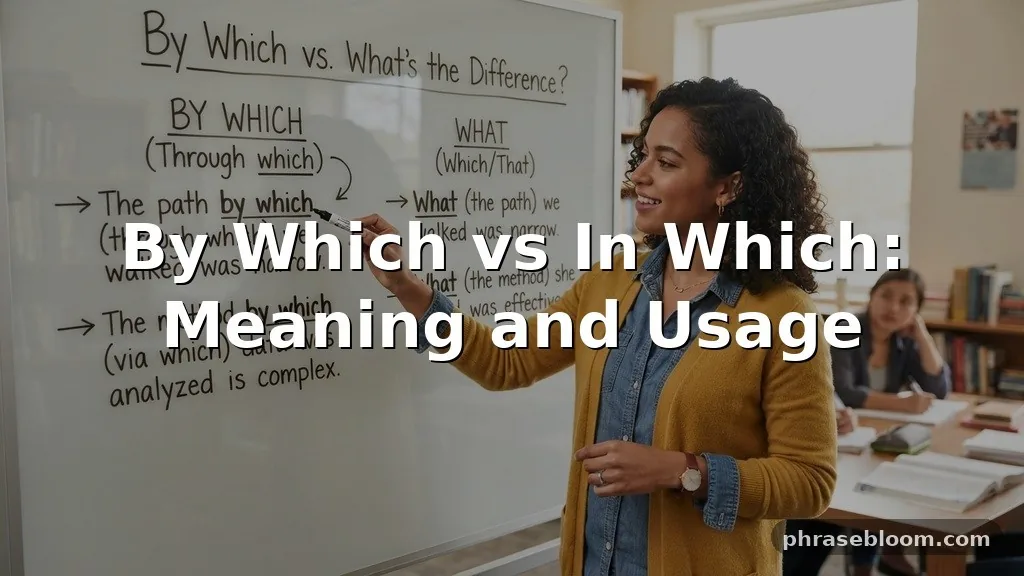
The difference between by which and in which depends mainly on the relationship the phrase expresses. By which usually points to a method, process, rule, or means, while in which usually identifies a place, situation, condition, or setting.
Both phrases introduce relative clauses, and both can sound formal in modern English. Once you identify the antecedent and ask whether the sentence means “through what method” or “in what situation,” the choice becomes much easier. The examples below show how each phrase works in formal English, workplace writing, academic prose, and everyday sentences.
By Which vs In Which: The Direct Answer
Use by which when you mean “through which,” “by means of which,” or sometimes “according to which.” Use in which when you mean “inside which,” “during which,” or “in the situation or context in which.”
| Form | Basic meaning | Typical use | Example |
|---|---|---|---|
| by which | Through, by means of, or according to which | Methods, processes, rules, mechanisms | The system by which payments are processed is secure. |
| in which | Inside, during, or within which | Places, situations, periods, conditions | The room in which we met was unusually quiet. |
In “The process by which the data is verified,” the phrase explains the method of verification. In “The environment in which the data is stored,” the phrase identifies the setting where storage occurs.
The distinction is about meaning, not simply about which preposition sounds more formal. A sentence can be grammatically correct with either phrase in different circumstances, but replacing one with the other may change the relationship between the main noun and the relative clause.
For example, “the procedure by which the application is reviewed” refers to the procedure used for reviewing it. “The office in which the application is reviewed” refers to the location where the review takes place.
Neither phrase is automatically better. The right choice follows the verb, noun, or idea that comes before it.
What “By Which” Means
By which commonly introduces a relative clause that describes a method or process. In plain English, it often answers the question “How?” or “By what means?”
Consider the sentence, “The company adopted a process by which employees can report safety concerns.” The phrase explains how employees report concerns: they use the process described by the relative clause.
Here are several common patterns:
- The method by which the results were calculated
- The system by which customers receive refunds
- The process by which new employees are trained
- The rule by which applications are evaluated
- The mechanism by which the device detects movement
In each example, by which connects a noun to an explanation of how something happens. The noun may be a method, system, process, rule, mechanism, or procedure, although other nouns can work as well.
By which as “through which”

Sometimes by which means “through which.” “The channel by which the message was delivered” means “the channel through which the message was delivered.” This use focuses on the route, instrument, or means that made an action possible.
For example, “Email was the channel by which the announcement reached employees” describes email as the means of communication. The sentence does not primarily describe a physical location or a time period.
The phrase can also describe a mechanism. “Researchers identified the process by which the cells repair damaged tissue” refers to the biological process responsible for the repair.
By which as “according to which”
In some formal sentences, by which means “according to which” or “under which.” “The standard by which performance is measured must be clearly stated” means that performance is measured according to that standard.
This pattern often appears with words such as standard, criteria, principle, rule, and policy. For instance, “The policy by which expenses are approved applies to every department” describes the policy governing approval.
Although this use is formal, it remains natural in contracts, reports, policies, academic writing, and official announcements. In casual conversation, writers may choose a simpler alternative such as “the standard used to measure performance.”
What “In Which” Means
In which usually introduces a relative clause that identifies a place, situation, period, condition, or context. It often answers “Where?” or “In what situation?”
“The building in which the conference was held” means “the building where the conference was held.” The phrase describes a physical location, so in is the natural preposition.
Other examples include:
- The year in which the company was founded
- The situation in which the error occurred
- The environment in which the software operates
- The context in which the statement was made
- The agreement in which both parties accepted the terms
Not all of these examples describe physical space. “The context in which the statement was made” refers to the surrounding circumstances, while “the year in which the company was founded” refers to time.
This wider use is important because learners sometimes assume that in which must refer to a room or container. It can also describe an abstract setting, such as a legal situation, social condition, business environment, or historical period.
In which for places
When a noun refers to a place that contains an event or object, in which is often appropriate. “The laboratory in which the experiment was conducted” and “the neighborhood in which she grew up” both describe locations.
In less formal English, where may replace in which. “The laboratory where the experiment was conducted” is natural and usually more conversational.
However, in which can be useful when the noun is not a straightforward physical place. “The database in which the records are stored” is more precise than “the database where the records are stored” for some technical audiences, although both versions are understandable.
In which for situations and conditions
Use in which when the relative clause describes circumstances. “The situation in which the contract was signed was unusual” refers to the circumstances surrounding the signing, not necessarily to a physical location.
Similarly, “The conditions in which the plants were grown affected their size” describes the temperature, light, moisture, or other circumstances of growth. The phrase introduces a subordinate clause that explains the setting in a broad sense.
This meaning is common in academic writing. A researcher might write, “The study examines the conditions in which workers make decisions,” where the phrase refers to the circumstances influencing those decisions.
How Relative Clauses Work
By which and in which are made from a preposition plus the relative pronoun which. A relative pronoun connects a subordinate clause to a noun that appeared earlier in the sentence.
That earlier noun is called the antecedent. In “The system by which payments are processed is reliable,” system is the antecedent, and “by which payments are processed” is the relative clause describing it.
The relative clause usually cannot stand alone as a complete sentence. “Payments are processed” can stand alone, but “by which payments are processed” depends on the noun it modifies.
Restrictive and nonrestrictive clauses
A restrictive relative clause, also called a defining relative clause, gives information needed to identify the noun. In “The process by which refunds are issued has changed,” the clause tells us which process the writer means.
A nonrestrictive relative clause, also called a non-defining relative clause, adds extra information. It is usually separated with commas: “The new refund process, in which customers submit fewer documents, will begin next month.”
The punctuation matters because the two clause types serve different purposes. A restrictive clause narrows the meaning of the noun, while a nonrestrictive clause provides additional information about an already identified noun.
Do not use commas automatically before every example with which. Ask whether the clause identifies the noun or merely comments on it.
Prepositions before which
The preposition comes before which in formal patterns such as by which, in which, with which, and for which. The choice depends on the relationship expressed by the sentence.
For example, “the tool with which the technician repaired the device” identifies an instrument. “The purpose for which the funds were collected” identifies a reason or intended use.
English also allows the preposition to move to the end in many less formal sentences. “The tool which the technician repaired the device with” is possible in ordinary speech, though many professional writers prefer “the tool with which the technician repaired the device.”
For additional guidance on relative pronouns and related clause structures, consult this relative pronoun reference from Purdue Online Writing Lab.
By Which and In Which in Real Sentences
Professional writing uses both phrases frequently because business documents often describe systems, procedures, locations, policies, and circumstances. The following examples show how the choice changes with the intended meaning.
Policies and company procedures
“The policy by which travel expenses are reimbursed requires original receipts.” Here, the policy establishes the rule governing reimbursement.
“The circumstances in which employees may work remotely are listed in the handbook.” The phrase describes the situations covered by the handbook.
The first sentence focuses on a governing standard. The second focuses on conditions or situations.
Training and employee announcements
“The training program by which new managers learn the reporting system lasts four weeks.” This describes the program as the method of learning.
“The meeting in which the new managers received the announcement was held on Monday.” This identifies the meeting where the announcement occurred.
These examples are directly adaptable to onboarding materials, internal communications, and human resources notices.
Business reports
“The model by which the forecast was generated uses historical sales data.” The phrase explains the analytical method behind the forecast.
“The quarter in which sales declined was affected by supply delays.” The phrase identifies a period of time.
A report may use both forms in nearby sentences because one describes a method and the other describes a period or context. Repeating one preposition simply because it appeared earlier would be a mistake.
Technology and software
“The encryption method by which user data is protected has been updated.” The phrase identifies the technical mechanism.
“The platform in which the records are stored has undergone maintenance.” The phrase identifies the digital environment or database.
In technical writing, the difference can affect precision. A method performs an action, while a platform or system provides the setting in which data or activity exists.
Public communication and marketing
“The campaign by which the product was introduced focused on small businesses.” This treats the campaign as the means of introduction.
“The market in which the product was launched had strong demand for low-cost tools.” This identifies the commercial environment or market setting.
The wording works because the first sentence emphasizes communication strategy, while the second emphasizes the market context.
Predicate and Adverbial Uses
The position of the phrase in a sentence can affect how it behaves. Before a noun, by which or in which usually forms part of a relative clause that modifies that noun.
After a linking verb, the phrase may act as a subject complement. “The policy is in which” would normally be incomplete, but “The policy is one in which employees have several options” is grammatical because in which modifies “one.”
With an adjective or phrase after a linking verb, writers may use a related prepositional expression instead. “The policy is one in which employees have several options” is clearer than trying to force in which directly after “is.”
Examples with “by which” after a noun
“This is the procedure by which claims are reviewed.” The relative clause modifies “procedure,” and the phrase means “the procedure through which claims are reviewed.”
“That was the standard by which the committee evaluated the proposals.” The phrase means “the standard according to which the committee evaluated them.”
The preposition remains because the verb or noun relationship requires it. “The procedure claims are reviewed” does not express the same grammatical relationship.
Adverbial use
Some expressions function adverbially, meaning they modify the action of the verb rather than a noun. “The new system was introduced company-wide” is an adverbial use of a different expression, while “The system in which the records are stored” contains a relative clause modifying “system.”
With by which, a sentence such as “The process was improved, by which the company reduced delays” uses the phrase to connect an earlier action with a result. This construction is formal and can sound awkward if the relationship is unclear.
A clearer version might be “The process was improved, and this reduced delays.” Good writing does not require a relative clause merely because one is grammatically possible.
Verb choice matters
Many preposition choices are controlled by the verb. We say “the method by which something is done,” but “the place in which something happens.” The noun alone does not always determine the answer; the entire relationship matters.
Compare “the agreement under which the service is provided” with “the document in which the agreement is recorded.” The first describes a governing arrangement, while the second identifies the document containing the text.
By Which vs In Which in Formal and Everyday English
Both phrases are associated with formal English because they place the preposition before the relative pronoun. This structure is common in contracts, academic articles, policy documents, business reports, and carefully edited prose.
In everyday speech, speakers often choose shorter alternatives. “The way the system works” may sound more natural than “the manner by which the system operates,” and “the place where we met” may sound more natural than “the place in which we met.”
Formal does not always mean better. A sentence should be precise without becoming unnecessarily stiff.
When “how” is clearer
“The method by which the machine operates” is grammatically correct, but “how the machine operates” may be simpler. “The process by which the team reached its decision” can often become “how the team reached its decision.”
Use the shorter version when the audience values speed and the meaning remains clear. In technical, legal, or academic documents, the longer form may be useful when the noun must be defined precisely.
When “where” is clearer
“The office in which the interview took place” and “the office where the interview took place” have the same basic meaning. The second is more conversational, while the first may fit a formal report.
For abstract nouns, where can sometimes sound less precise. “The situation in which the error occurred” is often preferable to “the situation where the error occurred,” especially in formal writing, because the phrase clearly presents the situation as a set of conditions rather than a physical place.
When rewriting helps
Writers sometimes create heavy sentences by placing a long prepositional phrase inside another long relative clause. If the sentence becomes difficult to follow, rewrite it.
Instead of “The framework by which the standards in which the report is grounded are evaluated,” write “The committee evaluates the report using a framework based on these standards.” The revised sentence states the action directly and reduces the number of nested clauses.
Common Grammar Mistakes
Many errors involving by which and in which are not really mistakes about the words themselves. They usually result from choosing the wrong preposition, attaching the clause to the wrong noun, or using formal wording where a direct sentence would be clearer.
Using “by which” for a location
Incorrect or unclear: “The office by which the interview was held was on the third floor.” If the intended meaning is the office where the interview occurred, write, “The office in which the interview was held was on the third floor.”
The phrase by which suggests a method or route, not a container or setting. If the sentence means “where,” use in which or where.
Using “in which” for a method
Unclear: “The procedure in which the company approves refunds is described below.” If the procedure is the method used to approve refunds, write, “The procedure by which the company approves refunds is described below.”
Use in which if you mean a situation involving approval, such as “the circumstances in which the company approves refunds.” That version refers to conditions, not the process itself.
Dropping a required preposition
Incorrect: “The system which payments are processed is being replaced.” Correct: “The system by which payments are processed is being replaced.” Another natural alternative is “The system used to process payments is being replaced.”
The relative clause needs a relationship between “system” and “payments are processed.” The preposition makes that relationship visible.
Creating an unnecessarily complicated clause
Unclear: “The mechanism by which the process in which the data is entered operates has failed.” A clearer revision is “The data-entry mechanism has failed.”
Relative clauses are useful, but several layers can hide the main point. If a noun phrase can be replaced with a direct verb, the direct version may be stronger.
Confusing which and that
In American English, writers often use that for restrictive clauses and which for nonrestrictive clauses, but usage varies by style and context. “The system that processes invoices is offline” identifies the system, while “The system, which processes invoices, is offline” adds information about an already identified system.
After a preposition, however, formal structures generally use which: “the system by which invoices are processed.” The phrase “the system by that invoices are processed” is not standard English.
Choosing the Right Form in Professional Writing
Professional writers should choose the preposition that matches the intended relationship, then decide whether the formal structure improves clarity. The audience and document type matter, but meaning comes first.
Use by which for methods, processes, means, standards, and governing rules. Use in which for places, times, conditions, circumstances, and contexts.
- For a process: “the method by which invoices are approved”
- For a location: “the office in which the review occurred”
- For a standard: “the criteria by which applications are judged”
- For a period: “the year in which the policy changed”
- For a situation: “the conditions in which the agreement applies”
Business emails
Business emails usually benefit from direct, readable phrasing. “Please explain the process by which requests are approved” is professional, but “Please explain how requests are approved” may sound more natural in a short message.
Choose the longer version when the process itself is the subject of the discussion. Choose the shorter version when the reader needs a quick answer.
Policies and legal documents
Policy and legal writing often uses by which and in which because exact relationships matter. “The conditions in which this policy applies” can define the scope of a rule, while “the procedure by which exceptions are granted” can define the approval mechanism.
Do not choose a phrase merely because it sounds legal. A policy should make its conditions, methods, responsibilities, and limits easy to identify.
Academic writing
Academic writers may use these phrases to connect evidence with a method or theoretical context. “The framework by which the data was interpreted” describes an analytical method, while “the historical period in which the study was conducted” identifies a time and context.
Academic style rewards precision, but it also values readable sentences. Replace an elaborate phrase with “how,” “where,” or “during which” if the shorter wording is equally exact.
Reports and presentations
Reports often need the formal structure in headings, findings, and methodology sections. “The model by which projected costs were calculated” is suitable for a methodology discussion.
Presentation slides may need simpler language. “How projected costs were calculated” is easier to scan and can reduce visual clutter without changing the meaning.
Related Expressions and Better Alternatives
Several alternatives can replace by which or in which. The best choice depends on whether you want to emphasize method, place, time, condition, or context.
| Expression | Main idea | Example | Best use |
|---|---|---|---|
| by which | Method or means | The process by which claims are reviewed | Formal explanations of procedures |
| in which | Place, time, or situation | The period in which demand increased | Formal descriptions of context |
| through which | Route or channel | The portal through which users submit forms | Physical or digital pathways |
| where | Place or sometimes context | The site where the test was conducted | Clear, natural general writing |
| how | Method or process | How the system verifies identity | Conversational and concise prose |
| during which | Time period | The meeting during which the decision was made | Events occurring within a period |
| under which | Rule or condition | The terms under which service is provided | Contracts and conditions |
By which versus through which
Through which often emphasizes a channel or route. “The portal through which customers submit claims” focuses on the portal as the route used to submit them.
By which can express the same idea, but it more often highlights the method or mechanism. “The process by which claims are reviewed” focuses on the steps involved in reviewing them.
In which versus during which
In which can refer to a period, but during which makes the time relationship more explicit. “The year in which the merger occurred” and “the year during which the merger occurred” are both grammatical.
The version with during emphasizes that the event happened within the time period. The version with in is shorter and often more neutral.
In which versus where
Where is usually the most natural choice for a physical place in everyday writing. “The restaurant where we met” sounds lighter than “the restaurant in which we met.”
In which can be preferable in formal writing or when the antecedent describes an abstract setting. “The environment in which the policy operates” is precise and professional.
Sentence Examples You Can Adapt
The following examples show practical patterns for reports, workplace communication, academic writing, and everyday English. Each sentence uses the phrase that best matches its meaning.
Examples with by which
- “Please describe the process by which customer complaints are escalated.”
- “The committee adopted criteria by which grant applications will be assessed.”
- “The software uses an algorithm by which duplicate records are identified.”
- “The agreement sets out the terms by which the service will be delivered.”
- “Managers should explain the method by which performance data is collected.”
These examples focus on a process, standard, algorithm, terms, or method. In each case, the relative clause explains how something is done or according to what rule it is done.
Examples with in which
- “The meeting in which the budget was approved lasted two hours.”
- “The report examines the conditions in which employees work most effectively.”
- “The database in which the records are stored will be updated tonight.”
- “The period in which demand increased coincided with the product launch.”
- “The context in which the comments were made was not included in the summary.”
These examples identify a meeting, conditions, database, period, or context. The phrase gives the setting in which an event exists or occurs.
Examples with simpler alternatives
- “We need to understand how the approval process works.”
- “The warehouse where the equipment is stored will close temporarily.”
- “The contract explains the terms under which customers may cancel.”
- “The project entered a phase during which testing became more frequent.”
These alternatives are not merely less formal versions of the same phrase in every case. Under which emphasizes governing conditions, while during which emphasizes time, so the preposition should still reflect the intended meaning.
Frequently Asked Questions
What is the difference between by which and in which?
By which usually describes a method, process, means, or standard. In which usually describes a place, period, situation, condition, or context.
Is “by which” always formal?
It is more common in formal writing than in casual conversation, but it is not incorrect or excessively formal in the right context. In everyday English, “how” or “through which” may sound more natural.
Can I use “in which” for an abstract situation?
Yes. “The circumstances in which the decision was made” and “the conditions in which the policy applies” are standard examples. The phrase does not have to refer to a physical location.
Can “where” replace “in which”?
Often, especially when the antecedent is a physical place. “The office where the meeting occurred” is natural. In formal or abstract contexts, “in which” may express the relationship more precisely.
How do I choose the correct phrase?
Ask what relationship you mean. If the answer is “how” or “by what method,” choose by which; if the answer is “where,” “when,” or “in what circumstances,” choose in which or a clearer alternative.
Conclusion: Choosing Between By Which and In Which
The key distinction in By Which vs In Which is the relationship expressed by the preposition. Choose by which for methods, mechanisms, processes, and standards; choose in which for places, periods, conditions, and contexts.
Before publishing, read the sentence aloud and ask whether “how,” “where,” “when,” or “under what conditions” captures the intended meaning. If a shorter alternative improves clarity, use it. With that simple check, your choice between by which and in which will be accurate, natural, and appropriate for both professional and everyday writing.
Related reading: Unselect vs Deselect, Hassle vs Hastle, Continuous vs Continous.