
The difference between “at the house” and “in the house” depends on what you want to describe. “At the house” usually identifies a general location or someone’s presence at a property, while “in the house” says that someone or something is inside the building.
Both phrases are grammatically correct. The choice is not simply about American English versus British English, or about one phrase being formal and the other informal. Sentence context matters most, especially when you are describing physical location, movement, an event, or the difference between a house and a home.
The Quick Answer: “At the House” or “In the House”?
Use “at the house” when you mean that someone is at a particular property or location. The person may be inside the building, outside it, in the yard, near the driveway, or simply associated with that location.
Use “in the house” when you specifically mean inside the building. The phrase focuses on interior location, so it is more precise when the difference between indoors and outdoors matters.
| Phrase | Basic meaning | Typical focus | Example |
|---|---|---|---|
| At the house | At a particular property or location | General presence or destination | We’ll meet at the house. |
| In the house | Inside the building | Interior physical location | The children are in the house. |
| At home | At one’s usual residence | Residence and personal belonging | I’ll be at home tonight. |
| In the home | Inside a residence, often in a formal context | Interior or domestic setting | The device is commonly used in the home. |
For example, “The contractor is at the house” does not tell us exactly where the contractor is. The contractor could be inspecting the roof, standing in the garden, unloading materials, or working indoors.
“The contractor is in the house” gives us more information. It tells us that the contractor is inside the building, although it still does not identify the particular room.
Neither phrase is automatically better. Choose the one that matches the physical location or idea you intend to communicate.
What “At the House” Means
The phrase “at the house” uses “at” as a preposition of place. In this context, “at” points to a location as a whole rather than emphasizing a specific position inside it.
If someone says, “I’m at the house,” they may mean they have arrived at the property. They could be in the driveway, speaking with someone on the porch, working in the backyard, or already inside the building.
That broad meaning makes “at the house” useful in everyday conversation. A person arranging a delivery might say, “The package will be at the house by noon,” even though the package may be left on a porch or beside a front door rather than inside.
Examples of “At the House”
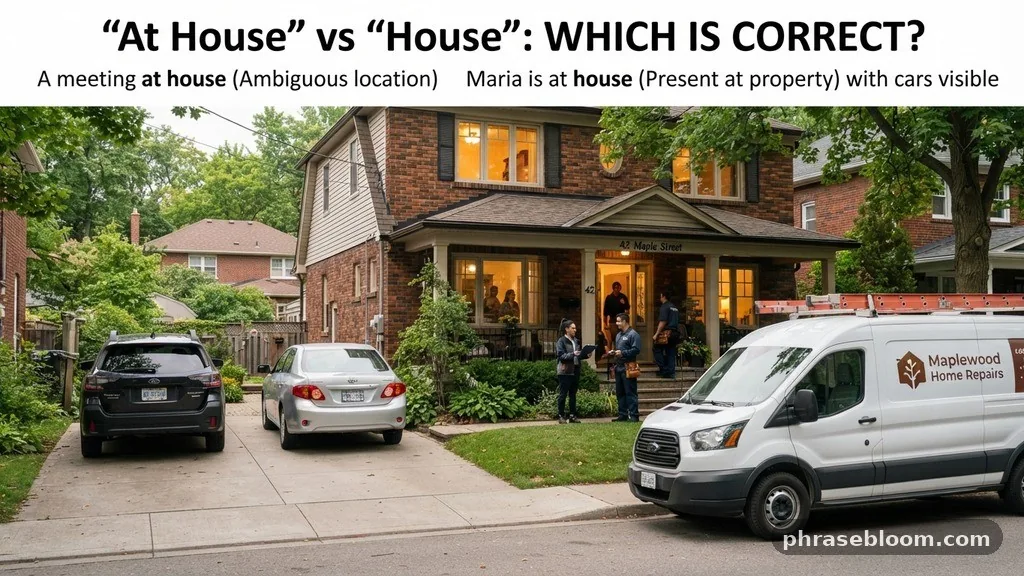
- We’re meeting at the house after work. The house is the meeting location, but the sentence does not specify whether the meeting will happen indoors.
- There are several cars at the house. The cars may be in the driveway, garage, or street nearby.
- Maria is at the house with the repair team. Maria is present at the property, but her exact position is unknown.
- The movers will arrive at the house at nine. The house is the destination for the movers.
- I left the documents at the house. The speaker identifies the property where the documents were left, without stating whether they are inside.
In each example, “at” treats the house as a point or destination. This is similar to phrases such as “at the office,” “at the store,” and “at the station.”
“At the house” can also describe an event connected with a property. “There’s a party at the house” generally means the party is taking place on the property, probably inside, but the wording does not require that every activity happen indoors.
The phrase is especially natural when the house is not the speaker’s own home. “I’m at the house” may refer to a client’s property, a relative’s residence, a house being renovated, or a building where an event is taking place.
What “In the House” Means
“In the house” uses “in” to show that someone or something is inside an enclosed space. The expression focuses on the interior of the building, making it more specific than “at the house.”
For example, “The dog is in the house” means the dog is indoors. It contrasts naturally with “The dog is outside the house,” which places the animal outdoors but near the building.
The phrase can describe people, animals, objects, sounds, activities, and conditions. You might hear “There’s someone in the house,” “The lights are on in the house,” or “A strange noise came from inside the house.”
Examples of “In the House”
- The children are in the house because it’s raining. The sentence contrasts indoor location with outdoor weather.
- We found the missing keys in the house. The keys were somewhere inside the building.
- There’s a meeting in the house this afternoon. The meeting will occur inside the building.
- The plumber is in the house repairing the bathroom. The plumber’s current location is indoors.
- No one was in the house when we arrived. The sentence says that nobody was inside, even if someone may have been somewhere on the property.
The distinction becomes particularly clear in a sentence such as, “The children are at the house, but the parents are in the house.” The first phrase gives a general location, while the second specifies that the parents are indoors.
“In the house” does not necessarily mean that a person lives there. A visitor, employee, cleaner, guest, or emergency worker can all be “in the house.” The expression describes location, not ownership or residence.
Why the Preposition Changes the Meaning
In English grammar, a preposition is a word that helps show a relationship involving location, time, direction, or other circumstances. In “at the house” and “in the house,” the preposition changes the way the listener understands the location.
“At” presents a place as a point or setting. It is useful when the exact position is not important, or when the location includes the surrounding property. “In” presents a place as an enclosed area and emphasizes being inside it.
| Sentence | What it tells us | What it does not tell us |
|---|---|---|
| David is at the house. | David is present at the property. | Whether David is indoors. |
| David is in the house. | David is inside the building. | Which room David is in. |
| The workers are at the house. | The workers have reached the property. | Whether they are working indoors. |
| The workers are in the house. | The workers are inside the building. | Whether they will remain there. |
This difference is not limited to the word “house.” Compare “She is at the school” with “She is in the school.” The first can refer to the school grounds or the school as a destination, while the second normally places her inside the building.
Context can make the broad phrase precise. If a person says, “The technician is at the house fixing the furnace,” listeners may reasonably infer that the technician is inside or near the building. The verb and surrounding details help fill in information that “at” does not state by itself.
English does not apply one automatic rule that makes “at” suitable for every exterior situation and “in” suitable for every interior situation. The speaker’s intended focus matters. A person can be “at the house” while standing inside it, because “at” identifies the property rather than the interior space.
House, Home, and the Idea of Residence
The difference between house and home also affects which phrase sounds natural. A house is usually understood as a physical building, while a home can mean the place where someone lives, including its personal and emotional associations.
“I’m at home” normally means “I’m at my residence.” It does not simply mean that the speaker is somewhere near a building. “I’m in the house,” by contrast, focuses on being inside a physical structure.
Consider the sentence, “I’m at the house, but I’m not in the house.” This could be said by someone sitting in a car in the driveway, standing in the garden, or waiting on the porch. The person is at the property but outside the building.
“At Home” Compared with “At the House”
“At home” is often more natural than “at the house” when the speaker is talking about their usual residence. “I’ll finish the report at home” sounds personal and familiar, while “I’ll finish the report at the house” may suggest a particular property that has already been identified.
“At the house” is also common when the house belongs to someone else or when it is being treated as a location for an activity. For example, “The inspection is at the house on Oak Street” identifies a property, not necessarily the inspector’s home.
“In the home” has a somewhat different tone. It often appears in formal writing, research, product descriptions, public information, and discussions of domestic life, as in “The device is designed for use in the home.”
For everyday speech, “in the house” is usually the more direct choice when you mean inside a particular building. “In the home” may sound broader, more formal, or more focused on household life than physical position.
Common Uses in Everyday and Professional English
Both phrases appear in ordinary conversation, workplace communication, property discussions, and public information. The best choice depends on whether the writer is identifying a destination, describing presence at a property, or specifying an interior location.
Everyday Conversation
“Are you at the house?” asks whether someone has reached or is present at the property. “Are you in the house?” asks whether that person is indoors, which may matter if the speaker is outside or trying to find them.
“I left my phone at the house” identifies the place where the phone was left. “I left my phone in the house” makes it clear that the phone is somewhere inside the building.
Workplace and Service Communication
A property manager might write, “The electrician will be at the house between eight and ten.” This gives the customer an arrival window and identifies the service location.
A follow-up message might say, “The electrician is in the house and has started inspecting the wiring.” Here, the writer gives a more precise update about the worker’s current physical position.
Announcements and Instructions
“Please wait at the house until the driver arrives” treats the house and its surrounding area as the meeting point. “Please wait in the house until the storm passes” specifically instructs people to remain indoors.
That difference can have practical consequences. In an emergency notice, “Stay in the house” is clearer if the instruction is to remain inside, while “Stay at the house” could allow someone to wait outside on the property.
The expressions also appear in public communication. A real estate listing may describe “a quiet office in the house,” while an event notice may advertise “a reception at the house.” The first focuses on an interior space, and the second identifies the property as the event venue.
American English and British English
Both “at the house” and “in the house” are used in American English and British English. There is no general rule that assigns one phrase exclusively to one national variety.
Speakers in both varieties use “at” for a general location and “in” for an interior location. Differences may appear in particular expressions, regional habits, or the vocabulary used for residences, but the central location distinction remains widely understood.
British English often uses “at home” in the same way American English does, and both varieties commonly say “in the house” to mean inside a building. The phrase “at the house” may sound more context-dependent in some situations, but it is not incorrect in British or American usage.
Sentence rhythm and local preference can influence what sounds most natural. A British speaker may choose “I’ll see you at the house” in one context, while an American speaker may choose “I’ll see you at the house” in the same context. The wording is not a reliable marker of nationality.
For formal writing, the safest approach is to follow standard grammar and make the physical meaning clear. The Cambridge Dictionary entry for “at” provides useful reference examples for understanding how the preposition identifies a place or point.
Regional variation becomes more noticeable with related expressions such as “in hospital” and “in the hospital,” or “at university” and “at the university.” Those patterns can differ by variety and context. “At the house” versus “in the house,” however, is primarily a difference in intended location rather than a major American and British English divide.
“At the House” Versus “In the House” in Different Situations
A useful way to choose between the phrases is to imagine what question the sentence answers. If the question is “Where is the meeting or destination?” “At the house” may be suitable. If the question is “Is the person or object inside?” “In the house” is usually better.
| Situation | More natural phrase | Reason |
|---|---|---|
| A delivery destination | At the house | The property is the destination. |
| A person inside during a storm | In the house | The sentence emphasizes indoor safety. |
| A contractor’s scheduled location | At the house | The contractor is assigned to the property. |
| A noise coming from indoors | In the house | The sound or source is inside. |
| A party held on a property | At the house | The house is the event location. |
| A lost item inside a building | In the house | The item’s interior location matters. |
Suppose a friend asks, “Where should I drop off the keys?” You could answer, “Leave them at the house,” if the person can place them somewhere on the property. Say “Leave them in the house” if you want the keys brought indoors.
Now consider a security message. “There is someone at the house” means someone is present at the property, but it does not establish whether the person is welcome or whether they are indoors. “There is someone in the house” can sound more urgent because it indicates entry into the building.
In property and construction writing, “at the house” often describes work connected with the site. “The crew completed the repairs at the house” refers to the property as a work location. “The crew completed the repairs in the house” emphasizes that the repairs occurred inside.
Common Mistakes and How to Correct Them
Most errors involving these phrases come from choosing a preposition without considering the intended meaning. The grammar is simple, but the location may be broad or specific.
Using “In” for a General Property Location
“The delivery driver is in the house” is correct only if the driver is inside the building. If the driver is waiting in the driveway, the sentence is inaccurate. Use “The delivery driver is at the house” for a general property location.
Using “At” When Indoor Location Matters
“The children are at the house because of the tornado” may be understood, but it does not clearly tell readers that they are indoors. “The children are in the house because of the tornado” communicates the safety instruction more precisely.
Confusing “At the House” with “At Home”
“I’ll be at home tonight” means the speaker will be at their residence. “I’ll be at the house tonight” may refer to a particular house, perhaps one being watched, renovated, rented, or visited.
Adding Unnecessary Words
Some writers say “inside in the house,” which is usually redundant. Write “inside the house” or simply “in the house,” depending on the sentence.
Similarly, “outside at the house” may be unnecessarily awkward. “Outside the house” identifies the exterior area, while “at the house” gives a broader property location.
Assuming One Phrase Is Always More Formal
Neither “at the house” nor “in the house” is inherently more formal. Formal writing should favor accuracy and clarity, not a supposedly elevated preposition.
The phrase “in the house” may be more exact in a report about indoor conditions, while “at the house” may be more appropriate in a service schedule. The subject determines the best wording.
A Practical Decision Guide
When you are unsure which phrase to use, identify the location you want the reader to picture. Do you mean the property as a whole, or the inside of the building?
- Use “at the house” for a general property location. Choose it for arrivals, meetings, deliveries, service visits, and events connected with a house.
- Use “in the house” for an interior location. Choose it when the person, object, activity, sound, or condition is inside the building.
- Use “at home” for someone’s usual residence. This is often the most natural option in personal conversation.
- Use “in the home” for a formal or broad domestic context. This wording often appears in reports, product information, and discussions of household life.
- Rewrite the sentence if the location remains unclear. Words such as “inside,” “on the property,” “in the driveway,” or “near the house” may communicate the meaning more directly.
For instance, “The inspector is at the house” may be enough in a text message. In a legal record or work order, “The inspector is on the property” or “The inspector is inside the building” may be more exact.
Professional writing benefits from a clear distinction between a destination and an interior position. A schedule may say, “The technician will arrive at the house at 10 a.m.” A status update may say, “The technician is now in the house and testing the alarm system.”
Sentence context can also remove ambiguity without changing the preposition. “We held the interview at the house in the front study” first identifies the property and then names the interior room. Good writing often uses both broad and precise location phrases together.
Examples You Can Copy and Adapt
The following examples show how the expressions work in natural sentences. Each one uses a context in which the intended location is clear.
General Presence and Arrivals
“The project manager will be at the house before the delivery arrives.” This is appropriate when the manager needs to be present at the property, whether indoors or outside.
“Please leave the materials at the house and call me when you arrive.” The sentence treats the house as the delivery location and does not require the materials to be placed indoors.
Interior Location
“The spare blankets are in the house, in the closet near the stairs.” The first phrase establishes that the blankets are indoors, and the second gives their precise position.
“We heard a smoke alarm in the house.” The phrase indicates that the alarm was inside the building, which may be important in a safety report.
Business and Property Communication
“The real estate agent is at the house for the inspection.” This sentence identifies the agent’s work location without claiming that the inspection is taking place indoors.
“The inspector found water damage in the house.” The wording indicates that the damage is inside the building, not merely somewhere on the property.
Personal Messages
“I’ll be at the house all afternoon, so the courier can come anytime.” The speaker will be available at the property.
“I’ll be in the house all afternoon, but I may not hear the doorbell.” This version stresses that the speaker will be indoors and may be unable to hear activity outside.
These examples show why “at the house” and “in the house” should not be treated as interchangeable in every sentence. Their meanings overlap, but their focus is different.
FAQ: At the House vs In the House
Is “at the house” correct?
Yes. “At the house” is correct when you mean that someone or something is at a particular property or location. It does not necessarily mean that the person or object is inside the building.
Is “in the house” correct?
Yes. “In the house” is correct when you mean inside the building. It is the clearer choice when indoor location matters.
Is “at the house” more formal than “in the house”?
No. Neither phrase is automatically more formal. The correct choice depends on whether you mean a general property location or an interior location.
Can I use “at home” instead?
Use “at home” when you mean someone’s usual residence. Use “at the house” when you are identifying a particular property, which may belong to someone else or may be the location of an event or service visit.
What is the difference between “at the house” and “in the house”?
“At the house” gives a broad location, while “in the house” specifically places someone or something inside the building. The difference is mainly one of physical location and emphasis.
Conclusion
Choosing between “at the house” and “in the house” depends on the location you want to express. “At the house” treats the property as a general destination or setting, while “in the house” makes clear that someone or something is inside the building.
When the distinction matters, use the more precise phrase: say “in the house” for an interior position and “at the house” for general presence at the property. In everyday writing, the best answer to the At the House vs In the House question is the one that matches your intended meaning, and you can always add words such as “inside,” “in the driveway,” or “on the property” for extra clarity.
Explore more on PhraseBloom.