
Both company-wide and companywide are used in modern English, and both generally mean “affecting the entire company.” The safest choice depends on grammar, audience, and house style, but company-wide is usually the clearest form when the word comes directly before a noun, as in “a company-wide policy.”
Companywide is also a legitimate closed compound, especially in business writing and in some dictionaries and style systems. The key is not a major difference in meaning. It is a question of spelling, grammatical position, editorial preference, and consistency.
The Direct Answer: Company-Wide or Companywide?
If you need one practical answer, use company-wide before a noun unless your organization’s style guide specifically prefers companywide. Write “a company-wide announcement,” “company-wide training,” and “a company-wide change.” The hyphen makes it immediately clear that the two words work together to describe the noun that follows.
Use companywide when your organization treats the term as a closed compound or when that spelling fits the style of the document. For example, “The changes apply companywide” is common and understandable, although “The changes apply across the company” may sound more natural to many readers.
The form company wide, written as two separate words, is generally not the preferred spelling when the expression functions as one modifier. It may appear in informal writing or in sentences where “wide” has a separate, literal meaning, but professional writers usually choose the hyphenated or closed form instead.
| Form | Spelling | Meaning | Typical grammatical function | Common context | Practical recommendation |
|---|---|---|---|---|---|
| company-wide | Hyphenated compound | Affecting the entire company | Adjective before a noun; also possible after a linking verb | Policies, announcements, training, initiatives | Safest default before a noun |
| companywide | Closed compound | Affecting the entire company | Adjective or adverbial use, depending on context | Business writing, internal communications, reports | Use if it matches the house style |
| company wide | Two separate words | Usually intended to mean company-wide | Less clear compound modifier | Informal or inconsistent writing | Usually revise to company-wide or companywide |
| across the company | Open phrase | Throughout the entire company | Prepositional phrase | Emails, reports, announcements | Excellent clear alternative |
| throughout the company | Open phrase | In all parts of the company | Prepositional phrase | Formal and general business writing | Useful when avoiding spelling questions |
What Company-Wide Means
Company-wide means something affects, involves, applies to, or covers the entire company. A company-wide policy applies to all relevant departments or employees, not just to one office, team, or business unit.
For example, a company-wide benefits announcement may explain a change that applies to employees in several departments. A company-wide software rollout may involve every location, while a department-wide rollout would be limited to one department.
The word normally describes scope. It tells readers how broadly an action, policy, change, or initiative reaches within the business.
- Company-wide policy: a policy that applies throughout the company.
- Company-wide announcement: a message sent to the whole company.
- Company-wide initiative: a project involving the organization as a whole.
- Company-wide training: training intended for employees across the company.
- Company-wide change: a change that affects the company broadly.
- Company-wide meeting: a meeting attended by, or communicated to, the whole company.
The expression does not necessarily mean that every person experiences something in exactly the same way. A company-wide policy can contain different procedures for different locations, roles, or legal jurisdictions while still applying across the organization.
That distinction matters in professional writing. “Company-wide” describes the reach of an action, but it does not automatically promise identical results for every employee.
Why the Hyphen Matters Before a Noun
A hyphen can show readers that two words form one descriptive unit. In “company-wide policy,” the words company-wide work together to modify the noun policy.
This kind of unit is called a compound modifier. The term sounds technical, but the idea is simple: two or more words combine to describe another word more precisely.
Consider these examples:
- The board approved a company-wide policy.
- Human Resources scheduled company-wide training.
- The chief executive issued a company-wide announcement.
- The company launched a company-wide initiative.
- Managers prepared employees for a company-wide change.
In each sentence, the compound comes immediately before a noun. The hyphen helps readers process “company-wide” as a single modifier rather than as two unrelated words.
The closed spelling can perform the same job: “a companywide policy” is readable and accepted in many forms of business English. Still, the hyphenated version is often the safest choice for a mixed audience because its structure is visible at a glance.
Hyphenation is not an automatic rule that produces one answer in every sentence. Established compounds often develop from hyphenated forms into closed forms over time, and different dictionaries or style guides may record different preferences.
The Merriam-Webster dictionary entry for company-wide is one useful reference when checking the term, but your organization’s own editorial policy should take priority in a consistent document.
Company-Wide Before a Noun
Before a noun, company-wide is a strong default. The form is especially useful in headings, policies, employee handbooks, reports, and formal announcements where readers benefit from immediate clarity.
“The company-wide policy takes effect in July” is clear because the compound modifier appears directly before “policy.” The sentence tells readers that the policy covers the company as a whole.
“The companywide policy takes effect in July” is also acceptable if the publication or organization uses the closed form. It does not change the basic meaning, and many readers will treat the two versions as equivalent.
Examples in Business Writing
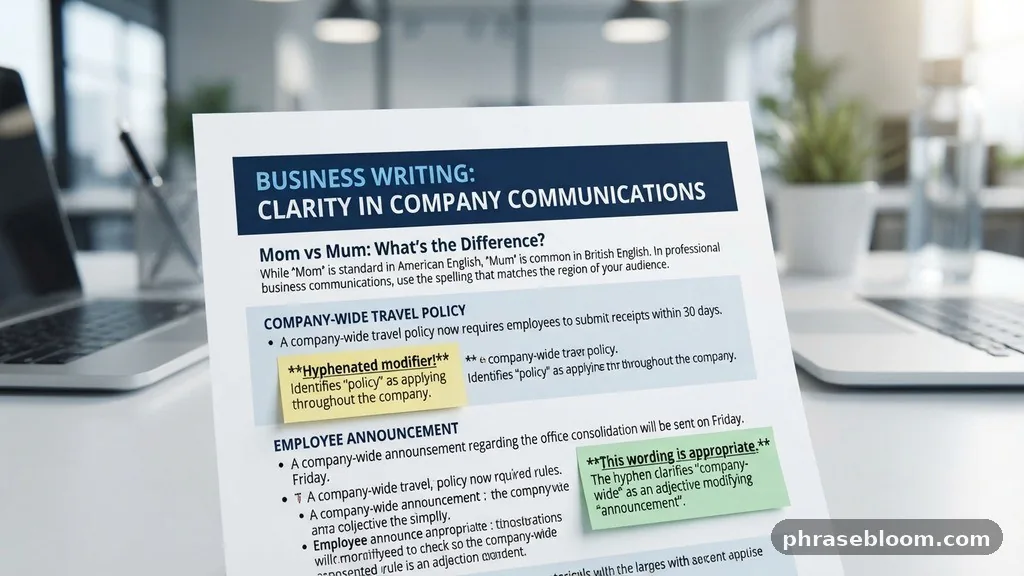
Company policy: “The company-wide travel policy now requires employees to submit receipts within 30 days.” The hyphenated modifier identifies the policy as applying throughout the company.
Employee announcement: “A company-wide announcement about the office consolidation will be sent Friday.” This wording is appropriate when the message is intended for employees across the organization.
Training: “All supervisors must complete the company-wide training module by October 15.” The expression signals that the training requirement is not limited to one department.
Benefits and HR: “Human Resources published a company-wide benefits update.” This is concise, professional, and natural in an employee communication.
Technology rollout: “The information technology team will begin a company-wide software rollout next quarter.” The wording communicates broad organizational scope without claiming that every employee will receive the software on the same day.
These examples use the hyphenated form because each compound appears before a noun. If a companywide house style is already established, the same sentences can use the closed spelling without changing their meaning.
Predicate and Adverbial Uses
The grammatical position can influence how writers handle the expression. A predicate adjective comes after a linking verb such as “is,” “was,” or “became,” while an adverbial use describes how or where an action applies.
These sentences are standard and clear:
- The policy is company-wide.
- The changes are companywide.
- The new system was introduced company-wide.
- The new system was introduced companywide.
- The changes apply company-wide.
- The changes apply companywide.
After a linking verb, the expression describes the subject. In “The policy is company-wide,” the phrase says that the policy covers the whole company.
In “The changes apply companywide,” the term works adverbially by explaining the scope of the application. Some editors prefer “The changes apply across the company” because the open phrase is more natural and less dependent on a disputed spelling choice.
There is no universal requirement that the hyphen must disappear after a verb. The important point is that usage differs by style system, and both company-wide and companywide appear in edited professional writing.
Writers should also avoid assuming that “company wide” is always correct simply because the phrase appears after a verb. “The changes apply company wide” may be understood, but many readers will see it as an inconsistent version of the compound. “The changes apply companywide” or “The changes apply across the company” is usually cleaner.
Is Companywide One Word?
Yes. Companywide is one word, also called a closed compound. A closed compound combines words without a space or hyphen, as in “workplace” or “headquarters.”
In companywide, “company” and “wide” have joined to create a single term meaning “throughout the company.” The word can function as an adjective before a noun, as in “companywide changes,” or as an adverbial term, as in “The system was deployed companywide.”
Calling companywide one word does not mean it is always the preferred word. A dictionary may recognize the closed form while a company style guide may still prefer the hyphenated form for readability.
The difference between companywide and company-wide is usually a spelling and style difference, not a difference in meaning. Neither form means that the company itself is physically wide, and neither form necessarily has a narrower or broader scope than the other.
Why Both Forms Exist
Compound words often move through several stages. Writers may first use two separate words, then a hyphenated form, and eventually a closed compound as the expression becomes familiar.
That development is not perfectly uniform. Different publications, dictionaries, industries, and countries may settle on different forms at different times.
For that reason, it is better to treat company-wide and companywide as accepted variants governed by context and style. Calling one form universally wrong oversimplifies actual usage.
Company Wide Without a Hyphen
Company wide, with a space and no hyphen, is generally not the best choice when the words function together to mean “throughout the company.” In “a company wide policy,” the reader can still understand the intended meaning, but the compound modifier is less clearly marked.
The preferred corrections are usually “a company-wide policy” or “a companywide policy.” Both versions show that the expression is one descriptive unit.
Compare these sentences:
- Less polished: “The company wide policy applies to all employees.”
- Preferred: “The company-wide policy applies to all employees.”
- Also acceptable: “The companywide policy applies to all employees.”
- Clear alternative: “The policy applies throughout the company.”
The issue is not that a space makes the sentence impossible to understand. The issue is that professional writing benefits from a stable, recognizable form, especially in formal policies and public-facing materials.
There are situations in which “company wide” could be interpreted literally, although such uses are uncommon. For example, a sentence about a banner being “company wide” might be trying to describe its physical dimensions rather than its organizational scope. If the intended meaning is organizational, rewrite the phrase.
Writers should also avoid companywidely. That form is not a standard replacement for company-wide or companywide. Use “throughout the company,” “across the company,” or another natural phrase instead.
American English, British English, and House Style
American English and British English do not divide this issue into a simple rule in which one region exclusively uses company-wide and the other exclusively uses companywide. Both forms can appear in U.S. English, UK English, Commonwealth English, and international business communication.
Regional spelling habits may influence what looks familiar to a reader, but dictionaries and style guides are often more important than geography. An American company may use companywide in its internal publications, while a British organization may prefer company-wide in a formal policy.
Canadian English, Australian English, and New Zealand English also reflect broader language variation. Their professional publications may follow local editorial conventions, an international corporate style, or a particular dictionary.
Formal and Professional Writing
In formal writing, clarity and consistency matter more than claiming that one variant is the only correct form. A legal department, university, government agency, or multinational company may have a house style that specifies how compound modifiers are written.
If the organization has no stated preference, company-wide is often the safest choice before a noun because the hyphen makes the relationship between the words easy to see. Companywide is a sound alternative when it is already common in the organization’s documents.
International readers may find “across the company” or “throughout the company” even more transparent. These alternatives avoid regional expectations about whether the compound should be open, hyphenated, or closed.
Do not change forms randomly because a document contains several kinds of writing. A website heading, an HR notice, and a board report can follow the same house style unless there is a deliberate reason to adapt the wording.
Company-Wide Usage in Real Sentences
Natural examples help show how the term works in workplace communication. The following sentences use the expression in situations that commonly arise in business English.
Internal Communications
“The chief operating officer will host a company-wide meeting on Tuesday.” This sentence works because the meeting is presented as an event for the organization as a whole.
“Please share the companywide update with employees who do not regularly check email.” The closed form is natural if it matches the company’s preferred style, and the sentence also shows that the message may need to reach employees through more than one channel.
Organizational Change
“The merger will create a company-wide change in reporting relationships.” This wording signals that the change reaches beyond one team or office.
“The companywide changes will be introduced in phases.” Here, the plural noun “changes” is modified by the closed compound. The sentence does not claim that every part of the change will happen simultaneously.
Business Reports
“The report evaluates the results of the company-wide customer service initiative.” The modifier identifies the initiative’s scope, while the rest of the sentence identifies what the report measures.
“Customer satisfaction improved after the companywide program was expanded.” This version is concise and suitable for a management report that uses closed compounds consistently.
Marketing and Public Communication
“The company-wide sustainability program includes changes to packaging and transportation.” This sentence is suitable for a public webpage because it explains a broad initiative without overstating its details.
“Our new service is available companywide.” The adverbial closed form works here, although “available throughout the company” would describe internal availability more explicitly if the audience might misunderstand the scope.
Emails and Everyday Workplace Writing
“A company-wide email will go out after the leadership team approves the wording.” The hyphenated form makes the noun phrase easy to scan in an email.
“The deadline has been extended across the company.” This alternative is especially useful when the writer wants a plain, direct sentence rather than a compound modifier.
Alternatives That Avoid the Hyphenation Question
Sometimes the clearest solution is not to choose between company-wide and companywide. A short rewrite can make the scope explicit and may sound more natural in an email, report, or announcement.
| Original idea | Clear alternative | Best use |
|---|---|---|
| A company-wide policy | A policy that applies across the company | Policy explanations and employee guidance |
| Companywide training | Training for all employees | HR notices and training schedules |
| A company-wide announcement | An announcement to the entire company | Internal communications |
| Company-wide changes | Changes throughout the company | Reports and organizational updates |
| The system was introduced companywide | The system was introduced across the company | Technology updates and project reports |
Across the company is conversational and direct. Throughout the company is slightly more formal and emphasizes coverage across locations or departments.
Across the organization is useful when the entity is not technically a company, such as a nonprofit, university, association, or public agency. Organization-wide has the same general structure as company-wide but a potentially broader institutional meaning.
Enterprise-wide often suggests scope across a large business, multiple divisions, or an entire enterprise technology environment. It is not always interchangeable with company-wide because an enterprise may contain several companies or legal entities.
Choose the alternative that reflects the real scope. A company-wide initiative may affect one company, while an organization-wide initiative may include subsidiaries, contractors, volunteers, or separate institutions.
Common Mistakes and Better Corrections
Small inconsistencies can make a document look unfinished, especially when the term appears in headings, tables, policy text, and email templates. The corrections below address the most common problems.
Changing Forms Without a Reason
Inconsistent: “The company-wide policy supports companywide training, and the company wide announcement will follow.”
Better: “The company-wide policy supports company-wide training, and the company-wide announcement will follow.” Another acceptable version is to use companywide throughout.
The problem is not that readers cannot understand the mixed forms. The problem is that inconsistent spelling makes the document appear to lack editorial control.
Using Company Wide as a Compound Modifier
Less polished: “Managers must explain the company wide change.”
Preferred: “Managers must explain the company-wide change.”
Also acceptable: “Managers must explain the companywide change.”
The words function together before “change,” so the hyphenated or closed form is clearer.
Inventing Companywidely
Incorrect or highly unnatural: “The new procedure was implemented companywidely.”
Better: “The new procedure was implemented companywide.” Even clearer: “The new procedure was implemented throughout the company.”
English does not form every adverb by adding “-ly” to an existing compound. Use an established form rather than creating a word that readers may not recognize.
Treating Companywide as a Noun
Unclear: “The companywide begins next month.”
Better: “The company-wide training begins next month.”
Company-wide and companywide usually function as adjectives or adverbial terms, not nouns. They need a noun such as “policy,” “training,” “announcement,” or “initiative” when they are used as modifiers.
Choosing the Compound When a Rewrite Is Better
Awkward: “The companywide will be sent to all staff.”
Better: “The announcement will be sent to all staff.”
Sometimes the writer knows the noun but leaves it out because it seems obvious. Restoring the noun produces a more complete and professional sentence.
How to Choose the Right Form
A reliable decision process can prevent most mistakes. First, ask whether the expression modifies a noun directly.
- If it appears before a noun, choose company-wide as the safest default.
- If your style guide uses the closed compound, choose companywide consistently.
- If it appears after a linking verb or as an adverbial term, either accepted form may work.
- If readers may find the spelling distracting, use “across the company” or “throughout the company.”
- If your organization already has a standard, follow it rather than mixing alternatives.
Next, consider the audience. A local internal memo may reflect a company’s established vocabulary, while an international website may benefit from the more transparent phrase “across the company.”
Then check the document type. A policy manual, legal document, annual report, and employee email can use the same spelling, but the level of formality may affect whether a plain alternative sounds better.
Recommendations by Context
Business emails: Use company-wide or companywide according to the company’s normal style. “Across the company” is a natural option when the email should sound direct and conversational.
Employee handbooks: Prefer a consistent form throughout the handbook. The hyphenated spelling is a safe choice before nouns such as “policy,” “training,” and “benefits announcement.”
Legal and policy documents: Check the relevant institutional style and define the scope precisely. “Applies to all employees of the company” may be clearer than relying on company-wide alone.
Reports: Use the form found in the report’s existing terminology. Avoid alternating between company-wide and companywide in headings, charts, and narrative text.
Websites and marketing materials: Consider international readers and choose “across the company” if the compound looks unfamiliar or if the sentence becomes easier to understand.
Internal software interfaces: Short labels may favor companywide, but clarity should come first. “For all employees” can be more useful than either compound in a button, menu, or notification.
Academic writing: Follow the required style manual, department guidance, or publisher instructions. If no rule exists, use company-wide consistently and avoid switching forms.
Building a Consistent House Style
A house style is an organization’s shared set of writing preferences. It may cover capitalization, dates, punctuation, terminology, and compound words such as company-wide.
If your organization chooses company-wide, record that preference in the style guide and use it in templates, policy documents, presentations, and public communications. If it chooses companywide, the same principle applies.
Consistency does not require ignoring grammar. A style guide can state that the organization uses companywide in all positions, or it can prefer company-wide before nouns and “across the company” in other contexts.
Editors should search the final document for all three versions: “company-wide,” “companywide,” and “company wide.” This simple check often finds inconsistencies that are easy to miss during drafting.
Teams can also reduce variation by storing approved phrases in templates. For example, an HR template might use “company-wide benefits update,” while a technology template might use “deployment across the company.” Approved wording saves time and supports a recognizable organizational voice.
Company-Wide or Companywide in Formal Writing
Neither spelling is automatically informal. Company-wide appears naturally in formal policies, executive communications, research reports, and public documents. Companywide can serve the same purposes when the publication’s style accepts the closed compound.
The safest form for formal writing is therefore the form that meets three conditions: it is grammatically appropriate, it is clear to the intended audience, and it matches the document’s established style.
If no style guidance exists and the term comes before a noun, company-wide is a practical default. If the term occurs repeatedly in a document and the organization prefers closed compounds, companywide is equally workable.
Formal writing should not treat a spelling preference as a difference in substance. A company-wide policy and a companywide policy normally describe the same kind of policy. The document’s definitions and scope statements matter more than the presence or absence of the hyphen.
Frequently Asked Questions
Is company-wide or companywide correct?
Both are used and generally correct. Company-wide is often the safest choice before a noun, while companywide is a recognized closed compound that may be preferred by a style guide or organization.
Is company-wide more formal?
Not necessarily. The hyphenated form can look especially clear in formal writing, but companywide is also suitable for professional documents when used consistently.
Should company-wide be hyphenated before a noun?
Usually, yes, if you are using the hyphenated form as a compound modifier: “a company-wide policy” or “a company-wide initiative.” The closed form “companywide policy” is also accepted in many style systems.
Is company wide wrong?
It is generally not the preferred spelling when the two words work together as one modifier. Use company-wide, companywide, or a phrase such as “across the company.”
Can I write “The policy is company-wide”?
Yes. “The policy is company-wide” is clear and grammatical. It states that the policy applies to the company as a whole.
Can company-wide be used after a verb?
Yes. Examples include “The changes apply company-wide” and “The system was introduced company-wide.” You can also use companywide or rewrite the sentence as “across the company.”
Is companywide one word?
Yes. Companywide is a closed compound written as one word. It usually has the same basic meaning as company-wide.
Which form should I use in professional writing?
Use company-wide as a safe default before a noun unless your organization has a different preference. Above all, follow the relevant style guide and use one form consistently.
Is there an American versus British difference?
There is no simple regional rule. Both company-wide and companywide appear in American English, British English, and international business writing, so dictionary and house-style preferences matter more than nationality alone.
What is a good alternative to company-wide?
Use “across the company,” “throughout the company,” “for the entire company,” or “for all employees.” Choose “organization-wide” or “enterprise-wide” only when the scope genuinely includes an organization or enterprise broader than one company.
Should I use one spelling consistently throughout a document?
Yes. Consistency improves clarity and makes the document look professionally edited. Check headings, tables, templates, emails, and body text for mixed forms.
Conclusion
The practical rule for company-wide or companywide is straightforward: use company-wide before a noun when you want the safest, clearest default, and use companywide when it matches an established style. Both forms usually mean that something affects the entire company.
Avoid company wide when the words function as one compound, and do not invent forms such as companywidely. If the spelling still feels distracting, rewrite the sentence with “across the company” or “throughout the company.” In professional writing, clarity, grammatical fit, and consistency matter more than treating one variant as universally correct.
Related reading: Unselect vs Deselect, Hassle vs Hastle, Continuous vs Continous.