
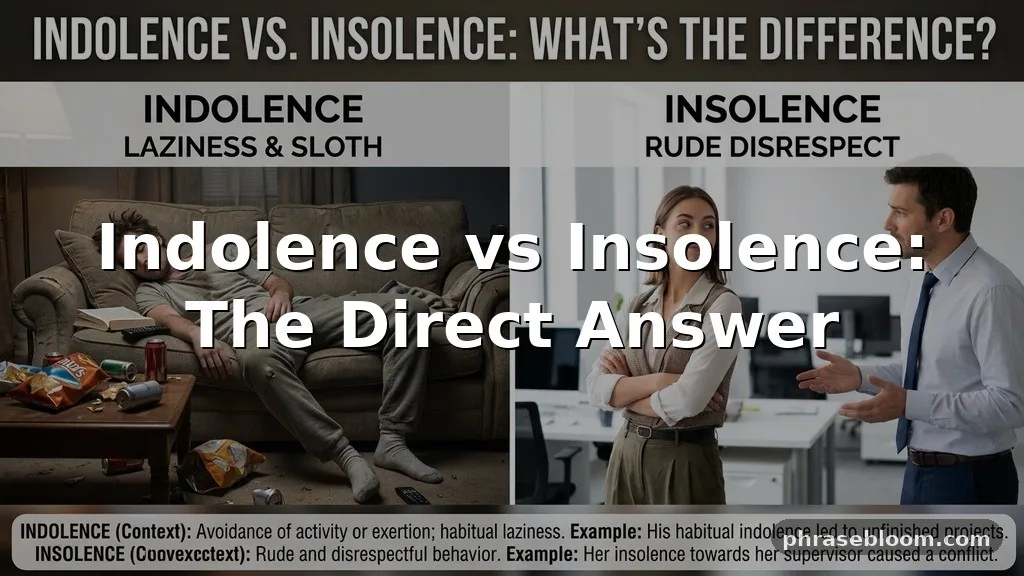
Indolence vs insolence is a distinction between two words that look and sound similar but describe very different behavior. Indolence means a tendency toward laziness, idleness, or avoiding effort, while insolence means disrespectful, rude, or openly defiant behavior.
The difference matters because confusing them can change the meaning of a sentence completely. A person who shows indolence may fail to act, whereas an insolent person actively speaks or behaves with impudence toward someone else. The definitions, word etymology, pronunciation, parts of speech, and examples below make the contrast easy to remember.
Indolence is laziness or a lack of willingness to work. Insolence is disrespect or rudeness, especially toward someone who expects obedience or respect. The words share a similar ending, but they refer to separate character traits and kinds of conduct.
| Word | Basic meaning | Typical behavior | Simple example |
|---|---|---|---|
| Indolence | Laziness, idleness, or unwillingness to exert effort | Failing to complete work or avoiding activity | His indolence delayed the project. |
| Insolence | Disrespect, rudeness, or impudence | Speaking or acting in a boldly disrespectful way | Her insolence offended the manager. |
| Indolent | Lazy or habitually inactive | Showing little effort or motivation | The indolent employee postponed the task. |
| Insolent | Disrespectful or offensively bold | Showing defiance through words or conduct | The insolent reply ended the discussion. |
A useful memory aid is this: indolence concerns effort, while insolence concerns attitude toward other people. Someone can be indolent without insulting anyone, and someone can be insolent even while working hard.
For a concise reference, the Merriam-Webster dictionary entry for indolence confirms the connection with laziness and inactivity. Dictionary definitions are helpful, but sentence context is what reveals which word belongs in a particular passage.
Indolence Definition and Meaning
The indolence definition is a state or habit of avoiding effort. An indolent person may be slow to begin a task, unwilling to maintain steady work, or content to remain inactive when action is needed.
Indolence is a noun. It names a condition, tendency, or pattern rather than describing a person directly. For example, “The committee criticized his indolence” identifies the behavior, while “He was indolent” uses the related adjective.
Indolence does not always mean physical laziness alone. It can describe mental inactivity, a lack of motivation, or an unwillingness to make decisions and solve problems.
- Indolence at work: repeatedly postponing assignments without a valid reason.
- Indolence in study: refusing to review material despite having enough time.
- Indolence in daily life: choosing prolonged idleness instead of necessary activity.
- Mental indolence: avoiding careful thought, research, or independent judgment.
The word often carries a negative judgment, but its tone can vary. In a formal report, indolence may suggest a serious failure of responsibility; in casual conversation, it may simply describe someone who is being lazy on a particular afternoon.
Indolent meaning in context
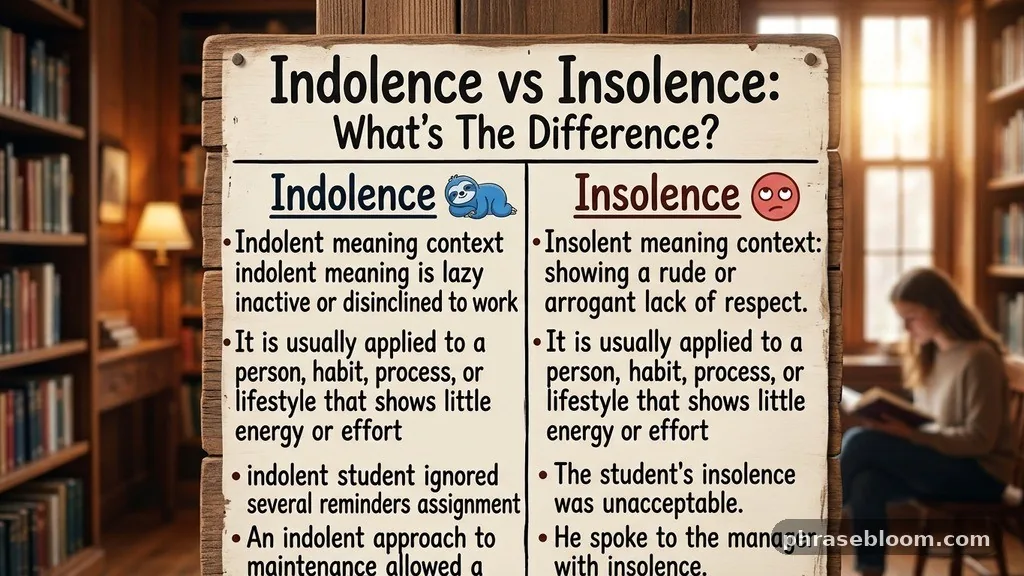
The indolent meaning is “lazy,” “inactive,” or “disinclined to work.” It is usually applied to a person, habit, process, or lifestyle that shows little energy or effort.
Consider these example sentences:
- The indolent student ignored several reminders about the assignment.
- An indolent approach to maintenance allowed a minor defect to become expensive.
- After a demanding week, she spent Saturday in harmless indolence.
The third example is softer than the first two. It treats indolence as temporary rest or inactivity rather than as a persistent moral failing.
Insolence Definition and Meaning
The insolence definition centers on disrespectful behavior. Insolence is an attitude or act of rudeness that may involve speaking boldly to someone who deserves respect, challenging authority in an offensive manner, or responding with contempt.
Insolence is also a noun. The related adjective is insolent, as in “an insolent remark” or “an insolent teenager.” The word normally involves a relationship between people, because disrespect requires a target or social expectation that has been violated.
Insolence can appear in speech, writing, facial expressions, or conduct. A sarcastic reply to a supervisor, a deliberately mocking email, and a contemptuous response to a parent can all be described as insolent if the context supports that judgment.
Several related ideas help clarify its range:
- Rudeness: a lack of courtesy that may be careless rather than deliberately defiant.
- Impudence: bold, cheeky, or presumptuous behavior.
- Defiance: open resistance to authority or an instruction.
- Disrespect: a broad term for treating a person or institution without proper regard.
Insolence can include all four qualities, but it is not identical to any one of them. A person may be rude without being openly defiant, and a person may be defiant for principled reasons without speaking insolently.
Insolent meaning in context
The insolent meaning is “disrespectfully bold” or “offensively impudent.” It commonly describes words, replies, gestures, or a person’s manner.
- The supervisor objected to the employee’s insolent response.
- His insolent tone made a reasonable disagreement sound like a personal attack.
- The witness was criticized for giving an insolent answer in court.
These examples show that insolence is not simply confidence. A confident person can disagree clearly and respectfully; an insolent person expresses disagreement in a way that belittles, mocks, or challenges another person improperly.
Word Etymology and Pronunciation
The similarity between indolence and insolence comes partly from their shared Latin background and similar endings. Their meanings, however, developed along different paths, so their modern definitions should not be treated as interchangeable.
Indolence is pronounced roughly “IN-duh-luhns,” with the stress on the first syllable. It is related to the Latin word indolentia, associated with freedom from pain and, later, a lack of concern or effort.
Insolence is pronounced roughly “IN-suh-luhns,” also with stress on the first syllable. It comes from Latin insolentia, connected with unusual or overbearing behavior and eventually with arrogance or disrespect.
The pronunciation difference is subtle, especially in fast speech. The vowel in the middle syllable can be easy to miss, which is one reason writers may confuse the words when they encounter them primarily through conversation.
| Term | Approximate pronunciation | Part of speech | Core idea |
|---|---|---|---|
| Indolence | IN-duh-luhns | Noun | Laziness or inactivity |
| Indolent | IN-duh-luhnt | Adjective | Lazy or inactive |
| Insolence | IN-suh-luhns | Noun | Disrespect or impudence |
| Insolent | IN-suh-luhnt | Adjective | Disrespectful or offensively bold |
Studying the parts of speech also prevents mistakes. “Indolence” and “insolence” name qualities, while “indolent” and “insolent” modify nouns or follow linking verbs.
Indolence vs Insolence in Real Sentences
Sentence context usually makes the distinction straightforward. If the sentence describes failure to act, lack of motivation, or avoidance of work, indolence is likely the intended word. If it describes an offensive reply, contemptuous behavior, or disrespect toward another person, insolence is more appropriate.
Examples involving work and responsibility
“The department’s indolence caused the report to miss its deadline.” The issue here is inactivity or failure to complete a task, not an insulting attitude.
“The department head rejected the employee’s insolence during the meeting.” This sentence identifies disrespectful conduct directed at another person.
“His indolence was frustrating, but his manner remained polite.” This example deliberately separates the two ideas. A person can be lazy without being rude.
“Her insolence was obvious even though she completed every assignment.” This sentence shows the reverse situation. Someone can work diligently and still speak disrespectfully.
Examples involving education and family life
“The teacher addressed the student’s indolence after three incomplete projects.” The criticism concerns effort and follow-through.
“The teacher addressed the student’s insolence after he mocked her instructions.” The criticism concerns disrespect and mockery.
“The parent worried about his son’s indolence during the school term.” The focus is a lack of motivation.
“The parent objected to her daughter’s insolent reply.” The focus is an offensive manner of speaking.
Examples involving public and formal language

“The editorial condemned the minister’s indolence during the emergency.” The writer claims that the minister failed to act energetically.
“The editorial condemned the minister’s insolence toward the journalists.” The writer claims that the minister behaved rudely or contemptuously toward them.
Changing one word changes the accusation. Calling someone indolent criticizes their effort; calling someone insolent criticizes their treatment of other people.
Synonyms and Antonyms for Both Words
Synonyms can help you choose the right word, but they do not always match perfectly. The strongest synonym depends on whether you want to emphasize inactivity, weak motivation, social disrespect, or open defiance.
| Word | Useful synonyms | Possible antonyms | Meaning emphasized |
|---|---|---|---|
| Indolence | Laziness, idleness, inactivity, sluggishness | Diligence, industry, energy, initiative | Failure to exert effort |
| Indolent | Lazy, inactive, idle, sluggish | Diligent, industrious, energetic, motivated | A person or habit lacking effort |
| Insolence | Disrespect, rudeness, impudence, impertinence | Respect, courtesy, humility, politeness | Offensive treatment of another person |
| Insolent | Disrespectful, rude, impudent, defiant | Respectful, courteous, deferential, civil | A person, tone, or remark showing disrespect |
“Apathy” can overlap with indolence, but it usually means a lack of interest or emotional concern. Someone may be apathetic about a project yet still complete it efficiently, while indolence specifically suggests a failure to act or apply effort.
“Defiance” can overlap with insolence, but it focuses more on resistance. A worker who refuses an unsafe order may be defiant without being insolent if the refusal is expressed calmly and respectfully.
Use “laziness” in ordinary conversation when a direct, familiar word is best. Use “indolence” in formal or literary writing when you want a more elevated term, and use “insolence” when the central issue is contemptuous or disrespectful conduct.
Common Confusions and Word Choice Mistakes
The most common mistake is using insolence to describe someone who simply avoids work. “His insolence kept him from finishing the assignment” suggests that disrespect caused the delay, while “his indolence kept him from finishing the assignment” clearly identifies laziness or inactivity.
The opposite mistake is also common. “Her indolence offended the director” says that her laziness caused offense, but it does not necessarily say that she insulted anyone. If the intended meaning is a rude answer, “her insolence offended the director” is more precise.
- Incorrect meaning: The employee showed insolence by missing the deadline.
- Better for inactivity: The employee showed indolence by repeatedly missing deadlines.
- Better for disrespect: The employee showed insolence by mocking the supervisor’s reminder.
Another mistake is treating the adjective and noun forms as interchangeable. “He is indolence” is incorrect because indolence is a noun; write “He is indolent” or “He displays indolence.” Similarly, write “She is insolent” or “She displayed insolence,” not “She is insolence.”
Writers sometimes use these words as if they were neutral descriptions of personality. Both can sound judgmental, especially in workplace, academic, or disciplinary writing. If the evidence is limited, a more specific description such as “did not complete the assigned work” or “responded dismissively” may be fairer and clearer.
How to Choose the Right Word
A simple decision process can prevent nearly every error. First, ask whether the sentence is about effort or respect.
- Choose indolence or indolent if the subject avoids work, remains inactive, or shows little motivation.
- Choose insolence or insolent if the subject speaks or behaves disrespectfully toward another person.
- Use a more ordinary synonym if the formal word makes the sentence sound harsher than intended.
- Check the part of speech before finalizing the sentence.
- Read the full sentence aloud to confirm that the behavior described matches the word.
For example, imagine an employee who ignores a request and then sends a sarcastic reply. The ignored request may demonstrate indolence, while the sarcastic reply may demonstrate insolence. One person can display both traits in the same incident, but the words describe different parts of the incident.
Context also matters in literary writing. An author may use “indolence” to suggest a relaxed, luxurious lifestyle, while “insolence” may portray a character’s rebellious pride. The surrounding details should support the intended shade of meaning.
Professional, Academic, and Everyday Usage
In professional writing, precision is more important than choosing the most sophisticated word. A performance review might describe “repeated delays and incomplete tasks” instead of labeling an employee indolent, especially when the document could affect employment decisions.
“Insolence” is similarly strong in workplace communication. A manager who writes that an employee displayed insolence is making a serious judgment about conduct. A factual description such as “the employee interrupted the meeting and addressed the client sarcastically” may be more useful.
Academic writing
Academic writers can use both terms when the evidence supports them. A history essay might discuss “the administration’s indolence in responding to the crisis,” while a literary analysis might examine “the character’s insolence toward social authority.”
Academic prose should define unusual or evaluative terms through context. If the argument depends on distinguishing inactivity from disrespect, explain the distinction rather than assuming every reader will interpret the words identically.
Business and workplace communication
In ordinary business English, “lack of follow-through” is often clearer than indolence. “Disrespectful conduct” may be more neutral than insolence in a policy document or human resources record.
Still, the formal words have a legitimate place in speeches, essays, commentary, and carefully written reports. Use them when they express the intended idea exactly, not merely because they sound more authoritative.
Everyday conversation
Friends may jokingly call someone indolent after a lazy weekend. Insolence usually sounds more serious, although it can appear humorously in phrases such as “the insolence of that cat,” where the speaker playfully treats an animal’s bold behavior as disrespect.
Tone changes interpretation. A sentence that sounds witty in a personal conversation may seem harsh or accusatory in a formal complaint.
Examples Readers Can Copy and Adapt
The following examples show how the words work in practical sentences. Each one keeps the distinction between inactivity and disrespect clear.
- The manager addressed the team’s indolence after several routine tasks remained unfinished.
- The manager addressed the contractor’s insolence after he insulted the project lead.
- Indolence became a serious problem once the employee stopped responding to client requests.
- The customer complained about the representative’s insolence, not the length of the delay.
- The novel presents indolence as a comfortable escape from responsibility.
- The novel presents insolence as the character’s way of challenging an unjust ruler.
- Her lack of motivation may reflect temporary exhaustion rather than permanent indolence.
- His disagreement was firm but respectful, so it should not be described as insolence.
- The supervisor documented missed deadlines instead of making an unsupported claim about indolence.
- The school’s conduct report described the student’s disrespectful behavior rather than simply calling it insolence.
These examples also demonstrate a useful writing principle: concrete actions often communicate more effectively than abstract labels. “Ignored three instructions” gives readers evidence, while “showed indolence” gives them an interpretation.
If you need a less formal alternative, replace “indolence” with “laziness,” “idleness,” or “lack of effort.” Replace “insolence” with “rudeness,” “disrespect,” or “an openly defiant attitude,” depending on the exact behavior.
FAQ: Indolence vs Insolence
What is the main difference between indolence and insolence?
Indolence means laziness, idleness, or a lack of effort. Insolence means disrespectful, rude, or offensively bold behavior toward another person.
Is indolent the same as lazy?
Indolent is a formal or literary synonym for lazy or inactive. It may describe a person, habit, lifestyle, or approach that shows little willingness to exert effort.
Is insolent the same as rude?
Insolent means disrespectful or impudent and is often stronger than simply rude. It usually suggests that a person speaks or behaves boldly in a way that challenges or insults someone else.
Can someone be both indolent and insolent?
Yes. A person may avoid work and also respond disrespectfully when criticized. Indolence describes the lack of effort, while insolence describes the disrespectful response.
What is a good alternative to indolence or insolence?
Use “lack of effort,” “laziness,” or “inactivity” for indolence. Use “disrespect,” “rudeness,” “impudence,” or “defiance” for insolence. A specific description of what happened is often clearer than either formal noun.
Final Takeaway on Indolence vs Insolence
The key to Indolence vs Insolence is to separate effort from attitude. Indolence describes a person who avoids work or remains inactive, while insolence describes a person who treats others with disrespect, rudeness, or defiance.
Before using either word, identify the behavior you are actually describing and check the part of speech. If a simpler phrase such as “lack of effort” or “disrespectful reply” is more accurate, use it. That small choice will make your writing clearer and prevent the two similar-looking words from being confused.
Related reading: Unselect vs Deselect, Hassle vs Hastle, Continuous vs Continous.