
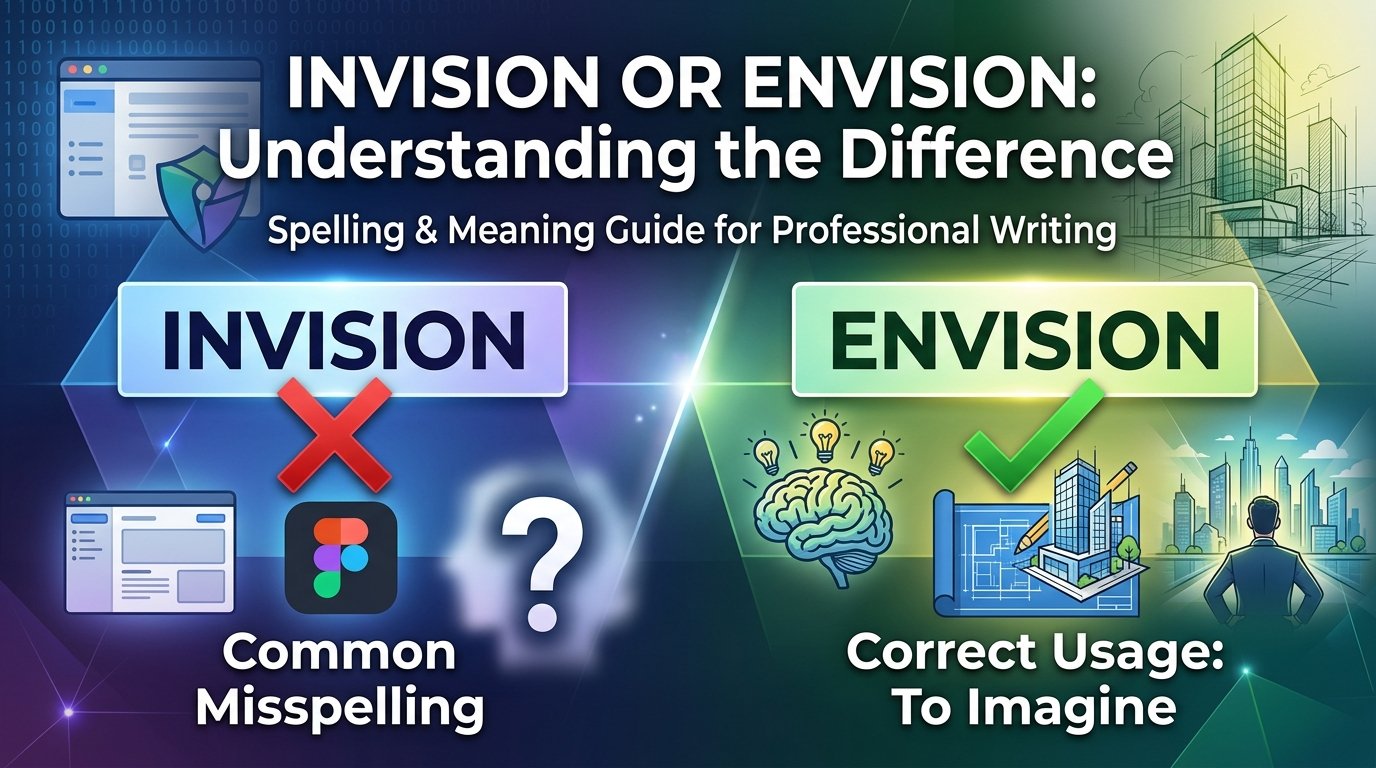
When writing an email, article, school assignment, or business proposal, you may suddenly stop and wonder: Invision or Envision?
Both forms look believable. They also sound almost identical when spoken. That makes the confusion understandable, especially when typing quickly.
However, there is an important distinction. Envision is the correct English word when you mean to imagine, picture, or mentally see something. Invision is not a standard English spelling.
There is one notable exception: InVision is a proper brand name associated with digital design and collaboration. In that context, the capitalized form is intentional.
This guide explains the difference between (Invision) and (Envision), explores their meanings and origins, and shows you exactly when to use each form.
Invision or Envision: Why Does the Confusion Exist?
The confusion between Invision or Envision mainly comes from pronunciation, visual familiarity, and the influence of branding.
When people pronounce “envision,” the first syllable can sound very similar to “in.” During fast speech, the difference between the two sounds may not feel obvious.
As a result, someone may write “invision” simply because it seems to match what they hear.
Another reason is familiarity. The word InVision has appeared as a technology and design brand. People who encounter that name regularly may unconsciously assume that “invision” is also a normal English word.
Autocorrect can make the problem worse. If a person repeatedly types an incorrect spelling, digital habits can reinforce the mistake.
There is also a pattern issue. English contains many familiar words beginning with “in,” including “invent,” “involve,” and “include.” It is easy to assume that “invision” follows the same pattern.
Why It Matters in Professional Settings
Correct spelling matters more when your writing represents you professionally.
A spelling mistake in an email, résumé, report, presentation, or business proposal can distract readers from your message. It may also make otherwise polished writing appear less careful.
Using standard English consistently is especially important in formal writing, academic writing, business communication, and published content.
Therefore, choosing “envision” instead of “invision” is not merely a minor spelling preference. It demonstrates control over language and helps your writing appear clear and credible.
Invision or Envision: Which One Is Correct?
The answer is straightforward:
Envision is the correct English word.
Invision is generally an incorrect spelling when you are using it as an English verb meaning “to imagine” or “to visualize.”
For example:
- Correct: I envision a better future.
- Incorrect: I invision a better future.
- Correct: She envisioned a successful business.
- Incorrect: She invisioned a successful business.
The word “envision” functions as a verb. It normally takes an object because you envision something.
For instance, you can envision a future, envision a solution, envision a new product, or envision a different approach.
There is one special case worth remembering. InVision can be correct when referring to the brand name of the design technology platform. In that situation, the capital letters identify a proper name rather than an English spelling variant.
So, for ordinary language, use envision.
See Also: Its Self or Itself: Understanding the Difference Clearly Today
What Does “Envision” Mean? Origins, Definition, and Usage
Understanding the meaning makes the spelling easier to remember.
To envision something means to imagine it, picture it mentally, or form an idea of what it could be like.
The word is often connected with the future. Someone may envision a goal, career, business, lifestyle, invention, or outcome before it actually exists.
Definition of Envision
Envision is a verb meaning to imagine or mentally picture a future possibility, situation, goal, or result.
For example:
I envision a more efficient workflow for the entire team.
Here, the speaker is mentally imagining a better workflow.
The word can also overlap with imagine, visualize, and foresee, but these terms are not completely interchangeable.
Imagine is broader and can refer to almost anything created in the mind.
Visualize often emphasizes forming a mental image.
Foresee suggests anticipating something based on knowledge, evidence, or experience.
Dream tends to carry a stronger emotional or aspirational meaning.
In business contexts, “envision” often communicates purposeful planning rather than simple fantasy.
Origins of the Word “Envision”
The etymology of “envision” is connected to the idea of vision and forming a mental picture.
Its development is associated with French influence and the Latin-rooted concept of vision. The word entered English usage in the nineteenth century.
The important point for modern writers is that “envision” became established as the standard English form.
English does contain many words where spelling has changed over centuries. However, “invision” is not an accepted alternative spelling of “envision” in standard modern English.
The relationship with the word vision is also helpful. “Envision” essentially carries the idea of putting something into your mental field of vision.
Why Invision Is a Common Misspelling
“Invision” is a common misspelling because it feels natural when heard aloud.
The initial sound of “envision” can be interpreted as “in,” particularly during fast conversation.
The mistake also benefits from visual familiarity. People have seen the spelling “InVision” in branding, websites, technology discussions, and design communities.
That exposure can make the lowercase spelling look legitimate even when it is not.
Another factor is English word formation. Learners often rely on familiar spelling patterns rather than memorizing every individual word.
Once you understand that the correct word begins with “en-,” the confusion becomes much easier to avoid.
The Significance of “Envision” in Professional and Creative Language
Although the original outline refers to a culinary context, “envision” is more useful when examined across the professional and creative settings where the word is commonly used.
The word is especially valuable when discussing ideas that do not yet exist.
A company may envision a new product. A leader may envision strategic change. An architect may envision a building before construction begins. A writer may envision a story before writing the first chapter.
The word therefore connects naturally with business, leadership, creativity, innovation, and goal setting.
Role of “Envision” in Professional Communication
In professional language, “envision” often expresses a planned or desired future.
Consider these examples:
- The company envisions expanding into new markets.
- The team envisions a simpler customer experience.
- The director envisions major improvements in efficiency.
- We envision new technology transforming the industry.
In each case, the word communicates a mental picture of a possible future.
This makes it particularly useful for discussing business vision, strategy, planning, and long-term objectives.
Common Reasons for the “Invision” Misspelling
Several factors contribute to the spelling mistake.
First, pronunciation creates a speech vs. spelling conflict. The sound of “en” may be perceived as “in.”
Second, phonetic confusion encourages writers to spell words according to how they sound.
Third, autocorrect and typing habits can reinforce an existing mistake.
Fourth, the InVision brand creates strong brand influence. Seeing a capitalized “InVision” can make “invision” appear familiar.
Finally, people often rely on visual patterns. Because “in” is common at the beginning of English words, the brain may select it automatically.
Recognizing these causes is useful because it turns a random spelling mistake into an understandable language pattern.
Side-by-Side Comparison: “Invision or Envision”
| Feature | Envision | Invision |
|---|---|---|
| Correct English spelling | Yes | No |
| Part of speech | Verb | Not a standard English word |
| Meaning | Imagine or mentally picture | No standard English meaning |
| Used in formal writing | Yes | No |
| Found as a normal dictionary word | Yes | No |
| Common use | Standard English | Misspelling |
| Brand-related use | No | “InVision” may be a proper brand name |
| Example | I envision a better future. | I invision a better future. ❌ |
This comparison makes the central rule simple: use envision when writing ordinary English.
If you are referring specifically to the technology brand, use its official capitalization: InVision.
Everyday Examples of “Envision” in Language
Seeing the word in different contexts makes its meaning clearer.
Everyday Examples
- I envision spending more time with my family.
- She cannot envision living in another city.
- He envisions a peaceful future.
- We envision a better way to solve the problem.
Business Examples
- The CEO envisions a company built around innovation.
- The team envisions stronger growth next year.
- We envision a product that makes everyday tasks easier.
- The organization envisions expanding its services.
Creative Examples
- The author envisioned an entirely new world.
- The designer envisioned the final layout before starting.
- She envisioned a colorful garden behind the house.
- The filmmaker envisioned the scene before production began.
These examples show that “envision” works naturally with both practical and imaginative ideas.
See Also: When I Can or When Can I: Understand the Difference
How to Spell “Invision or Envision”: Remember the Correct Spelling
If you are searching for how to spell “Invision or Envision”, remember one simple connection:
Envision → vision
The correct word begins with en-, followed by “vision.”
A useful memory sentence is:
If you want a vision, you envision it.
You can also connect “envision” with other words beginning with “en-,” such as “enable,” “encourage,” and “empower.”
Most importantly, do not let the pronunciation decide the spelling.
When you mean “to imagine or picture something,” write envision.
If you mean the technology brand, write InVision with the appropriate capitalization.
Practice Sentences
Try completing these sentences mentally:
- I ______ a successful future for the company.
- Can you ______ how this design will look?
- She ______ herself leading the project.
- We ______ a world with cleaner technology.
The answer in each ordinary English sentence is a form of envision.
Literature and Media Mentions: Correct Usage of “Envision”
The concept behind “envision” appears frequently in literature, journalism, business writing, and media because people often need language for imagined futures.
Authors may describe characters who envision a different life. Journalists may explain what policymakers envision for the future. Business leaders may discuss what they envision for their companies.
The word also appears naturally in discussions about technology and innovation.
For example, a technology leader might say that the company envisions artificial intelligence changing how people work.
In each situation, “envision” expresses an imagined possibility or intended future.
However, readers may encounter InVision in technology-related material. That capitalization matters because it can represent a brand name, not a spelling variation.
This distinction is especially useful when proofreading content about design software.
Frequently Asked Questions About Invision or Envision
What’s the correct way to spell “Invision or Envision”?
The correct English spelling is envision. “Invision” is a misspelling unless “InVision” refers specifically to the brand name.
Is “Envision” a French word?
Envision entered English through French influence and ultimately relates to older roots associated with vision, seeing, and forming mental images.
Why is spelling “Envision” correctly important?
Correct spelling improves clarity, professionalism, credibility, and readability, especially in academic, business, professional, and published writing.
Is Invision ever correct?
“Invision” is not standard English. InVision can be correct when referring to the technology brand, where capitalization identifies a proper name.
What is the difference between envision and imagine?
“Imagine” has a broader meaning, while “envision” often suggests mentally picturing a particular future, goal, possibility, or planned outcome.
Conclusion: Why It’s Important to Spell “Envision” Correctly
The difference between “invision” and “envision” is simple once you understand the pattern. Envision is the correct English verb for imagining, picturing, or mentally seeing a possibility. “Invision” is a common misspelling caused by pronunciation, familiarity, and branding. The main exception is InVision, when the term refers to a proper brand name. Remember the connection between “envision” and “vision,” and the correct spelling becomes easier to recall. Whether you are writing professionally, academically, creatively, or casually, choosing “envision” will keep your language accurate, polished, and clear.
4 thoughts on “Invision or Envision: Understanding the Difference and Correct Usage Today”