
English has many phrases that sound almost identical but have completely different meanings. Mine as well, might as well, or mind as well is a good example.
When people hear these expressions in fast conversation, it can be difficult to know which one is correct. The confusion becomes even grate because “might,” “mind,” and “mine” have similar sounds.
The good news is that the difference is easy to understand once you look at their grammatical roles and meanings.
In standard English, might as well is the correct idiomatic expression when you mean that something is sensible, reasonable, or worth doing because there is little reason not to do it.
Mine as well can be correct, but it has a completely different meaning. It normally expresses possession. Meanwhile, mind as well is generally a nonstandard or dialectal form of “might as well.”
Mine As Well, Might As Well, or Mind As Well: Why Does the Confusion Exist?
The confusion mainly comes from pronunciation.
In casual speech, “might as well” can be spoken quickly. The sounds may blend together, making “might” sound less distinct. Some speakers may therefore hear or say something closer to “mind as well.”
At the same time, “mine” is a familiar English word, so people sometimes assume that mine as well could work as a replacement for “might as well.”
However, these words have different grammatical functions.
“Might” is a modal verb, “mind” is normally a verb meaning to care about or pay attention to something, and “mine” is a possessive pronoun.
See Also: To Fast or Too Fast: Understanding the Difference Clearly
Why It Matters in Professional Settings
Correct word choice becomes especially important in formal writing, professional emails, academic work, reports, and business communication.
Using “mind as well” when you mean “might as well” can make your writing appear careless or nonstandard. Likewise, using “mine as well” without a clear context can confuse the reader.
In professional settings, clarity matters more than trying to reproduce casual pronunciation.
For example:
We might as well discuss the issue today.
This clearly suggests that discussing the issue now is a sensible option.
Mine As Well, Might As Well, or Mind As Well: Which One Is Correct?
The answer depends on what you want to say.
Might as well is the standard phrase when you want to suggest an action because it seems reasonable or because there is little benefit in choosing another option.
For example:
We might as well leave before the traffic gets worse.
Here, the speaker is suggesting leaving.
Mine as well is different. “Mine” indicates possession.
For example:
If nobody wants the extra ticket, it can be mine as well.
Here, “mine” means “belonging to me.”
Mind as well is generally not the standard form when you mean “might as well.” It may appear in informal speech or regional dialect, but standard writing should normally use “might as well.”
Therefore, when checking the difference between Mine As Well, Might As Well, and Mind As Well, remember this simple rule:
- Might as well = a reasonable suggestion
- Mine as well = also belonging to me
- Mind as well = generally a nonstandard form when intended to mean “might as well”
What Does “Mine As Well, Might As Well, or Mind As Well” Mean? Origins, Definition, and Usage
Understanding each word separately makes the entire issue much easier.
Definition of Mine As Well, Might As Well, or Mind As Well
Might as well is an idiomatic expression meaning “it makes sense to,” “there is little harm in,” or “we may as well.”
For example:
The store is already closed, so we might as well go home.
The speaker sees going home as the sensible choice.
Mine as well generally means that something can belong to the speaker too.
If nobody claims the seat, it can be mine as well.
Here, “mine” replaces a noun phrase such as “my seat.”
Mind as well does not normally have the same standard meaning. The verb “mind” can mean to care about, object to, or pay attention to something.
For example:
Would you mind opening the window?
That meaning has nothing to do with the suggestion expressed by “might as well.”
Read Also: Independent From vs Independent Of: Understanding the Difference
Origins of the Words “Might,” “Mine,” and “Mind”
The three words developed separately in English.
“Might” has long been associated with possibility and functions today as a modal verb. In the expression “might as well,” it became part of a fixed idiom used for suggestions or reasonable choices.
“Mine” developed as a possessive form related to “my.” It tells us that something belongs to or is associated with the speaker.
“Mind” has a different history and is connected with the ideas of thought, attention, care, and concern.
Because these words sound similar in some accents and fast speech, learners can easily confuse them.
Why “Mind As Well” Is a Common Misspelling
One major reason is informal speech.
People do not always pronounce every sound clearly during everyday conversation. When “might as well” is spoken quickly, listeners may interpret it as “mind as well.”
Another reason is phonetic spelling. Someone who has heard the expression but has never seen it written may spell it according to how it sounds.
That is why mind as well can appear online, in casual messages, or in dialogue.
Nevertheless, standard English generally uses might as well.
Exploring the Significance of “Might As Well” in Everyday Language
Unlike “mine as well,” might as well is extremely common in everyday English.
People use it when they are making a suggestion, accepting an available option, or explaining why an action seems reasonable.
Consider this example:
We are already here, so we might as well stay for dinner.
The speaker is not necessarily excited about staying. Instead, staying seems like a sensible choice because they are already there.
This gives the phrase a subtle meaning. It can sometimes suggest convenience, resignation, acceptance, or a lack of better alternatives.
Role of “Might As Well” in Everyday Communication
The expression often follows a situation that provides a reason for the suggestion.
It is getting late, so we might as well leave.
Nobody else is using the room, so we might as well work here.
The bus is delayed, so we might as well walk.
These examples show the common pattern:
might as well + base verb
Notice that the verb after “might” does not change.
Correct:
We might as well go.
Incorrect:
We might as well to go.
The second version violates the basic modal verb + base verb pattern.
Common Reasons for the “Mine As Well, Might As Well, or Mind As Well” Misspelling
Several mistakes repeatedly appear with these expressions.
The first is confusing might with mind. This usually happens because of pronunciation.
The second is assuming that “mine as well” means the same thing as “might as well.” It does not.
The third is adding “to” after “might.” Modal verbs such as might are followed by the base verb.
Another issue is unclear possession.
For example:
I could take the plate; mine as well.
This sounds incomplete because the reader may not know exactly what “mine” refers to.
A clearer version would be:
I could take the plate. It can be mine, too.
When you compare Mine As Well vs Might As Well vs Mind As Well, focus on meaning rather than sound.
Side-by-Side Comparison: “Mine As Well, Might As Well, or Mind As Well”
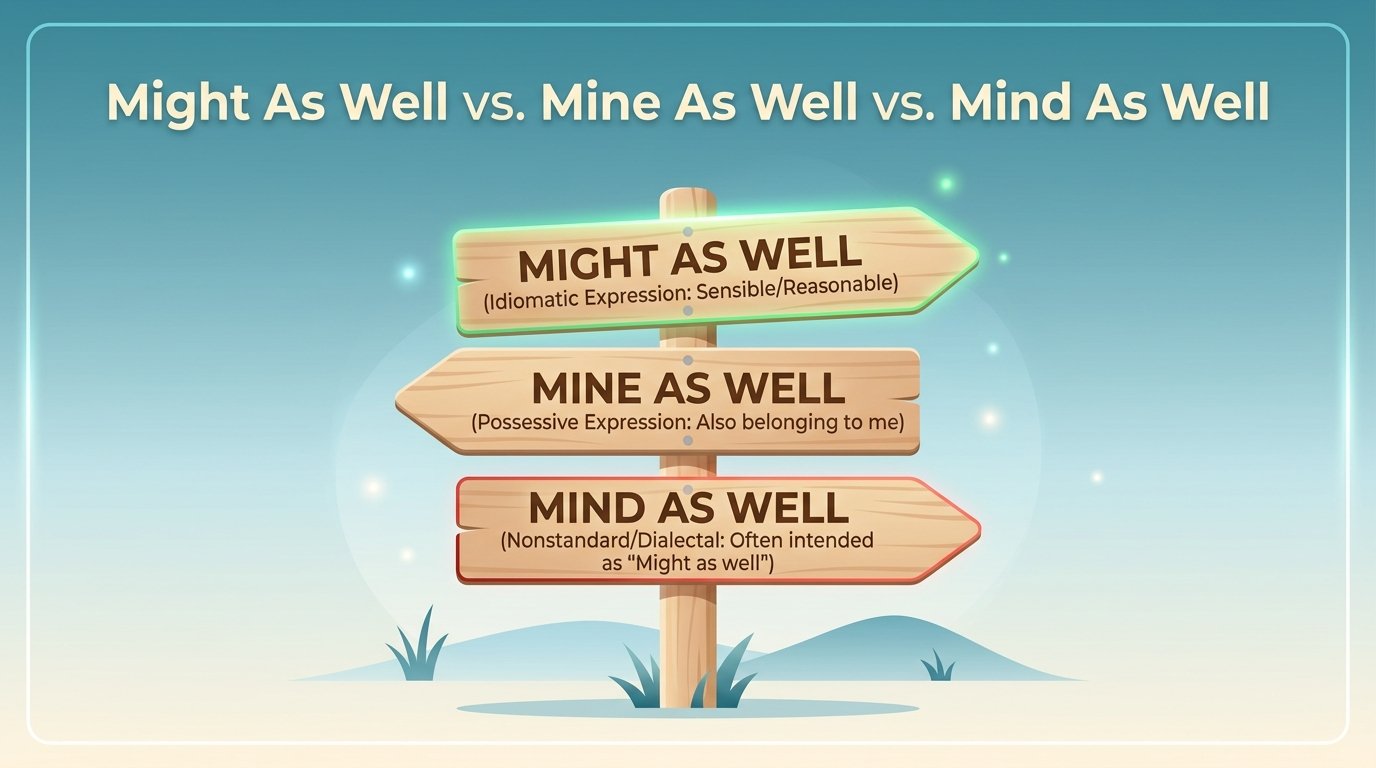
| Phrase | Main Function | Meaning | Example |
|---|---|---|---|
| Might as well | Idiomatic expression | It is sensible to do something | We might as well leave. |
| Mine as well | Possessive expression | Also belonging to me | The extra ticket can be mine as well. |
| Mind as well | Nonstandard/dialectal | Often intended as “might as well” | We mind as well go. |
The most important distinction is grammatical.
“Might” works as a modal verb. “Mine” works as a possessive pronoun. “Mind” normally works as a regular verb.
Therefore, they cannot simply replace one another.
Everyday Examples of “Mine As Well, Might As Well, or Mind As Well”
Here are some natural examples to make the distinction easier.
Might as well:
We might as well order pizza tonight.
Since you are already going there, I might as well come with you.
The weather is bad, so we might as well stay home.
Mine as well:
If nobody wants the last piece, it can be mine as well.
You have your bag, and this one can be mine as well.
Mind as well:
“We mind as well start now,” he said.
In the final example, “mind as well” can be retained when deliberately representing nonstandard speech or a particular dialect. In normal explanatory or professional writing, however, might as well is the safer choice.
“How to Spell Mine As Well, Might As Well, or Mind As Well”: Remember the Correct Spelling
If you are wondering how to spell “Mine As Well, Might As Well, or Mind As Well”, start with the intended meaning.
If you mean “it makes sense to do something,” spell it:
might as well
If you mean “belonging to me too,” you may use:
mine as well
If you see “mind as well” used to express a suggestion, check whether the writer actually means:
might as well
A useful substitution test can help. Replace the phrase with “it makes sense to.” If the sentence still expresses the intended idea, “might as well” is probably correct.
Practice Sentences
Try these examples:
We might as well wait here.
You might as well ask the manager.
That extra chair can be mine as well.
If the restaurant is closed, we might as well eat somewhere else.
Given the delay, we might as well take the train tomorrow.
The grammatical pattern is simple: might + base verb.
Literature and Media Mentions: Correct Usage of “Might As Well”
The phrase “might as well” frequently appears in everyday dialogue, fiction, television, films, and informal communication because it sounds natural and conversational.
Writers often use it to show a character accepting a situation or choosing an option that seems practical.
For example:
“We might as well go now.”
This sentence can communicate more than a simple suggestion. Depending on the context, it may show resignation, practicality, or acceptance.
In contrast, “mind as well” can be used intentionally in dialogue when an author wants to reproduce a speaker’s dialect or informal pronunciation.
However, writers should distinguish between authentic dialogue and standard narration.
In edited prose, educational content, and professional communication, use the standard form unless there is a specific reason to preserve dialect.
Frequently Asked Questions About Mine As Well, Might As Well, or Mind As Well
What’s the correct way to spell “Mine As Well, Might As Well, or Mind As Well”?
Use might as well for a sensible suggestion. Use mine as well for possession. Mind as well is generally nonstandard.
Is “mind as well” a correct English phrase?
It can occur in dialectal or informal speech, but standard English normally uses might as well when expressing a reasonable suggestion.
Why is spelling “might as well” correctly important?
Correct spelling prevents confusion, especially in formal writing. Might as well clearly communicates the intended idiomatic meaning to readers.
Can “mine as well” be grammatically correct?
Yes. Mine as well can be correct when “mine” replaces a previously mentioned noun and means that something belongs to the speaker too.
What verb comes after “might as well”?
Use the base verb after “might.” For example, say “might as well go,” “might as well wait,” or “might as well try.”
Conclusion: Why It’s Important to Spell “Mine As Well, Might As Well, or Mind As Well” Correctly
Choosing between mine as well, might as well, or mind as well becomes simple once you focus on meaning. Use might as well when suggesting a sensible action or accepting an option. Use mine as well when expressing possession or saying something belongs to you too. Treat mind as well as nonstandard when it is intended to replace “might as well,” except when deliberately representing dialect or informal dialogue. Remember that “might” is a modal verb followed by a base verb. When writing professionally, prioritize the standard form because precise wording makes your communication clearer, more natural, and easier for every reader to understand.
You may also like: Eaten vs Ate: What’s the Difference?
2 thoughts on “Mine As Well, Might As Well, or Mind As Well: Understanding the Difference”